
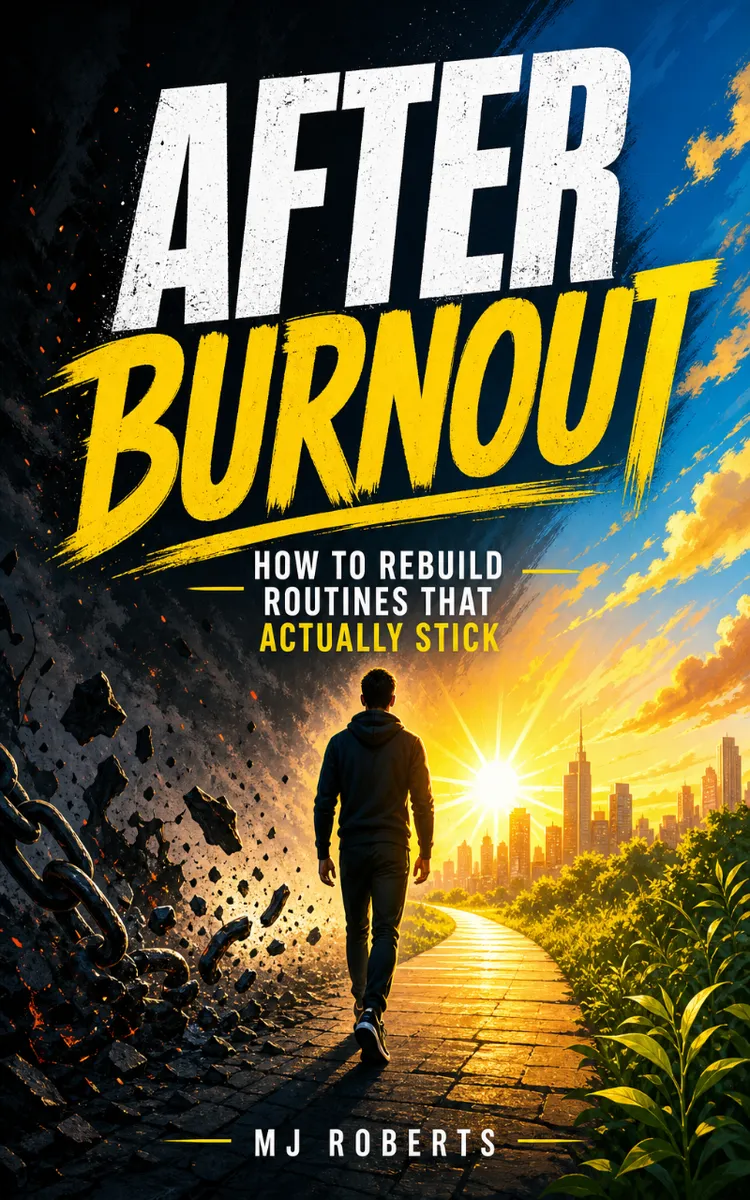
Read the first chapter
The whole of chapter one, free. About 7 min. Turn the pages with the arrows, your keyboard, or a swipe.
Chapter 1
Rebuilding Identity After Burnout
When Your Workday Becomes Your Identity
Nina is 34 and returning to her ER nursing job part-time after burnout. On her first week back, she works three shifts, comes home wiped out, and still feels she should be doing more. When a coworker thanks her for staying calm during a difficult handoff, Nina barely hears it. She notices only what she missed: one chart finished late, one meal grabbed instead of prepared, one evening spent on the couch.
Her body is asking for recovery, but her mind keeps presenting a familiar bargain: prove your value, then you’re allowed to rest. On a day when she manages laundry, a short walk, and a decent dinner, she feels oddly guilty. None of those things count as “real” accomplishments, at least not in the old scoring system.
If your sense of self rises and falls with your output, even a slower life can feel like failure.
You can’t rebuild a steady life while using exhaustion as evidence of your worth.
From Output-Based Worth to a Steadier Self
Old Belief: My value depends on how much I accomplish, how useful I am, and how well I perform.
New Reality: My output is something I do. It isn’t a measurement of who I am.
This shift can feel uncomfortable because achievement may have protected you for a long time. Working harder brought praise, money, progress, or a sense of control. In a busy workplace, being the person who always says yes can even become part of your reputation. The problem starts when the role quietly turns into an identity.
Then a missed task doesn’t feel like a missed task. It feels like proof that you’re slipping.
Nina’s old identity was built around being the nurse who could handle anything. Returning part-time challenged that story. She was still skilled, caring, and dependable, but she no longer had the same capacity. Her job had changed, and so had her needs. The Identity Rebuild Map helped her separate three things: what she did, what she valued, and what she needed to stay well.
On paper, this looked simple. After each shift, Nina wrote three short notes:
• Output: I completed my assigned patients and gave a clear handoff. - Value: I brought steadiness and care to a stressful room. - Need: I need a quiet evening without solving anyone else’s problems.
That last line mattered. It reminded her that recovery wasn’t a reward for excellent performance. It was part of maintaining the person who wanted to keep living and working with care.
Your work still matters. Your responsibilities still matter. But they’re expressions of you, not the foundation beneath you. When worth is no longer tied to output, rest stops looking like a character flaw. A smaller day can still be a complete day.
The Identity Rebuild Map in Real Life
The Identity Rebuild Map has three points: Output, Values, and Needs. Output asks, “What did I do?” Values ask, “What kind of person was I trying to be?” Needs ask, “What will help me remain that person without running myself into the ground?”
This map works because burnout often blurs these categories. You start believing that being useful is the same as being worthy. You confuse a full calendar with a meaningful life. You treat your needs as interruptions instead of information.
Try noticing whether this pattern is running your life:
1. You feel guilty during ordinary rest. A quiet hour feels acceptable only after every task is finished. Since the list never truly ends, rest keeps getting postponed.
2. You describe yourself with performance labels. You say, “I’m failing,” when you mean, “I missed a deadline.” The mistake becomes a verdict about your entire character.
3. You keep raising the finish line. Completing five important tasks brings relief for ten minutes, then your mind adds three more. Satisfaction stays just out of reach.
4. You hide your needs until they become emergencies. You wait to eat, ask for help, or take time off until your body forces the issue. By then, a small need has become a crisis.
A steadier identity lets your actions express your values without requiring them to prove your worth.
For Nina, the map also changed how she planned her week. Instead of measuring success by the number of shifts, chores, and errands completed, she chose one value to protect: presence. On workdays, that meant giving patients her attention without volunteering for every extra task. At home, it meant being present for dinner rather than trying to cook, answer messages, and organize the next day at once.
She didn’t become less caring. She became less available for self-erasure.
Questions for Separating Worth from Work
1. When you say, “I didn’t do enough today,” what exact number or task are you using as evidence? Write the sentence down, then add a second line: “What I also did was…” Include something that supported your health, such as stopping after a reasonable shift or eating before you were starving.
2. Which part of your identity feels most threatened when your output drops? Nina’s answer might be, “The capable nurse.” Yours could be the reliable owner, the strong parent, or the person who never needs help. Naming the threatened identity makes it easier to care for it without obeying every demand it creates.
3. What value were you trying to express through your overwork? Maybe you worked late because you value responsibility. Maybe you answered every message because you value service. Ask how that value could appear in a smaller, safer action.
4. What need have you been treating as something you must earn? Choose one: sleep, quiet, food, movement, support, or unstructured time. A truthful answer might be, “I only let myself rest when the house is perfect.” That rule is not a fact. It’s a rule you learned.
5. If your output stayed lower for the next month, what would help you respect yourself anyway? Be specific. You might choose a daily promise to stop work at a set time, attend two recovery appointments, or speak to yourself without insults after a mistake.
Don’t rush to produce beautiful answers. The useful answer is usually the one that makes you pause. You’re not trying to create a better slogan about yourself. You’re finding the conditions under which your self-respect can survive an ordinary, imperfect day.
The Seven-Day Worth Beyond Work Challenge
For the next 7 days, complete one Identity Rebuild Map after your main work or responsibility each day.
• Set aside five minutes before bed or after your shift. - Write one sentence under Output: what you completed, attempted, or chose not to take on. - Write one sentence under Values: the quality you practiced, such as patience, honesty, care, courage, or presence. - Write one sentence under Needs: what your body or mind needs next. - Add one non-output statement: “My worth is not decided by today’s results.” - Choose one small action that honors the need, such as drinking water, turning off work messages, taking a shower, or going to bed 30 minutes earlier.
Expected difficulty: Medium
At first, this may feel forced. Your brain has been trained to scan for proof of productivity, so it may dismiss values and needs as soft or irrelevant. Keep going. The repetition gives your attention a new place to land.
You’ll know it’s working when...
• You can name something meaningful about a day that wasn’t highly productive. - You catch yourself calling a task failure a personal failure, then correct the wording. - You take one needed pause before reaching total depletion. - You make a decision based on your values rather than on fear of disappointing someone. - Rest feels slightly less like permission and slightly more like maintenance.
Nina completed her map after each of her three shifts, then on four non-work days. On day two, she wrote under Output: “Watched television for an hour.” Her first impulse was to cross it out. Instead, she wrote under Values: “Allowed recovery instead of performing wellness.” Under Needs, she wrote: “More quiet tomorrow.”
That was not a dramatic breakthrough. It was better: a small piece of evidence that she could belong to herself even when she wasn’t producing.
A Self That Doesn’t Have to Be Earned
Your worth can remain steady even when your output changes; a sustainable routine begins when your life is built around that truth.
• Output tells you what happened, but it doesn’t define who you are. - Values help you recognize meaning in small actions, not just visible achievements. - Needs are not proof of weakness; they are information that protects your capacity. - The Identity Rebuild Map helps you plan days around a whole self instead of a constantly performing one.
Nina will still have hard shifts. She’ll still miss things and occasionally overdo it. The difference is that one difficult day no longer gets to decide what she believes about herself. She can return to the map, notice what happened, and choose the next steady action.
That’s the work ahead: not becoming a perfectly balanced person, but building routines that don’t require you to abandon yourself. The next step is learning how to turn this steadier self-concept into daily choices you can repeat - even on the days when motivation is nowhere to be found.
End of chapter one. 7 more chapters in the full book.
Swipe or use the arrows to turn the page


What's inside: 8 chapters
- 1. Rebuilding Identity After Burnout
- 2. Replacing All-or-Nothing Thinking
- 3. Designing Micro-Routines That Stick
- 4. Setting Boundaries Without Guilt
- 5. Building a Recovery-Friendly Schedule
- 6. Using Implementation Intentions for Habits
- 7. Recovering From Setbacks Without Spiraling
- 8. Creating Purpose-Driven Daily Meaning
About this book
"After Burnout" is a self-help book by MJ Roberts with 8 chapters and approximately 12,111 words. Rebuilding routines and habits after burnout.
This book was created using Inkfluence AI, an AI-powered book generation platform that helps authors write, design, and publish complete books. It was made with the AI Self-Help Book Writer.
Frequently Asked Questions
What is "After Burnout" about?
Rebuilding routines and habits after burnout
How many chapters are in "After Burnout"?
The book contains 8 chapters and approximately 12,111 words. Topics covered include Rebuilding Identity After Burnout, Replacing All-or-Nothing Thinking, Designing Micro-Routines That Stick, Setting Boundaries Without Guilt, and more.
Who wrote "After Burnout"?
This book was written by MJ Roberts and created using Inkfluence AI, an AI book generation platform that helps authors write, design, and publish books.
How can I create a similar self-help book?
You can create your own self-help book using Inkfluence AI. Describe your idea, choose your style, and the AI writes the full book for you. It's free to start.
Write your own self-help book with AI
Describe your idea and Inkfluence writes the whole thing. Free to start.
Start writingCreated with Inkfluence AI


