

Read the first chapter
The whole of chapter one, free. About 10 min. Turn the pages with the arrows, your keyboard, or a swipe.
Chapter 1
Choose a Profitable PDF Niche
What if you picked a “great topic” and still couldn’t sell a single PDF? That happens a lot. People choose niches based on what they enjoy or what they think sounds useful - but buyers don’t search for “nice ideas.” They search for specific outcomes, and they buy when the PDF solves a clear problem fast.
This chapter teaches you how to pick a PDF niche where (1) people already want the result, (2) other sellers aren’t crowding the exact same offer, and (3) buyers clearly understand what they’re paying for. After this chapter, you’ll use a simple tool - the Niche Demand-Value Scorecard - to choose one niche to start with, and you’ll know exactly what to check before you write a word.
You’ll also learn how to spot “false demand” (topics that look popular but don’t buy PDFs) and “fake low competition” (topics that have competition, just not the kind you can beat). By the end, you’ll be able to narrow from a list of ideas to one niche with a realistic PDF buyer and a clear angle you can sell.
Picking a PDF Niche That People Actually Buy
When you choose a niche with demand, you stop guessing. When you choose one with low competition, you stop fighting for attention against people who already built audiences. When you choose one with clear PDF buyers, you stop writing content that’s “interesting” but doesn’t match what buyers want to download.
The problem you’re solving is simple: beginners often create PDFs in a fog. They pick a subject, write a PDF, then wonder why traffic doesn’t turn into sales. The fix is to choose a niche using evidence you can check quickly - search behavior, buyer language, and the number of existing PDF-style offers that match what you plan to sell.
As you work through this chapter, keep one question in mind: Does this niche produce buyers who want a downloadable PDF right now? You’ll answer that question with the scorecard, not with hope.
The Niche Demand-Value Scorecard (Demand × Value × Buyer Clarity)
You need a way to compare niche ideas without overthinking. The Niche Demand-Value Scorecard helps you score each niche idea on three things: demand (do people look for it), value (do people pay for the outcome), and buyer clarity (do they already buy PDFs or downloadable guides for it).
Use this scorecard for niche ideas like “meal prep for seniors,” “job interview questions for retail managers,” or “wedding budget templates.” You’ll score each candidate niche, then pick the one that wins the score and passes your “buyer sanity check” (more on that soon).
Here are the three score parts, with concrete checks you can do today:
1. Demand: Check search language, not just interest Look for the exact phrases people type when they want a result. Search on Google for the niche phrase and related “how to” terms, then scan the top results for repeated wording (like “checklist,” “template,” “worksheet,” “guide,” “script,” or “steps”). Why this matters: demand shows up as repeated search language. Interest shows up as “likes,” but demand shows up as “I need this.”
2. Value: Look for payoff words and paid formats Scan the search results and listings for offers that match the outcome and feel “worth paying for.” You want words like “instant,” “complete,” “step-by-step,” “ready-to-use,” “download,” “template,” or “calculator.” Also check whether the content usually comes as a guide, workbook, or downloadable tool. Why this matters: when buyers see a clear payoff format, they feel safe paying for it.
3. Buyer clarity: Prove the PDF fits the job-to-be-done Ask: “Would a busy person download this PDF to solve a problem quickly?” Then check whether existing sellers target the same buyer situation with downloadable materials (not just blog posts). Why this matters: a niche can have demand and value, but still lack PDF buyers if the audience expects coaching, classes, or live services.
Now you’ll score. Use a simple 1-5 scale for each part:
• 1 = weak signals (you can’t find buyer language or matching offers) - 3 = mixed signals (some results fit, some don’t) - 5 = strong signals (clear buyer language and many matching PDF-style offers, but not overwhelming)
You’ll also apply one rule: Don’t chase a niche that only has blog posts and discussion threads. Your product is a PDF, and you need a market that buys downloadable tools.
Quick differentiator example (using Tanya): Tanya is 24 and tutors online. She doesn’t want a niche that requires deep industry knowledge. She wants a PDF buyers already understand, like “study plan templates” or “practice test answer guides.” When she tests niche ideas, she looks specifically for search terms that include “template,” “worksheet,” “practice,” or “schedule,” because tutoring students and parents often want something they can use immediately.
Ask yourself after each niche check: If I wrote a PDF, would someone feel confident downloading it instead of searching more? If the answer keeps flipping, score it lower and move on.
Apply the Scorecard to Tanya’s Tutoring PDF Niche
Let’s walk through a realistic scenario Tanya might use to choose a niche. She has a few tutoring topics she could teach, but she wants to pick one that sells PDFs.
She narrows to three niche ideas:
• Idea A: “College math study schedule” - Idea B: “High school algebra practice worksheet set” - Idea C: “SAT math walkthrough checklist”
She runs the Niche Demand-Value Scorecard on each one. She keeps notes so she doesn’t rely on memory.
Step-by-step: score and choose
1. Write the exact niche phrase you will test Tanya picks one phrase per idea and uses it in search. - A test phrase: “college math study schedule template” - B test phrase: “high school algebra practice worksheet pdf” - C test phrase: “SAT math walkthrough checklist pdf”
Expected outcome: you get consistent signals because you test the same type of phrase each time.
2. Score Demand (1-5) by scanning results for repeated “buyer language” Tanya opens the search results and looks for patterns. - For A, she might see schedules and planning tools, but also random blog posts. - For B, she might see worksheets and printable packs. - For C, she might see checklists, guides, and “what to do next” style downloads.
Expected outcome: A niches that show “template/worksheet/checklist” signals score higher.
3. Score Value (1-5) by checking whether the outcome looks “paid-for” Tanya looks for results that look like products, not just articles. She checks for downloadable formats and ready-to-use positioning. - If she sees “printable workbook,” “practice pack,” or “downloadable guide,” she scores higher. - If she sees mostly free advice posts, she scores lower.
Expected outcome: niches with clear product-format results feel easier to sell as PDFs.
4. Score Buyer Clarity (1-5) by asking who downloads Tanya asks: “Who would buy this PDF, and why would they download it instead of reading?” - Schedules often target students and parents who want structure. - Worksheets target students who need practice immediately. - Checklists target test-takers who want a last-mile plan.
Expected outcome: you pick the niche where the buyer’s job-to-be-done matches the PDF format.
5. Score Competition Low (simple rule: count matching PDF offers, not total websites) Tanya doesn’t count everything on the internet. She counts matching offers - PDFs or printable packs that look like they can compete with her. She also checks whether those offers feel beginner-friendly or overly advanced.
Expected outcome: you avoid niches where every top result is the same “perfect” PDF product.
6. Pick the winner using a tie-breaker: “Could I make this PDF noticeably better in one angle?” Tanya chooses the niche where she can add a clear improvement without building a huge course. - Example angles Tanya can use: - A: “2-week schedule broken into 30-minute blocks for busy students” - B: “Answer explanations written at a 10th-grade reading level” - C: “Checklist focused on the exact mistakes students make on SAT math”
Expected outcome: you choose the niche with the easiest path to a distinct offer.
Tanya’s score (example outcome)
Tanya scores like this:
| Niche idea | Demand (1-5) | Value (1-5) | Buyer Clarity (1-5) | Total | |---|---:|---:|---:|---:| | A: College math study schedule | 3 | 3 | 4 | 10 | | B: High school algebra practice worksheets | 4 | 4 | 4 | 12 | | C: SAT math walkthrough checklist | 4 | 5 | 3 | 12 |
Tanya has a tie. She uses the tie-breaker: what one angle can she make clearly better? She decides to start with Idea B if she can create something that feels immediately usable for practice. She decides to start with Idea C if she can create a checklist that directly targets common test-day confusion and mistakes.
Her expected outcome: she picks a niche where buyers already expect printable, downloadable materials and where she can compete with a clear angle.
Quick checklist (do this on your shortlist)
• Pick one exact search phrase per niche (add “template,” “worksheet,” or “checklist” if that matches your idea). - Scan the top results for repeated buyer language (not just blog topics). - Identify whether results look like downloadable products (PDF, printable pack, guide). - Decide who downloads the PDF and why (structure, practice, or last-mile steps). - Count matching PDF-style offers, not total webpages. - Choose one niche where you can improve one clear part of the offer.
Practical takeaway: the scorecard turns “I think this could work” into “I can see buyer behavior and product-format demand.”
What to Watch For When Niche Hunting (Mistakes That Cost Time)
Even when you use a scorecard, a few traps show up again and again. Here are the ones to watch for, plus the fixes you can apply immediately.
Mistake 1: Confusing blog traffic with PDF buyers Do this: Look at the search results and check what the “best matches” actually sell. If top results mainly show blog posts and free advice, you may have demand, but you likely don’t have PDF buyers. Not this: Spend a week writing a PDF because the topic gets views.
Fix: Search with “template,” “worksheet,” “checklist,” or “printable” and see if the results include downloadable offers. If you still don’t find PDF-style products, lower your score for buyer clarity.
Mistake 2: Choosing a niche that feels narrow but is actually crowded Do this: Count matching PDF offers. If you find many sellers offering almost the same thing (same level, same format, same promise), treat it as crowded even if the broader topic looks “small.” Not this: Assume “low competition” because only a few big brands show up.
Fix: Instead of chasing “general SAT math,” narrow to a specific buyer job and angle, like “SAT math practice pack focused on linear equations” or “study schedule for test-week.” If you can’t name the angle clearly, you don’t have a niche yet - you have a topic.
Mistake 3: Over-scoring demand and ignoring value Do this: Check whether the niche includes a “paid-for payoff” format. If buyers don’t see the outcome as something they pay for, you’ll struggle to price above free. Not this: Assume “people search for it” means “people pay for it.”
Fix: Look for product-positioning language in results: “ready-to-use,” “download,” “complete set,” “workbook,” “step-by-step guide.” If you see mostly free content, plan to sell at a lower price point first - or choose a different niche.
Practical takeaway: demand without PDF buyers turns into views, not sales. Low competition without a clear angle turns into a product nobody recognizes.
Your Next Move: Lock the Niche and Build the Right PDF
When you pick a niche with demand, low competition, and clear PDF buyers, you don’t need to guess what to create - you can build toward what people already expect to download.
Use the Niche Demand-Value Scorecard to compare your top ideas, then choose the one where you can improve one specific part of the outcome. Tanya’s example shows the real pattern: she scored niches by buyer language and PDF-format fit, then picked based on the easiest distinct angle.
Before you move on to writing or listing anything, take one minute and ask yourself: If I searched for my niche phrase today, would I find downloadable PDF-style offers that match what I want to sell? If the answer is yes, you’re ready to build. If it’s no, you still have time to switch niches - before you waste hours creating the wrong PDF.
End of chapter one. 7 more chapters and about 15,671 words in the full book.
Swipe or use the arrows to turn the page


What's inside: 8 chapters
- 1. Choose a Profitable PDF Niche
- 2. Validate Ideas with Keyword Demand
- 3. Create a PDF Offer Outline
- 4. Write Your PDF with a Simple Flow
- 5. Design a Professional PDF Layout
- 6. Set Pricing and Package Your Product
- 7. Build an Email List for Sales
- 8. Launch and Improve with Sales Tracking
About this book
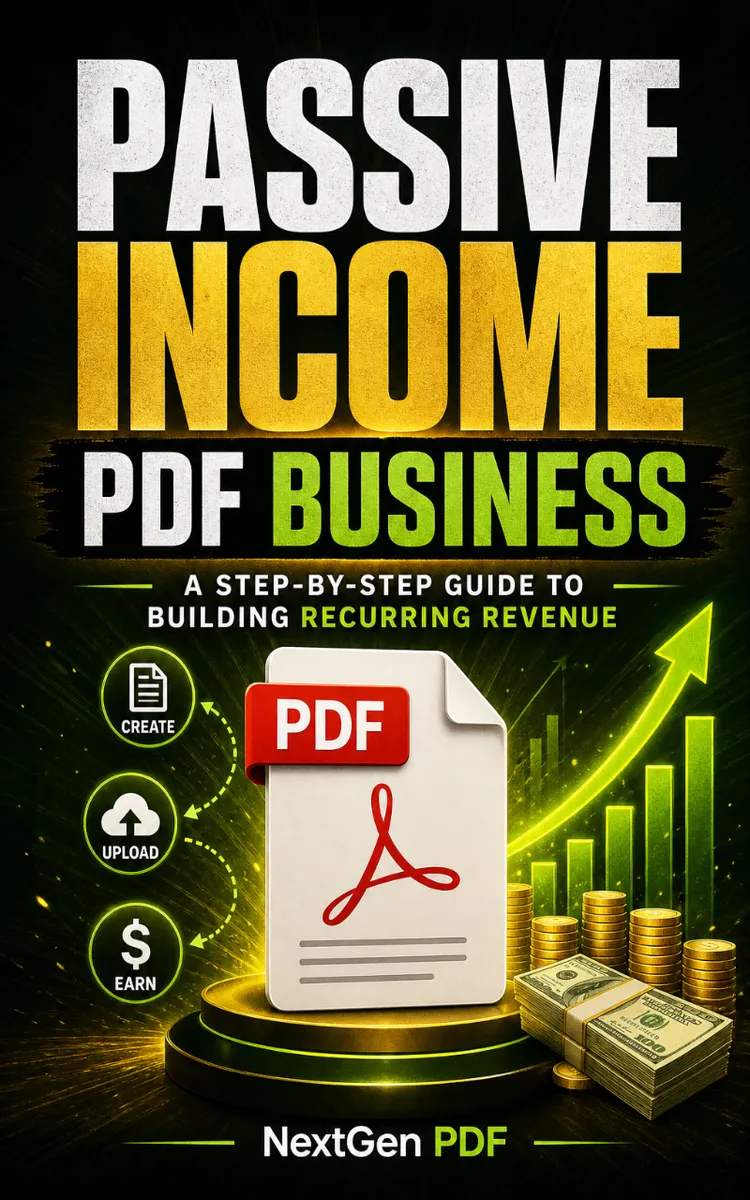
"Passive Income PDF Business" is a how-to guide book by NextGen PDF with 8 chapters and approximately 15,671 words. Creating and selling PDF products to generate passive income.
This book was created using Inkfluence AI, an AI-powered book generation platform that helps authors write, design, and publish complete books. It was made with the AI Ebook Generator.
Frequently Asked Questions
What is "Passive Income PDF Business" about?
Creating and selling PDF products to generate passive income
How many chapters are in "Passive Income PDF Business"?
The book contains 8 chapters and approximately 15,671 words. Topics covered include Choose a Profitable PDF Niche, Validate Ideas with Keyword Demand, Create a PDF Offer Outline, Write Your PDF with a Simple Flow, and more.
Who wrote "Passive Income PDF Business"?
This book was written by NextGen PDF and created using Inkfluence AI, an AI book generation platform that helps authors write, design, and publish books.
How can I create a similar how-to guide book?
You can create your own how-to guide book using Inkfluence AI. Describe your idea, choose your style, and the AI writes the full book for you. It's free to start.
Write your own how-to guide book with AI
Describe your idea and Inkfluence writes the whole thing. Free to start.
Start writingCreated with Inkfluence AI


