

Read the first chapter
The whole of chapter one, free. About 8 min. Turn the pages with the arrows, your keyboard, or a swipe.
Chapter 1
Understanding Special Education
Why the Learner-First Compass Matters
A student receives a worksheet with twenty problems. He understands the first three, stares at the fourth, and begins tapping his pencil. Within two minutes, the teacher sees “defiance.” A closer look may reveal a reading disability, slow processing speed, unclear directions, or anxiety about making another mistake. The label matters, but the teacher’s first responsibility remains practical: identify what blocks learning and what helps the student enter the task.
Special education begins with accurate language and careful observation. Terms such as disability, accommodation, modification, Individualized Education Program (IEP), and 504 plan describe different needs and supports. Christian teachers also bring a clear view of each student’s dignity. A disability does not erase ability, responsibility, spiritual worth, or the need for appropriate boundaries. Strengths-based teaching does not ignore difficulty; it starts with what the learner can do and uses that information to plan the next step.
The Learner-First Compass gives you a usable way to sort information. You will learn to identify a student’s strengths, understand the barrier, follow the student’s documented plan, and choose support that preserves meaningful learning. You will also learn to speak accurately with families, counselors, administrators, and specialists. Ask yourself: after reading a report or meeting a parent, can you explain what the student needs during reading, writing, math, transitions, and relationships? If not, keep gathering specific information rather than guessing.
Using the Learner-First Compass
The Learner-First Compass has four directions. Each direction answers one classroom question:
1. Strengths: What can the learner do? Record skills, interests, communication preferences, and conditions that help the student succeed. For example, a student may explain a science concept clearly aloud but struggle to write a paragraph. This difference gives you a starting point for instruction.
2. Barriers: What makes the task difficult? Describe the observable problem without assigning a motive. “The student reads 40 words aloud and omits endings” gives better information than “The student is careless.” Barriers may involve reading, attention, language, memory, movement, sensory input, emotional regulation, or social understanding.
3. Supports: What changes access without removing the goal? An accommodation changes how a student learns or shows learning. Examples include text-to-speech, extended time, a quiet seat, directions read aloud, or a response recorded by an adult. Use the support listed in the student’s plan because consistency allows the team to judge whether it works.
4. Goals: What meaningful skill must grow? A goal identifies the skill and the expected progress. A student may need to write a complete paragraph, begin work within three minutes, solve two-step problems, or request a break appropriately. Keep the goal visible while you plan daily instruction.
These directions connect to foundational terms. A disability is a condition that significantly affects learning, communication, movement, behavior, or daily functioning. Special education means specially designed instruction that meets a student’s individual needs. An Individualized Education Program (IEP) records educational goals, services, accommodations, and progress measures for an eligible student. A 504 plan describes accommodations for a student whose condition substantially limits a major life activity but who may not need specially designed instruction. Requirements differ by school and jurisdiction, so follow your administrator’s guidance and never promise a service based on a label alone.
Disability categories can help you understand patterns, but they never tell the whole story. Common categories include specific learning disability, speech or language impairment, autism, attention-deficit/hyperactivity disorder, intellectual disability, emotional or behavioral disability, orthopedic impairment, hearing impairment, visual impairment, and other health impairment. A category supports planning; it does not predict a child’s personality, faith, effort, or future. Two students with the same category may need very different supports. Read the plan, observe the student, and ask the special education teacher which classroom actions matter most.
Use precise language when you record concerns. Write, “During independent reading, the student looked away from the page four times in ten minutes and completed two of six questions,” rather than, “The student cannot focus.” The first statement gives the team a starting point, a measurable pattern, and a reason to examine the task. In a Christian school, speak about the student with the same care you would use in the student’s presence. Protect privacy, avoid labels used as insults, and separate a student’s behavior from the student’s identity.
A quick comprehension check: if a student receives fewer problems because writing exhausts working memory, ask whether the learning goal remains intact. If the goal involves solving equations, fewer equations may be an accommodation. If the goal involves completing ten equations independently, fewer problems may remove the target skill and require a team decision. The Compass helps you ask the right question before changing work.
Applying the Compass to a Classroom Task
Consider a seventh-grade social studies lesson on primary sources. The class must read a two-page document and answer six questions in 30 minutes. The student’s plan identifies a specific learning disability in reading, requires access to text-to-speech, allows extended time, and lists a goal for identifying the main idea and two supporting details.
1. Name the learning target. Write, “Identify the main idea and two supporting details from a primary source.” Do not replace the target with “finish the worksheet.” The expected outcome is accurate identification of evidence.
2. Identify the student’s strength. The student explains historical ideas clearly during discussion and remembers information presented through audio. This strength suggests that listening can open access to the same grade-level content.
3. Locate the barrier. Reading dense paragraphs independently takes too long and increases errors. The barrier affects access to the source, not necessarily understanding of its historical meaning.
4. Apply the documented support. Provide the digital document with text-to-speech enabled, check that the student knows how to pause and replay it, and allow 15 additional minutes. Do not read every answer aloud or tell the student which details to choose; those actions could change the skill being measured.
5. Give clear directions. Say, “Listen to the source. Mark one sentence that states the author’s main point. Then mark two sentences that support it. Answer questions one through six using those marks.” Give the directions in writing as well, because the student may lose part of a long oral explanation.
6. Check access early. After five minutes, ask, “Can you open the audio and find the marking tool?” This checks technology and understanding without supplying answers. Fixing access at minute five prevents a failed task at minute twenty-five.
7. Record the result. Note the time used, the support provided, the number of correct answers, and the student’s level of independence. An appropriate record might read: “Used text-to-speech and 15 extra minutes; identified the main idea and two supporting details with one teacher prompt; answered four of six questions correctly.”
The expected outcome is not simply a completed paper. The student should access the same essential content, show the target skill, and receive information that helps the team plan next instruction. If the student identifies evidence accurately but misses vocabulary questions, the next lesson may need direct vocabulary teaching rather than more time alone.
Quick checklist
• Read the student’s current plan before changing the task. - State the exact learning target. - Name one strength that can support access. - Describe the barrier in observable terms. - Provide each required accommodation consistently. - Check the tool or support before independent work begins. - Keep the grade tied to the stated target. - Record support, independence, accuracy, and next steps. - Share concerns through the school’s special education process, not through informal staff-room discussion.
This process works across grade levels. In kindergarten, a teacher may use picture directions and a first-then board while tracking how quickly a child begins. In high school, a teacher may provide speech-to-text for an essay while grading the quality of the argument rather than handwriting speed. The Compass keeps the focus on access, instruction, and growth.
Mistakes That Distort Student Needs
Treating a disability category as a complete description
A label such as autism or attention-deficit/hyperactivity disorder may help explain why a team evaluated a student, but it does not tell you how that student learns math, responds to noise, or communicates distress.
Do this: Read the present levels, goals, accommodations, and behavior or communication notes. Ask the special education teacher, “What should I see when this support works?”
Not this: Assume every student with the same label needs the same seating, reward, assignment, or correction.
Confusing an accommodation with lowering the standard
Teachers sometimes shorten every assignment, excuse essential practice, or give answers because they want to help. That approach can hide the student’s actual skill and prevent needed growth.
Do this: Keep the learning target and change the access method. Offer audio, speech-to-text, a visual model, chunked directions, or additional time when the plan calls for it.
Not this: Remove the target without consulting the team, or grade a student on work the student never had a fair way to access.
Describing behavior as character
Words such as lazy, disrespectful, manipulative, or unmotivated do not explain what happened. They can also damage trust with families and cause teachers to miss a disability-related barrier.
Do this: Record the setting, task, observable action, duration, response to support, and outcome. For example: “During silent reading, the student pushed the book away after four minutes. After receiving audio access and a two-minute break, the student returned and answered three questions.”
Not this: Write, “The student refused because he does not care.”
Ignoring strengths because the student still needs support
A student may need intensive help with reading and still show strong reasoning, humor, creativity, leadership, memory, or compassion. Strengths do not cancel needs, but they can guide instruction and protect the student from being reduced to a problem list.
Do this: Add one strength and one successful condition to your notes each week. Use them in planning: oral rehearsal before writing, diagrams before computation, movement before a long lesson, or a student interest to introduce difficult content.
Not this: Praise a strength without providing instruction in the difficult skill.
Accurate terms, careful observations, and faithful use of documented supports turn concern into a workable plan. The Learner-First Compass keeps every decision pointed toward the same destination: meaningful participation and measurable growth for the student in front of you.
End of chapter one. 24 more chapters and about 44,096 words in the full book.
Swipe or use the arrows to turn the page


What's inside: 25 chapters
- 1. Understanding Special Education
- 2. Recognizing Learning Differences
- 3. Evaluations and Diagnosis
- 4. Special Education Plans Explained
- 5. Private School Requirements
- 6. Building the Support Team
- 7. Partnering With Families
- 8. Confidentiality and Student Records
- 9. Preparing for the School Year
- 10. Designing an Accessible Classroom
- 11. Teaching Routines and Transitions
- 12. Planning Lessons From Student Plans
- 13. Accommodations and Modifications
- 14. Differentiating Instruction
- 15. Keeping Students Engaged
- 16. Communication Supports in Class
- 17. Positive Behavior Support
- 18. Responding to Distress and Escalation
- 19. Supporting Social Belonging
- 20. Working With Counselors and Specialists
- 21. Assessment and Progress Monitoring
- 22. Keeping Useful Teacher Records
- 23. Grading and Reporting Progress
- 24. Faith, Dignity, and Disability
- 25. Reviewing and Improving Supports
About this book
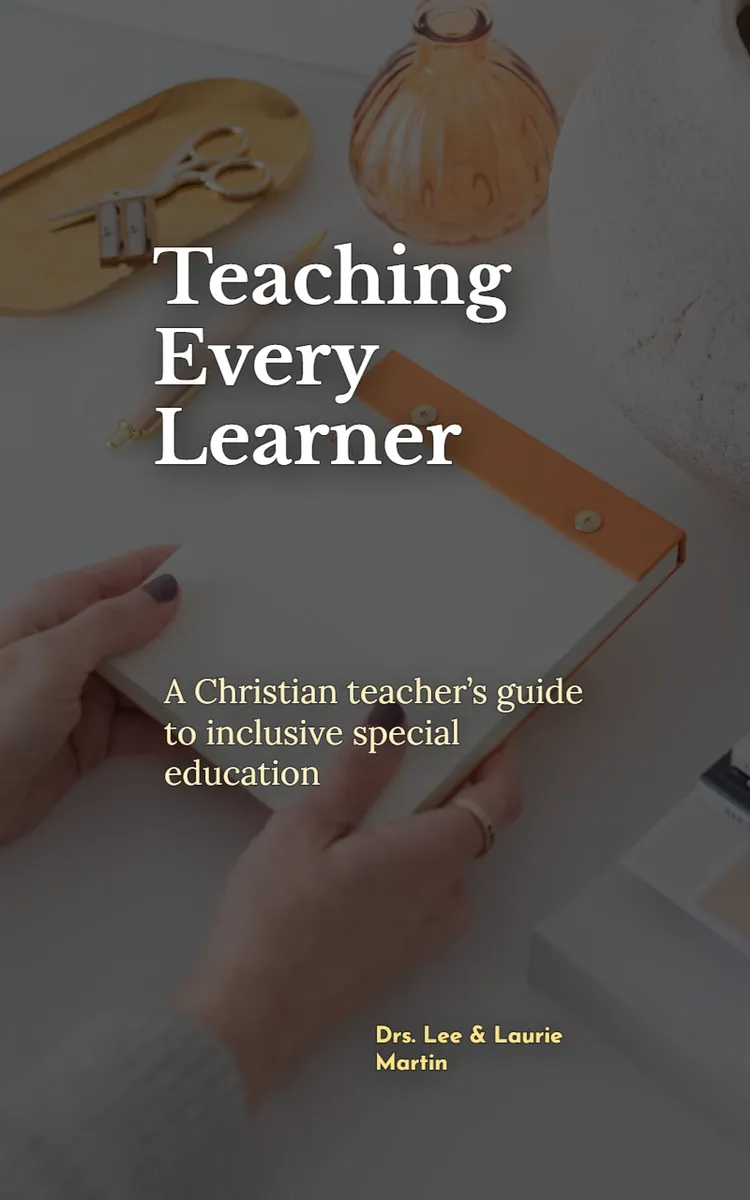
"Teaching Every Learner" is a how-to guide book by Drs. Lee & Laurie Martin with 25 chapters and approximately 44,096 words. Teaching, supporting, and managing K–12 students with special education needs.
This book was created using Inkfluence AI, an AI-powered book generation platform that helps authors write, design, and publish complete books. It was made with the AI Ebook Generator.
Frequently Asked Questions
What is "Teaching Every Learner" about?
Teaching, supporting, and managing K–12 students with special education needs
How many chapters are in "Teaching Every Learner"?
The book contains 25 chapters and approximately 44,096 words. Topics covered include Understanding Special Education, Recognizing Learning Differences, Evaluations and Diagnosis, Special Education Plans Explained, and more.
Who wrote "Teaching Every Learner"?
This book was written by Drs. Lee & Laurie Martin and created using Inkfluence AI, an AI book generation platform that helps authors write, design, and publish books.
How can I create a similar how-to guide book?
You can create your own how-to guide book using Inkfluence AI. Describe your idea, choose your style, and the AI writes the full book for you. It's free to start.
Write your own how-to guide book with AI
Describe your idea and Inkfluence writes the whole thing. Free to start.
Start writingCreated with Inkfluence AI


