

Read the first chapter
The whole of chapter one, free. About 8 min. Turn the pages with the arrows, your keyboard, or a swipe.
Chapter 1
Establishing a Christ-Centered Purpose
Why Purpose Comes Before Procedures
A seventh-grade teacher once began Monday morning by correcting three small problems: talking during attendance, missing pencils, and students moving seats without permission. By the end of the first period, she had given several warnings and still felt behind. Her rules addressed visible behavior, but they had not answered a deeper question: What kind of community should this classroom become?
Classroom management means shaping a safe, purposeful learning community so students can learn, participate, and grow. It includes routines, expectations, correction, relationships, room arrangement, and communication with families. These practices matter, but they work best when they serve a clear purpose. Without that purpose, a teacher may control noise while missing fear, confusion, loneliness, or unfairness beneath the noise.
Scripture gives Christian teachers a firm starting point. Jesus welcomed children and treated people as worthy of attention (Mark 10:13-16). He taught with authority while showing compassion (Matthew 9:36; 7:28-29). Paul instructed believers to do everything “decently and in order” (1 Corinthians 14:40, English Standard Version), not because order matters more than people, but because good order helps people worship, serve, and build one another up.
A Christ-centered purpose does not turn the classroom into a church service or excuse weak teaching. It calls the teacher to meet professional responsibilities with wisdom: protect students, teach clearly, apply expectations fairly, respect families, follow school policies, and provide access to learning. After establishing this purpose, you can make better decisions about rules, routines, correction, and care. Ask yourself: When students leave my room, what have my choices helped them practice - fear, confusion, selfishness, responsibility, truth, and love?
Using the Faithful Purpose Compass
The Faithful Purpose Compass is a four-part tool for making classroom-management decisions. It keeps the teacher’s calling connected to both Scripture and daily practice. Before adding a rule, responding to disruption, or planning a routine, check the decision against these four directions:
1. Honor God. Choose actions that reflect God’s truth, justice, patience, and love. This does not mean avoiding correction. Proverbs 27:5 says, “Better is open rebuke than hidden love.” A clear correction can honor God when it protects learning and restores responsibility rather than humiliating a student.
2. Protect people. Keep students physically and emotionally safe. A safe classroom does not permit threats, cruelty, harassment, or careless exposure of private information. It also does not treat a student’s mistake as entertainment. If two students argue during group work, separate the immediate problem from the public audience, listen to each student, and follow the school’s reporting procedures when needed.
3. Serve learning. Connect every routine and consequence to the work students need to do. A rule such as “Bring your science notebook and begin the warm-up within three minutes” serves learning because it removes delay and prepares students to think. A rule that exists only because the teacher prefers silence may need reconsideration. Students need appropriate discussion, questions, movement, and collaboration.
4. Build responsibility. Help students practice choices they will need beyond your classroom. Galatians 6:5 teaches that each person should carry his or her own load. A responsible response asks a student to identify what happened, repair what the student can repair, and make a plan for the next opportunity. It does not remove every consequence or demand perfection before offering help.
These four directions prevent two common extremes. A teacher who focuses only on control may produce quiet but resentful students. A teacher who focuses only on kindness may allow repeated behavior to harm classmates. The Faithful Purpose Compass holds truth and grace together. Jesus forgave, but He also called people to changed lives (John 8:11). Your management should do the same: name the problem accurately, protect the community, and provide a path forward.
Write your purpose statement in one sentence before you write your rules. For example: “Our classroom protects every learner, pursues excellent work, speaks truthfully, and practices responsibility as an expression of love for God and neighbor.” Then turn the statement into observable actions. “Protects every learner” becomes “We keep hands, objects, and words from causing harm.” “Pursues excellent work” becomes “We begin assigned work within three minutes and ask for help before giving up.” Observable actions help students understand what success looks like, and they help you correct behavior without guessing at motives.
Use Scripture as a foundation, not as a weapon. Colossians 3:12-14 names compassion, kindness, humility, gentleness, patience, forgiveness, and love. These qualities shape the teacher’s manner, but they do not replace school policy or professional judgment. If a student reports bullying, respond promptly, document facts, notify the appropriate staff member, and follow required procedures. Christian purpose strengthens professional responsibility; it never permits a teacher to ignore it.
A useful test asks three questions: “What behavior do I see?” “What learning or safety concern does it create?” and “What response teaches responsibility?” If a student calls across the room, you might say, “You called out while Maya was explaining her evidence. That interrupted her explanation. Raise your hand and wait; I will call on you after she finishes.” The correction stays specific, protects the speaker, serves learning, and teaches a replacement behavior.
Applying the Compass to a First-Period Classroom
Consider a class of twenty-eight students who enter at 8:05 each morning. During the first week, six students wander, four begin side conversations, and several students wait for the teacher to explain every step. The teacher wants a safe, purposeful community rather than a daily struggle. The following sequence turns the Faithful Purpose Compass into a working plan.
1. Write the purpose statement before students arrive. The teacher posts: “We learn with focus, speak with respect, and help one another grow.” The statement gives every later decision a clear reason.
2. Choose three to five observable expectations. The teacher posts four: enter quietly, begin the posted task within three minutes, speak respectfully, and care for people and materials. Four expectations remain memorable enough for students to practice and apply.
3. Teach the expectations directly. On Monday, the teacher demonstrates both a strong and weak entry. Students identify which actions help learning. The teacher then has students rehearse entering, opening notebooks, reading the task, and starting work. Practice turns a vague request into a routine.
4. Connect each expectation to purpose. The teacher explains, “Starting within three minutes gives everyone time to think before discussion. Respectful speech protects people from embarrassment and helps us examine ideas honestly.” Students are more likely to follow expectations when they understand the community benefit.
5. Respond to the first disruption with a brief, private correction. When a student talks during instructions, the teacher moves near the desk and says quietly, “You are speaking while directions are being given. That makes it harder for others to know what to do. Please track the speaker now; I will check your understanding in one minute.” The teacher avoids a public argument and returns attention to learning.
6. Follow up with restoration when needed. If the student continues and distracts a partner, the teacher meets with the student after class for two minutes. The teacher asks, “What happened? Who did it affect? What will you do during tomorrow’s directions?” The student moves seats for the next lesson and practices the entry routine again. The expected outcome is not shame; it is a clear plan and improved access to instruction.
7. Review evidence after five school days. The teacher records how many students begin within three minutes and notes repeated interruptions. If twenty-four of twenty-eight students begin on time by Friday, the routine works for most students. The teacher reteaches it to the remaining four instead of labeling them as careless. If interruptions remain high, the teacher shortens directions, posts them visually, or adds a brief check for understanding.
Quick checklist
• Write one purpose statement that names safety, learning, respect, and responsibility. - Select no more than five expectations students can observe and practice. - Explain why each expectation serves the community. - Model the expected behavior and let students rehearse it. - Correct the behavior, not the student’s worth. - Use private correction when public attention would increase embarrassment. - Ask what happened, who was affected, and what repair is needed. - Follow school policy for safety concerns, bullying, and serious misconduct. - Review classroom evidence after five days and reteach before assuming defiance.
The teacher’s goal is not perfect silence or instant agreement. The goal is a room where students know what to do, understand why it matters, and experience fair responses when they fall short. That combination makes purpose visible.
Avoiding Distortions of Christian Purpose
Mistake: Treating control as the main evidence of success
A quiet room can still contain confusion, fear, or disengagement. A teacher may silence every question and call the result “order,” while students stop taking intellectual risks. Do this: Check whether students can explain the task, participate appropriately, and seek help. Build planned moments for discussion, questions, and movement. Not this: Demand silence whenever students need to think aloud or work together.
Mistake: Using Scripture to shame students
Quoting a verse in an angry voice can make students associate the Bible with public humiliation. It can also ignore the teacher’s duty to follow school expectations about religious expression and student rights. Do this: Let Scripture shape your patience, honesty, fairness, and care. When your setting permits direct biblical instruction, explain the passage accurately and connect it to a shared practice such as truthful speech or forgiveness. Not this: Use a Bible verse as a threat, a shortcut around school policy, or proof that a student’s mistake reveals a bad heart.
Mistake: Confusing grace with the removal of every consequence
Grace does not mean pretending harm did not occur. If a student damages materials, interrupts instruction repeatedly, or insults a classmate, ignoring the behavior leaves others unprotected and fails to teach responsibility. Do this: State the behavior, describe its effect, apply a fair consequence, and offer a repair step. A student who tears a group’s poster can apologize, help recreate the missing section, and complete the assignment under a clear plan. Not this: Excuse repeated harm because you want to appear kind, or impose a severe punishment that has no connection to the behavior.
A Christ-centered classroom purpose becomes trustworthy when students can see its results: safety receives protection, learning receives time, truth receives honest attention, and correction leads toward responsibility. The Faithful Purpose Compass gives you a steady way to make those choices. Before you manage a behavior, decide what kind of community your response will help form. Then make that purpose visible through the routines, words, and decisions students encounter each day.
End of chapter one. 21 more chapters and about 38,453 words in the full book.
Swipe or use the arrows to turn the page


What's inside: 22 chapters
- 1. Establishing a Christ-Centered Purpose
- 2. Preparing the Classroom Environment
- 3. Building Relationships Before Correction
- 4. Teaching Rules and Shared Expectations
- 5. Routines for Smooth Transitions
- 6. Planning Engaging, Well-Paced Lessons
- 7. Giving Directions Students Can Follow
- 8. Using Praise and Positive Reinforcement
- 9. Correcting Behavior Calmly and Consistently
- 10. Redirecting Disruption Without Escalation
- 11. Responding to Defiance and Power Struggles
- 12. Managing Conflict Between Students
- 13. Teaching Emotional Regulation Skills
- 14. Supporting Diverse Learning Needs
- 15. Addressing Bullying and Student Safety
- 16. Partnering with Families Constructively
- 17. Documenting Behavior and Progress
- 18. Using Consequences Ethically
- 19. Leading Group Work Productively
- 20. Managing Digital Devices and Online Conduct
- 21. Reviewing Data and Adjusting Strategies
- 22. Sustaining Teacher Resilience and Growth
About this book
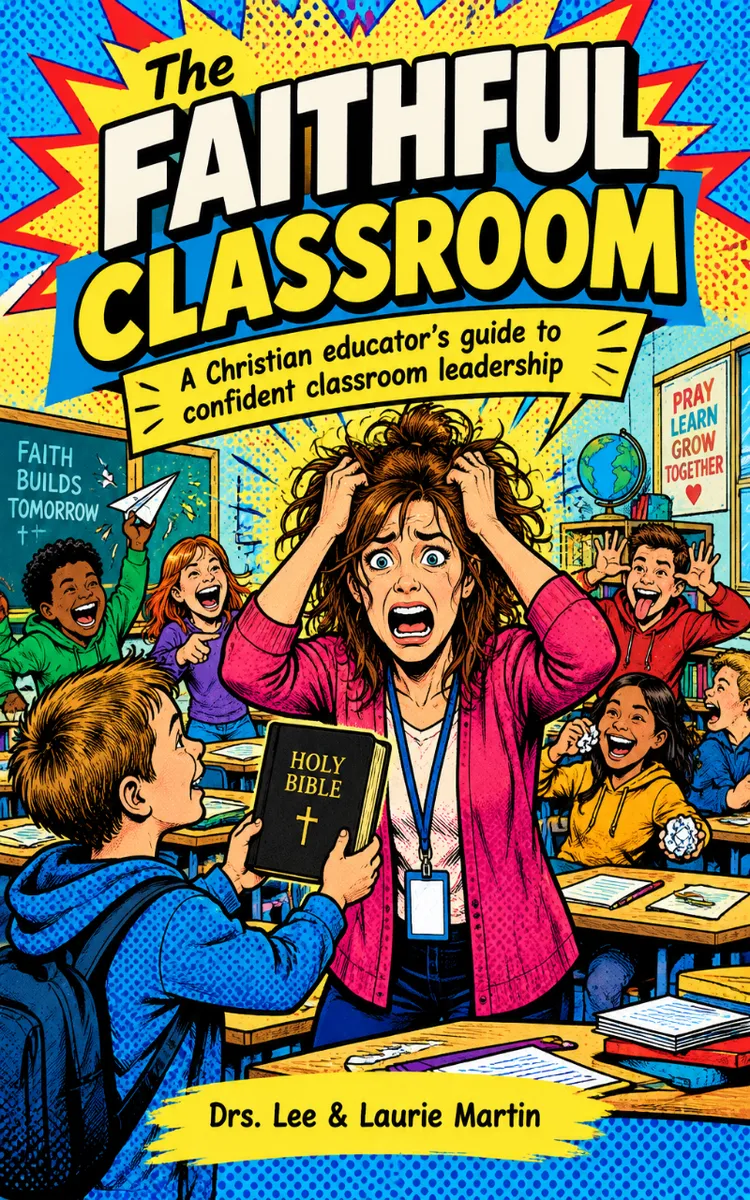
"The Faithful Classroom" is a how-to guide book by Drs. Lee & Laurie Martin with 22 chapters and approximately 38,453 words. Biblically grounded classroom management for new teachers and Christian educators.
This book was created using Inkfluence AI, an AI-powered book generation platform that helps authors write, design, and publish complete books. It was made with the AI Ebook Generator.
Frequently Asked Questions
What is "The Faithful Classroom" about?
Biblically grounded classroom management for new teachers and Christian educators
How many chapters are in "The Faithful Classroom"?
The book contains 22 chapters and approximately 38,453 words. Topics covered include Establishing a Christ-Centered Purpose, Preparing the Classroom Environment, Building Relationships Before Correction, Teaching Rules and Shared Expectations, and more.
Who wrote "The Faithful Classroom"?
This book was written by Drs. Lee & Laurie Martin and created using Inkfluence AI, an AI book generation platform that helps authors write, design, and publish books.
How can I create a similar how-to guide book?
You can create your own how-to guide book using Inkfluence AI. Describe your idea, choose your style, and the AI writes the full book for you. It's free to start.
Write your own how-to guide book with AI
Describe your idea and Inkfluence writes the whole thing. Free to start.
Start writingCreated with Inkfluence AI


