

Read the first chapter
The whole of chapter one, free. About 6 min. Turn the pages with the arrows, your keyboard, or a swipe.
Chapter 1
A Fresh Start-God’s Truth for Body, Soul, and Spirit
Scripture Focus
1 John 1:3
> That which we have seen and heard declare we unto you, that ye also may have fellowship with us: and truly our fellowship is with the Father, and with his Son Jesus Christ.
The Christian life begins with receiving God’s truth as revealed in Scripture and sharing fellowship with Him through prayer, the Holy Spirit, and obedient daily practice.
John does not present faith as a private idea or a religious mood. He speaks of what the apostles had “seen and heard.” The Greek word for fellowship is koinonia, meaning shared life, participation, and communion. Biblical faith is not merely agreeing that God exists. It is being brought into living relationship with the Father through Jesus Christ.
That relationship gives us the foundation for understanding body, soul, and spirit. Scripture does not treat the human person as a collection of unrelated parts. Our physical life, inner life, and spiritual life affect one another, yet they are not identical. The body is our physical existence. The soul includes the mind, will, emotions, and personal life. The spirit is the deepest part of us, the part that must be made alive toward God through the Holy Spirit.
Hebrews 4:12 says, “For the word of God is quick, and powerful, and sharper than any twoedged sword, piercing even to the dividing asunder of soul and spirit.” The verse does not encourage us to become fascinated with dividing ourselves into compartments. It shows that God’s Word can examine what human observation cannot fully separate. Scripture reveals our motives, habits, wounds, desires, and spiritual condition with perfect accuracy.
This is why the Bible must remain the chief authority for our study. Psychology can help us describe patterns in thought and behavior. Medicine can help us understand the body. Theology helps us think rightly about God and His work. But Scripture judges every subject under the lordship of Christ. The word “truth” in the New Testament often reflects the Greek aletheia, reality uncovered and brought into the light. God’s truth does not merely give information. It brings the whole person into honest alignment with Him.
Proverbs 18:14 gives a sober and practical observation:
> The spirit of a man will sustain his infirmity; but a wounded spirit who can bear?
Here, “spirit” refers to the inner strength or vitality of a person. The Hebrew word ruach can mean breath, wind, spirit, or the inner disposition of a person, depending on context. A resilient inner life can help someone endure physical weakness, but a wounded inner life can make suffering feel unbearable. This does not mean every illness is caused by sin or that prayer replaces proper medical care. It means our inner condition matters. God cares about the body, soul, and spirit, and He ministers to the whole person.
Jesus gives the governing priority in Matthew 6:33:
> But seek ye first the kingdom of God, and his righteousness; and all these things shall be added unto you.
The word “seek” translates the Greek zēteō, which means to pursue, search for, or desire earnestly. Seeking God’s kingdom means placing His rule first in our values, decisions, schedules, relationships, and physical habits. Grace does not make discipline unnecessary. Grace teaches us to live in a way that honors God (Titus 2:11-12). The Holy Spirit does not simply give us a powerful worship moment. He forms Christ’s character in us through daily surrender.
Pentecostal faith rightly emphasizes the present work of the Holy Spirit. The Spirit convicts, regenerates, sanctifies, empowers, guides, and gives spiritual gifts. Jesus promised, “Ye shall receive power, after that the Holy Ghost is come upon you” (Acts 1:8). That power is not given for spiritual display alone. It equips us to witness, obey, pray, endure, and serve. The Spirit helps us apply biblical truth to ordinary life - how we speak when tired, how we care for our bodies, how we respond to anxiety, and how we bring our thoughts under the authority of Christ.
Prayer, then, is not an emergency button pressed only when life becomes painful. It is fellowship with God. The Greek word proseuchē, commonly translated “prayer,” carries the idea of directing oneself toward God. In prayer, we listen to Scripture, confess honestly, receive grace, ask for wisdom, and yield our will to the Father. A prayerful life keeps the three lenses together. We bring our bodies before God, our souls before His truth, and our spirits before His presence.
Christian psychology also reminds us that repeated thoughts shape emotional responses and behavior. Scripture said this first in its own language: “Be ye transformed by the renewing of your mind” (Romans 12:2). The Greek metamorphoō means a change of form or inward transformation. This renewal is not positive thinking detached from God. It is the work of the Holy Spirit through truth, prayer, repentance, wise community, and practiced obedience. When a fearful thought arises, we do not pretend it is absent. We examine it in the light of Scripture and answer it with what God has said.
The opening posture for this devotional journey is therefore clear: Scripture is our authority, prayer is our fellowship, grace is our foundation, and the Holy Spirit is our Helper. God’s truth brings the whole person into fellowship with Him. We do not study body, soul, and spirit to become experts in ourselves. We study so that we may know God more truly and follow Jesus more faithfully.
Practice for Today
1. Establish a three-lens Scripture reading. Read 1 John 1:3, Proverbs 18:14, and Matthew 6:33 slowly, aloud if possible. After each passage, write one sentence under these headings: “My body,” “My soul,” and “My spirit.” For example, under “My body,” you might write, “I need to treat rest and nourishment as stewardship rather than as an afterthought.” Under “My soul,” you might write, “My anxious thoughts need to be brought to God’s truth.” Under “My spirit,” you might write, “I need fresh fellowship with the Father through Jesus.”
2. Set a ten-minute prayer appointment. Spend the first three minutes thanking God for physical life and daily provision. Spend the next three minutes naming the thoughts or emotions that need His truth. Use the final four minutes to ask the Holy Spirit for power to obey one clear instruction from Scripture today. Don’t rush to fill every silence. A quiet moment before God is not wasted time.
3. Journal with honest attention. Write this sentence and complete it: “The area of my life that most needs to come under God’s kingdom first is…” Then explain why. You might identify a sleep pattern, a repeated worry, an unresolved offense, or a habit of making decisions without prayer. End by writing one grace-filled response: “Because God helps me, today I will…” This is not a promise to save yourself through effort. It is a practical act of cooperation with the Holy Spirit.
Keep a Bible and a notebook in the same place for the next seven days. That small arrangement matters. It turns spiritual intention into a visible habit. When you open the Bible, begin with a simple request: “Holy Spirit, help me understand and obey what I read.” Then read for truth, not merely for a feeling. Some days the passage will comfort you. Other days it will correct you. Both are gifts of grace.
As you practice, remember that a healthy biblical foundation includes wise care. If your body is sick, seek qualified medical help. If your soul is burdened by trauma, depression, addiction, or persistent anxiety, seek mature pastoral care and appropriate professional support. The Lord often provides help through physicians, counselors, pastors, and faithful friends. Asking for help is not a failure of faith. It can be an expression of humility and wisdom.
Closing Prayer
Father, I place my body, soul, and spirit before You. Let Your Word be my authority, Your grace be my foundation, and Your Holy Spirit be my Helper. Teach me to seek Your kingdom first, to pray with honesty, and to obey what You reveal. Bring my thoughts, habits, and desires into fellowship with Jesus Christ. Amen.
End of chapter one. 13 more chapters and about 19,791 words in the full book.
Swipe or use the arrows to turn the page


What's inside: 14 chapters
- 1. A Fresh Start-God’s Truth for Body, Soul, and Spirit
- 2. Seeing the Whole Person-Body, Soul, and Spirit in Scripture
- 3. The Soul’s Capacity-Hope, Healing, and the Inner Reservoir (Prov. 18:14)
- 4. Seek First-Kingdom Priorities for Spirit, Soul, and Body (Matt. 6:33)
- 5. Fellowship with the Truth-Walking in the Light (1 Jn 1:3)
- 6. The Holy Spirit’s Role-Grace That Transforms the Inner Life
- 7. Renewing the Mind-From Thoughts to Faith-Filled Choices
- 8. Healing the Emotions-God’s Care for the Soul’s Feelings
- 9. Surrender and Obedience-Cooperating with the Spirit (Not Striving)
- 10. Prayer That Reaches Spirit, Soul, and Body
- 11. Spiritual Warfare in the Inner World-Truth Over Lies
- 12. The Body as Worship-Holiness in Habits, Health, and Rest
- 13. Identity in Christ-Spirit-Led Assurance and Renewed Purpose
- 14. Living from the Spirit-Hope, Perseverance, and Kingdom Impact
About this book
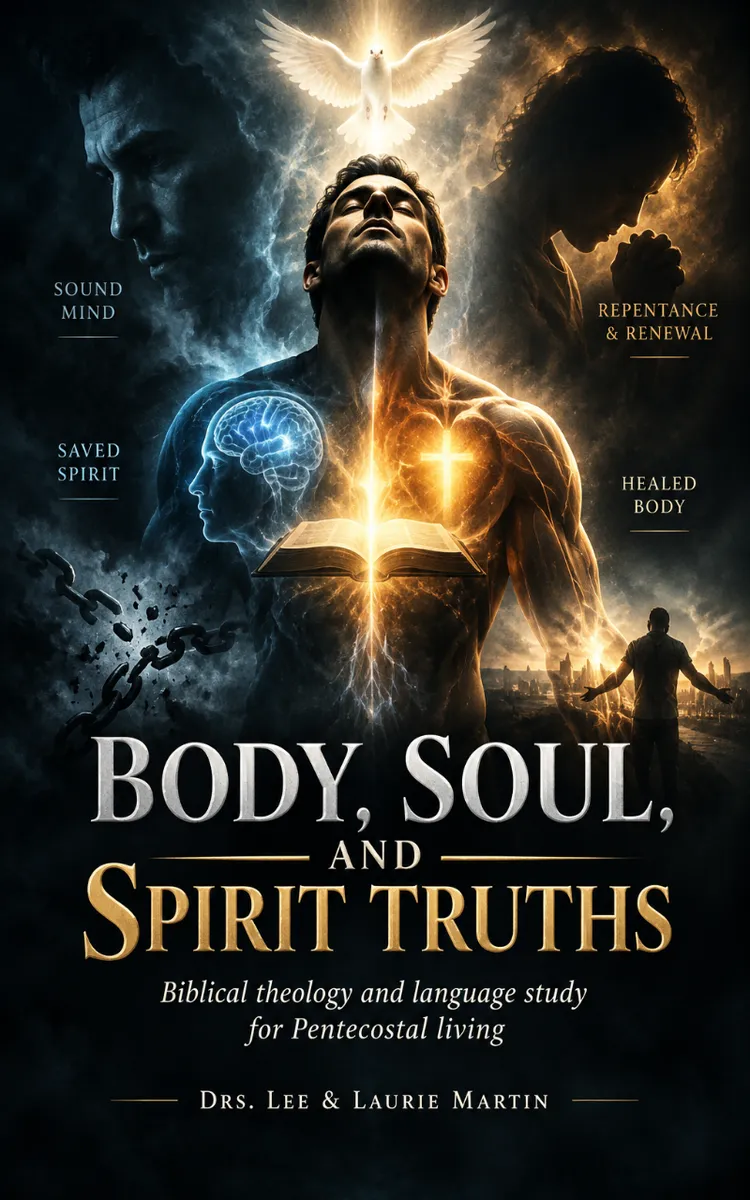
"Body, Soul, And Spirit Truths" is a religious devotional book by Drs. Lee & Laurie Martin with 14 chapters and approximately 19,791 words. Christian theology on body, soul, spirit using Bible, Hebrew, and Greek.
This book was created using Inkfluence AI, an AI-powered book generation platform that helps authors write, design, and publish complete books.
Frequently Asked Questions
What is "Body, Soul, And Spirit Truths" about?
Christian theology on body, soul, spirit using Bible, Hebrew, and Greek
How many chapters are in "Body, Soul, And Spirit Truths"?
The book contains 14 chapters and approximately 19,791 words. Topics covered include A Fresh Start-God’s Truth for Body, Soul, and Spirit, Seeing the Whole Person-Body, Soul, and Spirit in Scripture, The Soul’s Capacity-Hope, Healing, and the Inner Reservoir (Prov. 18:14), Seek First-Kingdom Priorities for Spirit, Soul, and Body (Matt. 6:33), and more.
Who wrote "Body, Soul, And Spirit Truths"?
This book was written by Drs. Lee & Laurie Martin and created using Inkfluence AI, an AI book generation platform that helps authors write, design, and publish books.
Write your own religious devotional book with AI
Describe your idea and Inkfluence writes the whole thing. Free to start.
Start writingCreated with Inkfluence AI


