

Read the first chapter
The whole of chapter one, free. About 10 min. Turn the pages with the arrows, your keyboard, or a swipe.
Chapter 1
Smoke Over the Rue Cler
The first éclair slid from Marcel Duret’s fingers at precisely seven minutes past eight.
It struck the blue-and-white tiles of Moreau Pâtisserie with a soft, wet slap. For one absurd second, Camille Moreau thought he had dropped it because the chocolate glaze had made his gloves slippery.
Then Marcel folded over the little marble table.
“Madame Duret?” Camille called, already moving.
The morning rush pressed against the shop windows along Rue Cler: bicycles rattling over the stones, the green awning of the cheese shop lifting in the breeze, a delivery boy balancing a crate of oranges against his hip. Inside, the bell above the door chimed twice as two more customers entered, carrying the chill of the Paris morning with them.
Marcel’s wife caught his shoulder. “Marcel!”
Camille reached the table and lowered him carefully to the floor. His face had gone gray beneath his neatly trimmed beard. One hand clawed at his collar.
“What did he eat?” Camille asked.
Madame Duret pointed to the éclair lying beside the chair. “Only that. He said it tasted - ” Her voice broke. “He said it tasted bitter.”
Camille’s gaze fixed on the pastry.
It was one of her best. A slim choux shell, filled with coffee cream and capped with dark chocolate. She had piped the morning batch herself before dawn, checking each shell for cracks, each filling for smoothness. The éclair rested on its side, its glaze smeared across the tile like black paint.
Behind her, the espresso machine hissed. Someone gasped.
“Call an ambulance,” Camille said. “Now.”
“I’m calling,” said the young man at the counter, fumbling with his phone.
Camille loosened Marcel’s collar and felt for his pulse. It fluttered beneath her fingers, quick and thin.
“Stay with us, monsieur,” she murmured. “The ambulance is coming.”
Madame Duret knelt beside him, her skirt brushing the floor. “He has a heart condition.”
“Does he have allergies?”
“No. No, nothing like this.”
Camille looked again at the éclair. The chocolate gleamed under the pendant lights. A faint gray mark ran across one end, almost hidden beneath the glaze. Not a crack. Something burned into it.
The oven alarm shrilled from the kitchen.
Camille jerked toward the sound.
A ribbon of smoke pushed beneath the swinging door at the back of the shop. It curled low along the floor, thin at first, then thickening into a dirty veil.
“Everyone out,” Camille said.
The customers stared at her.
“Out, please. Across the street if you can. The oven may be on fire.”
The young man with the phone stopped speaking. “The ambulance is coming.”
“And the fire brigade will come faster if you move.”
That broke the spell. Chairs scraped. The bell over the door rang again and again as customers crowded onto Rue Cler. Madame Duret refused to leave Marcel.
“He cannot move,” she said.
“He must,” Camille replied. “The smoke will make him worse.”
Together, Camille and the young man lifted Marcel beneath the arms. His shoes dragged over the tiles. Camille felt the heat before they reached the door, a dry wave pressing through the smoke. They got him onto the pavement just as a siren began to rise somewhere beyond the market stalls.
Camille turned back.
The éclair remained on the floor.
Her back room lay beyond the kitchen, past the ovens and the narrow passage where she kept invoices, spare piping bags, and the locked cabinet of specialty ingredients. If the pastry was poisoned, it had to be preserved. She needed the éclair off the floor, away from shoes, frightened hands, and the spreading smoke.
She took one step toward the kitchen.
“Camille!” called Madame Duret. “Come outside!”
“I’ll be right there.”
The smoke thickened around the swinging door. It smelled of scorched butter and hot metal. Somewhere inside, a pan clanged as the oven fan shuddered.
Camille pulled her apron over her mouth and ducked through.
Her kitchen, usually bright with copper pans and morning order, had become a narrow gray tunnel. Smoke streamed from the old convection oven beneath the pastry racks. The temperature struck her cheeks. Her eyes watered at once.
The oven’s red warning light blinked.
“That isn’t possible,” she muttered.
She had turned it off before opening the shop. She remembered the click of the switch, the quiet settling of the burners. She remembered because she always remembered.
A sharp pop came from within the oven.
Camille flinched, then reached for the wall switch. The extractor fan coughed but did not start. She slapped it again. Nothing.
The fire blanket hung beside the sink, just beyond the oven. She grabbed it, wrapped one corner around her hand, and opened the oven door a fraction.
Flame licked along the bottom tray.
Camille dropped the blanket over the opening and shut the door. Smoke burst around her wrists. Heat bit through the fabric of her sleeve.
“Come on,” she whispered.
She needed the back room. She needed the éclair. She needed to get out before the kitchen became impossible.
The passage between the oven and the worktable was barely wide enough for her shoulders. A fallen rack blocked half of it, its wheels twisted beneath a tray of ruined pastry. Camille stepped over the tray, slipped on something soft, and caught herself against the wall.
Her palm struck a smear of warm cream.
The smoke pressed lower. She crouched and crawled.
At the edge of the kitchen, the éclair lay near the fire door, exactly where the customer had dropped it. A blackened cloth had fallen beside it. Camille could see the pastry through the haze, its chocolate coating intact except for the small gray mark.
She reached for the stainless-steel tongs resting on a shelf.
The shelf was hot.
Camille snatched her hand back, then seized the tongs with the corner of her apron. She stretched toward the éclair. The tips closed around it but slipped. The pastry rolled, stopping against a line of soot.
“No.”
She tried again. This time the tongs caught the shell.
A crash sounded behind her.
The oven door had sprung open.
Flame flashed across the floor, low and bright, catching the edge of a towel. Camille pulled the éclair toward her, tucked it into the clean waxed paper she carried in her apron pocket, and backed toward the passage.
The towel flared.
Camille grabbed the fire blanket and threw it over the flames. Smoke billowed so heavily that the kitchen vanished. She could no longer see the door. The tiled wall guided her hand, cool beneath her fingertips where the heat had not yet reached.
She counted the steps in her head.
Three to the worktable. Two to the sink. One to the swinging door.
Her shoulder struck the door, and she fell through into the shop.
Fresh air rushed over her face. Camille coughed until her ribs hurt. The waxed packet remained clenched in her fist.
Outside, a fire engine turned onto Rue Cler, its bell clanging. Two paramedics hurried toward Marcel, and a uniformed police officer moved with them.
The officer saw Camille emerge from the smoke.
“Madame,” he called. “Step away from the building.”
“I have the pastry.”
His eyes dropped to the packet. “Put it down.”
“No.”
The word came out before she could soften it.
The officer stopped. Behind him, Marcel’s wife was crying as the paramedics fitted an oxygen mask over her husband’s face. A crowd had gathered beside the market stalls, drawn by the siren and the smoke.
Camille looked at the packet in her hand. A smear of chocolate marked the wax paper. The evidence was already fragile. If she set it down on the pavement, someone could step on it. If she carried it into the back room, she might preserve it - but the police would wonder why she had hidden it.
The officer approached more carefully.
“Madame Moreau?”
“Yes.”
“Inspector Garnier will speak with you.”
Camille knew the name. Luc Garnier had once come into the shop for a pear tart and complained that the crust was too perfect to be trusted. She had liked him immediately, which was inconvenient now.
“I need to put this in my back room,” she said.
“Absolutely not.”
“It’s the éclair monsieur ate.”
“Then hand it to me.”
“I can preserve it properly.”
His expression hardened. “You can also destroy evidence properly.”
The accusation landed harder than the smoke.
Camille held his gaze. “I found it beside the fire. I did not touch it until I used tongs.”
“Did anyone see that?”
“No.”
“Then you understand my concern.”
A second siren approached. From the shop’s open door came a deep crack, followed by the collapse of something metal. Black smoke rolled over the pavement.
Camille’s fingers tightened around the packet.
The back room was only ten steps away. She could place the éclair in the small refrigerator, away from the heat, and keep the wax paper intact. But the officer was right about one thing: every movement could look like concealment.
“I am not hiding it,” she said. “I am keeping it from the fire.”
“Give it to me.”
Before Camille could answer, Inspector Luc Garnier came through the crowd.
He was taller than she remembered, his dark coat buttoned against the morning cold. His hair was silver at the temples, and his eyes moved from the smoking shop to Marcel on the pavement, then to the packet in Camille’s hand.
“Camille,” he said.
“Inspector.”
“What happened?”
“A customer ate an éclair and collapsed. Then the oven caught fire.”
Garnier looked at the uniformed officer. “And the pastry?”
“She refuses to surrender it.”
“I refuse to leave it on the pavement,” Camille said.
Garnier held out his hand. “Let me see.”
She passed him the packet.
He did not open it. “Did you prepare this batch?”
“Yes.”
“Did you serve the customer?”
“I served everyone.”
“That isn’t what I asked.”
Camille felt the cold now, creeping beneath her soot-streaked sleeves. “I placed the éclair on the tray. I did not hand it to him.”
“Who did?”
“I don’t know. It was a self-service display.”
Garnier’s gaze returned to the shop. “And the fire?”
“The oven was switched off.”
“Was it?”
“Yes.”
He studied her face, and she understood that he was not asking whether she believed it. He was asking whether she could prove it.
A firefighter emerged from the doorway, coughing into his sleeve. “The fire’s contained,” he called. “But the wiring’s been tampered with. Someone jammed the extractor and wedged the oven control.”
Camille stared at him.
Garnier’s expression changed, just slightly.
The uniformed officer took a notebook from his pocket. “So this was deliberate?”
“Looks that way,” the firefighter said.
For a moment, the Rue Cler market seemed to tilt. Camille saw the flower seller across the street arranging tulips in a bucket, each stem bright and innocent. She saw the black smoke staining the pale morning. Her shop door stood open behind her, and every customer who had ever trusted her pastries could now look inside and wonder what she had put in them.
Garnier closed the waxed packet around the éclair.
“Madame Moreau, the bakery is a crime scene.”
“I know.”
“You’ll need to remain available.”
“I know that too.”
He handed the packet to an evidence technician, then glanced down at the pavement near Camille’s shoes. “What is that?”
A small blue glint rested beside the soot-darkened pastry box.
Camille crouched before anyone could stop her. She did not touch it. The shard was no larger than a fingernail, translucent and sharply faceted, bright blue beneath the gray dust.
Sugar.
Not ordinary colored sugar, either. She knew every decoration in her kitchen: pearl dust, silver leaf, violet crystals, pistachio crumbs. This blue was too deep, almost the color of the Seine beneath a winter sky.
“Don’t move,” Garnier said.
“I’m not.”
He crouched beside her. “You recognize it?”
“I don’t use it.”
“Could it have come from the éclair?”
“Not from my ingredients.”
The evidence technician photographed the shard, then lifted it with tweezers into a clear envelope.
Garnier looked at Camille. “You’re certain?”
“Yes.”
Behind them, a firefighter shut the bakery doors. The familiar blue awning disappeared beneath a strip of police tape. Madame Duret sat in the ambulance while Marcel was taken inside, still breathing, still alive, but no longer visible through the gathering crowd.
Camille watched the tape stretch across her entrance.
“I need to clean the kitchen,” she said quietly.
“No,” said Garnier. “You need to leave it exactly as it is.”
“My shop - ”
“Is now a crime scene.”
The words settled more heavily than the smoke.
Camille looked at the evidence envelope in the technician’s hand. Inside it, the blue shard caught the weak morning light.
She had wanted to save the éclair.
She had saved it.
Now the police had taken her shop, her oven, and perhaps the trust of every person on Rue Cler - and left her with one bright fragment of sugar that did not belong to her.
End of chapter one. 9 more chapters and about 22,652 words in the full book.
Swipe or use the arrows to turn the page


What's inside: 10 chapters
- 1. Smoke Over the Rue Cler
- 2. A Recipe for Courage
- 3. The Blue Sugar Trail
- 4. The Locked Market Cellar
- 5. The Flour-Dusted Alibi
- 6. The Cost of Suspicion
- 7. The Festival Tart Disaster
- 8. The Empty Kitchen
- 9. The Last Batch at Dawn
- 10. A Fresh Start on Rue Cler
About this book
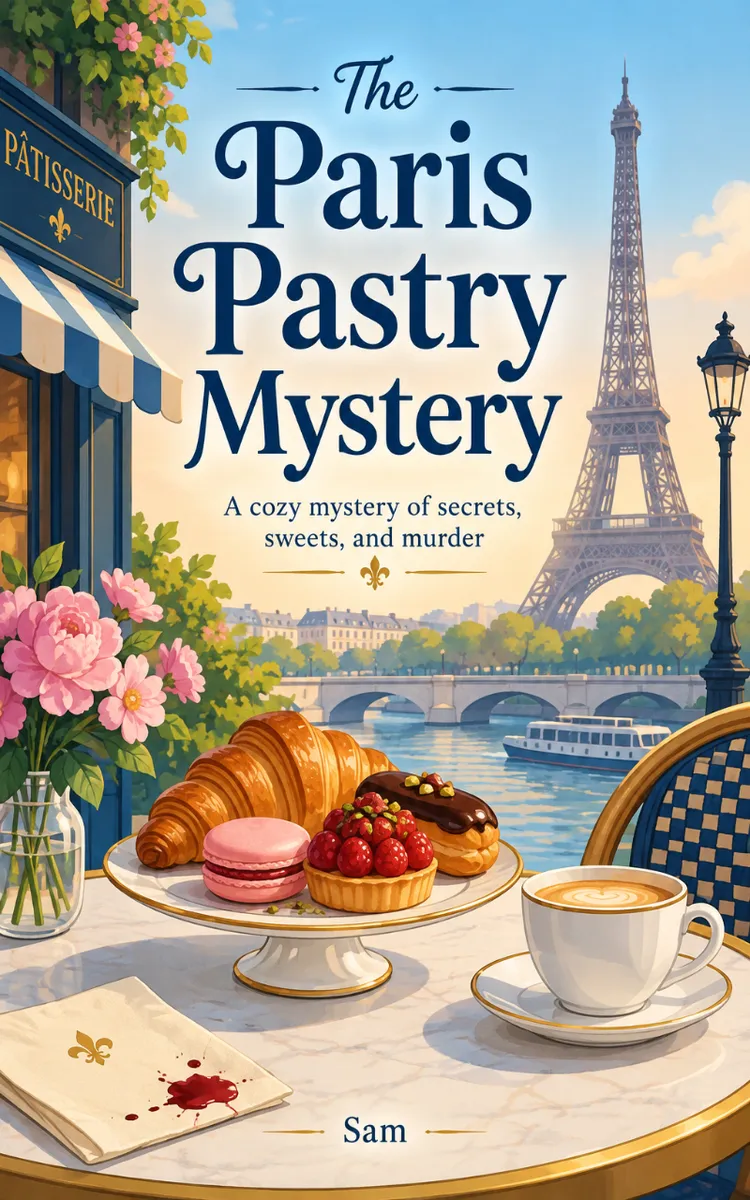
"The Paris Pastry Mystery" is a fiction book by Sam with 10 chapters and approximately 22,652 words. A pastry chef investigates crimes amid Parisian cafés and bakeries.
This book was created using Inkfluence AI, an AI-powered book generation platform that helps authors write, design, and publish complete books. It was made with the AI Novel Writer.
Frequently Asked Questions
What is "The Paris Pastry Mystery" about?
A pastry chef investigates crimes amid Parisian cafés and bakeries
How many chapters are in "The Paris Pastry Mystery"?
The book contains 10 chapters and approximately 22,652 words. Topics covered include Smoke Over the Rue Cler, A Recipe for Courage, The Blue Sugar Trail, The Locked Market Cellar, and more.
Who wrote "The Paris Pastry Mystery"?
This book was written by Sam and created using Inkfluence AI, an AI book generation platform that helps authors write, design, and publish books.
How can I create a similar fiction book?
You can create your own fiction book using Inkfluence AI. Describe your idea, choose your style, and the AI writes the full book for you. It's free to start.
Write your own fiction book with AI
Describe your idea and Inkfluence writes the whole thing. Free to start.
Start writingCreated with Inkfluence AI


