
Read the first chapter
The whole of chapter one, free. About 6 min. Turn the pages with the arrows, your keyboard, or a swipe.
Chapter 1
Fighting The Obvious
When Fear Looks Like Commitment
What if the reason you’re still with her isn’t love - but the thought of being alone on a Friday night, explaining the breakup to your family, or starting over with an empty apartment?
That question can sting because fear rarely announces itself honestly. It doesn’t say, “I’m fear.” It says, “Give it another month.” It says, “She’s not perfect, but nobody is.” It reminds you of the good weekend, the birthday gift, the time she showed up when you were sick. Meanwhile, your stomach tightens every time her name appears on your phone.
You may still love her. That’s the maddening part. Love and fear can sit in the same room, wearing similar clothes.
Are you choosing the relationship - or hiding inside it?
The Belief That Keeps You Stuck
Old Belief: If I’m still here, I must be committed.
New Reality: Staying proves only that you’re staying. Commitment is a clear, willing choice - not a surrender to loneliness, guilt, or fear of change.
That distinction matters because a man can remain in a relationship long after his heart has stopped agreeing with it. He keeps paying bills, making plans, and saying “we” because leaving would force him to face uncomfortable facts. He might have to admit that the relationship isn’t becoming what he hoped. He might disappoint her. He might disappoint himself even more.
Picture a man who owns a small shop and spends every Sunday night dreading Monday. The work looks respectable from the outside. He tells himself he can’t walk away because he’s already invested years. But the years aren’t proof that the business is right for him. They’re simply years. The same goes for a relationship. Time invested is not a life sentence.
Genuine commitment has some life in it, even during rough seasons. You can still speak honestly. You want to repair what’s broken. You’re not merely trying to avoid the consequences of leaving. Fear-based staying feels different. It’s heavy, defensive, and full of private bargaining: “Maybe if I keep the peace, things won’t get worse.” That isn’t devotion. That’s emotional survival wearing a nice jacket.
The Clear-Eyed Commitment Lens
The Clear-Eyed Commitment Lens asks you to separate three things that often get tangled together: what you feel for her, what you fear about leaving, and what the relationship is actually doing to your life.
Start with the uncomfortable question: if loneliness, guilt, and change were removed from the equation, would you still choose this relationship? Not the memories. Not her potential. Not the version of her who appears after a blowup and promises to do better. The relationship as it exists on an ordinary Tuesday.
Fear may be running your life when:
• You list the pain of leaving more easily than the value of staying.
You can name the empty house, awkward conversations, and lost routines. But when someone asks what you’re building together, your answer gets foggy.
• You confuse her distress with your responsibility.
You stay because she’ll cry, threaten to fall apart, or accuse you of ruining her life. Her feelings may be real, but they don’t automatically make you responsible for remaining unhappy.
• You keep waiting for permission to be done.
You search for one final betrayal, one dramatic incident, or a courtroom-quality reason. Sometimes the truth is quieter: the relationship has become a place where you keep abandoning yourself.
• You feel relief when you picture leaving, then shame yourself for feeling it.
Relief is information. It doesn’t make you cruel. It may mean your body has been carrying a load your mind keeps trying to explain away.
Commitment moves toward a shared life; fear merely postpones an unwanted decision.
Consider the difference between staying through a hard patch and staying because you’re terrified of the next chapter. In the first case, both people are facing the problem. In the second, you’re mostly managing reactions, avoiding conversations, and hoping time will decide for you. Time is not a decision-maker. It’s just a clock.
Questions You Can’t Answer With a Lie
• If she didn’t become angry, heartbroken, or vindictive, would you choose to stay?
Be precise. If your honest answer is, “I’d leave tomorrow,” then fear - not commitment - is holding the steering wheel.
• When you picture another five years together, what do you feel first: peace, energy, dread, or numbness?
Don’t judge the answer too quickly. Numbness is an answer too. So is the tightness in your chest when you imagine the same arguments continuing.
• What are you asking this relationship to become before you’ll allow yourself to leave?
Write down the condition. “She has to admit everything.” “We need one more chance.” “I need to know I tried.” Then ask whether that condition is realistic or just another locked gate.
• Are you grieving the woman beside you, or the future you hoped she would give you?
Those are different losses. You can miss the future you pictured and still recognize that the actual relationship cannot carry you there.
• What would you tell a close friend who described your relationship word for word?
Don’t give him the polished speech you give yourself. You’d probably notice the fear faster from the outside.
Take ten quiet minutes with these questions. No music, no beer, no scrolling between answers. Use paper if you can. A phone makes it too easy to edit the truth before you’ve even written it down.
The Seven-Day Clear-Eyed Test
Challenge: The Fear-Free Choice
For the next seven days, don’t make a dramatic announcement and don’t pick a fight to “test” her. Just observe yourself with unusual honesty.
• Each evening, write two short answers: “What drew me toward staying today?” and “What frightened me about leaving today?”
• Record one concrete moment when you felt connected, respected, or willing to repair things.
• Record one concrete moment when you felt trapped, guilty, or relieved at the thought of distance.
• Before bed, complete this sentence: “If I knew I could handle loneliness, I would…”
• On the seventh day, read every entry aloud. Notice which words repeat.
Difficulty: Medium
You’ll know it’s working when:
• You stop using “love” as a catch-all explanation.
• You can name the difference between missing her and fearing life without her.
• Your reasons for staying become specific instead of vague.
• You notice relief without immediately attacking yourself for it.
• You can discuss the relationship without turning every thought into a prosecution or defense.
The goal isn’t to force a breakup. It’s to remove the fog. A clear answer may tell you to leave. It may tell you there is honest work worth doing. Either way, you’ll be responding to reality instead of panic.
Choose With Your Eyes Open
You’ve learned to question the idea that staying automatically equals commitment.
• Love can be present while fear still keeps you stuck.
• Guilt is not the same thing as responsibility.
• Loneliness is painful, but it is not proof that the relationship is healthy.
• Relief, dread, and numbness deserve attention rather than punishment.
• The Clear-Eyed Commitment Lens separates what you feel for her from what you fear about leaving.
The right relationship is chosen with an open heart - not defended with a frightened one.
You don’t need to become cold to make a clear decision. You need to stop calling self-abandonment loyalty. From here, the work gets more concrete: you’ll begin looking at the patterns that keep repeating, because one good night - or one terrible argument - doesn’t tell the whole story.
End of chapter one. 39 more chapters and about 60,529 words in the full book.
Swipe or use the arrows to turn the page


What's inside: 40 chapters
- 1. Fighting The Obvious
- 2. Trusting What You Notice
- 3. Naming Your Nonnegotiables
- 4. Recognizing Your Own Blind Spots
- 5. Reading Patterns, Not Promises
- 6. Understanding Respect in Practice
- 7. Keeping Your Identity Intact
- 8. Seeing Compatibility Clearly
- 9. Distinguishing Conflict from Contempt
- 10. Taking Emotional Safety Seriously
- 11. Setting Boundaries Without Apology
- 12. Speaking So You Can Be Heard
- 13. Listening Without Losing Yourself
- 14. Repairing After an Argument
- 15. Ending the Silent Treatment
- 16. Sharing the Work of Love
- 17. Facing Chronic Dishonesty
- 18. Handling Jealousy Without Control
- 19. Protecting Privacy and Consent
- 20. Recognizing Emotional Manipulation
- 21. Taking Threats and Violence Seriously
- 22. Breaking the Rescue Habit
- 23. Facing the Sunk-Cost Trap
- 24. Weighing Hope Against Evidence
- 25. Getting Outside Perspective
- 26. Making the Decision Deliberately
- 27. Preparing for a Safe Exit
- 28. Ending Things with Clarity
- 29. Untangling Shared Money and Belongings
- 30. Setting Contact After the Breakup
- 31. Co-Parenting Through Separation
- 32. Grieving Without Rewriting History
- 33. Managing Loneliness After Leaving
- 34. Rebuilding Confidence in Your Judgment
- 35. Owning Your Part Without Self-Blame
- 36. Changing the Patterns You Bring
- 37. Dating Again at Your Own Pace
- 38. Choosing Partners by Character
- 39. Building a Life Beyond Romance
- 40. Carrying Your Standards Forward
About this book
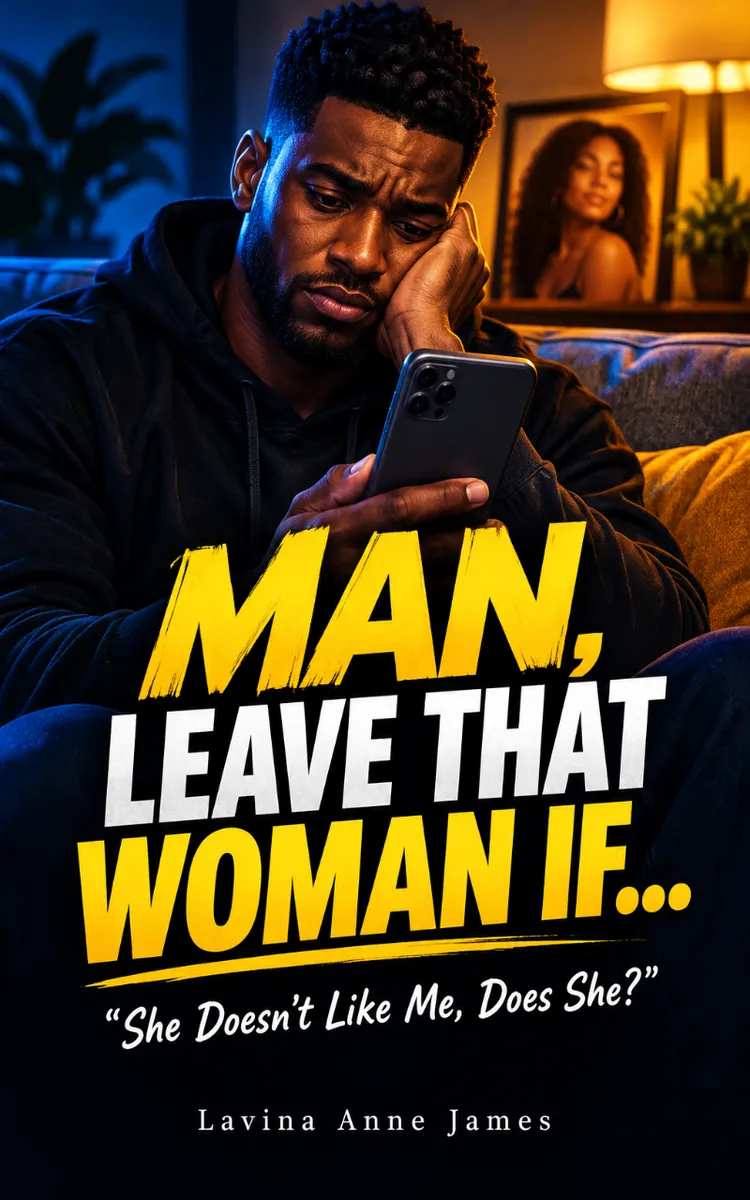
"MAN, LEAVE THAT WOMAN IF..." is a self-help book by Lavina Anne James with 40 chapters and approximately 60,529 words. Recognizing unhealthy relationship patterns and deciding when to leave.
This book was created using Inkfluence AI, an AI-powered book generation platform that helps authors write, design, and publish complete books. It was made with the AI Self-Help Book Writer.
Frequently Asked Questions
What is "MAN, LEAVE THAT WOMAN IF..." about?
Recognizing unhealthy relationship patterns and deciding when to leave
How many chapters are in "MAN, LEAVE THAT WOMAN IF..."?
The book contains 40 chapters and approximately 60,529 words. Topics covered include Fighting The Obvious, Trusting What You Notice, Naming Your Nonnegotiables, Recognizing Your Own Blind Spots, and more.
Who wrote "MAN, LEAVE THAT WOMAN IF..."?
This book was written by Lavina Anne James and created using Inkfluence AI, an AI book generation platform that helps authors write, design, and publish books.
How can I create a similar self-help book?
You can create your own self-help book using Inkfluence AI. Describe your idea, choose your style, and the AI writes the full book for you. It's free to start.
Write your own self-help book with AI
Describe your idea and Inkfluence writes the whole thing. Free to start.
Start writingCreated with Inkfluence AI


