
Read the first chapter
The whole of chapter one, free. About 7 min. Turn the pages with the arrows, your keyboard, or a swipe.
Chapter 1
Caring as a Choice, Not a Mood
You can feel it, can’t you? That moment when someone needs you, and your heart is there - but your body and brain are dragging. Maybe you’re tired from a long shift. Maybe you’re irritated about something that happened earlier. Maybe you’re just flat-out not in the mood to be kind.
And then a thought shows up: “I should care more.” Or worse: “If I don’t feel caring, then I don’t really care.” That’s the trap. Caring isn’t a weather report that only shows up when your emotions cooperate. Caring is something you can choose - then return to - like you’re flipping a switch when your feelings lag behind.
For Nora, 34, an ER nurse working rotating shifts, this happens in the smallest moments: the extra minute to explain what’s happening, the steady tone when a patient is scared, the quick check-in that makes someone feel less alone. On her worst nights, her feelings don’t match the job she’s good at. But the choice still can. And once she starts making that choice on purpose, caring stops depending on mood and starts depending on her.
Caring Like a Deliberate Return: The Choice-Care Switch
This chapter is for you if you’ve ever thought caring “should” come naturally, but your tiredness, stress, or irritation keeps stealing the moment. You’ll get a clear way to treat caring like a decision you can come back to - without forcing your emotions to behave first. The shift you can expect is practical: you’ll learn how to stop waiting for the feeling and start using a repeatable switch instead.
• You want empathy that holds up even when you’re drained, not just when you’re energized. - You’ve noticed you care in bursts, then feel guilty when it fades. - You want a way to choose caring that doesn’t require you to be a different person. - You’re ready for a simple tool you can use at work, at home, or both.
The Core Truth: Caring Is a Choice You Can Return To
Caring is a deliberate choice you can return to, even when your feelings lag behind.
Here’s what’s true underneath the frustration: feelings are real, but they’re not the steering wheel. They’re more like headlights - helpful, but not in charge of where you go. When you wait for the “right” feeling to show up before you act, you end up caring only when your inner world is already cooperating. That can work for a while. Then life happens: sleep debt, crowded schedules, conflict, grief, stress. Suddenly caring becomes inconsistent - and you start judging yourself for it.
The Choice-Care Switch is your reminder that caring can be intentional. Not fake. Not forced. Intentional. You can decide, in the middle of a day that doesn’t feel gentle, to do the next caring thing anyway. You don’t have to feel warm and fuzzy to speak with respect. You don’t have to feel patient to slow down for one sentence. You don’t have to feel “good” to choose “kind.”
Let’s put it on Nora’s ER shift, because that’s where the Choice-Care Switch earns its keep. One night, she’s running behind. A patient is upset and keeps repeating the same question - again and again. Nora can feel the irritation rising. Her brain wants to rush, to get it over with, to move on to the next task. Her feelings are pushing for speed, not care.
Instead of trying to magically change her mood, she flips the switch. She decides: “I’m going to care for the next 60 seconds.” That decision doesn’t erase her fatigue. But it changes what she does with it. She makes eye contact. She takes a breath before answering. She says the information clearly, then repeats it once more with the same calm tone. The patient relaxes - not because Nora suddenly felt like a saint, but because Nora chose steady care when her feelings weren’t offering it on demand.
In Practice, This Means... - You choose a caring action for a specific moment (like the next 60 seconds) rather than waiting to “feel caring.” - You use a simple cue - like one breath or one sentence - to interrupt irritation before it drives your words. - You separate “I feel impatient” from “I choose to be respectful.” - You treat caring as something you can practice, not something you either have or don’t.
Putting the Choice-Care Switch Into Daily Practice
The Choice-Care Switch works best when you plan for the times you’re most likely to miss it. You know those times: right after a hard phone call, right before you lose your patience, right when you’re about to snap. So you don’t rely on luck. You build a return path.
Think of it like this: you don’t need your feelings to lead. You need a tiny decision rule that pulls you back. The switch is short on purpose. If it’s complicated, you’ll forget it when you need it most.
Here’s a way to anchor it in your day with simple timing cues that actually fit real life.
1. Morning (one-minute setup): Before you’re busy, ask, “What kind of caring do I want to practice today?” Keep it specific - one caring tone, one clear explanation, one check-in. Then pick your switch phrase: “Next right caring thing.” 2. Midday (reset when you notice friction): When you catch yourself thinking, “Ugh, here we go,” do a quick reset: pause, breathe once, and choose one caring action before you speak again. (One action. Not ten.) 3. Evening (two-minute reflection): Ask, “Where did I choose caring even though I didn’t feel like it?” Then ask, “Where did I wait for feelings instead?” You’re not collecting shame. You’re collecting data. 4. Before hard moments (pre-decide the next step): If you know you’ll be stretched - closing time, shift change, after school pickup - decide what your caring move will be. For Nora, it might be “I’ll explain once more without rushing,” even if the question repeats.
This is how caring stops being fragile. You’re not trying to manufacture feelings. You’re training your choices to show up consistently.
Real-Life Example: Nora’s “Next 60 Seconds” Switch
Before: Nora is halfway through an exhausting stretch. A patient is anxious and keeps asking the same question. Nora feels her shoulders tighten and her tone get shorter in her head. She wants to get through it. She’s annoyed that the patient isn’t moving faster. Her feelings are loud, and her patience is thin.
Action: She uses the Choice-Care Switch: “Next 60 seconds.” One breath. Eye contact. She answers the question clearly, then adds one caring line: “I know this is frustrating. I’m here with you, and I’ll keep you updated.” She repeats the key information in the same calm way, without making the patient prove their worth first.
Result: The patient’s body language shifts. The anxiety doesn’t disappear instantly, but it settles enough for conversation. Nora’s own stress drops too - not because the night got easier, but because she stopped fighting her feelings and started directing her choices. She still has a hard shift ahead. But she experiences her work as meaningful again, not just demanding.
That’s the point: caring is not a mood. It’s a return.
Time to Reflect: What Your Caring Is Really Waiting For
If you want to make this stick, you need to get honest about what you’ve been expecting from yourself. Most people aren’t refusing to care. They’re waiting for permission from their emotions. Let’s check that gently, without blaming you for being human.
1. What do I think “caring” is supposed to feel like? If your answer is “warm and patient,” you might be setting yourself up for failure on tired days. Caring can look steady, not sparkly.
2. When I don’t feel caring, what story do I tell myself? Common ones sound like “I’m failing” or “I don’t really mean it.” Notice if the story turns your feelings into a verdict.
3. Where do I avoid caring because I’m afraid of what it will cost? Sometimes caring feels like it will drain you, slow you down, or open the door to more need. Reflection helps you separate “it costs something” from “it costs everything.”
4. What’s the smallest caring action I can do in the next moment? If you can name it, you can choose it. If you can’t name it, your caring might be too big and vague to land.
5. What would change if I treated caring as a decision, not a feeling? Try answering this like you’re talking to yourself on a rough day. Your answer will usually reveal your next most practical step.
You don’t need to have perfect insight. You just need enough awareness to flip the switch more often.
Complete Today: Pick One Caring Switch Moment and Run It
Your decisive action today is simple: choose one specific moment you know you’ll likely feel irritation, fatigue, or flatness - and decide your caring switch move in advance.
Write it down as a sentence you can actually follow. For example: “When I notice myself getting short, I will take one breath and use one respectful sentence before I respond.” Or: “If someone repeats a question, I’ll answer clearly again without rushing.”
Time needed: 5-10 minutes to decide and write it down. Then you’ll use it when the moment arrives.
You will know it worked when... you catch yourself in friction and still choose the next caring action - without needing your mood to change first. Even if you only get it right once today, that’s proof. Caring has started acting like a choice you can return to.
Next, you’ll build on this - because once you can switch caring back on in the middle of a hard day, it becomes easier to live like your own empathy matters too.
End of chapter one. 7 more chapters in the full book.
Swipe or use the arrows to turn the page


What's inside: 8 chapters
- 1. Caring as a Choice, Not a Mood
- 2. The Quiet Power of Small Acts
- 3. Empathy Without Losing Yourself
- 4. Rewriting the Meaning of “It’s Not Enough”
- 5. Turning Guilt Into Repair
- 6. The “You Do Care” Daily Reset
- 7. Choosing Presence Over Perfect Advice
- 8. Living Your Care as a Legacy
About this book
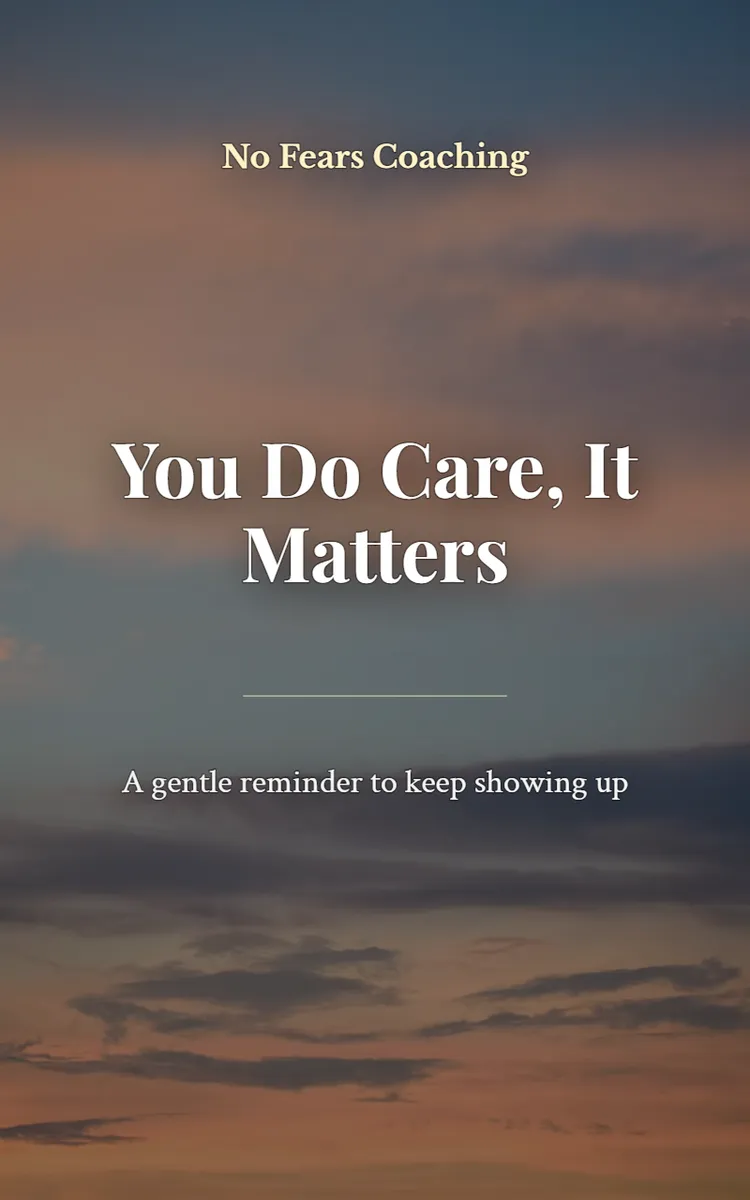
"You Do Care, It Matters" is a inspirational book by No Fears Coaching with 8 chapters and approximately 13,195 words. Encouragement about empathy, caring, and personal significance.
This book was created using Inkfluence AI, an AI-powered book generation platform that helps authors write, design, and publish complete books. It was made with the AI Inspirational Book Writer.
Frequently Asked Questions
What is "You Do Care, It Matters" about?
Encouragement about empathy, caring, and personal significance
How many chapters are in "You Do Care, It Matters"?
The book contains 8 chapters and approximately 13,195 words. Topics covered include Caring as a Choice, Not a Mood, The Quiet Power of Small Acts, Empathy Without Losing Yourself, Rewriting the Meaning of “It’s Not Enough”, and more.
Who wrote "You Do Care, It Matters"?
This book was written by No Fears Coaching and created using Inkfluence AI, an AI book generation platform that helps authors write, design, and publish books.
How can I create a similar inspirational book?
You can create your own inspirational book using Inkfluence AI. Describe your idea, choose your style, and the AI writes the full book for you. It's free to start.
Write your own inspirational book with AI
Describe your idea and Inkfluence writes the whole thing. Free to start.
Start writingCreated with Inkfluence AI


