
Read the first chapter
The whole of chapter one, free. About 7 min. Turn the pages with the arrows, your keyboard, or a swipe.
Chapter 1
Reframing Alone as Choice
Set the chapter focus: How to treat solitude like a space you chose The first time I heard the phrase “alone time,” it sounded comforting - like a cup of tea. The first time I felt alone for real, it sounded like a verdict. Same letters, different weight. One evening, after a long shift, I caught myself staring at my phone like it owed me something. No messages. No plans. Just the quiet hum of my own life. And that’s when it hit me: solitude can feel like rejection when I’m not calling it what it is.
So let’s reframe. Not with a fake smile or a fortune-cookie attitude - just with language that matches what’s actually happening. If I’m alone, that’s a fact. Whether it’s lonely is a story I’m telling about that fact. This chapter is about learning to see solitude as a chosen space, not a verdict, so your nervous system can feel steadier in your own company - even on the days when nobody else is around.
This Chapter Is For You If... - You’ve ever thought, “Something must be wrong with me” when you’re by yourself. - Quiet evenings feel heavy, but you can’t exactly change your schedule right now. - You want a practical way to shift your mindset without pretending you’re fine. - You’d like to feel calmer in your own presence, not just busy enough to avoid the feeling.
The Core Truth: Solitude becomes steadier when you treat it as a choice, not a conclusion. Here’s the core principle, simple enough to say out loud: Solitude becomes steadier when you treat it as a choice, not a conclusion.
When you’re alone, your brain will naturally try to answer, “Why am I alone?” If the answer it lands on is “because I’m unwanted,” loneliness shows up like a smoke alarm. But if the answer is “because I needed space,” loneliness has less to grab onto. Same situation. Different meaning.
Think about how you’d talk to someone you care about. If a friend said, “I’m taking a quiet night tonight,” you’d probably nod and mean it. You wouldn’t assume they’re broken. You’d assume they’re choosing. That’s the exact shift we’re making here: you’re not rewriting your life - you’re updating the interpretation.
Talia, 34, an ER nurse on rotating shifts, understands this the hard way. After a run of long nights, she’d come home and feel the familiar sting: “I should have someone to go home to.” But she also knew something true - most of her relationships were built around chaotic schedules and limited overlap. She couldn’t force her life into a neat shape. What she could do was stop treating “alone” as evidence and start treating it as a deliberate pause. On nights when she chose to eat slowly, wash up without rushing, and turn off the noise, her loneliness didn’t disappear instantly. It softened. Like the sting had less permission to stay.
And that’s the point: you’re not trying to “be positive.” You’re trying to be accurate. Solitude can be chosen even when your circumstances aren’t perfect.
In Practice, This Means... - You swap “I’m alone, therefore I’m lonely” for “I’m alone, so I’ll care for myself on purpose.” - You choose one small comfort ritual (like a warm drink or a 10-minute walk) that signals “this is on purpose.” - You notice the verdict-thought (“I’m being left out”) and label it as a thought, not a fact. - You create a quick exit plan for loneliness spirals (something you do within 5 minutes, not 5 hours).
Putting It Into Practice: The Choice Lens Reframe (daily actions that build steadiness) This is where the reframe stops being a concept and starts being a habit. The Choice Lens Reframe is basically a way to ask, in real time, “What part of this is a choice I still have?” Not in a dramatic way - just enough to get your footing back.
Try these daily actions, using the timing that fits your body and schedule:
1. Morning (30 seconds, right after you wake up): name your solitude on purpose. Before your brain loads the day, tell yourself: “Today includes some solitude.” Then add one line that turns it into a choice: “I’m using it to reset.” (Even if you don’t feel reset yet. We’re building a trail to walk on.)
2. Midday (one check-in during a natural pause): ask the Choice Lens question. When you catch loneliness creeping in, ask: “What can I choose in the next 10 minutes?” It might be as small as stepping outside for fresh air, eating slowly, or sending a single text that’s honest and simple.
3. Evening (2 minutes before bed): assign the meaning you want. Instead of reviewing every “empty” moment, do a meaning swap: “Tonight I was alone, and I protected my peace.” Then choose one action you’ll repeat tomorrow (same comfort, same sequence, different day).
4. Any time a verdict thought shows up: interrupt with a re-label. When your mind says, “I’m alone because I’m not wanted,” respond with: “That’s a story, not a verdict.” Then pick one grounding behavior (hands on a warm mug, a short shower, or a slow stretch) to anchor the new meaning.
These steps matter because they give your brain a job. Instead of only reacting to the feeling, you’re directing the next moment.
Real-Life Example: Talia’s shift from verdict to chosen space Before: After a 12-hour ER shift, Talia got home and sat in silence with her phone in her hand. No one had texted. Her mind filled in the blanks fast: “You’re alone because no one wants to deal with you.” The loneliness felt sharp - like she’d been handed a label she didn’t ask for.
Action: She took a breath and did the Choice Lens Reframe without overthinking it. She didn’t argue with her emotions. She simply changed the question. “What can I choose in the next 10 minutes?” Her answer was practical: she put her phone face down, made tea, and ate one meal slowly while watching something familiar (not scrolling, not searching). Then she said out loud, “This is my quiet reset.”
Result: The loneliness didn’t vanish like a light switch. But it stopped feeling like punishment. It felt like a signal - “You need rest.” Once she treated the solitude as chosen space, her body calmed enough that she could actually rest. The next morning, her thoughts were still honest, but they were less dramatic. She felt steadier in her own company, not because she forced happiness, but because she stopped accepting the verdict.
Talia’s takeaway wasn’t “solitude is always great.” It was, “Solitude can be held differently.” That difference is huge.
Time to Reflect: Questions that help you examine the story you’re using You don’t have to dig forever. You just need a few honest questions that point you back to choice. Here are prompts that work well when you’re alone and the verdict-thought shows up (or when it’s been hanging around for days).
1. When I feel lonely, what exact sentence does my mind use? Write it down in plain words. “I’m alone because…” is often the giveaway. The clearer you are, the easier it is to reframe.
2. What part of this situation is truly not a choice - and what part is? Separate what’s fixed (like your schedule) from what’s flexible (like your next 10 minutes). You’re not denying reality - you’re reclaiming what you can steer.
3. If this solitude belonged to someone I care about, what would I assume it means? Your answer will expose the double standard you’re carrying. Notice the kindness you’d offer them, and try offering that same kindness to yourself.
4. What comfort ritual could I repeat tonight that would signal “chosen space”? (Pick one.) Choose something concrete - tea, a shower, a short walk, a specific playlist. Loneliness hates specifics because they give your body a plan.
5. What’s one “verdict thought” I can label as a story instead of truth? You’re not trying to win an argument with your mind. You’re teaching it that your thoughts don’t get to drive the whole car.
Next Step: Complete one choice statement today (and make it measurable) Pick one moment today when you’ll be alone - maybe a commute, a break, or even the last 20 minutes before bed. Then complete this sentence out loud or on paper:
“I’m alone right now, and I choose this space for ____.”
Fill in the blank with something you can actually do (rest, reset, quiet focus, recovery). Then do one small action that matches the choice within the next hour - something you can measure with your senses. (Warm drink, quick tidy, 10-minute walk, silence without scrolling.)
Time needed: 10-15 minutes total. You will know it worked when... within that hour, the loneliness feels less like a verdict and more like a signal you can respond to - even if it’s still there.
When you start treating solitude like a chosen space, you don’t have to chase company to feel okay. You just have to keep choosing the meaning you want to live from - and that momentum carries you into the next chapter’s kind of steadiness.
End of chapter one. 7 more chapters in the full book.
Swipe or use the arrows to turn the page


What's inside: 8 chapters
- 1. Reframing Alone as Choice
- 2. Separating Loneliness From Solitude
- 3. Building Daily Gratitude Micro-Routines
- 4. Practicing Self-Compassion When It Hurts
- 5. Designing Connection Without Overcommitting
- 6. Turning Solitude Into Creative Momentum
- 7. Managing Negative Thoughts With Thought Weather
- 8. Choosing a Life That Fits You
About this book
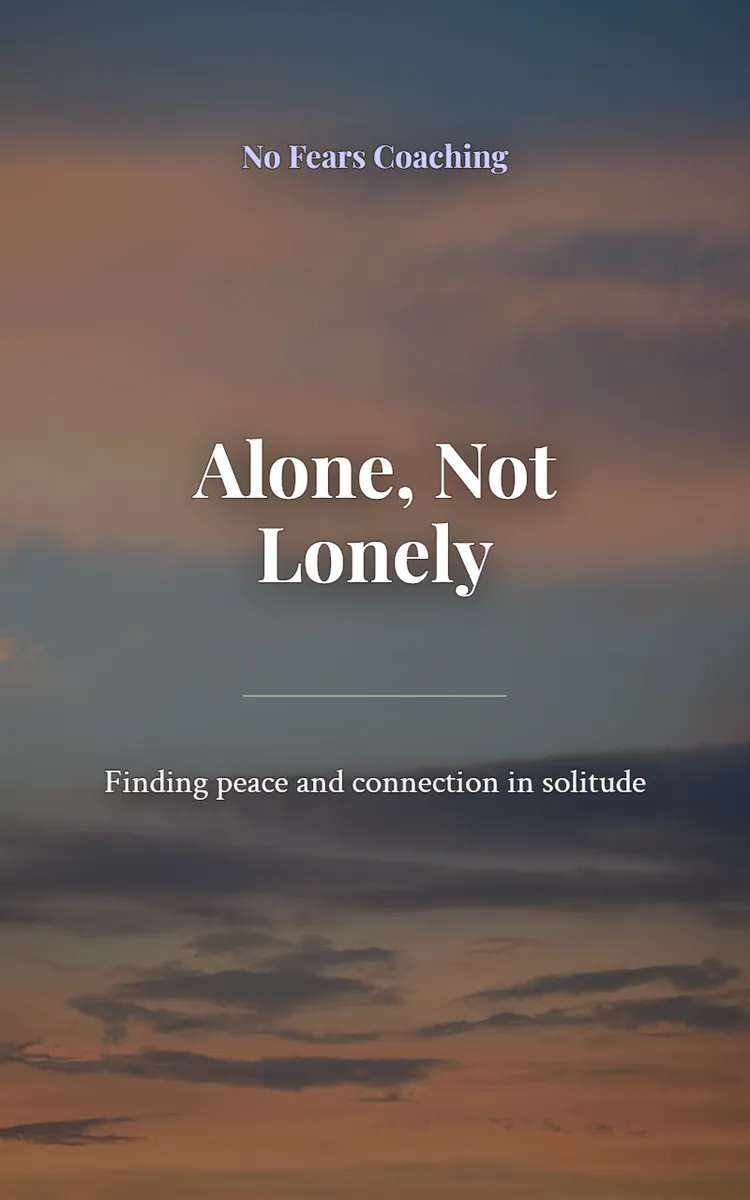
"Alone, Not Lonely" is a inspirational book by No Fears Coaching with 8 chapters and approximately 13,069 words. Embracing solitude without feeling lonely.
This book was created using Inkfluence AI, an AI-powered book generation platform that helps authors write, design, and publish complete books. It was made with the AI Inspirational Book Writer.
Frequently Asked Questions
What is "Alone, Not Lonely" about?
Embracing solitude without feeling lonely
How many chapters are in "Alone, Not Lonely"?
The book contains 8 chapters and approximately 13,069 words. Topics covered include Reframing Alone as Choice, Separating Loneliness From Solitude, Building Daily Gratitude Micro-Routines, Practicing Self-Compassion When It Hurts, and more.
Who wrote "Alone, Not Lonely"?
This book was written by No Fears Coaching and created using Inkfluence AI, an AI book generation platform that helps authors write, design, and publish books.
How can I create a similar inspirational book?
You can create your own inspirational book using Inkfluence AI. Describe your idea, choose your style, and the AI writes the full book for you. It's free to start.
Write your own inspirational book with AI
Describe your idea and Inkfluence writes the whole thing. Free to start.
Start writingCreated with Inkfluence AI


