

Read the first chapter
The whole of chapter one, free. About 8 min. Turn the pages with the arrows, your keyboard, or a swipe.
Chapter 1
The Seattle Enlistment
The departure board above King Street Station clicked from LOCAL to MILITARY, and the sound carried through the waiting room like a bolt being drawn.
Danny Keating tightened his grip on the paper envelope in his coat pocket. Inside was his induction notice, folded twice, and beneath it the train ticket the recruiting sergeant had told him not to lose. He had checked for both so often that the corners had softened.
“Danny.”
His mother’s voice came from behind him. He turned too quickly and nearly struck the suitcase between his shoes.
The station was crowded with uniforms and wool coats, with women holding babies and men pretending not to watch the clock. Steam pressed against the tall windows from the platforms below. Somewhere beyond the doors, a locomotive gave a long, impatient whistle.
“I’m going,” Danny said.
“You haven’t gone yet.”
“I’m due at the induction point by noon.”
His mother looked at the clock. She had dressed carefully in her blue coat, though one button was missing near the cuff. Her hair, usually pinned loose for work, had been drawn tight against her head. She held a small brown parcel against her ribs.
His father stood beside her, hat in both hands. He had come straight from the shipyard, still carrying a gray crescent of metal dust along one sleeve. Danny’s younger sister, Rose, pressed close to him and stared at the soldiers near the ticket windows.
“Your bag,” his father said.
“It’s there.”
“Let me see.”
“It’s only clothes.”
“Let me see it.”
Danny set the suitcase on the bench. The latch snapped open. Two shirts, work socks, underwear, a razor, and the Bible his mother had put in without asking lay beneath a folded Army undershirt. His father lifted the shirt, inspected the seams, then shut the case.
“You’ve got no gloves,” he said.
“They issue them.”
“They issue plenty of things after you need them.”
“I’ll be fine.”
His father’s mouth tightened. “That what they told you?”
Danny looked toward the platform doors. A corporal was directing men through a gate, checking papers one by one. The line moved in jerks. Each man who passed through seemed to become less a person and more a piece of freight.
“I’m not going to stand here all day,” Danny said.
“No,” his father answered. “You’re not.”
The words landed harder than Danny expected. He picked up the suitcase, but his mother caught his sleeve.
“Wait.”
She opened the parcel. Inside was a sandwich wrapped in waxed paper, two apples, and a photograph in a small envelope.
“For the train,” she said.
“I can buy something.”
“Take it.”
He accepted the food. The envelope remained in her hand.
Rose spoke without looking up. “Are you going to shoot Germans?”
“Maybe.”
“Are you going to shoot Japanese?”
“Rose,” their mother said.
“What? He said maybe.”
Danny crouched in front of his sister. Her face had the solemn, offended look she wore when adults tried to hide something from her.
“I’m going to training first,” he said. “I’ll write.”
“You don’t write now.”
“I will there.”
“You said that when you went to Tacoma.”
“That was a week.”
“It was three days.”
His mother put a hand on Rose’s shoulder. “Danny has to go.”
The station loudspeaker crackled, swallowed the first half of an announcement, then gave up in a burst of static. Men in uniform began moving toward the gate. Danny felt the ticket in his pocket and the weight of his suitcase pulling at his arm.
He had wanted this since December, since the newspapers began filling with photographs of burning ships and men running along beaches whose names he had never heard. He had wanted to leave the welding shop, the rented rooms, the alley behind their house where rainwater gathered black around the drain. He had wanted a uniform that made people look twice.
Now his mother’s fingers still held the envelope.
“What’s in it?” he asked.
She glanced at his father.
“A picture,” she said.
“Of what?”
“Us.”
“You already gave me one.”
“That was before.”
Before the war, she meant. Before he had signed his name.
Danny reached for the envelope. She did not give it to him.
His father looked past him toward the gate. “They’re calling the men.”
“I know.”
“Then go.”
Danny turned on him. “You want me gone that badly?”
His father’s face changed, not much, but enough. The lines around his eyes deepened.
“I want you to go where you said you were going.”
“That isn’t the same thing.”
“No,” his father said. “It isn’t.”
A soldier at the gate called, “Induction group for Fort Lewis! Papers ready!”
Danny’s pulse jumped. He picked up the suitcase and stepped toward the line.
“Danny,” his mother said.
He stopped.
She came close and pressed the envelope into his palm. Her hand was cold. “Don’t open it on the platform.”
“Why not?”
“Because you’ll miss the train.”
The answer sounded foolish, and because of that it nearly broke him. He tucked the envelope into his inner pocket beside the induction notice.
“I’ll write from Fort Lewis.”
“You write your own name first,” his father said. “So we know it’s you.”
Danny nodded.
Rose hugged him around the waist. Her cheek struck the brass buckle of his borrowed belt.
“Don’t get killed,” she said.
His mother made a small sound, but Danny kept his hands on Rose’s shoulders.
“I won’t.”
He had no right to promise it. The lie came easily anyway.
He kissed his mother, then his father. His father’s coat smelled of cold rain and hot metal. For a moment Danny was back in the kitchen, watching that same coat hang by the stove while his father slept before the night shift. The memory held him there until the corporal called again.
“Keating!”
Danny raised his hand.
The corporal checked his papers, looked at his suitcase, and waved him through. “Keep moving.”
Danny crossed the gate.
On the other side, the station seemed altered by a single rail and a brass sign. His family remained behind the barrier, his mother with one hand lifted, his father standing rigidly beside her. Rose waved with both arms now.
Danny lifted his own hand. He wanted to turn around. The want came sharp and physical, like thirst.
He kept walking.
The stairs down to the platform were slick with tracked-in rain. Men crowded the steps, boots knocking against metal edges. A porter shouted for them to clear the passage. The train waited below, black-sided and breathing steam through the couplings.
At the bottom, Danny looked back.
His mother had moved closer to the barrier. She was holding the brown parcel against her chest, though he had taken the food. The photograph, he realized, must not have been in the envelope after all. She had packed something else. Something she had meant to give him and then decided not to.
A whistle shrilled.
The men began boarding. Danny climbed into the nearest car and found himself wedged between a broad-shouldered recruit and a window filmed with condensation. Someone behind him cursed when a suitcase caught on the steps.
“Move down,” a sergeant shouted. “There’s room inside.”
Danny pushed along the aisle. The seats were already filling. Men leaned over their bags, calling goodbyes through open windows. A boy with a red scarf was crying into his mother’s shoulder. Near the rear door, a recruit had left his cap on the seat while he ran back to the platform.
Danny found an empty place beside the window and set his suitcase beneath his knees.
Outside, his family was no longer visible. The train roof blocked the upper platform, and steam rolled between the cars. Danny stood, searching for the blue coat, the gray sleeve, Rose’s pale face.
Nothing.
The engine gave a heavy jolt. His suitcase slid forward and struck his boots.
A hand appeared through the open window. “Keating!”
His father.
Danny leaned out. His father stood below, one hand gripping the window frame, the other holding the brown parcel.
“You left this,” he said.
Danny reached for it. Their fingers touched, but the train lurched again. His father lost his grip and stumbled back.
“Dad!”
The wheels began to turn.
His father threw the parcel through the window. Danny caught it against his chest. The paper split. A pair of wool gloves fell into his lap, hand-knit and uneven, one thumb longer than the other.
Behind his father, Danny saw his mother running along the platform. She had the photograph envelope in her hand.
“Danny!” she called.
He pushed toward the window, but the man in the red scarf blocked him, fumbling with his bag.
“Move,” Danny said.
The train gathered speed. The platform slid away in pieces: the station wall, the iron columns, the blue coat, Rose’s raised arms. His mother reached the end of the platform and stopped. The envelope remained in her hand.
Danny shoved the window open farther. Rain struck his face. He could see her clearly now, standing beneath the station clock, the photograph still with her.
Then the train passed beyond the canopy, and the city broke into wet brick, warehouses, and the long gray backs of freight cars.
Danny sat down hard. The gloves lay in his lap. One carried a loose thread that trembled with the movement of the train.
The recruit beside him glanced over. “Family?”
Danny folded the gloves together.
“Yes.”
“First time away?”
Danny looked out at Seattle slipping past: the shipyard cranes, the narrow houses, the wet streets where he knew every turn.
“No,” he said, though it was the first time he had left them.
The recruit waited for more. Danny gave him nothing.
He reached into his coat and touched the empty place where the photograph should have been. His mother had packed it, then kept it. Maybe she had changed her mind. Maybe she could not bear to put their faces in his hands and send them into a war none of them could see.
The train crossed the bridge south of the station. Water flashed between the girders, steel-colored and restless. Danny watched the city fall behind him until the last familiar roof disappeared.
Only then did he open his hand around the ticket.
Fort Lewis. Induction. Training.
The words were printed in black, firm and official.
Danny tucked the ticket away, pulled on the crooked wool gloves, and faced forward as the train carried him toward the Army.
End of chapter one. 39 more chapters and about 83,178 words in the full book.
Swipe or use the arrows to turn the page


What's inside: 40 chapters
- 1. The Seattle Enlistment
- 2. Orders for the Aleutians
- 3. The Fogbound Crossing
- 4. Buna's Mud Wall
- 5. The Photograph Left Behind
- 6. The Orders to Hold
- 7. The Missing Supply Ledger
- 8. The Ridge Without Shelter
- 9. A Photograph in the Rain
- 10. The Landing Craft Splits
- 11. The Unmarked Beach
- 12. The Last Dry Rice
- 13. The Ridge Under Fire
- 14. The Counterattack at Night
- 15. The White Flag Question
- 16. The Ravine Gives Way
- 17. The Choice on Attu
- 18. The Attu Clearing
- 19. The Ship South
- 20. The Letter Returned
- 21. The Jungle's First Fever
- 22. The Supply Drop Burns
- 23. The Empty Rice Sack
- 24. The Flooded Crossing
- 25. The Men Left Behind
- 26. The Bridge Blown Early
- 27. The Missing Patrol
- 28. The Mountain Pass Ration
- 29. The Burma Road Map
- 30. The Last Ration
- 31. The Village Warning
- 32. The Monsoon Cut
- 33. The Letter Kept Dry
- 34. The Position Beyond the Ridge
- 35. The Ridge Taken
- 36. The Letter's Unread Lines
- 37. The Road Below
- 38. A Name in Translation
- 39. The Homeward Manifest
- 40. The Other Shore
About this book
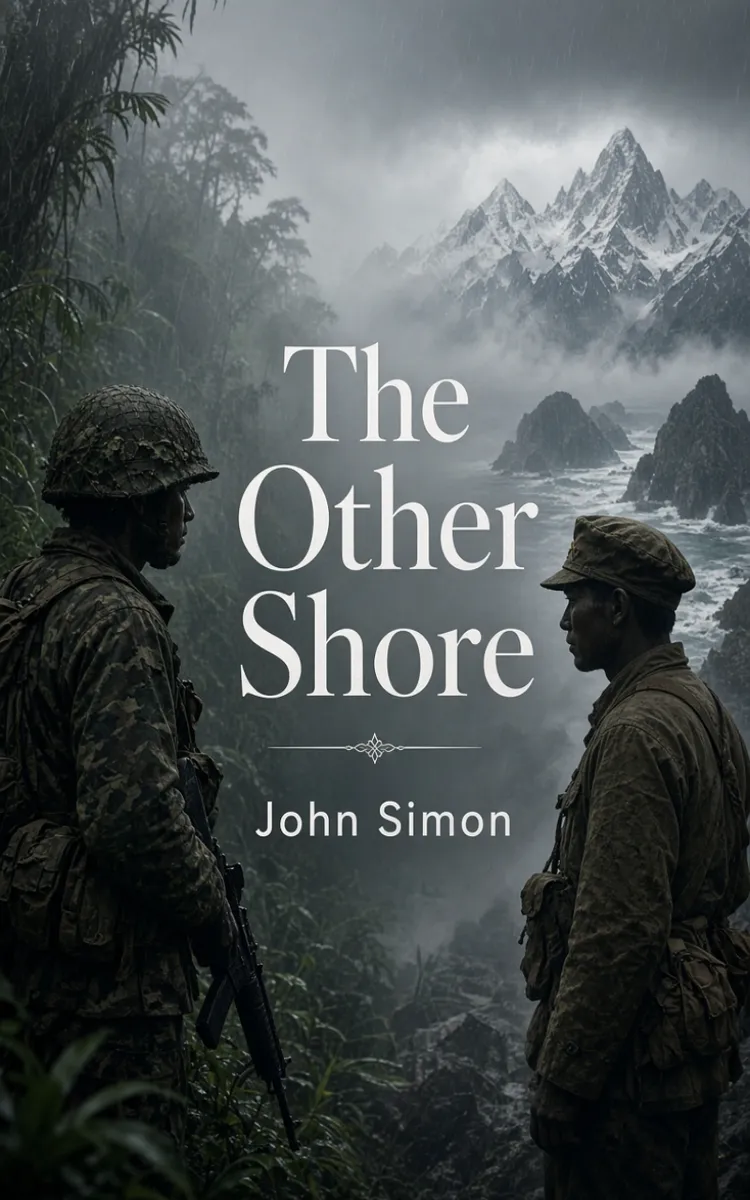
"The Other Shore" is a fiction book by John Simon with 40 chapters and approximately 83,178 words. Two opposing soldiers endure the Aleutians, New Guinea, and Burma campaigns.
This book was created using Inkfluence AI, an AI-powered book generation platform that helps authors write, design, and publish complete books. It was made with the AI Novel Writer.
Frequently Asked Questions
What is "The Other Shore" about?
Two opposing soldiers endure the Aleutians, New Guinea, and Burma campaigns
How many chapters are in "The Other Shore"?
The book contains 40 chapters and approximately 83,178 words. Topics covered include The Seattle Enlistment, Orders for the Aleutians, The Fogbound Crossing, Buna's Mud Wall, and more.
Who wrote "The Other Shore"?
This book was written by John Simon and created using Inkfluence AI, an AI book generation platform that helps authors write, design, and publish books.
How can I create a similar fiction book?
You can create your own fiction book using Inkfluence AI. Describe your idea, choose your style, and the AI writes the full book for you. It's free to start.
Write your own fiction book with AI
Describe your idea and Inkfluence writes the whole thing. Free to start.
Start writingCreated with Inkfluence AI


