
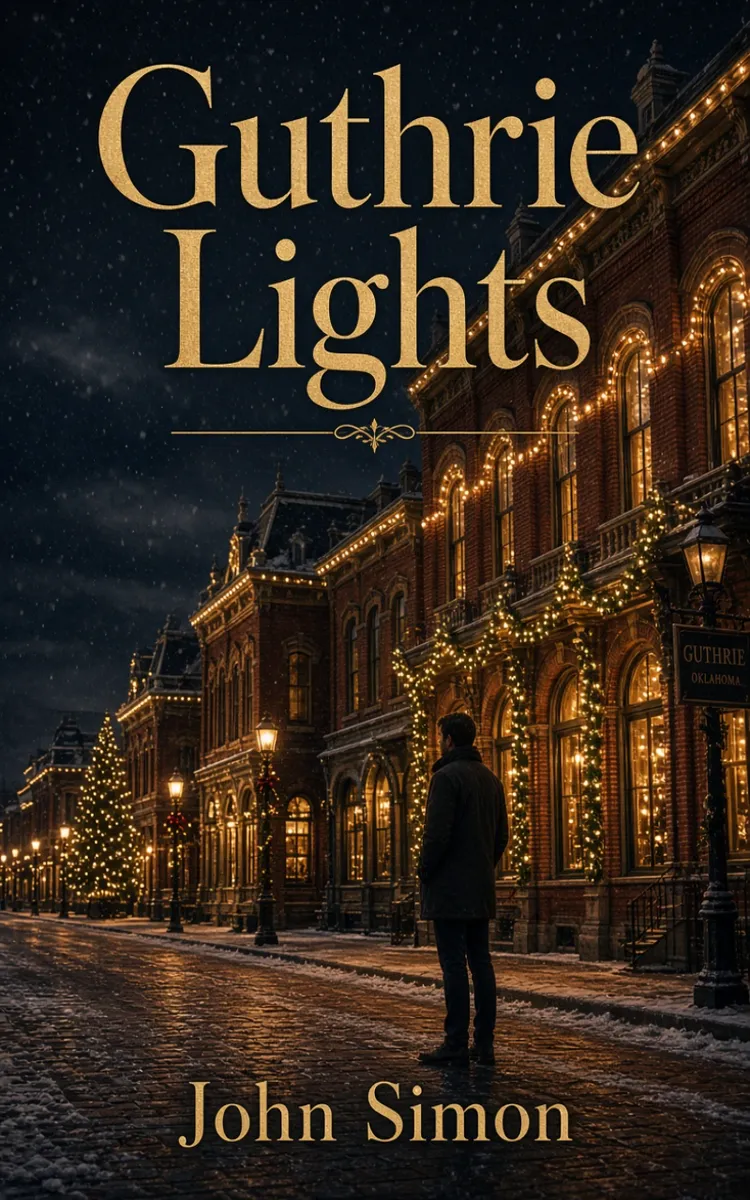

Read the first chapter
The whole of chapter one, free. About 9 min. Turn the pages with the arrows, your keyboard, or a swipe.
Chapter 1
The Roof Calls Him Home
The first Christmas light caught in Luke Harper’s windshield before the Guthrie city limit sign did - a red star blinking from a utility pole above the dark stretch of Highway 33.
He tightened both hands on the steering wheel.
By the time he reached Oklahoma Avenue, the historic district had turned itself into a bright, crowded corridor. White lights traced the old brick storefronts. Green garlands hung from black lampposts. A horse-drawn carriage waited beside the curb while bundled families crossed between parked cars, their voices rising over the clop of hooves and the faint music spilling from a shop doorway.
Luke kept driving.
He had one job. Reach Harper’s Antiques, climb onto the roof, find the leak, and make it safe enough to last through Christmas morning. Then he would go back to Oklahoma City, where the construction crews started early and nobody asked him to stand beneath a wreath his father had hung.
His phone buzzed in the cup holder. Ruth.
He let it buzz twice before answering. “I’m here.”
“Where?”
“On Oklahoma Avenue.”
“Can you see the shop?”
“I’m looking at it.”
The storefront sat halfway down the block, its red-painted door framed in evergreen. A painted sign above the windows read HARPER’S ANTIQUES in gold letters worn thin at the edges. Someone had placed electric candles in the display windows. Behind them, brass lamps and old picture frames gleamed beneath strings of colored bulbs.
Ruth said, “The back corner is worse than it was this morning.”
“You said it was a drip.”
“It was a drip.”
“That isn’t what you just said.”
“I said the back corner is worse.”
Luke pulled toward the curb, but a delivery van blocked the space in front of the shop. A man in a red coat stepped into the street without looking. Luke braked hard. The truck behind him leaned on its horn.
“Luke?” Ruth said.
“I’m trying to park.”
“Don’t park in front. The parade people are setting up.”
“What parade?”
“The Christmas parade. Tonight.”
Luke looked at the crowd. A little girl in a velvet dress pressed both hands to the window of the carriage. Her breath fogged the glass. Across the street, a man dressed like a Victorian gentleman adjusted a top hat while two teenagers carried a wooden sign toward the sidewalk.
“Tonight?” Luke asked.
“You knew the lights went up this weekend.”
“I knew the lights went up. I didn’t know the whole town was going to be here.”
“It’s Guthrie.”
He heard the tired smile in her voice, and for a second he could see her behind the shop counter, one hand resting on the old cash register, waiting for him to admit something neither of them wanted named.
Luke turned onto a side street and found a place behind the old post office. He grabbed his tool bag from the passenger floor and stepped into the cold. The wind pushed through his work jacket at once. He had dressed for the roof, not for standing around under Christmas lights while strangers watched him return.
As he walked toward the shop, the brick under his boots felt uneven and familiar. Two years had not changed that. The buildings leaned close over the street, their upper windows dark except where holiday displays glowed. A loudspeaker crackled near the courthouse. Someone tested a trumpet, producing three uncertain notes.
Luke kept his head down.
At the shop door, he tried the handle. Locked.
He knocked once, then again.
No one came.
“Ruth,” he called through the glass.
The display room looked empty. A row of wooden soldiers stood beside a table set with silver candlesticks. In the back, a blue plastic bucket sat beneath a dark stain spreading across the pressed-tin ceiling.
Luke knocked harder.
A shape moved beyond the shelves. Ruth appeared with another bucket in her hands. She wore a gray sweater, an old green apron, and the expression of someone who had been caught doing work she had promised not to do alone.
She unlocked the door.
“You made good time,” she said.
“You said the roof was leaking.”
“It is.”
“You didn’t say the ceiling was coming down.”
“It hasn’t come down.”
Luke stepped inside. The doorbell gave a thin, cheerful ring. Water struck the bucket behind him. Plink. Plink. Plink.
Ruth set the second bucket beneath a fresh drip. “The rain started last night.”
“You knew I was driving up this morning.”
“I knew you were coming.”
“That’s not the same thing.”
She glanced toward the front windows, where lights from the street moved across her face. “I didn’t want you turning around before you got here.”
Luke put his tool bag on the floor. The shop smelled of dust, old wood, and wet plaster. A damp patch spread along the ceiling toward the display window. One of the electric candles flickered, then steadied.
“How bad?” he asked.
Ruth looked up. “I don’t know.”
“That’s why I’m here.”
“You can get on the roof?”
“I can get on the roof.”
“Tonight?”
Luke stared at her.
She rubbed her hands over the apron. “The weather’s dropping below freezing after dark. If the water freezes in there, it’ll split something.”
“Something is already split.”
“I called three roofers.”
“And?”
“One is booked through December. One didn’t call back. The third said he’d come Monday.”
“Monday’s four days away.”
“I know what day it is.”
The words landed sharper than she meant them to. Ruth looked away first.
Outside, a drumline began somewhere down the avenue. The sound rolled between the brick buildings, bright and busy. People laughed near the curb. A carriage bell chimed.
Luke unzipped his tool bag. “Where’s the ladder?”
“In the alley.”
“Roof access?”
“Back stairwell.”
“Show me.”
Ruth hesitated. “You just got here.”
“I’m not here to look at buckets.”
“You haven’t eaten.”
“I ate.”
“When?”
“This morning.”
“That was five hours ago.”
“I’m fine.”
She studied him in the yellow shop light. “Your father used to say that.”
Luke closed the tool bag.
For a moment, only the water answered.
Ruth’s face changed. Not much. A small tightening around her mouth, as if she had heard the sentence too late to take it back.
Luke lifted the bag again. “Ladder.”
The alley behind the shop was narrow and slick with leaves. A strand of lights had been fastened above it, their reflections shivering in puddles. Ruth held the back door while Luke dragged the aluminum ladder from behind a stack of empty crates.
“Careful,” she said.
“I know.”
“The third rung bends.”
“I know.”
He leaned the ladder against the brick wall. The roofline rose above him, black against a sky the color of old steel. Wind moved over the shingles with a dry whisper. Luke climbed, testing each rung before putting his weight down. At the third, the metal gave under his boot.
Ruth caught the ladder.
“I said it bends.”
“And I heard you.”
He climbed higher. From the roof, Guthrie opened in every direction: courthouse lights glowing beyond the trees, storefronts outlined in white, the tall water tower dim in the distance. Oklahoma Avenue looked like a stage set built for people who had never lost anything.
Luke crouched near the back slope and swept leaves away with his glove. The shingles were brittle beneath his palm. Water had found a broken seam near the chimney flashing. He could see where it had run under the shingles and toward the wall.
The repair was not complicated. It was old, neglected, and spreading.
He climbed down with a piece of loose flashing in one hand.
Ruth waited below. “Can you fix it?”
“I can patch it.”
“That’s what I asked.”
“No. You asked if I can fix it.”
Her eyes went to the metal in his hand. “What’s the difference?”
“A patch gets you through the next storm. Fixing it means replacing the flashing, pulling up the shingles around it, checking the decking underneath.”
“How long?”
Luke looked back at the roof. “I don’t know.”
“You said you’d be here until Christmas morning.”
“I said I planned to be.”
The drumline grew louder. A crowd had gathered at the end of the alley, drawn toward the avenue. Red and green light shone over their shoulders. Someone called for children to clear the street.
Ruth folded her arms. “Your room is ready.”
“I’m not staying that long.”
“You don’t have to decide tonight.”
“I already decided.”
“Luke.”
He looked at her.
She stood beneath the ladder, one hand curled around its side. She seemed smaller than he remembered, though he knew the shop had not grown. Her hair, once dark, had gone mostly silver. There was a damp mark on her sleeve where the bucket had splashed her.
“I need you to understand,” she said. “This isn’t only a roof.”
Luke glanced through the back door at the buckets, the spreading stain, the shop his father had repaired one wall at a time. “It’s a roof, Mom.”
“It’s the shop.”
“I know what it is.”
“Do you?”
The question was quiet, but it followed him inside.
At the front window, the parade moved into view. A marching band passed beneath the lights, brass instruments flashing. Behind them came a float shaped like a Victorian house, its windows filled with children waving. The crowd cheered as if the town had been waiting all year for permission to be happy.
Luke set the loose flashing on the counter.
“I’ll cover the seam tonight,” he said. “Tomorrow I’ll see what’s under it.”
Ruth released the ladder. “You’ll stay?”
“Until I know how bad it is.”
“That could take a while.”
“I know.”
Another drop fell into the bucket. Then another, faster now.
Ruth looked toward the ceiling. Luke followed her gaze. The damp stain had darkened while they stood there. A thin crack ran from its edge toward the front of the shop, crossing above the display of silver candlesticks.
He took off his jacket.
“What are you doing?” Ruth asked.
“Moving the antiques out from under it.”
“You just got here.”
“I noticed.”
He lifted the first box from the display table. It was heavier than it looked, packed with old glass ornaments. Ruth reached for the other side, but Luke shook his head.
“I’ve got it.”
“I can carry a box.”
“I didn’t say you couldn’t.”
For a moment they stood together beneath the leaking ceiling, each holding one end.
Then the lights outside flickered.
The parade music faltered. The shop went dark except for the candles in the window and the red star blinking across the street. In the silence, water struck the bucket three times in quick succession.
Ruth tightened her grip on the box.
Luke looked up at the ceiling. “The cold’s coming faster than they said.”
“I know.”
He carried the box toward the back room. Behind him, Ruth moved the candles away from the leak. Outside, the crowd began to murmur, but the lights along Oklahoma Avenue came back one row at a time, brightening the glass and the wet bricks.
Luke set the box down and returned for another.
He had wanted to find a leak, patch it, and leave before the town could make a claim on him. Instead, the roof opened above his mother’s head, the weather was turning, and every bucket in the shop was beginning to fill.
Ruth stood beneath the widening stain with the last empty bucket in her hands.
“There’s more upstairs,” she said.
Luke took it from her.
“How much more?”
She looked toward the narrow staircase at the back.
“Enough,” she said, “that your father never got to finish it.”
End of chapter one. 39 more chapters and about 87,743 words in the full book.
Swipe or use the arrows to turn the page


What's inside: 40 chapters
- 1. The Roof Calls Him Home
- 2. A Sister Holds the Shop
- 3. The Missing Repair Ledger
- 4. The Parade Blocks Oklahoma Avenue
- 5. The Window He Won’t Decorate
- 6. The Patch Gives Way
- 7. A Name in the Envelope
- 8. The Bellweather House Freezes
- 9. The Funeral He Avoided
- 10. The Walk Loses Its Power
- 11. The Caretaker’s Old Photograph
- 12. The Icy Staircase
- 13. June’s Quiet Breaking Point
- 14. The Cold Snap Cuts the Roads
- 15. The Panel Behind the Plaster
- 16. The Darkened Historic District
- 17. The Christmas Carol Invitation
- 18. The Theater Boiler Fails
- 19. A Ride Through the Light Display
- 20. What His Father Meant to Keep
- 21. The Plans Are Not a Promise
- 22. The Shop Ceiling Comes Down
- 23. The Missing Sheet’s Trail
- 24. The Frozen Home Tour
- 25. June Refuses Another Rescue
- 26. The Volunteer Crew Runs Short
- 27. The Client’s Christmas Card
- 28. The Iced Bridge Crossing
- 29. The Parade Moves Without Lights
- 30. Luke Packs for the Road
- 31. The Client Answers Ruth
- 32. The Library Door Will Not Open
- 33. A Boundary Becomes a Choice
- 34. The Missing Plan Stays Away
- 35. The Wall Holds Through Christmas
- 36. Christmas Morning Without a Deadline
- 37. The Shop Opens One Window
- 38. June Takes the Ledger
- 39. The Road Opens After Christmas
- 40. The Plans Find Their Place
About this book
"Guthrie Lights" is a fiction book by John Simon with 40 chapters and approximately 87,743 words. A grieving son returns to Guthrie and faces family ties during Christmas.
This book was created using Inkfluence AI, an AI-powered book generation platform that helps authors write, design, and publish complete books. It was made with the AI Novel Writer.
Frequently Asked Questions
What is "Guthrie Lights" about?
A grieving son returns to Guthrie and faces family ties during Christmas
How many chapters are in "Guthrie Lights"?
The book contains 40 chapters and approximately 87,743 words. Topics covered include The Roof Calls Him Home, A Sister Holds the Shop, The Missing Repair Ledger, The Parade Blocks Oklahoma Avenue, and more.
Who wrote "Guthrie Lights"?
This book was written by John Simon and created using Inkfluence AI, an AI book generation platform that helps authors write, design, and publish books.
How can I create a similar fiction book?
You can create your own fiction book using Inkfluence AI. Describe your idea, choose your style, and the AI writes the full book for you. It's free to start.
Write your own fiction book with AI
Describe your idea and Inkfluence writes the whole thing. Free to start.
Start writingCreated with Inkfluence AI


