

Read the first chapter
The whole of chapter one, free. About 9 min. Turn the pages with the arrows, your keyboard, or a swipe.
Chapter 1
The Montana Rupture
The white lines on Interstate 90 had vanished beneath snow, but Earl Riggs could still feel where they ran.
Thirty-seven hours behind the wheel had reduced the world to instruments, wipers, and the diesel growl of his battered Peterbilt. The storm shoved at the cab hard enough to make the mirrors tremble. Every few seconds, lightning showed him the black Montana hills and the bent silhouettes of fence posts. Then the dark closed again.
“Come on,” Earl muttered. “Just get me to a place with coffee and walls.”
The CB answered with a burst of static.
“ - all westbound traffic, bridge out near mile marker - ”
The transmission dissolved under a wash of interference. Earl leaned closer to the windshield. His eyes burned. His hands felt packed with sand. The unmarked Department of Defense container behind him groaned against its chains as the trailer bucked over ice.
He wanted one thing: a dry place to stop without getting buried in a ditch.
The map showed an old access road two miles ahead, leading to a decommissioned research station. Earl had seen the site once, years ago, back when the sign still carried a federal seal and the gate had a lock worth respecting. Now the road was barely a gray scar through the blowing snow.
The Peterbilt’s headlights caught the gate.
It stood open.
“That’s neighborly,” Earl said.
The truck hit the access road at fifty-five. The steering wheel kicked against his palms. Snow rattled across the hood like thrown gravel. On either side, concrete foundations and rusting light poles appeared and vanished in the storm.
Earl tapped the brakes.
The trailer swung.
The back end of the rig slid left, dragging the cab toward a low concrete building half-hidden behind a chain-link fence. Earl fought the wheel, but the road had turned to polished ice. The Peterbilt’s tires spun uselessly.
“Not there.”
The front bumper struck the fence. Metal shrieked. The cab punched through, clipped a concrete post, and slewed sideways. Behind him, the container tore loose with a sound like a ship breaking apart.
The impact threw Earl against the belt. His forehead struck the steering wheel. Glass burst inward. The truck stopped with the engine still roaring.
For a moment, he heard only the fan blowing and the rain ticking against the roof.
Then the trailer folded.
A deep metallic boom rolled through the facility. The container split along one corner. Something inside hissed with a high, electric whisper.
Earl unbuckled. The door would not open. He shoved it once, twice. It moved an inch and jammed against the fence.
“Fine,” he said. “We’ll use the expensive exit.”
He grabbed the emergency hammer and smashed the side window. Cold rain blew into the cab. Earl climbed through, boots landing in brown floodwater that reached his ankles. The storm had filled the facility’s lower yard, turning it into a shallow, fast-moving river.
The container lay on its side thirty feet away. Its doors had blown open. No markings showed on the gray metal except a stenciled number and a small black rectangle stamped with a government inventory code.
A pale mist crawled from the opening.
Earl took one step toward it, then stopped.
The mist was moving against the wind.
He backed toward the cab. “Nope.”
The research building groaned. Water poured through a broken roof and down the walls. A section of the upper walkway collapsed, slamming into the yard where he had been standing seconds earlier.
Earl looked at the Peterbilt. The front axle was buried against the concrete post. The trailer had jackknifed across the access road. Even if the engine could pull, there was nowhere to go.
He waded to the cab and reached beneath the dash for the radio handset.
“Dispatch, this is Riggs. I’m at the old research site off I-90. Rig’s wrecked. Need a wrecker and - ”
The radio spat static. The storm swallowed his voice.
He tried again. Nothing.
A sharp vibration ran through the flooded ground and up his legs.
Earl turned toward the container.
The pale mist had thickened around it. Tiny points of light moved inside, too many and too quick to be snow. They crawled over the metal like sparks looking for a wire.
He stumbled backward. His heel caught a length of broken pipe. He went down hard, one hand plunging into the freezing water.
The mist reached him.
It touched his glove and vanished.
For half a second, nothing happened.
Then his hand seized.
Earl shouted and tore at the glove. The fabric came away in strips. Beneath it, a silver sheen raced over his skin, branching from his knuckles toward his wrist.
He slapped at it. The swarm scattered, then gathered again.
“Get off.”
He scraped his hand against the concrete post. Skin tore. Blood washed pink into the floodwater. The silver threads sank beneath the wound.
Pain flashed up his arm, bright enough to clear the exhaustion from his head.
Earl crawled toward the cab. Behind him, the container gave another hollow boom. More of the swarm spilled into the water.
He reached the open door and pulled himself up. His boots slipped. His shoulder struck the frame.
The Peterbilt’s engine idled with a rough, familiar throb.
Earl grabbed the steering wheel.
The vibration changed.
It was not louder. It was closer, as if the engine had moved inside his ribs. He felt the fuel pump ticking. He felt the damaged axle bearing grinding against its housing. He felt the trailer’s weight pressing unevenly into the mud, the right wheels sunk deeper than the left.
Information arrived without words.
The truck was hurt.
The truck could still move.
Earl gripped the wheel. “You and me both.”
The silver lines had reached his neck.
His vision fractured. The dashboard lights stretched into thin green bars. Every sound separated into layers: wind through the broken fence, water rushing beneath the trailer, the engine’s uneven idle, the tiny mechanical clicks inside his own blood.
His body convulsed.
He fell across the seat, knocking the gearshift into neutral. The Peterbilt rolled backward a few inches and stopped against the post.
The swarm poured through the broken window.
It entered his mouth, his nose, the cuts along his face. Earl tried to breathe and found his lungs locked. His chest hammered against the seat belt. He clawed at his throat, but his fingers were already stiffening beneath a skin of moving silver.
The pain became too large to hold.
He saw a truck stop in Wyoming, a waitress setting down eggs he had not ordered. He saw his mother’s old porch in Nebraska. He saw the blacktop stretching west under a clean morning sky.
Then the images went dark.
Something inside him kept working.
His heart stumbled once.
The swarm tightened around it.
Earl’s heart beat again.
The nanites moved through his blood in shining streams, repairing torn tissue, binding damaged muscle, reinforcing bone. They found the exhaustion in him and did not remove it. They changed its meaning. Fatigue became a signal. A low warning. A gauge near empty, but not yet empty.
His lungs opened.
He dragged in air and sat upright.
The storm still raged. The cab still leaked. The engine still idled.
Earl stared at his hands.
The skin looked normal except for faint silver flecks beneath the knuckles. He flexed his fingers. The steering wheel creaked.
He let go.
The wheel had bent under his grip.
Earl looked at it for a long moment. “That’s going to come out of somebody’s deposit.”
A tremor shook the building. Concrete cracked somewhere above him. The floodwater rose over the floorboards.
He tried the door. It remained jammed.
Earl planted both boots against the dash and pulled.
The metal frame tore loose with a shriek.
He fell backward into the seat, holding the door in his hands.
For several seconds, he did not move.
Then he looked down at the door.
It weighed what a door ought to weigh. The problem was that the Peterbilt’s door had been welded to its frame after a winter accident in Iowa, and two men had failed to remove it with a cutting torch.
Earl shoved it aside.
Cold rain struck his face. He climbed down into the yard and walked toward the trailer. The water was above his knees now, fast and full of debris. A steel beam floated past and struck his thigh hard enough to bend around him.
Earl barely noticed.
The container had split wider. Its interior was empty except for broken brackets and a black residue clinging to the floor. The swarm had left it. Most of the tiny lights now moved beneath Earl’s skin.
A red warning lamp blinked near the container’s rear panel.
Earl reached for it.
The ground dropped.
Floodwater tore his legs out from under him and dragged him toward a collapsed drainage trench. He caught a bent railing with one hand. The metal buckled. His arm held.
He hung above the dark water, boots kicking against the concrete wall.
The old Earl would have lost his grip.
The new one did not seem to understand the instruction.
He pulled himself up.
The railing came free in his fist.
Earl rolled onto the concrete and lay there while water rushed beneath him. His lungs worked steadily. His pulse beat slow and hard. The storm no longer felt like an enemy outside his body. He could feel its pressure through the building, the shifting weight of snow on the roof, the weak point in the eastern wall.
He could feel the Peterbilt, too.
The truck waited behind him, engine turning over, diesel burning.
A warning surfaced beneath his thoughts.
Move.
Earl pushed himself upright.
The access road was gone beneath water and debris. The gate had collapsed. The research building blocked the only clear path toward the interstate.
He walked back to the truck.
The trailer had sunk to its axles, but the weight distribution came to him as clearly as the truck’s engine vibration. If he pulled straight, he would bury the drive tires. If he cut left, climbed the concrete apron, and used the trailer’s rear wheels to climb out, the rig might clear the flood channel.
Might.
Earl climbed into the cab and turned the key.
The engine answered.
He set the transmission in low and eased down on the throttle.
The Peterbilt lurched. Mud surged around the tires. The trailer chains snapped one after another, whipping through the storm. Earl felt every wheel. He felt the rear suspension twist. He felt the exact instant before the frame would break.
He corrected without thinking.
The truck crawled forward.
A concrete beam fell from the building and smashed across the hood. Earl ducked. The windshield cracked into a white web. The beam slid off, leaving the hood crushed flat.
The engine kept pulling.
“Good girl,” Earl said. “Ugly as sin, but good.”
The truck reached the apron. One drive tire spun. Earl shifted the weight through the throttle, not by calculation but by instinct. The tire caught.
The Peterbilt climbed.
Behind him, the ruptured container disappeared under the rising water.
Earl glanced at the mirror. The black residue inside it had begun to glow.
A burst of static came through the CB.
“Unidentified unit at the research site, respond.”
Earl froze with one hand on the wheel.
The voice returned, clearer this time.
“Driver, do not leave the cargo.”
Earl looked at the dark Montana road ahead. The storm had erased the interstate, but beneath the mud and snow he could feel the highway’s shape, every curve and grade leading east.
The engine vibrated through his bones.
He put the Peterbilt in gear.
“Cargo can find its own way home,” he said.
The truck rolled out of the flooded yard, carrying Earl toward the road. Behind him, the facility collapsed into the water, and the broken container sank beside it.
The warning beneath his thoughts remained.
Move.
Earl pressed the throttle.
He was alive, altered, and stranded in a storm with no radio, no clear road, and something inside him that had decided stopping was no longer an option.
End of chapter one. 39 more chapters and about 89,792 words in the full book.
Swipe or use the arrows to turn the page


What's inside: 40 chapters
- 1. The Montana Rupture
- 2. The Engine That Wouldn't Quit
- 3. The Cargo's Missing Manifest
- 4. The Weigh-Station Trap
- 5. A Driver's Choice
- 6. The First Roadblock
- 7. Signals on Channel Nineteen
- 8. The Closed Mountain Pass
- 9. The Home He Can't Reach
- 10. The Convoy Ambush
- 11. Who Sold the Route
- 12. The Rest-Stop Net
- 13. The Face in the Mirror
- 14. The Bridge Gives Way
- 15. The Engineer's Paper Trail
- 16. The Frozen Bypass
- 17. A Name on the Radio
- 18. The Stolen Fuel Train
- 19. The Truckers' Detour
- 20. The Soldier-Hardening Files
- 21. The Price of Staying Moving
- 22. The Night of False Calls
- 23. The Real Distress Signal
- 24. The Depot's Blind Corner
- 25. The Man in the Mirror
- 26. The Freight Yard Fire
- 27. A Route Beneath the Route
- 28. The Service-Road Cutoff
- 29. The Loader's Bargain
- 30. The Empty Tank
- 31. The Captive's Map
- 32. The Loading-Bay Maze
- 33. The Choice to Be Seen
- 34. The Transfer Order
- 35. The Convoy Comes Apart
- 36. The Road After Victory
- 37. The Rest Stop Without Sleep
- 38. A Voice on the CB
- 39. The Peterbilt's New Route
- 40. The Ghost Driver's Mile
About this book
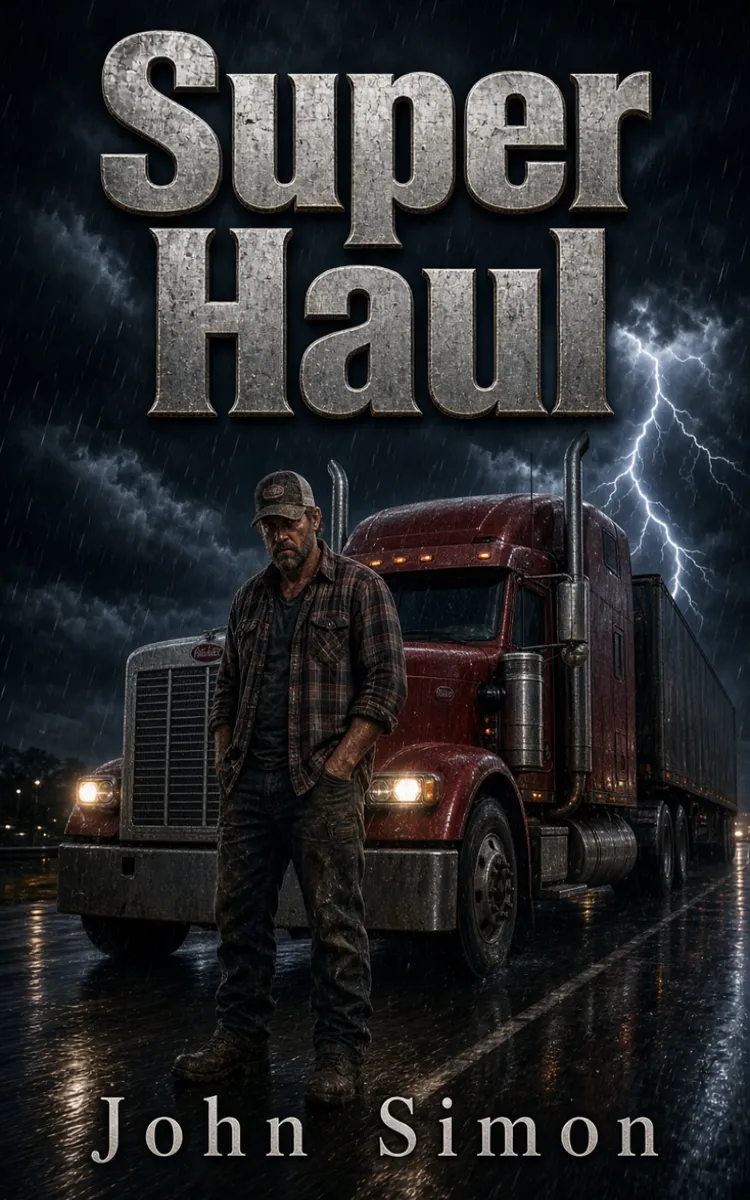
"Super Haul" is a fiction book by John Simon with 40 chapters and approximately 89,792 words. A trucker bonded to nanites fights a contractor across the highways.
This book was created using Inkfluence AI, an AI-powered book generation platform that helps authors write, design, and publish complete books. It was made with the AI Novel Writer.
Frequently Asked Questions
What is "Super Haul" about?
A trucker bonded to nanites fights a contractor across the highways
How many chapters are in "Super Haul"?
The book contains 40 chapters and approximately 89,792 words. Topics covered include The Montana Rupture, The Engine That Wouldn't Quit, The Cargo's Missing Manifest, The Weigh-Station Trap, and more.
Who wrote "Super Haul"?
This book was written by John Simon and created using Inkfluence AI, an AI book generation platform that helps authors write, design, and publish books.
How can I create a similar fiction book?
You can create your own fiction book using Inkfluence AI. Describe your idea, choose your style, and the AI writes the full book for you. It's free to start.
Write your own fiction book with AI
Describe your idea and Inkfluence writes the whole thing. Free to start.
Start writingCreated with Inkfluence AI


