
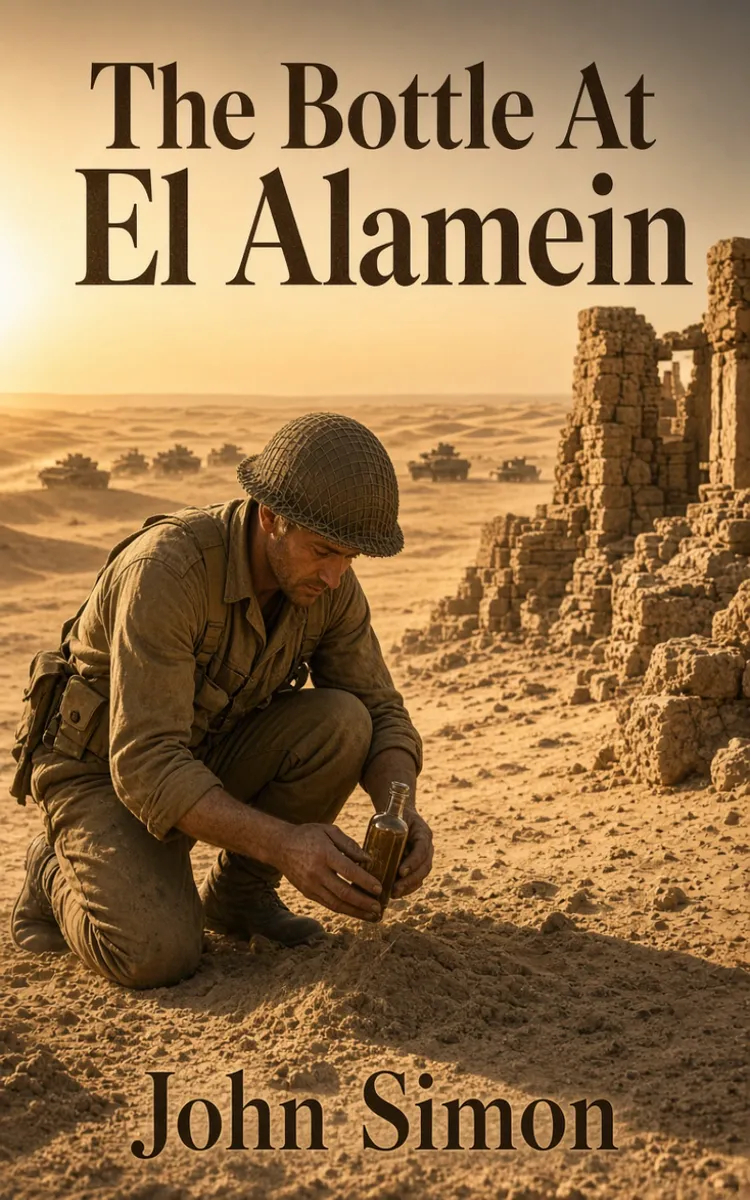

Read the first chapter
The whole of chapter one, free. About 8 min. Turn the pages with the arrows, your keyboard, or a swipe.
Chapter 1
The Chamber Beneath the Caravanserai
The first mortar round struck the caravanserai’s eastern wall and knocked a blue tile from the arch above Tommy Hale’s head.
The tile spun past his cheek. He felt its edge kiss skin, then heard it shatter among the stones behind him.
“Move, Tommy!”
He moved.
The ruined caravanserai had been a square of mud brick once, built for merchants who had trusted walls more than the desert. Now its courtyard was a basin of dust, broken pillars, and old camel bones. Beyond it, the Western Desert ran flat and white toward the Libya-Egypt border, with the sun hammering every surface until even the dead looked bleached.
Another burst of machine-gun fire stitched the entrance.
Tommy dropped behind a fallen lintel. Sand struck his neck. His rifle lay across his forearms, hot enough to burn through the cloth of his sleeve.
“Where’s Sergeant Bell?” someone shouted.
“Down by the well!”
The well had been dry for a hundred years. Sergeant Bell was not.
Tommy raised his head just far enough to see the section scattered across the courtyard. Private Mercer crouched behind a trough with blood on one sleeve. Connolly was firing toward the ridge beyond the broken gate, though the enemy were mostly muzzle flashes and dust. A Bren gun chattered from somewhere outside, answered by the harsh crack of rifles.
Their patrol had entered the ruins looking for water and a German observation post. They had found both, in the wrong order.
Tommy’s immediate wish was simple: get his section under cover, then remain alive long enough to go home. Manchester had never seemed so far away. He pictured the narrow back yard behind his mother’s house, the cracked basin, the washing line that sagged in the middle. He would have given a great deal for that washing line.
“Tommy!” Connolly yelled. “You planning to marry that wall?”
“Not unless it improves.”
A round punched through the lintel. Tommy flinched as grit filled his mouth.
To the left, a low arcade ran along the inner wall. Several of its arches had collapsed, but the shadows beneath them were deeper than the open courtyard. If they could reach it, they might get out of the fire.
Tommy waved. “Arcade! On my mark!”
Connolly looked at him as if Tommy had suggested swimming home. “That’s where the shooting’s coming from.”
“Then they’ll be surprised.”
He counted three seconds between bursts. At the next pause, Tommy rose and ran.
The courtyard seemed to lengthen beneath his boots. Heat pressed at his face. A bullet struck the ground beside him and threw a fan of stones against his shins. He stumbled, recovered, and reached the arcade just as Connolly came in behind him.
Mercer did not.
Tommy turned. Mercer was on one knee by the trough, trying to work his rifle while blood ran down his hand.
“Leave him!” Connolly shouted. “We can’t - ”
Tommy went back.
It was not courage. Courage had better manners. He simply could not bear the thought of explaining to himself, later, why he had left Mercer in the open.
Tommy crossed half the distance before the machine gun opened again. The sound flattened the world. Dust leaped around Mercer. One round tore through the trough. Another struck the wall above Tommy, and the old brick gave a deep, tired groan.
He seized Mercer by the webbing at his shoulder.
“Can you walk?”
“Can you stop asking stupid questions?”
“Good. That means you’re alive.”
Together they lurched toward the arcade. Connolly reached out, caught Mercer’s collar, and hauled him beneath the nearest arch.
The wall collapsed.
It fell with the slow certainty of something that had been waiting decades for permission. Brick and timber came down across the arcade, cutting off the courtyard. Tommy threw himself forward. A slab caught his shoulder and drove him to the floor. Dust swallowed him.
For several seconds there was no battle, only pressure and darkness.
Then Connolly’s voice came through the rubble.
“Tommy?”
“Here.”
“Mercer?”
A cough. “Here.”
“Can you get out?”
Tommy pushed against the slab. Pain flashed through his shoulder and down his arm. The stone did not move.
“Not that way.”
The chamber behind them had opened where the collapse tore through the floor. Tommy felt along the ground and found a narrow drop beneath the broken arcade. Cool air breathed up from it, carrying the stale scent of old dust and something metallic.
Connolly crouched beside him. “That a tunnel?”
“Looks like.”
“Brilliant. We’ll hide underground until the Germans grow bored.”
Outside, a burst of fire struck the remaining wall. Bricks trickled down. Smoke began to creep through the cracks, grey and oily. Someone had set fire to the dry brush near the entrance, or perhaps a vehicle was burning. Either way, the chamber was becoming an oven with a lid.
Tommy found the mouth of the opening. It was barely wide enough for a man with a rifle. A carved stone rim circled it, buried beneath sand and fallen brick.
“Give me a hand,” he said.
Connolly stared at the gap. “That’s a grave.”
“Then it’s got better ventilation than this place.”
Tommy lowered himself first. His boots found a sloping passage. Sand poured around his ankles. He pressed his back to the wall and slid down, rifle held against his chest. Connolly followed, muttering about promotions and the afterlife.
The passage ended in a chamber no larger than a railway carriage. Its walls were plastered in faded blue, though most of the colour had flaked away. A stone bench ran along one side. On the opposite wall, someone had carved a line of writing in a script Tommy could not read.
The ceiling shuddered as another round struck above.
Tommy looked up. Fine sand sifted through a crack.
“Lovely,” Connolly said. “A room under a room.”
Mercer came down last, clutching his wounded arm. His face had gone pale beneath the dust.
Tommy helped him onto the bench. “Let me see it.”
“Just a scratch.”
“It’s leaking like a tap.”
“It’ll stop.”
“It may. Eventually. After you’ve bled out.”
Tommy tore a strip from his field dressing and bound the wound tight. Mercer hissed but did not complain again.
At the top of the passage, the opening filled with smoke. Connolly climbed two steps and peered up.
“Blocked,” he said. “The bricks have shifted.”
“Can you move them?”
“From this side? With what, a polite request?”
Tommy tried anyway. He climbed until his shoulders met the rubble and pushed. The stones ground against one another. Smoke slid into his eyes. He retreated coughing.
The chamber had one entrance and no exit. The men above were either dead, captured, or unable to reach them. Outside, gunfire came in ragged bursts, then ceased, then began again from another direction.
Mercer leaned his head against the wall. “We’re not staying here.”
“No,” Tommy said.
“Good.”
“We’re getting out.”
Connolly gave him a look. “That was not the impression made by the architecture.”
Tommy ignored him and searched the chamber. The floor was covered by a layer of sand, but not evenly. Near the far wall, beneath a broken clay jar, the dust had settled in a long shallow ridge. He crouched and brushed it aside.
His fingers struck metal.
The object lay beneath a slab of plaster and stone. Tommy cleared the sand with both hands, then levered the slab aside with the butt of his rifle.
A brass bottle emerged from the dark.
It was longer than his forearm, narrow at the neck, and blackened with age except where the metal caught a dull red gleam. A heavy stopper sealed its mouth. Strange marks had been cut around the neck - not decoration, Tommy thought, but words. The brass was warm despite the cool earth.
Connolly came down beside him. “What is it?”
“Bottle.”
“I can see that.”
“Then you’re ahead of me.”
Tommy lifted it. The weight surprised him. It was too heavy for its size, as though it contained lead, or a small and particularly resentful animal.
Mercer watched from the bench. “Leave it.”
“It might be worth something.”
“We’re trapped under a building while men with machine guns search for us,” Connolly said. “If that’s treasure, it can wait.”
Tommy turned the bottle in his hands. A seal of dark material covered the stopper. It bore a shape like a flame bent into a circle.
The sight of it stirred something from childhood: lamplight in the Manchester parlour, his mother asleep in the chair, and Tommy with a battered copy of The Arabian Nights open on his knees. Bottles, caves, princes turned into dogs. Stories in which a poor boy found a marvel and was rewarded for being clever.
The stories had neglected to mention that the poor boy might be trapped underground with smoke in his lungs and a bullet still trying to find him.
Connolly reached for the bottle. “Put it down.”
Tommy tightened his grip. “Why?”
“Because every sensible instinct I possess is shouting.”
“Your instincts also told you the patrol route was safe.”
“They were overruled by the lieutenant.”
“Then blame him.”
“I do. Constantly.”
A deep crack sounded overhead.
The chamber wall trembled. Sand spilled from the ceiling in a steady stream. Mercer looked toward the passage.
“We need another way out,” he said.
Tommy held the bottle close to the light filtering through the smoke. Beneath the blackened brass, a line of tiny engraved letters ran around its belly. He could not read the script, but one mark resembled a crooked eye.
Outside, boots crossed the courtyard. Voices carried through the rubble - German, sharp and hurried.
Connolly lowered his voice. “They’re here.”
Tommy’s mouth went dry.
He searched the chamber again. The walls were solid. The ceiling was sinking. The only object that looked remotely useful was the bottle in his hands, sealed by a thing that looked less like wax than dried blood.
“Don’t,” Connolly whispered.
Tommy looked at the stopper.
He thought of the courtyard, of Mercer bleeding beside the trough, of Bell at the well, of the road home shrinking behind every mile of desert. He thought of the stories his mother had called nonsense and the way, as a boy, he had believed nonsense might still save a man if he was desperate enough.
A rifle butt struck the rubble above them.
Dust fell over Tommy’s hands.
He set the bottle on the stone floor.
Then he broke the seal.
End of chapter one. 39 more chapters and about 88,188 words in the full book.
Swipe or use the arrows to turn the page


What's inside: 40 chapters
- 1. The Chamber Beneath the Caravanserai
- 2. The Red Wind Answers
- 3. A Wish Against the Guns
- 4. The Survivors’ Roll Call
- 5. The Book from Manchester
- 6. Orders for the Lucky Private
- 7. The Missing Shell Craters
- 8. Across the Salt Flats
- 9. A Rifleman’s Measure
- 10. The Bottle in the Map Room
- 11. The Officer Who Collected Myths
- 12. The Wadi Without Shade
- 13. The Homeward Wish
- 14. The Sonderkommando’s Map
- 15. The Name in the Ledger
- 16. The Listening Post
- 17. A Story from Nabil
- 18. The Signal That Drew Them
- 19. The Oasis of Old Names
- 20. The Sandstorm’s First Sign
- 21. The Wish’s Long Shadow
- 22. Supply Lines Under Sand
- 23. The Stalemate Report
- 24. The Dune Road Closes
- 25. The Mark on Tommy’s Hand
- 26. The Raid at the Waystation
- 27. The Sorcerer’s Inscription
- 28. The Minefield at Qattara
- 29. Vane’s Greater Good
- 30. No Safe Wish Left
- 31. The Third Wish’s Price
- 32. The Night Route to El Alamein
- 33. The Desert Is Not Empty
- 34. The Bottle’s Intended Path
- 35. The Third Wish at Midnight
- 36. A Freedom With Boundaries
- 37. The Oasis After the Guns
- 38. The Road Home Reconsidered
- 39. The Campaign Moves Again
- 40. The Seal Beneath the Sand
About this book
"The Lamp Of El Alamein" is a fiction book by John Simon with 40 chapters and approximately 88,188 words. A British soldier confronts an ancient jinn amid the North African campaign.
This book was created using Inkfluence AI, an AI-powered book generation platform that helps authors write, design, and publish complete books. It was made with the AI Novel Writer.
Frequently Asked Questions
What is "The Lamp Of El Alamein" about?
A British soldier confronts an ancient jinn amid the North African campaign
How many chapters are in "The Lamp Of El Alamein"?
The book contains 40 chapters and approximately 88,188 words. Topics covered include The Chamber Beneath the Caravanserai, The Red Wind Answers, A Wish Against the Guns, The Survivors’ Roll Call, and more.
Who wrote "The Lamp Of El Alamein"?
This book was written by John Simon and created using Inkfluence AI, an AI book generation platform that helps authors write, design, and publish books.
How can I create a similar fiction book?
You can create your own fiction book using Inkfluence AI. Describe your idea, choose your style, and the AI writes the full book for you. It's free to start.
Write your own fiction book with AI
Describe your idea and Inkfluence writes the whole thing. Free to start.
Start writingCreated with Inkfluence AI


