
Read the first chapter
The whole of chapter one, free. About 9 min. Turn the pages with the arrows, your keyboard, or a swipe.
Chapter 1
The Party Name That No Longer Fits
The Label on the Ballot
What if the most familiar political words in America are also the least reliable? A voter can select “Republican” or “Democrat” using a label whose history reaches back more than two centuries, while the party behind it now makes promises that would have startled its founders.
That is the quiet puzzle of American politics. Party names endure because they are useful shortcuts: they identify a team, a tradition, a family habit, and often a community. But the meanings attached to those names do not stay still. They move with wars, economic crises, migrations, court decisions, religious movements, and changes in the country’s understanding of freedom.
The result is a kind of political time lag. Voters inherit words from parents and grandparents, then encounter new policies under those old names. The label feels stable even when the promise has shifted. The Label Drift Compass helps us notice that movement by separating three things often treated as one: the name a party carries, the coalition that supports it, and the governing ideas it advances.
When a party keeps its name but changes its meaning, what exactly is the voter choosing?
When “Republican” Meant a Principle, Not a Party
The word republican existed in American political language long before the modern Republican Party. It referred to a system in which public authority belonged to citizens rather than a hereditary monarch. A republican government was supposed to resist concentrated power, protect civic independence, and depend on the judgment of a politically engaged public.
In the early United States, “republican” was therefore less a team jersey than a description of the new nation’s political ideal. Thomas Jefferson’s Democratic-Republicans, organized in the 1790s, opposed the Federalists’ vision of a stronger central government tied to finance, commerce, and national administration. Jefferson’s supporters presented themselves as defenders of farmers, local authority, and the plain citizen against what they regarded as an American aristocracy.
The label itself carried an argument. To call oneself a republican was to suggest that political virtue lived closer to ordinary citizens than to banks, courts, offices, or inherited wealth. Yet the party that used the name did not remain fixed. Jefferson’s coalition governed a growing republic, purchased Louisiana, expanded national territory, and confronted the practical demands of governing a large country. The word remained; its surroundings changed.
The modern Republican Party emerged in the 1850s from opposition to the expansion of slavery into western territories. Its first voters included former Whigs, antislavery Democrats, Free Soilers, and others who believed the federal government should prevent slavery from spreading. Abraham Lincoln, elected as the first Republican president in 1860, represented a party whose central purpose was preserving free labor in the territories and, during the Civil War, preserving the Union.
That history complicates the labels inherited today. The party called Republican was once the vehicle of a powerful federal response to secession and slavery. Its leaders used national authority to fight a rebellion, establish emancipation policy, and support constitutional amendments that transformed citizenship and voting rights. The name did not contain a permanent policy package. It was a container, filled by the crisis of its time.
The Democratic Name Changes Shape
The Democratic label has an equally long and unsettled history. Andrew Jackson’s Democrats in the 1820s and 1830s portrayed themselves as the defenders of the ordinary white voter against entrenched privilege. Their language emphasized popular rule, but their definition of “the people” excluded women, enslaved people, and Native Americans. Democracy was not a complete moral principle in practice; it was a political claim made within the boundaries of the era.
For much of the nineteenth century, Democrats were associated with limited federal government, agrarian interests, states’ rights, and the white South. Those associations were not accidental. The party’s strength depended heavily on the former slave states, and its leaders often defended local control as a shield against federal interference with racial hierarchy.
By the twentieth century, the Democratic coalition began to change under pressure from industrialization, urban poverty, immigration, labor organizing, and the Great Depression. Franklin D. Roosevelt’s New Deal, launched after his election in 1932, attached the Democratic name to a more active federal government. Social Security, labor protections, public works, and financial regulation changed what many Americans expected Washington to do.
The same party label now carried a different promise. “Democrat” increasingly suggested that government might protect people from the hazards of industrial capitalism, unemployment, old age, and corporate power. Yet the coalition remained internally divided. Southern Democrats defended segregation while northern Democrats increasingly depended on urban workers, immigrants, and organized labor.
The contradiction could persist for decades because party labels are broad enough to shelter opposing commitments. A party can speak of ordinary people while disagreeing sharply about who belongs among them. It can defend local control in one setting and demand national power in another. The label survives these tensions because voters often use it as a family resemblance, not as a carefully updated definition.
A party name is less like a dictionary entry than an old building. The sign may remain above the door while the rooms inside are rebuilt.
The Long Migration of the Coalitions
The most important changes in party meaning did not occur in a single election. They accumulated through long political migrations. The New Deal brought many working-class voters, including urban Catholics and union members, into the Democratic coalition. Black voters, once strongly associated with the Republican Party because of Lincoln and Reconstruction, moved increasingly toward the Democrats during the 1930s and 1940s. By the New Deal era, the party’s older regional and racial structure was under strain.
The civil rights era made that strain visible. Democratic presidents and congressional leaders supported major federal legislation against segregation and racial discrimination, including the Civil Rights Act of 1964 and the Voting Rights Act of 1965. Many white southern voters opposed these measures. Some left the Democratic coalition immediately; others moved gradually toward Republican candidates over subsequent decades.
This was not a simple overnight exchange in which every voter changed sides at once. Party realignment is usually a slow sorting process. Race, religion, region, education, class, and views of government begin to line up differently. Candidates discover which appeals work with the emerging coalition, and voters learn to associate old symbols with new positions.
The Republican Party’s “Southern strategy,” associated with campaigns in the late 1960s and afterward, helped national Republican candidates attract white southern voters through appeals involving crime, social order, local control, and opposition to federal civil rights enforcement. The language was often indirect, but its political setting was clear. Over time, the South became a central Republican stronghold, while the Democratic Party became more dependent on Black voters, urban centers, labor constituencies, and later college-educated metropolitan voters.
The surprising connection is that party identity can change most dramatically without either party formally changing its name or writing a new founding document. Voters themselves move, generations replace one another, and candidates adjust their messages to the new coalition. The continuity is therefore partly visual and verbal; the underlying social machinery is being rebuilt.
That matters because many people interpret political history as a sequence of fixed parties with fixed beliefs. The more accurate picture resembles a river changing course while keeping its name. The water is new, the banks shift, and yet maps made long ago still call it by the same word.
The Brain’s Shortcut and the Ballot’s Old Words
Political labels endure partly because human beings are economical thinkers. We cannot investigate every candidate’s record, every proposed law, and every institutional consequence from first principles. Party identification compresses information. It tells voters what a candidate is likely to value, whom they are likely to listen to, and which side of a familiar conflict they will probably join.
Political scientists often describe party identification as a durable attachment, something closer to an identity than to a single policy preference. That durability explains why voters may continue supporting a party even when its current positions differ from the reasons their parents or grandparents first trusted it. The label carries emotional and social information that no campaign advertisement needs to explain.
A voter may say “Republican” and mean fiscal restraint, religious conservatism, national strength, opposition to federal regulation, or simply the political tradition of a rural county. Another voter may say “Democrat” and mean labor rights, civil rights, social insurance, environmental protection, urban pluralism, or the family’s historic allegiance. These meanings overlap, but they are not identical.
The Label Drift Compass points to the gap between inherited identity and present policy. Its first direction is memory: what the label once promised. Its second is coalition: which communities now give it strength. Its third is governing practice: what elected officials actually do with power. A label can remain emotionally familiar while all three directions shift.
One sentence captures the problem: The oldest political promise in the room may be the one no current party is making.
Consider “small government,” a phrase frequently associated with Republican politics. Historically, Republicans have sometimes expanded federal power dramatically, from the Civil War through national infrastructure, military policy, and later executive actions. Democrats, meanwhile, have often defended federal authority but also accommodated business interests, balanced budgets, or supported policies that limited particular forms of government intervention. The labels offer clues, not guarantees.
This is why political arguments can feel strangely circular. Two people may use the same party name while referring to different historical versions of it. One is talking about Lincoln’s Republican Party, another about the conservative movement of the late twentieth century, and a third about the current coalition. The word sounds precise because it is familiar. Its history makes it slippery.
A County Where the Sign Stayed the Same
The transformation becomes easier to see in Appalachia, where many counties once depended on Democratic politics, labor unions, and the economic promises associated with the New Deal. Coal miners and their families often supported Democrats because the party was linked to union protections, workplace regulation, and federal programs. The local Democratic label could mean practical solidarity: the party that had helped make collective bargaining and public assistance part of political life.
Over the late twentieth and early twenty-first centuries, much of the region shifted toward Republican candidates. The reasons varied by place. Union membership declined. Mines closed or mechanized. Religious conservatism became more politically organized. Cultural conflicts over guns, abortion, race, and federal authority grew more important. Republican candidates increasingly presented themselves as defenders of local identity against distant institutions, while Democrats became associated with cities, environmental regulation, and a more socially liberal national coalition.
The county courthouse might still display the same American flags, the same party registration forms, and the same inherited stories about public service. But the word “Democrat” no longer pointed to the same network of institutions and expectations. The old label had not vanished; its social address had changed.
That is the central mystery of party names. They are not merely descriptions of policy. They are containers for memory. A voter can remain loyal to a label because it recalls a union hall, a church community, a parent’s convictions, or a region’s sense of dignity - even after the party’s national coalition and governing promises have moved elsewhere.
What the Names Conceal
Political language works because it allows continuity to coexist with change. “Republican” can evoke a founding ideal of civic independence, Lincoln’s antislavery party, twentieth-century conservatism, or a present-day coalition shaped by different concerns. “Democrat” can evoke Jacksonian popular politics, the New Deal state, civil rights, urban pluralism, or current debates over the reach of government. None of these meanings is imaginary; each belongs to a real period and coalition.
The danger is not that labels are useless. It is that they appear more permanent than the political arrangements beneath them. A name can preserve the feeling of an old promise long after the promise has been revised, narrowed, or redirected.
Human beings are loyal not only to ideas but to stories about who has stood with them. Parties understand this, which is why they rarely abandon inherited names. The most revealing question may not be what a party calls itself, but which memories its name still activates - and which changes those memories quietly conceal.
End of chapter one. 7 more chapters and about 14,685 words in the full book.
Swipe or use the arrows to turn the page

What's inside: 8 chapters
- 1. The Party Name That No Longer Fits
- 2. When Promises Became Performances
- 3. The Donor Switch That Changed Incentives
- 4. Primaries and the Vanishing Middle
- 5. The Culture-War Shortcut
- 6. Media Echoes That Rewrote Reality
- 7. The Voter Identity Trap
- 8. What Parties Mean Now
About this book
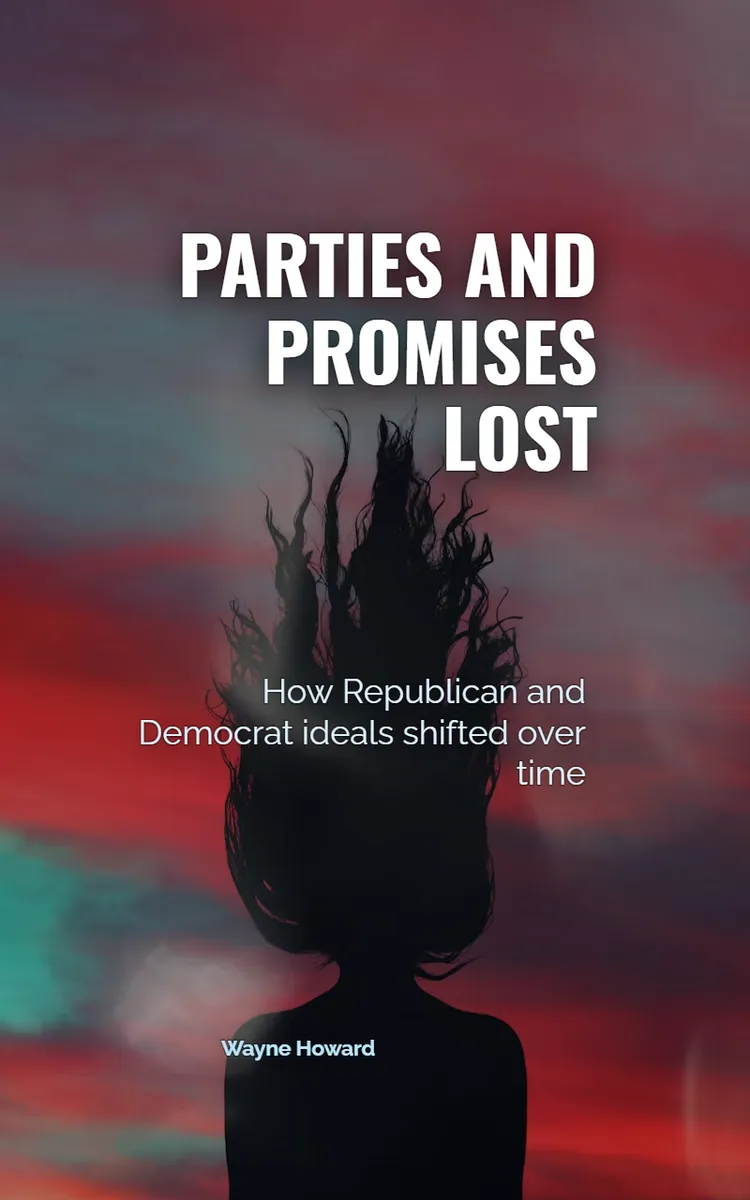
"Parties And Promises Lost" is a curiosity book by Wayne Howard with 8 chapters and approximately 14,685 words. The evolution of Republican and Democratic meanings in America.
This book was created using Inkfluence AI, an AI-powered book generation platform that helps authors write, design, and publish complete books.
Frequently Asked Questions
What is "Parties And Promises Lost" about?
The evolution of Republican and Democratic meanings in America
How many chapters are in "Parties And Promises Lost"?
The book contains 8 chapters and approximately 14,685 words. Topics covered include The Party Name That No Longer Fits, When Promises Became Performances, The Donor Switch That Changed Incentives, Primaries and the Vanishing Middle, and more.
Who wrote "Parties And Promises Lost"?
This book was written by Wayne Howard and created using Inkfluence AI, an AI book generation platform that helps authors write, design, and publish books.
Write your own curiosity book with AI
Describe your idea and Inkfluence writes the whole thing. Free to start.
Start writingCreated with Inkfluence AI


