
Read the first chapter
The whole of chapter one, free. About 8 min. Turn the pages with the arrows, your keyboard, or a swipe.
Chapter 1
Claim Your Communication Identity
Picture This: The Moment You Realized You “Sound Like Yourself”… and Not Like You Want To Talia, 32, customer success manager, had just finished a call where everything technically went fine. The customer said the issue was solved. The ticket was closed. No alarms. Yet when she walked back to her desk, she couldn’t shake one detail: she’d apologized three times for things that weren’t her fault. And she’d ended the call with a “Let me know if…” that sounded - she hated how it sounded - like she was hoping the conversation would disappear.
Later that afternoon, she watched the recording again. Her voice wasn’t “wrong,” but her presence felt… smaller. Not calm-smaller. Not confident-smaller. More like she was trying to shrink the room so nobody would notice she wanted the customer to trust her. She could almost feel the loop: I’m not sure they’ll like me → I’ll soften my words → they’ll relax → I’ll feel safer. Except the result wasn’t safety. It was distance. The customer had been polite, but the connection wasn’t there.
Here’s the question that landed hard in her chest: If you’re always speaking from the person you feel like in the moment, how do you ever become the person you’re trying to show?
The Mindset Shift: Stop Acting Like a Mistake - Start Acting Like an Identity Old Belief: “I’m just being myself. If I sound different, it means I’m fake.” New Reality: “I’m choosing which version of my communication identity shows up - every time.”
That shift matters because “being yourself” is often a cover for autopilot. You don’t notice the micro-decisions you make: the speed of your words, the tone you use when you’re unsure, the body language you default to when you want approval. Autopilot can feel like “me,” but it’s usually your protection strategy wearing your face.
Think about Talia’s apologies. They weren’t random. They were her identity trying to keep things smooth - peacekeeper mode. When she apologized for things outside her control, she wasn’t trying to be dishonest. She was trying to prevent conflict and earn safety. The problem is that her customer didn’t need reassurance that she felt responsible; they needed clarity that she understood the situation and had a plan. When she kept shrinking, the customer had less room to trust her competence.
Here’s a concrete example: on her next call, Talia started with a different identity statement in her head - something simple like, “I’m the person who brings clean next steps.” She didn’t change her facts. She changed how she carried them. Instead of “I’m sorry, I know this is frustrating,” she said, “Here’s what we’ll do next, and when you’ll see the fix.” Her shoulders dropped. Her voice slowed just a touch. And the customer’s responses became more specific - less “polite nodding,” more collaboration. Same skill set, different presence. That’s the point.
Signs this pattern is running your life You’ll recognize the Identity-Behavior Loop when you notice these patterns repeating:
1. You speak “smaller” when you’re nervous - shorter sentences, extra softeners, more apologies, less direct asks. 2. You say “yes” to keep the peace, then feel resentful later because your words didn’t match your real intention. 3. Your body gives away your thoughts before your mouth does (fidgeting, avoiding eye contact, sitting back when you want credibility). 4. You replay conversations and label yourself as “bad at communication,” instead of seeing it as a loop you can steer.
Identity doesn’t just describe you - it directs what you do with your voice, face, and timing.
Going Deeper: The Identity-Behavior Loop (and Why It’s So Hard to Notice) Most people try to “fix” communication by tweaking words: speak clearer, use better wording, be more confident. That helps for a moment. But it usually doesn’t stick, because words are the last step. Before you speak, your identity is already running the show.
The Identity-Behavior Loop goes like this: a situation triggers a feeling (pressure, uncertainty, fear of being judged). That feeling activates an identity story in your head (for Talia, it was something like *“I need to make this go smoothly so I don’t get in trouble”*). Then your behavior follows that identity story automatically - tone, pace, posture, and wording all adjust to protect that identity.
When the protection identity is active, your brain treats certain communication moves like danger. Directness might feel risky. Boundaries might feel rude. Confident phrasing might feel like you’re “showing off.” So you choose safer behaviors: hedging, apologizing, over-explaining, or asking for permission when you actually want to lead.
The tricky part? You don’t experience this as a choice. It feels like a personality trait. “That’s just how I am.” But if you’ve ever turned a dial in your tone on purpose - like when you switched from casual to professional - you already know communication can be steered. You just weren’t connecting it to identity.
Here’s another lived example, and it’s super common: you ask a question at work and immediately add, “Sorry to bother you.” That isn’t just politeness. It’s identity behavior. Your inner story is trying to prevent friction. The reason it sticks is because it works short-term. People respond kindly. You feel safer. And your brain files it away: This behavior keeps me accepted. So the loop tightens over time.
Breaking it doesn’t mean becoming a different person. It means updating the identity story so your behavior has permission to match the presence you want - calm, clear, grounded, respectful, and direct.
Reflection & Self-Assessment: Name the Identity Story You Keep Acting From If you want to change your communication without forcing it, start by tracking the identity story behind your behavior. You’re not hunting for flaws. You’re collecting clues.
Try this right now: think of your most recent awkward moment in conversation. Not a disaster - just one moment where you felt a dip in confidence or a tug toward “softening.” When you recall it, don’t focus on what you said first. Focus on what you believed about yourself in that moment. What identity was active? (Even if the answer is uncomfortable.)
Then ask yourself what behaviors followed. Did your voice speed up? Did you apologize? Did you avoid eye contact? Did you suddenly explain too much? This is where the loop becomes visible - and visibility is power.
Thought-provoking questions to apply this to your life 1. When I felt least confident in that conversation, what did I think would happen if I spoke more clearly? Your honest answer might sound like: “They’d think I’m incompetent” or “I’d seem too pushy.” That’s the identity story protecting you.
2. What “identity” was I trying to be - peacekeeper, expert, easygoing, invisible, or unproblematic? You might notice you weren’t being yourself; you were being a role designed to prevent discomfort.
3. Which specific behavior showed up first: my tone, my body language, or my wording? If your tone changed before your words, that tells you the loop starts earlier than you thought - so you’ll need to intervene earlier too.
4. What did I want the other person to feel, and did my behavior actually create that? Maybe you wanted trust, but you gave reassurance. Or you wanted clarity, but you gave hedging.
5. If I could keep my values but change my identity story, what would I want to believe instead? For Talia, the replacement identity wasn’t “I’m the best.” It was closer to: “I’m the person with clean next steps.”
Growth Challenge: Run a 7-Day Identity Check Before You Speak You don’t need a whole new personality. You need a new default identity story - small enough to use under pressure.
Challenge Title: The 10-Second Identity Check (7 Days) - For the next 7 days, before any important conversation (calls, meetings, customer chats, even tricky texts), take 10 seconds to answer in your head: - “Who am I showing up as right now?” - “What communication behavior matches that identity?” - Pick one “identity-matching” behavior to practice consistently each day. Examples: - Speak one sentence more directly (less “just,” less “maybe”). - Replace one apology with a next-step statement. - Slow your pace slightly when you feel pressure. - After the conversation, spend 30 seconds to jot one line: - “My identity story was __.” - “My behavior was.” - “Next time I’ll try __.”
Difficulty Rating: Medium (because it asks you to notice yourself in real time)
You’ll know it’s working when... - You catch the loop earlier - before you’ve already apologized, hedged, or shrunk. - Your “after” feeling changes from regret to awareness (“Oh, there it is again - now I can steer it.”). - One repeated behavior shifts (for Talia, it might be fewer apologies or more direct next steps).
Key Takeaway: Choose Your Identity - Then Let Your Voice and Body Catch Up When you treat communication as identity first, you stop blaming your personality and start steering your presence. Talia didn’t “become confident” by sheer willpower. She changed what she believed about her role in the room, and her behavior followed - like her body finally got the memo her mouth had been trying to send.
Your communication improves fastest when you stop managing words and start managing the identity story that creates them.
• You already have an Identity-Behavior Loop - even if you didn’t have a name for it. - “Being yourself” is often autopilot; identity is the steering wheel. - When you name your identity story, you can choose behaviors that match your desired presence. - A tiny pre-speech check (10 seconds) can interrupt the loop and change your outcome.
Next, we’ll make that steering even easier by looking at the signals your body and voice send - because sometimes your identity story is louder than your words, and we can learn to align them.
End of chapter one. 7 more chapters in the full book.
Swipe or use the arrows to turn the page


What's inside: 8 chapters
- 1. Claim Your Communication Identity
- 2. Unlearn the Fear of Being Misunderstood
- 3. Master Nonverbal Signals That Build Trust
- 4. Speak With Clarity Using the 3-Part Map
- 5. Ask Better Questions to Steer Conversations
- 6. Handle Conflict With Calm, Direct Scripts
- 7. Build Boundaries Without Guilt
- 8. Turn Communication Into Resilient Confidence
About this book
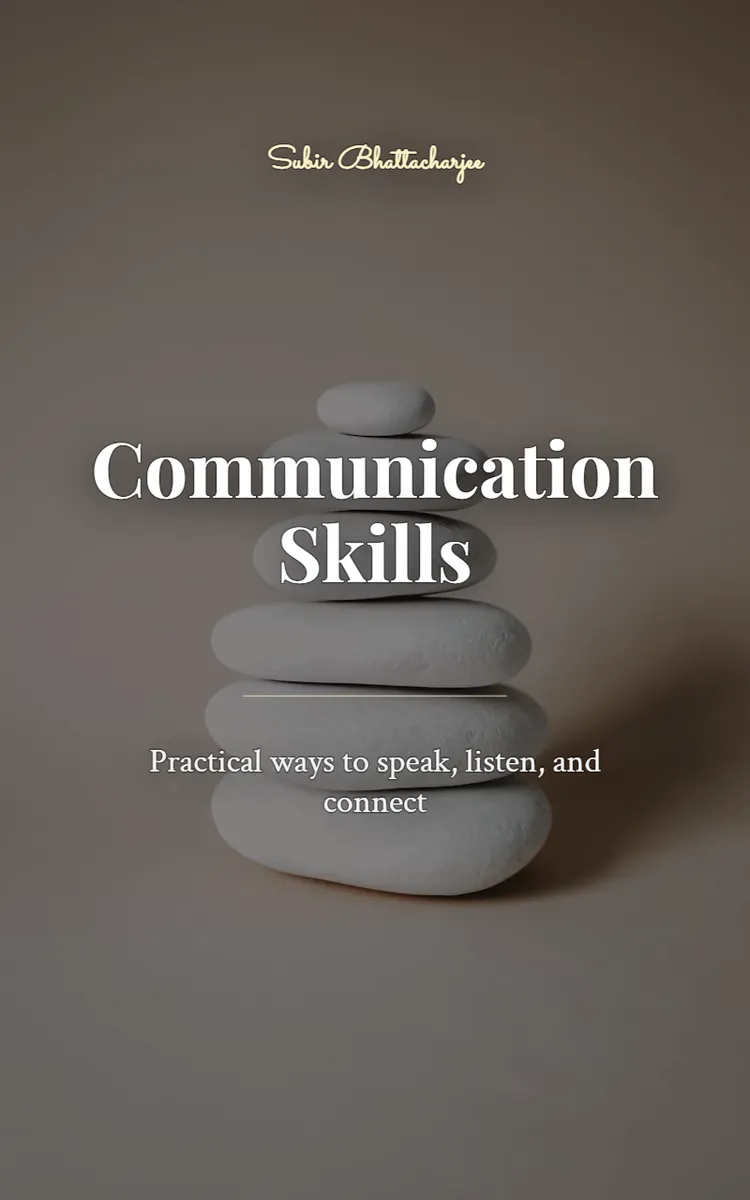
"Communication Skills" is a self-help book by Subir Bhattacharjee with 8 chapters and approximately 12,298 words. Improving verbal and nonverbal communication in daily life.
This book was created using Inkfluence AI, an AI-powered book generation platform that helps authors write, design, and publish complete books. It was made with the AI Self-Help Book Writer.
Frequently Asked Questions
What is "Communication Skills" about?
Improving verbal and nonverbal communication in daily life
How many chapters are in "Communication Skills"?
The book contains 8 chapters and approximately 12,298 words. Topics covered include Claim Your Communication Identity, Unlearn the Fear of Being Misunderstood, Master Nonverbal Signals That Build Trust, Speak With Clarity Using the 3-Part Map, and more.
Who wrote "Communication Skills"?
This book was written by Subir Bhattacharjee and created using Inkfluence AI, an AI book generation platform that helps authors write, design, and publish books.
How can I create a similar self-help book?
You can create your own self-help book using Inkfluence AI. Describe your idea, choose your style, and the AI writes the full book for you. It's free to start.
Write your own self-help book with AI
Describe your idea and Inkfluence writes the whole thing. Free to start.
Start writingCreated with Inkfluence AI


