
Read the first chapter
The whole of chapter one, free. About 7 min. Turn the pages with the arrows, your keyboard, or a swipe.
Chapter 1
Rebuilding Your Overachiever Identity
When Your Best Effort Still Feels Like Failure
You finish a task you used to handle before breakfast. It took all afternoon, but it’s done. Instead of relief, you open your laptop again and scan for what you missed. The finished work barely registers. Your mind goes straight to the gap between who you were and who you are today.
Maybe you’ve started measuring your days by output alone. Did you answer enough messages? Earn enough? Train hard enough? Make enough progress to justify the space you took up? When the answer is no, your confidence drops with it. Then you push harder, feel worse, and wonder why ambition hasn’t returned.
What if your drive isn’t gone - what if it no longer trusts the way you’ve been using it?
The Identity Split: From Output to Worth
Old Belief: My value rises and falls with what I accomplish.
New Reality: Output is something you produce; worth is something you carry, even when your capacity changes.
This distinction can feel almost offensive when you’ve built your identity around being capable. Achievement gave you evidence. A completed project, a growing business, a personal best, a packed calendar - these became proof that you were disciplined and valuable. When burnout took away your usual performance, it also seemed to take away the proof.
That’s why “just rest” often doesn’t work. Rest can feel like a threat when your nervous system has learned that slowing down means falling behind. You’re not simply taking a break from work. You’re facing the frightening possibility that, without your usual output, you won’t know who you are.
The Identity Split Protocol helps separate two things that have been fused together: who you are and what you produce. It doesn’t ask you to stop caring about excellence. It asks you to stop using excellence as the entrance fee for self-respect.
Take a business owner who used to reply to every inquiry within minutes. During burnout, answering ten messages in a day becomes difficult. The old identity says, “A serious owner would do more.” The split identity says, “I’m still the owner. My current capacity changes the size of today’s workload, not the value of my role.” That shift doesn’t magically make the messages disappear. It does remove the shame that turns one hard task into a verdict on your entire character.
Ambition can return when it no longer has to protect you from self-rejection. You can want more without needing more to prove you deserve to be here.
Catching the Worth-Output Pattern
Burnout often exposes a pattern that was already running quietly. You may have called it standards, discipline, or responsibility. Sometimes it was all three. But underneath was a bargain: “If I perform well, I’m safe. If I slow down, I’m failing.”
The bargain works for a while. Praise reinforces it. Progress distracts you from the cost. Then your capacity drops, and the bargain becomes impossible to keep. Every ordinary limitation starts feeling personal.
Signs this pattern is running your life:
1. A completed task gives you only a few minutes of relief. You immediately move the finish line. The win doesn’t settle into you because your brain treats achievement as temporary protection, not genuine satisfaction.
2. Rest makes you feel guilty rather than restored. You may tell yourself you’re being lazy, even when you’re exhausted. The guilt is a sign that your worth has been assigned to productivity’s schedule.
3. Small reductions in output create oversized shame. Missing one workout or postponing one decision feels like evidence that you’re becoming unreliable. The event is small; the identity judgment is huge.
4. You hide your actual capacity from people who depend on you. You say “I’m fine” because admitting you can do less feels like admitting you are less. That secrecy keeps you performing the identity instead of caring for the person underneath it.
Your output can describe your capacity today without defining your character.
The Identity Split Protocol begins with noticing the sentence that comes after a limit. “I couldn’t finish” is information. “I couldn’t finish, so I’m useless” is the old fusion. The goal isn’t to argue with every difficult feeling. It’s to stop letting that feeling write your identity in permanent ink.
Questions That Separate You from Your Scoreboard
1. Who are you when nobody can see what you accomplished today? Don’t reach for a polished answer. You might notice that you’re still loyal, perceptive, funny, caring, or persistent - even if none of those qualities produced a measurable result.
2. Which achievement are you still using as proof that you deserve respect? Name one specific result: a promotion, revenue target, qualification, body change, or reputation. Then ask what you’re afraid people would conclude if that result disappeared.
3. When your capacity drops, what do you call yourself? Write the exact words. “Weak,” “lazy,” “behind,” and “not myself” reveal the terms of your old identity contract. Seeing them clearly gives you a chance to challenge them instead of obeying them.
4. What would ambition look like if it didn’t require self-betrayal? Make the answer practical. It might mean pursuing growth while keeping one evening protected, accepting a slower timeline, or refusing to build success on chronic exhaustion again.
5. What is one thing you can do today because it matters - not because it proves anything? Choose something small and real. Send the thoughtful message, take the walk, finish one useful task, or stop working at the time you promised yourself. The point is to practice choice without turning it into a performance review.
Your answers don’t need to sound inspiring. Honest is more useful than impressive here. If the truth is “I’m terrified that people will lose respect for me,” start there. That fear has been steering your effort. It deserves attention, not another demand to push through.
The Seven-Day Identity Split Practice
Challenge: Keep the Result, Release the Verdict
For the next seven days, separate what you did from what you made it mean about you. This is deliberately simple. The difficulty is emotional, not technical.
• At the end of each day, write down one piece of output you completed or attempted. - Under it, write the identity verdict your mind attached to that output. For example: “I answered three emails, so I’m falling behind.” - Rewrite the verdict as a capacity statement: “I answered three emails today. My energy was limited, and I still made progress.” - Add one quality you showed that wasn’t measured by the result, such as patience, honesty, care, courage, or judgment. - Choose one stopping point each day and honor it without earning permission through extra work.
Expected difficulty: Medium
You’ll know it’s working when...
• You catch yourself using “I am” where “I did” would be more accurate. - A smaller day feels disappointing without becoming a personal disaster. - You can name progress without immediately adding criticism. - Rest feels slightly less like a moral failure. - You begin asking, “What’s wise with my capacity?” instead of “How do I force more?”
Don’t turn this practice into another achievement badge. Missing a day doesn’t mean you failed the challenge. It gives you another chance to practice the split. The work is not producing a perfect record. The work is refusing to make your record the measure of your worth.
Ambition Without Self-Abandonment
You don’t have to choose between being ambitious and being well. You do have to stop confusing ambition with constant self-overriding. The version of drive that burned you out may have been powered by fear, approval, or the need to outrun inadequacy. It was effective, but it was expensive.
A healthier ambition can still be serious. It can still want growth, mastery, money, contribution, and meaningful goals. The difference is that it includes you in the future you’re working toward. You’re not building a life you can only survive by abandoning yourself.
• Your worth remains intact when your output changes. - Burnout can reveal an identity built too tightly around performance. - The Identity Split Protocol separates capacity from character. - Ambition becomes safer when it no longer has to prove that you deserve respect.
You are more than what you produce, and your ambition can grow again without demanding that you disappear.
As you rebuild this separation, your goals can become choices rather than emergency tests. That creates room for the next part of recovery: learning to recognize what your depleted system is actually asking for, before you answer every need with more effort.
End of chapter one. 7 more chapters in the full book.
Swipe or use the arrows to turn the page

The Ghosting Recovery and Reply Blueprint Expanded

Stop The Protruding Gut Tonight

Finding The Perfect Wife
What's inside: 8 chapters
- 1. Rebuilding Your Overachiever Identity
- 2. Defusing the ‘Forever Burned Out’ Story
- 3. Turning Down the Inner Pressure Dial
- 4. Designing Recovery-First Daily Habits
- 5. Building Boundaries Without Guilt
- 6. Relearning Focus With ‘Start Tiny’ Work
- 7. Communicating Capacity to Teams and Partners
- 8. Rebuilding Purpose Through Relapse-Proofing
About this book
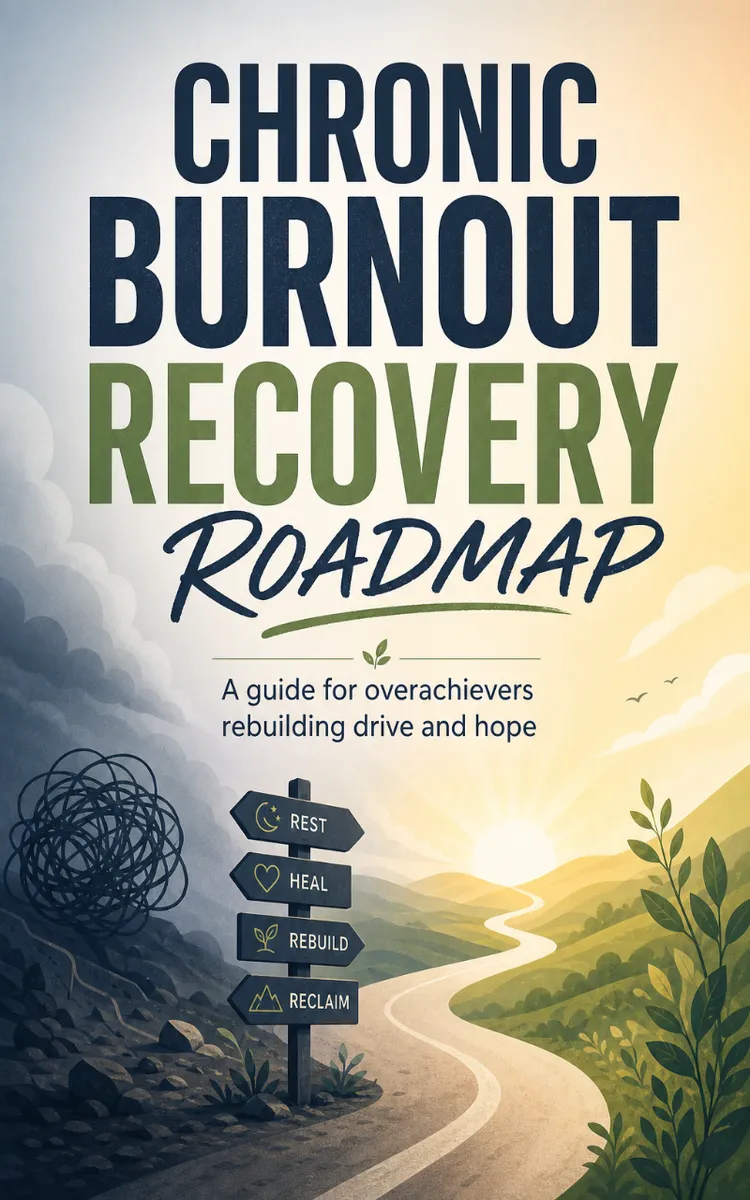
"Chronic Burnout Recovery Roadmap" is a self-help book by Dag Ronhovde with 8 chapters and approximately 12,247 words. Burnout recovery for overachievers who feel drive is gone.
This book was created using Inkfluence AI, an AI-powered book generation platform that helps authors write, design, and publish complete books. It was made with the AI Self-Help Book Writer.
Frequently Asked Questions
What is "Chronic Burnout Recovery Roadmap" about?
Burnout recovery for overachievers who feel drive is gone
How many chapters are in "Chronic Burnout Recovery Roadmap"?
The book contains 8 chapters and approximately 12,247 words. Topics covered include Rebuilding Your Overachiever Identity, Defusing the ‘Forever Burned Out’ Story, Turning Down the Inner Pressure Dial, Designing Recovery-First Daily Habits, and more.
Who wrote "Chronic Burnout Recovery Roadmap"?
This book was written by Dag Ronhovde and created using Inkfluence AI, an AI book generation platform that helps authors write, design, and publish books.
How can I create a similar self-help book?
You can create your own self-help book using Inkfluence AI. Describe your idea, choose your style, and the AI writes the full book for you. It's free to start.
Write your own self-help book with AI
Describe your idea and Inkfluence writes the whole thing. Free to start.
Start writingCreated with Inkfluence AI


