

Read the first chapter
The whole of chapter one, free. About 8 min. Turn the pages with the arrows, your keyboard, or a swipe.
Chapter 1
What Your Birth Date Can-and Cannot-Tell You
The Question Hidden in a Calendar Date
What if the date printed on your birth certificate says something real about your beginning, but not everything about who you became? A birthday can place you inside a season, a family story, a school-year boundary, a generation, and a long chain of cultural symbols. It cannot, by itself, explain your character.
That tension is the starting point for the Birthdate Compass. A compass does not decide where you must go. It gives orientation. Your birth date can point toward patterns worth examining: the meaning attached to your month, the weekday under which you arrived, the expectations placed on children born at that time, and the historical atmosphere surrounding your first years.
Astrology becomes more useful when it is treated as a language of reflection rather than a machine for prediction. It can offer images and questions. Science, family history, memory, and lived experience test whether those images fit. A horoscope may describe a symbol; it does not replace evidence about temperament, health, relationships, or circumstance.
Where does a birth date end - and where does interpretation begin?
What a Date Actually Contains
A birth date is not a single fact. It is a bundle of facts compressed into numbers: a year, a month, a day of the month, a weekday, a season, and a position within a family’s timeline. Someone born on 14 February 1990 entered the world on a Wednesday, during winter in the Northern Hemisphere, in the final years before the internet became an ordinary household presence. Someone born on that same month and day in 2020 entered a very different social world.
Traditional astrology usually begins with the apparent movement of the Sun, Moon, and planets against the zodiac. The familiar Sun sign comes from the Sun’s position at birth, while a fuller birth chart also considers the exact time and location. That system has a long cultural history, but its symbolic claims are not the same as scientific findings. There is no reliable evidence that a zodiac sign fixes a person’s personality or predicts a particular future.
The calendar itself is also historical, not natural in the simple sense. The modern civil calendar used in much of the world is the Gregorian calendar, introduced in 1582 under Pope Gregory XIII to correct a drift in the older Julian calendar. Months do not all have the same length, and the names of several months preserve Roman political history: July honors Julius Caesar, while August honors Augustus. Even the order many people treat as obvious was assembled through reforms, power, and custom.
That makes the month of birth symbolically interesting without making it mystical proof. January carries associations of beginnings partly because the Roman god Janus was linked with doors and transitions. September, once the seventh month in an earlier Roman arrangement, still carries a name built from the Latin word for seven. A date can hold layers of language and history long before astrology assigns it a sign.
The weekday adds another layer. In English, Monday remembers the Moon, while Sunday remembers the Sun. Saturday preserves the name of Saturn and is the only English weekday named directly for a Roman god rather than an adapted Germanic one. In many traditions, Saturday is also associated with the Sabbath, though the “real Sabbath day” depends on religious tradition: Jewish Sabbath runs from sunset Friday to sunset Saturday, while many Christian communities observe Sunday as the principal day of worship. The difference matters because calendars are not neutral grids. They carry beliefs about work, rest, worship, and time.
The Birthdate Compass and the Limits of Symbolism
The Birthdate Compass reads a date through several directions rather than one verdict. The first direction is calendar meaning: month, season, weekday, and the historical ideas attached to them. The second is family position: whether the child was firstborn, youngest, one of several siblings, or born after a major change in the household. The third is generational setting: the technologies, institutions, anxieties, and customs present during childhood. The fourth is personal evidence: memories, habits, relationships, and traits that can actually be observed.
This approach prevents a common mistake. A person born in December may be described as disciplined because of a Capricorn association, but December birth can also place a child near a school-entry cutoff, in a holiday-heavy family season, or among relatives who attach special meaning to year-end celebrations. Those social conditions may influence experience more directly than a constellation.
Birth-order research offers a useful caution. Family roles often shape behavior, but birth order is not destiny. The oldest child may receive more responsibility; the youngest may receive more protection; a middle child may learn to negotiate attention. Yet families differ widely, and the same birth position can produce opposite patterns. A firstborn in one household may become highly organized, while a firstborn elsewhere may resist expectations placed on them.
The same caution applies to generations. Terms such as Baby Boomers, Generation X, Millennials, and Generation Z can help describe broad historical surroundings, but they are rough labels, not personality types. A person’s country, class, race, religion, rural or urban setting, and access to technology may matter more than the label attached to their birth year. “Generation” describes a location in time; it does not finish the description of a human being.
Love language belongs in this same category of useful but limited symbolism. The popular five-language model - words of affirmation, acts of service, receiving gifts, quality time, and physical touch - can give families a vocabulary for discussing affection. It should not be treated as a scientific diagnosis or a permanent category. A person may prefer practical help during a stressful week and conversation during a lonely one. Birth dates do not reveal a love language. Relationships reveal patterns of giving, receiving, misunderstanding, and repair.
A date can suggest a question. It cannot supply the answer.
The Scientific Problem with Personality by Birthday
The surprising fact is that birth-date effects can exist without astrology being correct. A child’s birthday may influence school placement, sports eligibility, or how old they are compared with classmates. Those institutional effects can shape confidence and opportunity, creating patterns that later look like personality.
This is known as a relative-age effect. In youth sports and education, children born soon after a selection cutoff may be older and more physically developed than classmates born near the cutoff’s end. Coaches and teachers may interpret early advantage as talent, giving the older child more practice and attention. Over time, an initial age difference can become a difference in experience.
That finding changes the question. Instead of asking whether a particular month makes people naturally ambitious or sensitive, we can ask what systems do to people born at particular times. A December-born child may be among the youngest in a school year in one country and among the oldest in another, depending on the enrollment rules. The date remains the same; the social consequences change.
Seasonal conditions can matter too, though they are complicated. Exposure to daylight, school schedules, infectious diseases, family work patterns, and local climate may affect early life. None of this supports the claim that a zodiac sign determines character. It shows that birth dates can connect people to real environments through ordinary mechanisms.
Astrology’s enduring appeal may come partly from its ability to organize these many layers into memorable symbols. “Aries,” “Libra,” or “Saturn” is easier to remember than a paragraph about season, family expectations, and historical context. Symbols compress experience. They also tempt us to mistake a vivid description for a proven cause.
The right way to learn about ourselves through astrology is therefore neither blind belief nor automatic dismissal. It is comparison. Read the symbol, then check it against biography, family history, culture, and evidence. Notice where the image illuminates something already known and where it fails. The failure matters as much as the fit, because a system that explains everything after the fact may not be explaining much at all.
A Birthday in the Real World
Consider Barack Obama, born on 4 August 1961 in Honolulu, Hawaii. His date places him under the tropical Sun sign Leo, on a Friday, in a year often associated with the early Baby Boom generation. Those labels can provide a symbolic frame, but they do not explain his public life. His identity was shaped by a biracial family, childhood years in Hawaii and Indonesia, education, law, politics, and the racial history of the United States.
Even the phrase “Baby Boomer” needs care here. Obama was born near the later edge of the commonly used 1946-1964 range, but generational boundaries are not laws of nature. The experiences of a child born in Honolulu in 1961 were not identical to those of a child born in a rural town on the mainland. Geography and family circumstance cut across the neat lines drawn by generational labels.
His birthday also illustrates the difference between symbolism and evidence. Leo imagery may emphasize visibility, leadership, or performance. Those themes can feel relevant to a president, but the same imagery could be applied to thousands of people born on 4 August who never sought public office. The symbol becomes meaningful when placed beside a documented life; it becomes misleading when used to manufacture one.
A self-writing section based on a birth date can hold this distinction clearly. It is not a horoscope report and not a confession extracted from the stars. It is a record of what the date brings into view: the month’s family traditions, the weekday’s religious or cultural meaning, the season of childhood, the generation’s technologies, the duties associated with birth order, and the forms of affection that actually appeared at home. Questions belong there, but not every question deserves an answer from astrology. “What did my family expect from a child born at this time?” is grounded. “What career was I destined to have?” asks the date to do work it cannot do.
What the Date Leaves Unsaid
A birth date is a doorway into context, not a locked room containing a personality. It can show how time, family, culture, and symbolism surround a person before memory begins. It cannot tell us which parts of that inheritance will be accepted, resisted, forgotten, or transformed.
Human beings keep returning to birthdays because they make an invisible process visible: the passage of time through one particular life. The numbers are fixed, but their meaning keeps changing as family stories, generations, and memories gather around them. Somewhere between the calendar and the person is the mystery astrology has always tried to name.
End of chapter one. 7 more chapters and about 14,246 words in the full book.
Swipe or use the arrows to turn the page


What's inside: 8 chapters
- 1. What Your Birth Date Can-and Cannot-Tell You
- 2. The Meaning Hidden in Your Birth Month
- 3. A Year Is Not Just January to December
- 4. What Monday Through Sunday Ask of You
- 5. The Child’s Place in the Family Story
- 6. Love Languages Beyond the Horoscope
- 7. Which Generation Shaped Your Inheritance?
- 8. Write the Meaning You Choose to Live
About this book
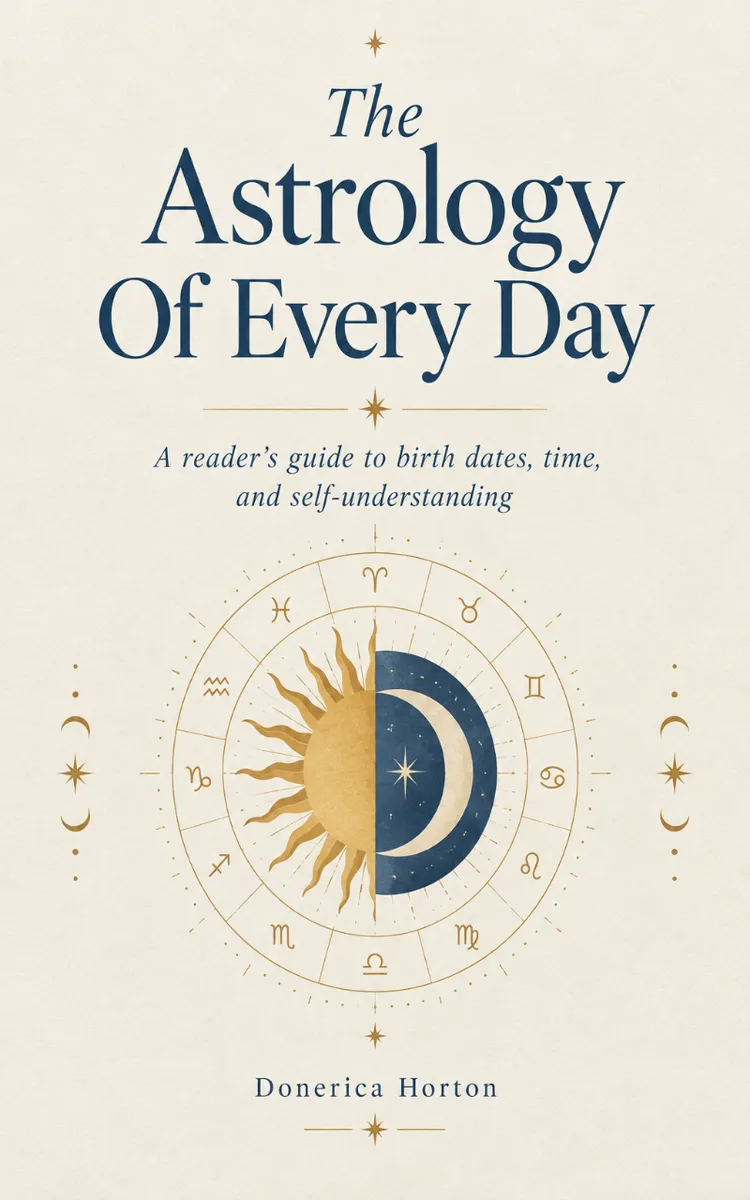
"The Astrology Of Every Day" is a curiosity book by Donerica Horton with 8 chapters and approximately 14,246 words. Astrology exploring birth dates, calendar meanings, family roles, generations, and self-reflection.
This book was created using Inkfluence AI, an AI-powered book generation platform that helps authors write, design, and publish complete books.
Frequently Asked Questions
What is "The Astrology Of Every Day" about?
Astrology exploring birth dates, calendar meanings, family roles, generations, and self-reflection
How many chapters are in "The Astrology Of Every Day"?
The book contains 8 chapters and approximately 14,246 words. Topics covered include What Your Birth Date Can-and Cannot-Tell You, The Meaning Hidden in Your Birth Month, A Year Is Not Just January to December, What Monday Through Sunday Ask of You, and more.
Who wrote "The Astrology Of Every Day"?
This book was written by Donerica Horton and created using Inkfluence AI, an AI book generation platform that helps authors write, design, and publish books.
Write your own curiosity book with AI
Describe your idea and Inkfluence writes the whole thing. Free to start.
Start writingCreated with Inkfluence AI


