
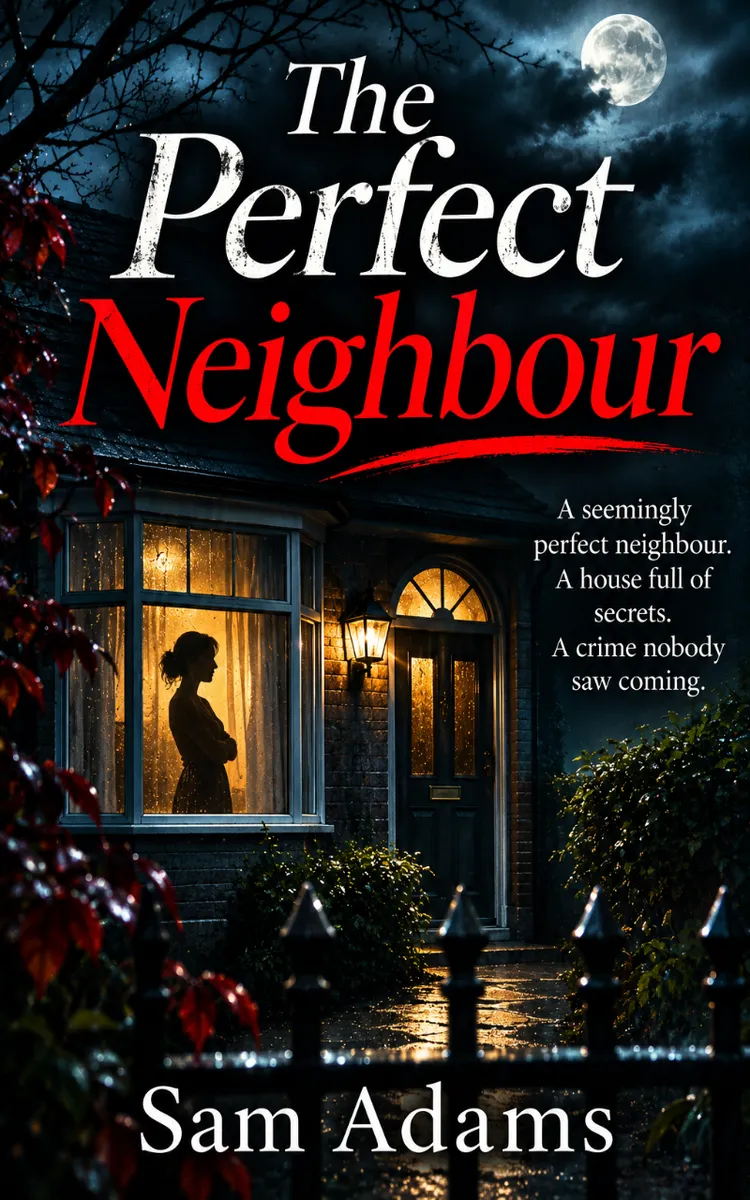

Read the first chapter
The whole of chapter one, free. About 9 min. Turn the pages with the arrows, your keyboard, or a swipe.
Chapter 1
The House at Number Twelve
The removal van had left a dark rectangle on the kerb where its tyres had rested, and rainwater was already gathering in it. I stood beside the open boot of my car with a box marked KITCHEN balanced against my hip, listening to the soft, patient ticking of the cooling engine.
Number Twelve faced a row of clipped privet hedges and identical pebble-dashed houses, each with a narrow path running from pavement to front door. The street was quiet enough for me to hear a gate click somewhere behind me, then the faint scrape of a curtain being drawn.
I carried the box inside.
The house still smelled of cardboard, fresh paint and the lemon cleaner the estate agent had used before the viewing. My footsteps sounded too loud on the bare floorboards. In the sitting room, three more boxes leaned against the wall, their labels written in my hurried black capitals: BOOKS, BEDROOM, IMPORTANT.
Important contained my decree absolute, two passports, the mortgage papers and a folder of solicitor’s letters I had no intention of opening again.
I put the kitchen box down and pressed both hands to the small of my back. The house was mine. Not jointly owned. Not waiting for Daniel to come home. Mine.
For the first time in months, nobody could ask where I had been, who I had spoken to or why I had taken so long in the supermarket.
A car passed at the end of the road. Its tyres hissed over the wet tarmac, and I found myself looking towards the front window.
Nothing moved beyond the glass except the branches of a young maple tree.
‘Get a grip,’ I murmured.
The words vanished into the empty hallway.
I unpacked two plates, a saucepan and the kettle. The cupboards were clean and unnervingly white inside. I filled the kettle from the tap, switched it on and stood watching the red light glow. Somewhere upstairs, a pipe knocked once. Then again.
I froze with my hand on the worktop.
The sound stopped.
The silence that followed seemed to press against the walls. I told myself it was an old house settling. I told myself several things that day, most of them in Daniel’s voice: You’re imagining it. You always make things bigger than they are.
The kettle clicked off.
Before I could reach it, someone knocked at the front door.
Three taps. Evenly spaced.
I wiped my palms on my jeans and walked through the hall. The door had a narrow pane of frosted glass beside it. A woman’s outline stood on the other side, one hand raised, the other holding something covered with a white tea towel.
I opened the door on the chain.
‘Hello?’
The woman smiled. She was perhaps my age, with dark blonde hair cut neatly at her jaw and a raincoat the colour of oatmeal. Her face was open and pleasant, the sort that made an instant apology seem unnecessary.
‘You must be Laura.’ She glanced at the box behind me. ‘I’m Rebecca Shaw. Number Eleven.’
She nodded towards the house next door. Its windows were bright with lamplight, although the sky had not yet darkened.
‘I hope I’m not interrupting.’
‘No. I was only making tea.’
‘Then I’ve arrived at the right moment.’ She lifted the covered dish slightly. ‘I thought you might not have managed to organise dinner yet. Moving day is always chaos.’
The offer was so ordinary, so perfectly timed, that suspicion felt rude.
I undid the chain. ‘That’s very kind.’
‘It’s only shepherd’s pie. Nothing impressive, but it reheats well.’ She stepped closer, and the smell of rosemary and browned cheese drifted through the doorway. ‘You can give me the dish back whenever. Or don’t. I’ve got plenty.’
‘Thank you.’
Her gaze moved past me, taking in the boxes and the bare hall.
‘You’ve done well to get this far. The previous owners left an awful lot behind.’
‘They did.’
‘The attic was the worst, wasn’t it?’
I looked at her.
Rebecca’s smile held. ‘Sorry. I only meant the house in general. When we moved in, there were boxes everywhere. We found old paint tins under the stairs and a broken cot in the loft.’
‘I haven’t seen the attic.’
‘Best leave it for a few weeks.’ She gave a small laugh. ‘This place has plenty of storage, but it likes to make you earn it.’
A gust of wind swept along the path, lifting the edge of the tea towel. Rebecca reached out and steadied the dish.
‘You’ll want to keep the front door shut at night,’ she said. ‘The draught catches it.’
‘I will.’
‘And if you hear the boiler clicking, don’t panic. It does that when the heating comes on.’
I glanced into the hall. ‘I heard a knocking upstairs.’
‘Probably the pipes. They’re temperamental.’
She said it lightly, but her eyes sharpened for half a second, as if she had been waiting to hear whether I would mention it.
I shifted the dish in my hands. It was warm through the towel.
‘Thank you for the warning.’
‘That’s what neighbours are for.’ Rebecca looked towards the road. ‘Although most people keep to themselves now. It wasn’t always like that.’
A dark hatchback stood opposite my house, parked beneath the maple tree. Its windows were black with reflected evening. I couldn’t see anyone inside.
When I looked back, Rebecca was watching me.
‘You’ll settle in quickly,’ she said. ‘It’s a safe street.’
The certainty in her voice should have comforted me. Instead, I became aware of the open doorway behind my back, the boxes visible from the pavement, the folder marked IMPORTANT sitting half exposed in the sitting room.
Rebecca touched the edge of the dish. ‘Eat before it gets cold.’
‘I will.’
She turned away, then paused at the bottom of the path.
‘Oh, and Laura?’
‘Yes?’
‘If you need anything, just knock. I’m home most evenings.’
She walked next door without looking back. At her gate, she raised one hand in a brief wave and disappeared behind the hedge.
I closed my door and locked it.
Then I checked the lock again.
The shepherd’s pie was still warm. I ate it standing at the kitchen worktop, using one of the plates I had unpacked. The gravy was rich and peppery. There were peas in it, and carrots cut into tiny, precise cubes.
I tried to enjoy it. I tried to let the warmth of the food settle the unease beneath my ribs.
Outside, a hedge rustled.
I put down my fork.
The front of the house had gone dark. The hallway light was off, and beyond the frosted pane the street had become a blur of grey and black. I moved towards the window and lifted the blind by an inch.
The hatchback was gone.
A small parcel sat on the front step.
I had not heard anyone approach.
For several seconds I remained bent over the blind, watching the parcel through the glass. It was wrapped in brown paper and tied with blue string. No card. No label.
The sensible explanation arrived first. Rebecca had brought something else over. Perhaps bread. Perhaps a bottle of wine. She might have left it while I was eating.
But I had been in the kitchen. I would have heard the door.
I lowered the blind and stepped back.
The parcel remained on the step.
My phone lay on the worktop beside the half-empty plate. I picked it up and opened the camera. Through the front window, I took a photograph of the parcel. The flash lit the hall and threw my reflection across the glass: pale face, damp hair, one hand gripping the phone too tightly.
I could have called Rebecca.
Instead, I took my keys from the bowl by the door.
The cold struck through my socks when I stepped outside. Rain ticked against the leaves, and somewhere nearby a television laughed behind closed curtains. The street looked deserted, but I had the distinct impression of being observed from one of the houses opposite.
I walked down the path.
The parcel was smaller than I had expected. A cardboard box, light in my hand. The blue string had been tied in an elaborate knot. I carried it inside and set it on the kitchen table.
For a moment, I considered putting it straight in the bin.
Then I fetched a pair of scissors.
The paper opened with a dry tearing sound. Inside was a round metal tin, old-fashioned and painted with faded roses. When I lifted the lid, the smell of cinnamon and butter filled the kitchen.
Biscuits.
They were pale, ridged around the edges, with a thin layer of jam in the centre. I recognised them before I could say why.
My grandmother had made biscuits like these.
Not often. Only at Christmas, and only when I was small enough to sit on the kitchen worktop and watch her press the dough with a glass tumbler. The memory came with a flash of yellow curtains, flour on her knuckles, and a chipped blue bowl.
I touched one biscuit but did not pick it up.
There was no note.
I carried the tin to the window. Next door, Rebecca’s house was brightly lit. A figure moved behind the downstairs curtain, then stopped.
I stepped away from the glass.
My phone vibrated on the table.
The message came from an unknown number.
WELCOME TO ASH GROVE.
I stared at it until the screen dimmed.
A second message appeared.
I HOPE YOU’RE HAPPIER HERE THAN YOU WERE AT NUMBER 8.
The kitchen seemed to contract around me.
Number 8 had been the house Daniel and I had shared. The house I had left three days earlier. The house whose address I had not given to anyone in Ash Grove.
I read the message again. Then a third one arrived.
ASK REBECCA WHAT HAPPENED TO ELAINE.
My fingers went cold.
The name meant nothing. Or almost nothing. It hovered at the edge of memory, attached to some old place, some locked-away corner of my childhood. Before I could catch it, the phone rang.
Rebecca’s name appeared on the screen.
I let it ring twice before answering.
‘Hello?’
‘Laura?’ Her voice was warm, concerned. ‘I’m sorry to call so late. I wondered whether the supper reached you.’
‘Yes.’
‘Was it all right?’
‘It was lovely.’
‘Good. I was worried you might be too tired to eat.’ She paused. ‘Moving house after everything you’ve been through is exhausting.’
I looked at the phone.
‘What do you mean?’
‘The divorce.’ She sounded genuinely surprised. ‘I’m sorry. I assumed you’d mentioned it to the estate agent.’
‘I didn’t.’
‘Perhaps he told us. People talk in a small neighbourhood.’
‘Who is “us”?’
A soft laugh. ‘Oh, Laura. Don’t sound so alarmed. I only meant the people on the street.’
I glanced at the tin of biscuits.
‘Did you leave something else outside my door?’
There was a silence.
‘Something else?’
‘A tin of biscuits.’
‘I didn’t.’
The word seemed to settle between us.
‘Are you sure?’
‘Quite sure.’ Her voice had changed, just slightly. ‘What kind of biscuits?’
‘Jam biscuits.’
Another pause. Longer this time.
‘That’s odd.’
‘Do you know who left them?’
‘I can’t imagine.’ Rebecca’s tone regained its softness. ‘You should throw them away if you’re worried.’
‘Why?’
‘Because you don’t know where they came from.’
I looked towards the window. The curtain over Rebecca’s sitting room had gone still.
‘You said this was a safe street.’
‘It is.’ She exhaled quietly. ‘Mostly.’
The call ended a moment later.
I stood in the kitchen with the phone against my ear, listening to the empty line. Then I noticed the lid of the tin was no longer beside it.
It was on the floor.
I had not heard it fall.
I crouched to pick it up. Beneath the roses, scratched into the metal, were two initials.
E.M.
My phone vibrated again.
This time there was no number, only a blocked caller.
I opened the message.
YOUR SOLICITOR CAN EXPLAIN WHO ELAINE WAS.
A knock sounded at the front door.
Three taps. Evenly spaced.
I did not move.
A woman’s voice came through the frosted glass, gentle and familiar.
‘Laura? It’s Rebecca. I’ve brought you something for breakfast.’
I looked down at the tin in my hands.
On the other side of the glass, Rebecca knocked once more.
‘It’s about your solicitor,’ she said. ‘Martin Vale.’
End of chapter one. 19 more chapters and about 37,861 words in the full book.
Swipe or use the arrows to turn the page


What's inside: 20 chapters
- 1. The House at Number Twelve
- 2. A Welcome on the Step
- 3. The Name in the Ledger
- 4. Voices Through the Fence
- 5. The Divorce I Remember
- 6. The Message Under Glass
- 7. The Watchful Window
- 8. The Lane Behind the Gardens
- 9. The Woman I Became
- 10. The File Before the Move
- 11. The Street Meeting
- 12. The Camera That Wasn't There
- 13. The Locked Summerhouse
- 14. The Fire in the Conservatory
- 15. The Empty Spare Room
- 16. The Voice on the Tape
- 17. The House Beneath the House
- 18. The Door Left Open
- 19. The Truth in the Register
- 20. The Perfect Neighbour
About this book
"The Perfect Neighbour" is a fiction book by Sam with 20 chapters and approximately 37,861 words. A divorced woman uncovers her neighbour’s obsession, surveillance, and hidden motives.
This book was created using Inkfluence AI, an AI-powered book generation platform that helps authors write, design, and publish complete books. It was made with the AI Novel Writer.
Frequently Asked Questions
What is "The Perfect Neighbour" about?
A divorced woman uncovers her neighbour’s obsession, surveillance, and hidden motives
How many chapters are in "The Perfect Neighbour"?
The book contains 20 chapters and approximately 37,861 words. Topics covered include The House at Number Twelve, A Welcome on the Step, The Name in the Ledger, Voices Through the Fence, and more.
Who wrote "The Perfect Neighbour"?
This book was written by Sam and created using Inkfluence AI, an AI book generation platform that helps authors write, design, and publish books.
How can I create a similar fiction book?
You can create your own fiction book using Inkfluence AI. Describe your idea, choose your style, and the AI writes the full book for you. It's free to start.
Write your own fiction book with AI
Describe your idea and Inkfluence writes the whole thing. Free to start.
Start writingCreated with Inkfluence AI


