

Read the first chapter
The whole of chapter one, free. About 9 min. Turn the pages with the arrows, your keyboard, or a swipe.
Chapter 1
Grounding Lessons in Scripture
A leader once read, “I can do all things through Christ,” and asked the group what difficult thing each person wanted God to help them accomplish. The discussion became energetic, but Philippians 4:13 never addressed personal achievement. Paul wrote those words while explaining how he had learned contentment in hunger, abundance, need, and plenty. The group had heard a familiar verse, yet the passage itself had not guided the lesson.
That problem reaches beyond one misused verse. When leaders detach a statement from its literary and historical setting, personal opinion quietly becomes the lesson’s authority. The leader may still mention Bible verses, but the group learns to trust the leader’s interpretation more than God’s Word. Sound lesson design reverses that order. Scripture supplies the claim, context supplies the boundaries, and the leader creates questions that help the group observe and obey what the text actually says.
The Text-to-Truth Method gives you a repeatable way to move from passage to lesson. You will learn to locate a text within its book, paragraph, and historical setting; identify what the author communicates; test your interpretation against the rest of Scripture; and build participation around the text rather than around your preferences. Prayer and dependence on the Holy Spirit belong at every stage, because accurate handling requires more than technique. It requires a teacher who submits to the Word.
Read the Passage Before You Explain It
Context means the words and circumstances surrounding a passage that help determine its meaning. Literary context concerns the passage’s place within the book: its paragraph, argument, genre, repeated words, contrasts, and connection to what comes before and after. Historical context concerns the people, events, customs, problems, and setting addressed by the writer. You need both because a command spoken to a particular church may reveal a lasting principle without applying in exactly the same form today.
Begin with the passage itself. Read it aloud at least three times in two or three reliable translations. Mark repeated words, commands, reasons, contrasts, questions, and conclusions. Do not begin with a commentary or a sermon outline. First ask, “What does the text emphasize?” A leader studying James 1:19-27, for example, should notice the movement from hearing the word to doing the word, the warning against self-deception, and the concrete examples of controlling speech and caring for vulnerable people.
Then place the passage inside its paragraph and book. Read the surrounding section, and write a one-sentence summary of the author’s main point. For James 1:19-27, James addresses believers who face trials and temptation. He connects genuine reception of God’s word with obedient action. That summary protects the leader from reducing the passage to “be nicer when people talk.” Listening matters, but James presses toward a life that practices the implanted word.
The Text-to-Truth Method uses four movements:
1. Trace the text. Record what the passage says, not what you expect it to say. List repeated terms, commands, reasons, and results. This step keeps observation separate from opinion. 2. Place the text. Read the surrounding paragraphs and identify the book’s purpose, audience, genre, and historical situation. This step prevents isolated-verse teaching. 3. Test the truth. Compare your interpretation with the immediate context, the whole book, and clear teaching elsewhere in Scripture. Scripture interprets Scripture; one difficult phrase should not overturn a clear biblical theme. 4. Build the lesson. State one central truth in language that reflects the passage, then design questions and activities that lead the group to discover and apply that truth. This step makes the text - not the leader - the authority.
Genre matters. A proverb presents wise guidance, not an automatic promise that every outcome will occur in every case. A parable communicates through a story, so you should identify its main point before assigning meaning to every detail. A psalm may use poetic images such as “the mountains skipped like rams” (Psalm 114:4); you should not treat poetry as a technical report. Historical narrative reports events, but not every reported action receives approval. David’s adultery in 2 Samuel 11 teaches through its consequences, not through imitation.
Ask yourself, “Could I show this conclusion from the passage and its setting?” If your answer depends mainly on a personal experience, a striking illustration, or a preferred theological phrase, return to the text. A strong lesson does not hide the leader’s preparation; it makes the leader’s submission visible. End your preparation by writing one sentence: “Because this passage says, the group should understand and respond by ___.”
Apply the Text-to-Truth Method
Prayer begins the work, not merely the closing moment. Ask God to expose your assumptions and to help you handle the Word faithfully. Paul told Timothy, “Do your best to present yourself to God as one approved, a worker who has no need to be ashamed, rightly handling the word of truth” (2 Timothy 2:15). The Holy Spirit gives understanding and conviction, but His guidance does not excuse careless reading. Pray, read carefully, compare Scripture, and remain willing to correct your first impression.
Use a simple preparation page with five headings: passage, observations, context, central truth, and response. Under “context,” record the book’s author, audience, occasion if known, and the paragraph’s role. Consult a study Bible, Bible dictionary, or trusted commentary after you form your initial observations. These resources can clarify customs, geography, and difficult language, but they should serve the biblical text rather than replace it. If a source proposes an interpretation, verify its claim by reading the cited verses yourself.
Consider Philippians 4:10-13. The literary context includes Paul’s gratitude for the Philippians’ renewed care and his explanation of contentment in every circumstance. The historical context includes Paul’s imprisonment and the church’s financial partnership with him. The central truth is not “Christ guarantees success in every goal.” It is “Christ strengthens His servant to remain faithful whether he has plenty or lacks necessities.” That truth fits verses 11-12, where Paul names hunger, abundance, need, and plenty.
Your lesson questions should move in the same direction as the passage. Start with observation: “What circumstances does Paul name in verses 11-12?” Move to interpretation: “What has Paul learned in those circumstances?” Then ask application: “Where might contentment require faithful trust rather than control?” A final question can invite a concrete response: “What practice will help you receive your present circumstances without treating Christ as a means to personal success?” The questions remain interactive, yet they do not allow the group to drift from the text.
Keep the central truth narrow enough to guide the meeting. If your statement could fit ten unrelated passages, it probably lacks contact with this one. The outcome should also be observable. Instead of “feel encouraged,” write, “Each participant will identify one circumstance in which he or she needs to practice contentment and name one faithful action.” The wording matters because it helps you judge whether the group engaged the passage or merely discussed religious ideas.
A Text-to-Truth Lesson on Philippians 4:10-13
Use the following preparation for a sixty-minute small-group meeting with eight participants. The expected outcome is a clear correction of the common misuse of Philippians 4:13 and one Scripture-shaped response from each participant.
1. Pray for ten minutes before planning. Ask the Holy Spirit to expose any desire to make the passage support ambition, comfort, or a favorite slogan. Expected outcome: you approach the text as a servant, not as its owner. 2. Read Philippians 4:10-13 three times. Use the English Standard Version, New International Version, and Christian Standard Bible, then compare wording differences. Expected outcome: repeated ideas such as contentment, circumstances, learning, and strength become visible. 3. Read Philippians 4:1-23. Mark Paul’s instructions about unity, anxiety, prayer, thought life, generosity, and contentment. Expected outcome: verse 13 sits inside a letter about faithful Christian living rather than personal achievement. 4. Write the historical setting. Note Paul’s imprisonment and the Philippians’ financial partnership, using Philippians 1:7 and 4:14-18. Expected outcome: the group sees why Paul discusses need, abundance, and receiving support. 5. State the central truth. Write: “Christ gives strength for faithful contentment in both lack and abundance.” Expected outcome: your lesson has one text-based aim. 6. Prepare three questions. Ask what Paul says, what he means, and how the group should respond. Expected outcome: discussion follows the passage’s movement instead of the leader’s opinions. 7. Read verse 13 in its immediate setting. Ask participants to read verses 11-13 silently, then explain the contrast Paul makes. Expected outcome: participants identify “all things” as the varied circumstances Paul has learned to face. 8. Give each person two minutes of silence. Ask them to write one present circumstance that tempts them to measure Christ’s faithfulness by visible success. Expected outcome: application becomes personal without turning into uncontrolled storytelling. 9. Invite pairs to compare responses for five minutes. Require each person to connect his or her response to a phrase from verses 11-13. Expected outcome: participants practice grounding application in Scripture. 10. Close by reading Philippians 4:19 and praying for faithful trust. Do not promise a specific material outcome; ask God to provide and strengthen according to His will. Expected outcome: the group leaves with a faithful response rather than a motivational slogan.
Quick checklist
• Read the whole paragraph, not only the familiar verse. - Identify the author, audience, occasion, and genre. - Mark repeated words, commands, contrasts, and reasons. - Write one central truth that the passage itself supports. - Compare the interpretation with the rest of Scripture. - Ask observation, interpretation, and application questions. - Require participants to connect responses to the text. - Pray for the Holy Spirit’s help before, during, and after teaching. - Check whether the lesson’s outcome matches the passage’s actual emphasis.
The test of success is not how many comments the group makes. The test is whether participants can explain what the passage means, show how its context supports that meaning, and name a response that follows from it.
Correct the Errors That Pull Lessons Away from Scripture
Mistaking a familiar verse for a complete message
A well-known verse can carry years of slogans and assumptions. Leaders may read Jeremiah 29:11 as a direct promise of immediate personal success while ignoring the exile, the seventy-year setting, and the surrounding call to seek the welfare of Babylon. The verse still reveals God’s faithful purposes, but context guards the application.
Do this: Read at least the surrounding paragraph and identify the original audience and situation. Not this: Build the lesson around the verse’s most popular use before reading its setting.
Treating historical background as the lesson’s authority
Background information helps, but it can become a substitute for Scripture. A leader may spend twenty minutes explaining first-century customs and only five minutes examining the passage. Participants then remember the setting but cannot state the biblical claim.
Do this: Use background to clarify a phrase, practice, or problem, then return to the text and ask how that information improves understanding. Not this: Let a commentary, map, or cultural detail carry the main point.
Confusing personal application with personal meaning
A passage can apply differently to people in the group, but it does not mean something different for each person. Hebrews 4:12 may expose one participant’s anger and another’s fear, yet the text still teaches that God’s living word searches the heart. Personal response must grow from shared meaning.
Do this: State the passage’s meaning first, then invite each participant to identify a specific response. Not this: Accept every interpretation as equally valid because it feels meaningful.
When disagreement arises, slow down and return to the words, grammar, context, and cross-references. Say, “Show us where you see that in the passage.” That question does not silence discussion; it teaches the group how to listen to Scripture together. A leader who corrects an interpretation should explain why, using the text with humility rather than embarrassment or force.
The Word of God remains the lesson’s authority when every part of the meeting points back to it: the central truth, the questions, the discussion, the correction, and the response. Prayer opens your hands; careful context steadies your reading; participatory questions help others see what you have seen. Build that pattern consistently, and your group will learn not merely to discuss the Bible, but to hear and obey it together.
End of chapter one. 7 more chapters and about 15,845 words in the full book.
Swipe or use the arrows to turn the page


What's inside: 8 chapters
- 1. Grounding Lessons in Scripture
- 2. Praying Through Lesson Preparation
- 3. Discerning the Spirit’s Guidance
- 4. Designing a Clear Lesson Plan
- 5. Writing Questions That Open Scripture
- 6. Facilitating Participatory Discussion
- 7. Applying Christian Psychology Wisely
- 8. Evaluating Growth and Refining Lessons
About this book
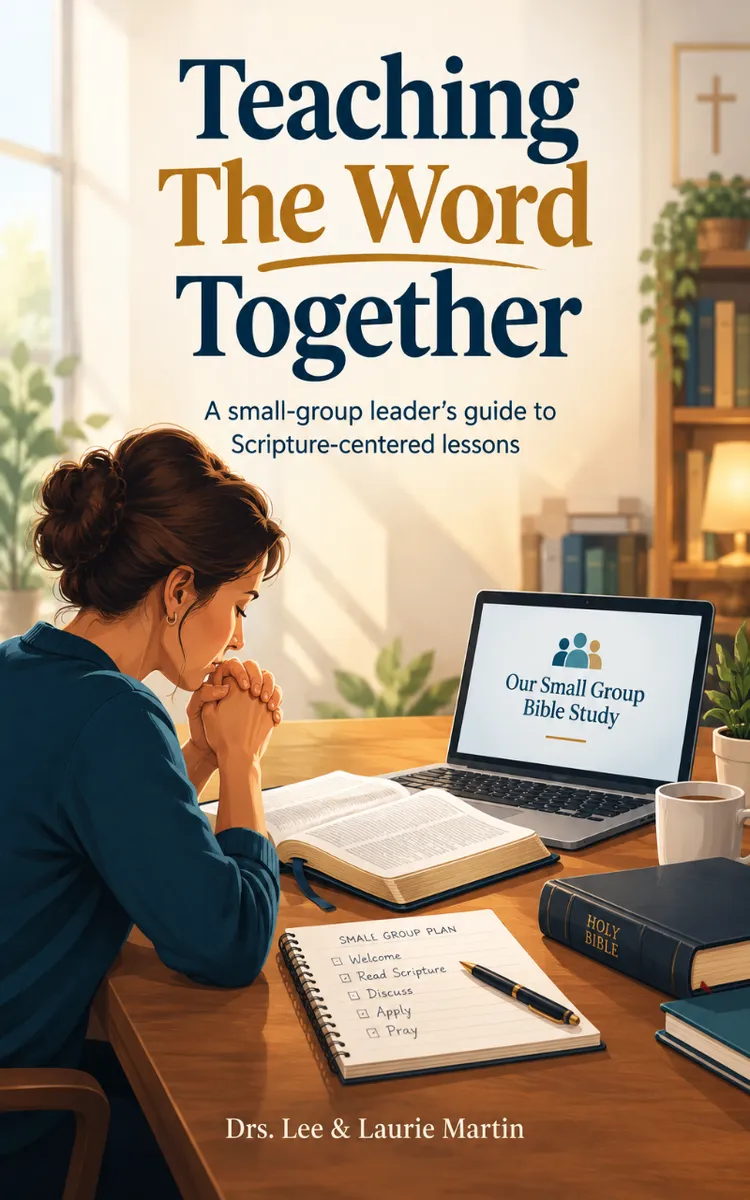
"Teaching The Word Together" is a how-to guide book by Drs. Lee & Laurie Martin with 8 chapters and approximately 15,845 words. Designing interactive, participatory Bible lessons for small groups.
This book was created using Inkfluence AI, an AI-powered book generation platform that helps authors write, design, and publish complete books. It was made with the AI Ebook Generator.
Frequently Asked Questions
What is "Teaching The Word Together" about?
Designing interactive, participatory Bible lessons for small groups
How many chapters are in "Teaching The Word Together"?
The book contains 8 chapters and approximately 15,845 words. Topics covered include Grounding Lessons in Scripture, Praying Through Lesson Preparation, Discerning the Spirit’s Guidance, Designing a Clear Lesson Plan, and more.
Who wrote "Teaching The Word Together"?
This book was written by Drs. Lee & Laurie Martin and created using Inkfluence AI, an AI book generation platform that helps authors write, design, and publish books.
How can I create a similar how-to guide book?
You can create your own how-to guide book using Inkfluence AI. Describe your idea, choose your style, and the AI writes the full book for you. It's free to start.
Write your own how-to guide book with AI
Describe your idea and Inkfluence writes the whole thing. Free to start.
Start writingCreated with Inkfluence AI


