

Read the first chapter
The whole of chapter one, free. About 29 min. Turn the pages with the arrows, your keyboard, or a swipe.
Chapter 1
How Trump Won the 2016 Republican Nomination
Verbal Attacks on His Primary Campaign Challengers
To my surprise and seemingly everyone’s surprise, Donald J. Trump won the 2016 presidential election. Those who voted for Trump were every bit as surprised as were Hillary’s supporters. Officially, the Electoral College voting results were 232 for Hillary Clinton; 306 for Donald J. Trump. Clinton received 2.87 million more votes than Trump did (48 percent to Trump’s 46 percent). Ultimately, Trump received 304 electoral votes, and Clinton, 227, as two faithless electors defected from Trump and five defected from Clinton.
With seventeen Republican primary candidates showing the nasty nature of today’s political campaigns, using negative attack ads against everyone, including one another, most Americans tuned them out. This was the largest presidential primary field for any political party in American history at the time. The Democratic primary had very few candidates running and only two serious contenders, Hillary Clinton and socialist Bernie Sanders.
Most Republican voters had little interest in what established politicians were saying. The country was fed up with a do-nothing, highly partisan Congress. Almost all the people I know spoke of being so tired of feeling the ineffectiveness of our government that they listened intently to someone who “talked like they do.” To them, Trump appeared to be a really interesting person and also a seemingly very successful businessman. This appealed to dissatisfied voters to elect someone who was not tied to a specific party’s agenda.
The long list of Republican primary candidates, whose performances in office had tired voters, did not offer much competition against Trump. Donald Trump had a story to sell to the public, and he did so in very unconventional ways. This was an act that actually appealed to many people of all walks of life. He attacked his opposition in malicious ways. He used demeaning names for most and used disparaging information against those most threatening to him. This pseudo-macho appearance, with his talk of being the law-and-order president, resonated with many voters who were tired of all the dissension we see every day from our two-party system.
Trump’s overwhelming popularity with his devoted supporters gave the Republican Party notice. His surprising popularity showed that the GOP was now committed to Trump as their leader, but with much apprehension initially. Remember how Trump made fun of his opposing candidates and also criticized the Republican Party’s foreign policy strategy under the Bush–Cheney eight-year administration. He attacked Florida governor Jeb Bush, whom he saw as the favored candidate, using their family history of involvement in the highly contentious Iraq War.
Another real threat to Trump’s election was Marco Rubio, whom Trump liked to call “little Marco.” Trump’s campaign aired a television ad in Florida that repeatedly labeled the state’s Sen. Marco Rubio as “corrupt” and accused the senator of “defrauding the people of Florida.” The ad mentioned that as a state lawmaker, Rubio was accused of changing his vote on an issue after he sold his house to the mother of a lobbyist. Rubio said this is “categorically false” because the deal was “an arm’s-length transaction” that did not impact his decision. While serving in the Florida legislature, Rubio was also caught using a Republican Party credit card to pay for paving his driveway, which he said was a mistake that he corrected. The ad further stated that he double-billed the state and the party for airline tickets, which he also said was a mistake. The ad called Rubio “a total no-show in the US Senate, worst voting record of all.”
In releasing the ad, Trump included a statement that begins with “Lightweight Senator Marco Rubio is a dishonest person. He has cheated with credit cards, and does favors for lobbyists. In my opinion, he is a total crook, and I am doing the people of Florida a great favor by further exposing him.” The statement went on to call Rubio a “puppet” for the Republican establishment and super PACs, “a choke artist,” and a “yes-man.” The ad ended with the narrator calling Rubio “another corrupt, all-talk, no-action politician,” with the word politician pronounced with extreme disgust. The ad features solemn black-and-white photos and bold red lettering. Marco Rubio suspended his campaign on March 15, 2016, after finishing a distant second in Florida’s primary.
Trump’s attacks on his closest rival Ted Cruz were the most vicious, as were Cruz’s in return. Trump and Ted Cruz, who eventually dropped out of the GOP primary in May of 2016, attacked each other’s wives, citizenship, religious faith, and integrity. They even threatened to sue each other for accusations of lying and cheating. They attacked each other fourteen times in very nasty ways. Trump tweeted that “Lyin’ Ted Cruz just used a picture of Melania from a GQ shoot in his ad. Be careful, Lyin’ Ted, or I will spill the beans on your wife!” The tweet came after an anti-Trump group that wasn’t controlled by Cruz ran an ad in Utah featuring a provocative picture of Melania, a former model, from a GQ photo shoot more than a decade ago. Trump implied that Cruz’s wife, Heidi, was responsible for the provocation Trump felt.
Heidi Cruz, who earned a master’s in European business from Solvay Brussels School of Economics and Management of the Université Libre de Bruxelles in Brussels, Belgium, and a second MBA from Harvard Business School, was active at the time in her husband’s primary campaign. She previously worked as an economic policy director on the Bush presidential campaign and later worked for the Bush administration in several high-level capacities.
Trump kicked the insults up a notch by retweeting a composite image featuring an unflattering photo of Heidi next to a photo of Melania. “No need to ‘spill the beans,’” a caption on the image read. “The images are worth a thousand words.” The senator’s wife hit back at Trump on the campaign trail in Wisconsin. “Well, as you probably know by now, most of the things, many of the things others say are not based in reality,” Heidi Cruz said.
By March 16 of 2016, only three candidates remained in the race: Trump, Cruz, and Kasich. Cruz won the most delegates in four Western contests and in Wisconsin, keeping a credible path to denying Trump the nomination on the first ballot with 1,237 delegates. Trump then increased his lead by scoring landslide victories in New York and five Northeastern states in April, followed by a decisive victory in Indiana in early May, securing all fifty-seven of the state’s delegates. Without any further chances of forcing a contested convention, both Cruz and Kasich suspended their campaigns. Trump remained the only active candidate and was declared the presumptive Republican nominee by Republican National Committee chairman Reince Priebus on the evening of May 3, 2016.
By October 2018, Trump decided that he and Cruz needed each other. Cruz was no longer “lyin’ Ted”—his notorious nickname for the senator during the campaign—and was now “beautiful Ted.” The president made the announcement ahead of a campaign rally he hosted in Texas to support Cruz’s tough reelection bid. This says a lot about politicians who will do whatever is necessary to hold their political positions of power within our government.
The Electoral College
The Electoral College was never intended to be the “perfect” system for picking the president. It was a compromise created as a solution to two different concerns. One group of delegates felt strongly that Congress shouldn’t have anything to do with picking the president. Too much opportunity for corruption between closely aligned members of the executive and legislative branches. At the time, no other country in the world directly elected its chief executive, so the delegates were looking into uncharted territory. Further complicating the task was a deep-rooted distrust of executive power. After all, the fledgling nation had just fought its way out from under a tyrannical king and overreaching colonial governors. They didn’t want another despot ruling our country.
Others among our forefathers were dead set against letting the people elect the president by a straight popular vote. First, they thought eighteenth-century voters lacked the resources to be fully informed about the candidates, especially in rural outposts. Second, they feared a large, headstrong group with the intent on steering the country astray. And third, a populist president appealing directly to the people could command dangerous amounts of power. Did our forefathers predict exactly what gravely concerns our country today?
Out of those drawn-out debates came a compromise based on the idea of having electoral intermediaries. These intermediaries wouldn’t be picked by Congress or elected by the people. Instead, the states would each appoint independent “electors” who would cast the actual ballots for the presidency. State legislatures are responsible for nominating electors. The process can actually differ from state to state, but in general, there are two most common ways. The first way is by nominating a representative elector by his or her state party committee. Many are picked as a reward for their many years of service to the party. A second way is by the elector campaigning for a spot, with the decision being made during a vote held at the state’s party convention.
Usually, electors are people who are politically active in their party or connected to the political system. This includes political activists, party leaders, elected officials of the state, and even people who have personal or political ties to the presidential candidates. To me, choosing someone who has personal ties to the president-elect is troublesome. This final way of electing a president by members of the Electoral College means that a president who was not the strongest choice of the American people could be elected. Therefore, members of the Electoral College could decide to support an opponent instead of whom you’ve helped elect by casting your presidential vote.
Five times in history, presidential candidates have won the popular vote but lost the Electoral College. This has led some to question why Americans use this system to elect their presidents in the first place. The system calls for the creation, every four years, of a temporary group of electors equal to the total number of representatives in Congress. Technically, it is these electors, and not the American people, who vote for the president. In modern elections, the first candidate to get 270 of the 538 total electoral votes wins the presidency.
This is what happened in favor of Donald Trump and against Hillary Clinton, who won the popular vote by almost 2.9 million votes, with 65,844,954 (48.2 percent) to his 62,979,879 (46.1 percent), according to revised and certified final election results from all 50 states and the District of Columbia.
The 2016 election was the first in over a hundred years in which multiple electors worked to alter the result of the election. This resulted in their being seven successfully cast opposition votes. The Democratic Party nominee, Hillary Clinton, lost five of her pledged electors, four from the state of Washington and one from Hawaii. The Republican Party nominee, Donald Trump, lost two, both from the state of Texas.
The final state totals of the Electoral College resulted in Trump receiving 306 and Clinton 232 votes. Trump won 30 states, with Clinton only 20 states. The defections fell well short of the number needed to change the result of the election; only 2 of the 7 defected from the winner, whereas 37 were needed to defect in order to force a contingent election in Congress (a tally of less than 270).
The morning after the November 8, 2016, election, everyone knew that Donald Trump won the election by passing the minimum requirement of 270 electoral votes with over 300 based on the number of states he predictably won. This election demonstrated that it is possible to win the Electoral College but lose the popular vote. This has happened only in 2016, in 2000, and three times in the 1800s. George W. Bush won in 2000 and now Trump in 2016. Some of the writers of our Constitution worried about this happening, with the possibility that someone unfit to be president may be chosen by these electors.
This dilemma was addressed in The Federalist Papers essay number 68, in which Alexander Hamilton wrote that electors had a constitutional duty to make sure “that the office of President will never fall to the lot of any man who is not in an eminent degree endowed with the requisite qualifications.” It also encouraged electors to thwart the election of any president who might serve as a vessel for “the desire in foreign powers to gain an improper ascendant in our councils.”
This dilemma wasn’t properly recognized in 2016. Wasn’t Donald Trump elected by the people because they thought of him as an ordinary citizen like themselves, making him unqualified? Further consider that, as a businessman, he had financial dealings with countries that are not always friendly to American interests.
The Federalist Papers is a collection of 85 articles and essays written by Alexander Hamilton, James Madison, and John Jay under the collective pseudonym Publius to promote the ratification of the United States Constitution. Federal judges, when interpreting the Constitution, frequently use The Federalist Papers as a contemporary account of the intentions of the framers and ratifiers. The Federalist had been quoted 291 times in Supreme Court decisions. In addition to laying out the many ways in which they believed the Articles of Confederation didn’t work, Hamilton, Jay, and Madison used The Federalist essays to explain key provisions of the proposed Constitution, as well as the nature of the republican form of government.
Much of America was quite disturbed by the results of the election and tried to put as much pressure on the members of the Electoral College to vote against their state’s popular vote. On December 14, the Unite for America campaign released a video published on YouTube and other media directly pleading to Republican electors, urging them to vote for a Republican other than Donald Trump for president. The video featured numerous public figures, including Debra Messing, Martin Sheen, and Bob Odenkirk, urging Republican electors to prevent a Trump presidency, expressing several times the message “I’m not asking you to vote for Hillary Clinton.” In electing an alternative Republican, the featured speakers asked the electors to become an “American hero” by using the electors’ constitutional “authority” to give “service and patriotism to the American people” through a vote of “conscience.”
This pressure on the Electoral College members from the Democratic side was met with even greater pressure from the Republican side. The Republican National Committee mounted an expansive whip operation to ensure that all those electors selected to vote for the Republican nominee indeed did so. According to one member of the Electoral College who spoke under the condition of anonymity, Donald Trump’s campaign was pressuring Republican electors into voting for them under “threats of political reprisal.”
The elector emphasized that these reports had come straight from the Republican electors themselves, with the threats steering clear of violence but instead focusing on “career pressure.” “It’s all political, basically,” the elector said. “If Trump becomes the president, he’s going to be able to put pressure on the state parties, and they won’t be involved anymore.” On December 14, the day of their voting, multiple Republican members of the Electoral College stated under condition of anonymity that they were threatened to vote for Donald Trump. They received “threats of political reprisal,” adding that the Donald Trump campaign was putting pressure on Republican electors to vote for him because their political future was based on whether or not they did.
Looking back on George Bush’s 2000 election, which is considered one of the closest elections in US history, ending with the state of Florida being the controversial deciding factor, the returns showed that Bush had won Florida by such a close margin that state law required a recount. A month-long series of legal battles led to the highly controversial 5–4 Supreme Court decision Bush v. Gore, which ended the recount. The recount having been ended, Bush won Florida by 537 votes, a margin of 0.009 percent. Ultimately, Bush won 271 electoral votes, one more than a majority, despite Gore receiving 543,895 more votes (a margin of 0.51 percent of all votes cast).
His Primary Campaign Strategy—Rallies
Trump’s campaign methods resonated with American voters through the use of social media and his primary rallies. When his growing following expressed the feeling that “he is like us,” they got the impression he was for their common beliefs and was not a politician. He got their attention by saying the things that they wanted to hear and by the way he acted when in the eye of a camera. Voters were fed up with all the established politicians who were so polarized that they have not performed in the best interests of everyday working Americans.
Having a successful businessman as president was very appealing. Why not have our government run like a successful business? The answer to this question is one that needs to be fully understood. Will a very successful real estate magnate govern in our best interests? Will his business practices and experiences be good for government? What does he know about foreign policy and the history of our alliances with foreign nations?
Although Donald Trump was so unexpectedly elected president, the many reasons for his successful campaign are still being debated to this day, and history will be the final judge of his presidency. His abundant use of social media to appeal to America was unique in method and prominent in his campaign. Throughout his presidency, Trump used these rallies as a never-ending platform for fundraising.
It would be an eye-opening experience for anyone who is willing to take the time and interest to use their DVR to record and play back President Trump’s rallies. The interaction between Trump and his ardent followers is very revealing when you’re watching everyone wildly applauding his exaggerated accomplishments, most of which are not of his making and verifiably false. Because Trump’s rallies are televised and used as his personal show, his misleading statements, hyperbole, and outright lies were seen as totally believable by his audience. In watching many of these performances, I believe that his backdrop of supporters shown behind Trump’s podium are repeat attendees. Like a TV show’s audience, Trump’s programmers place the people who appear before the cameras who are willing to cheer gleefully while displaying signs of support and gladly applaud his ridicule of opponents.
What is most alarming at Trump’s political rallies is seeing how the audience has been captively influenced by disproven conspiracy theories that have been continually promoted by right-wing conservative TV, radio, and news reporters. They hold up signs displaying QAnon, considered to be a cult of far-right political conspiracy theories and a mass political movement. The original posts associated with QAnon conspiracy theories appeared in late October 2017, purporting to be from a Trump insider with Q security clearance who said Hillary Clinton faced arrest and her allies were running a massive child-sex ring.
From November 2017 on, QAnon was the single most frequent hashtag tweeted by accounts that Twitter has since identified as Russian backed, a Reuters analysis of the archive shows, with the term used some seventeen thousand times. A Q clearance or Q access authorization, is the United States Department of Energy (DOE) security clearance required to access top-secret restricted data. Followers of these conspiracy theories say that Trump was planning mass arrests and executions of thousands of cabal members on a day known as the Storm or the Event. QAnon supporters have named Hollywood actors, Democrat politicians, high-ranking government officials, business tycoons and medical experts as members of the cabal.
Unfortunately, I believe that most of the people who go to these political rallies believe in what he is saying. They hear these same things on Fox News and don’t take the time to watch other reports by mainstream media. I’ve come to believe that Trump does say different things that contradict what he said before. Who has the time to find out who is right when we seem to accept that all politicians lie?
As it later turns out for Trump’s 2020 reelection campaign, Facebook now claims the group QAnon was removed for repeatedly posting content that violated its policies. The deleted Facebook group, called Official Q/QAnon, had nearly two hundred thousand members. However, there are many other QAnon groups that are currently still active on the platform. QAnon followers are mainly supporters of Trump and his policies. In July 2020, both Twitter and TikTok also cracked down on QAnon content. Twitter banned thousands of accounts and said it would block QAnon URLs, while TikTok deleted hashtags that signposted QAnon videos. Reuters reported that Official Q / QAnon “crossed the line” on bullying, harassment, hate speech, and the sharing of potentially harmful misinformation. The FBI issued a warning about “conspiracy theory-driven domestic extremists” and designated QAnon a potential domestic extremist threat.
What might be the most frightening aspect of Trump’s public appearances is his constant demeaning of all who disagree with him, for he is “the only one who can solve America’s problems.” The total irony is that he is responsible for the hatred that has caused family members to oppose and openly argue with each other to the point of alienation. Worse yet is his promoting that his followers are the real Americans and that all foreigners hate us and are in our country to take advantage of our “socialism” type of benefits that they don’t deserve. This is especially true of Medicaid benefits for the truly needy. He constantly claims that all his disfavored foreign nations hate America or are jealous of American democracy and that immigrants from these countries are illegal anarchists, rapists, and murderers.
When I listen to the chants of “lock her up,” meaning Hillary Clinton, from his MAGA audience, I get sick to my stomach. This is an extreme pronouncement that he promotes to destroy Hillary Clinton in the minds of voters. There is no evidence of any criminal wrongdoing by his political opponent, only the distorted versions of what takes place during congressional hearings. These sound bites that are constantly parroted over the airwaves become fact depending on whether you are getting your information from left-leaning channels or right-favored channels.
It would be wonderful if we Americans showed greater concern for understanding the complexities of our country’s problems and looked for the truth within the conflicting news stories which so greatly affect our lives. How much time is spent with our congressional representatives actually working together to develop legislation that is logically laid out in enough detail to prevent loopholes of abuse by people who will take advantage of every opportunity they think they can get away with? Look at how so many people today are involved in scamming the government and, sadly, vulnerable, trusting people of all ages and circumstances.
We need to listen to both sides of a conflicting government legislation, but first we need to understand how our government functions. When candidate Donald Trump tells you that he will build a wall all across our southern border and that Mexico will pay for it, how is that something he can actually accomplish? This is also true if a Democrat presidential candidate declares that they will remove the right of ownership of all weapons that they consider capable of mass destruction. What does that actually mean? This must be precisely defined by our legislators working together to understand the cause of the problem in conjunction with the solution.
We have three decidedly coequal branches of government: the executive, legislative, and judicial. Each branch of our government has been given certain powers under the US Constitution, in order to form a system of checks and balances over one another. No president should have the right to usurp control over the other branches of our government. This is what makes campaign promises suspect in nature and creates demand for individual research on an important issue with a definite need for fact-checking. Our government needs to function in a system that does not work solely for the interests of the wealthy, nor is it a permanent system of support for the needy. Our government was designed as a system of democracy that benefits all of us fairly.
Another advantage that Trump and all Republican candidates had is in the fact that many voters were primarily concerned with a single issue and voted only for those who support that principle belief. Strong examples are gun rights, as previously mentioned and the highly contentious subject of abortion rights, which has also spread as being an attack on Christianity. In reality, all religions are now under attack in our country that pledges the freedom of religion. Other issues that made people believe in choosing the Republican Party are their belief in the free enterprise system and not having the government spending their tax dollars on the hated idea of socialism. Let’s talk about these issues.
The Right to Bear Arms
You will always hear that if you vote for a Democrat, they will take away your guns. This is nonsense and should not be the only deciding factor in your voting decision. Please acknowledge the fact that legislation that takes away the right of citizens to protect themselves, their family, and home, or for hunting and target shooting, will never be passed.
In 2008, the Supreme Court ruled on the Second Amendment for the first time in almost seventy years after Dick Heller sued the District of Columbia over its ban on handguns in the home. The court ruled in Heller’s favor, affirming an individual right to keep handguns in the home for self-defense. However, in that Supreme Court ruling, Justice Scalia said, “Like most rights, the right secured by the Second Amendment is not unlimited.” It is “not a right to keep and carry any weapon whatsoever in any manner whatsoever and for whatever purpose.”
With gun ownership comes responsibility for the actions taken with all weapons you possess. Guns are purchased for variously reasons, and all of them present a danger for anyone being near someone else who is carrying. Democrats don’t want to lose your vote by passing sweeping gun-restricting legislation. When voting for an individual to serve in any federal government position, you need to look closely at all other candidates and understand exactly what they stand for and, just as importantly, their character.
Everyone purchasing a gun has some discretion as to its usage and should be able to enjoy the feeling this freedom offers. The problem that non–gun owners see with those who possess guns is knowing a neighbor who possesses a weapon and is seen as being irresponsible and of short temper in disagreement. That individual is perceived as a potential danger to their family. Even when a neighbor is a close friend and feels comfortable handling guns, you still always worry about what may happen if the weapon falls into the hands of someone else who is dangerous. There is a definite need, given the volatile state of today’s society, for sensible gun legislation.
A handgun is no match against a rifle, for it isn’t anywhere near as accurate. A hunting rifle is no match against a semiautomatic rifle, which is designed for a rapid and continuous deadly attack due to the automatic chambering of rounds after each trigger pull. Fully automatic weapons are designed to achieve a certain purpose, mainly military assault, and should be restricted to those special purposes. Here, one pull of the trigger sends off a continuous flow of bullets until the action is interrupted. There are strict rules for gaining possession; however, rules vary from state to state, along with how closely they are regulated.
The AR15 (a semiautomatic rifle) used in Parkland and Sandy Hook school shootings, or similar models in other major attacks, has continued to prompt calls for new restrictions. Just three days after the Parkland massacre at Marjory Stoneman Douglas High School, student Emma González mustered remarkable resilience and courage when she transformed her anguish and heartbreak into unabashed activism. She delivered an impassioned speech at a gun control rally in Fort Lauderdale, calling on President Trump’s BS, other politicians, and the NRA for not tightening gun laws that could prevent “the hundreds of senseless tragedies that have occurred.” Her speech was broadcast nationally. Research and listen to these Florida students who spoke so eloquently about the warlike, destructive nature of what they witnessed.
Experts say there is one element of an assault weapons ban that could make a concrete difference in mass shootings: restricting large-capacity magazines, which the original bill limited to ten rounds. The shooter who killed twelve people and shot fifty-eight others at a movie theater in Aurora, Colorado, in 2012 used a hundred-round drum magazine, for example, which prompted Colorado legislators to ban magazines that carry over fifteen bullets. Louis J. Klarevas, who researched five decades of mass shootings for his book Rampage Nation, concluded that “the factor most associated with high death tolls in gun massacres is the use of a magazine holding more than ten bullets.”
The issue of gun rights is a very effective campaign issue for the Republican Party with their instilling fear into the populace of restriction that won’t stop. Every time there is a mass shooting, the topic of gun restriction becomes news. Gun dealerships become overwhelmed with buyers in a state of panic. We now even see on the dark web the sale of bump stocks and ghost guns. Some semiautomatic rifles like the AR-15 can be privately modified to become a fully automatic assault-type rifle by using devices such as bump stocks. Bump-stock-type devices allow a semiautomatic firearm to shoot more than one shot with a single pull of the trigger and continue firing without additional physical manipulation of the trigger by the shooter.
On October 1, 2017, a gunman used bump stocks to fire into a crowd in Las Vegas, killing 58 people and injuring hundreds. The gunman, Stephen Paddock, opened fire on the Route 91 Harvest music festival from the 32nd floor of the Mandalay Bay Resort and Casino. Investigators later determined 422 people suffered injuries as a direct result of gunfire, while another 851 individuals suffered other injuries during the attack.
To his credit, Pres. Donald Trump vowed to outlaw bump stocks shortly after the Las Vegas shooting. But some lawmakers and some gun lobbyists resisted, making any new legislation unlikely. That made a regulatory change the only realistic path to accomplishing the president’s goal. At Trump’s direction, the Justice Department in March 2018 proposed a rule clarifying that bump stocks were not merely parts, but instead were “machine guns”—what the federal government calls fully automatic weapons—as defined by existing law. Civilian possession of fully automatic weapons was outlawed in 1986 except for those already lawfully in people’s ownership; this is called the grandfather clause.
Religion—Abortion a Fierce Religious Dilemma
The subject of abortion is a deeply held religious conviction that voters are more adamant about when selecting someone into government office than any other national issue. It is an issue that everyone needs to understand should not be the only reason for choosing a political candidate. This is especially true in a presidential election. Politicians will say whatever they believe will get them elected. After all, Trump was never a pro-life antiabortion advocate until he ran for president. His religious values seem to be confined to his speeches and not in his real-life practices, with having three different wives and known extramarital affairs. His penchant for lies, distortion of facts, and his apparent inability to express compassion for others are contradictory to having a religion-based belief system.
I personally have great respect for all those who are determined and willing to accept the birthright responsibility of having a child, regardless of what a doctor may foresee as a difficult birth that may result in having a less than normal child. That is their right and should be respected by others for the challenges the family faces. The same respect needs also to be given to those who choose not to give birth due to their personal circumstances during that time in their life. God gave us the freedom of choice, the ability to make our own decisions regardless of the consequences.
But who is to judge the right or wrong of these decisions? Creation is a religious concept that greatly differs among each religious sect. Our Constitution gives us our freedom of religion, and our government does not have the right to legislate for or against religious doctrine. What authority has the right to force an individual to do something that they know is too much for them to handle either physically or mentally, or most likely both ways?
Unfortunately, certain groups of religiously committed people have forced legislation on others that restricts their ability to prevent a birth, although they have no intimate knowledge as to why others may wrestle with making that crucial decision. Antiabortion advocates state that the sonogram taken of a fetus scientifically shows a human life occurs at birth. Fetal “heartbeat” bills have become the antiabortion legislative measure of choice in the US war on sexual and reproductive health and rights (SRHR). The antiabortion movement has regularly used ultrasonic imagery dating back to The Silent Scream, the influential 1984 film that depicts an abortion in progress.
The National Right to Life Committee (NRLC) was formally incorporated in May 1973 in response to the US Supreme Court Roe v. Wade decision (which struck down most state laws in the United States restricting abortion in the first trimester of pregnancy). The NRLC was formed in 1968 under the auspices of the National Conference of Catholic Bishops (NCCB) to coordinate information and strategy between emerging state antiabortion groups. The NCCB launched into a campaign to amend the United States Constitution with the enactment of a Human Life Amendment seeking not only to overturn the Roe v. Wade decision, but to also forbid both Congress and the states from legalizing abortion within the United States.
In more recent years, states have passed a range of regulations regarding ultrasound procedures in order to gain more control over abortion care. Abortion rights opponents have promoted ultrasound viewing, believing that women who view their own ultrasound images are likely to be dissuaded from abortion. Abortion rights advocates, in contrast, routinely oppose these regulations, citing concerns that ultrasound viewing in the abortion context will be emotionally difficult for women.
In May of 2011, Texas passed a bill that women seeking an abortion will have to view a picture of the embryo or fetus and hear a description of its development before having the procedure. The law became effective on September 1. Despite the controversy, this bill in Texas easily passed through the state house and senate, both of which are controlled by Republicans. It was signed into law by then Gov. Rick Perry, also a Republican.
The law says that at least twenty-four hours before an abortion is performed, women must undergo a sonogram, which is a procedure that uses ultrasound to create an image. Then a doctor is required to give, “in a manner understandable to a layperson, a verbal explanation of the results of the sonogram images, including a medical description of the dimensions of the embryo or fetus, the presence of cardiac activity, and the presence of external members and internal organs,” the law states.
In 2019, Georgia House Bill 481 (HB 481) passed by a narrow margin, banning abortions upon detection of embryonic cardiac activity, as early as six weeks gestation. The purpose of this study was to distinguish and characterize the arguments and tactics used by legislators and community members in support of Georgia’s early abortion ban. The following is according to the National Right to Life Committee Inc. under the heading “Window into the Womb: A Guide to State Laws on Ultrasound” (updated September 17, 2019).
Five states require that an ultrasound be performed prior to an abortion. The screen must be displayed so the mother can view it, and a description of the image of the unborn child must be given. They are Kentucky, Louisiana, North Carolina, Texas, and Wisconsin. Six states require that an ultrasound be performed and that the mother be offered the opportunity to view the ultrasound. They are Alabama, Arizona, Florida, Iowa, Mississippi, and Virginia. Twelve states require that the mother be provided with an opportunity to view an ultrasound if ultrasound is used as part of the abortion process. They are Arkansas, Georgia, Idaho, Kansas, Michigan, Nebraska, Ohio, Oklahoma, South Carolina, Tennessee, Utah, and West Virginia. Five states require that the mother be provided with the opportunity to view an ultrasound. They are Indiana, [1] Missouri, North Dakota, South Dakota, and Wyoming.
[1] North Carolina and Indiana are currently in litigation.
Under pressure from organizations like the National Right to Life Committee (NRLC), some conservative-leaning state governments actually passed legislation that anyone seeking an abortion must have an ultrasound. Some states have even forced expectant mothers to view the images of the developing fetus and listen to the pulsing of the heartbeat. How audacious is that? This type of law was conceived and passed into law purely on the belief that this would pressure a woman, already suffering a stressful period in their life, not to have the abortion.
In some instances, the ultrasounds have affected women in ways not intended by antiabortion strategists. Because human features may barely be detectable during much of the first trimester, when nine of ten abortions are performed, some women find viewing the images reassuring. This is why some states require the ultrasound technician to explain what they believe is happening with the fetal movements and point out what the birth mother is seeing. This makes the reality that a fetus will result in a healthy baby more effective in the mind of anyone contemplating the need for an abortion.
End of chapter one. 14 more chapters and about 161,886 words in the full book.
Swipe or use the arrows to turn the page
What's inside: 15 chapters
- 1. How Trump Won the 2016 Republican Nomination
- 2. The GOP’s All-Out Attack on Hillary Clinton
- 3. The Republican-Controlled House of Representatives
- 4. Hillary Clinton’s Emails
- 5. Russian Election Interference and Social Media
- 6. The Russian Influence on the Trump Campaign
- 7. House Intelligence Committee under Chairman Devin Nunes
- 8. The Trump Tower Meeting in New York City
- 9. Donald Trump’s Cabinet Appointments
- 10. Trump’s A List of Appointments
- 11. House and Senate Intelligence Investigations (2018)
- 12. Special Counsel Mueller Investigation
- 13. The Role of Fox News and Conservative Media
- 14. Epilogue
- 15. Conversations with Trump Supporters—Part 1
About this book
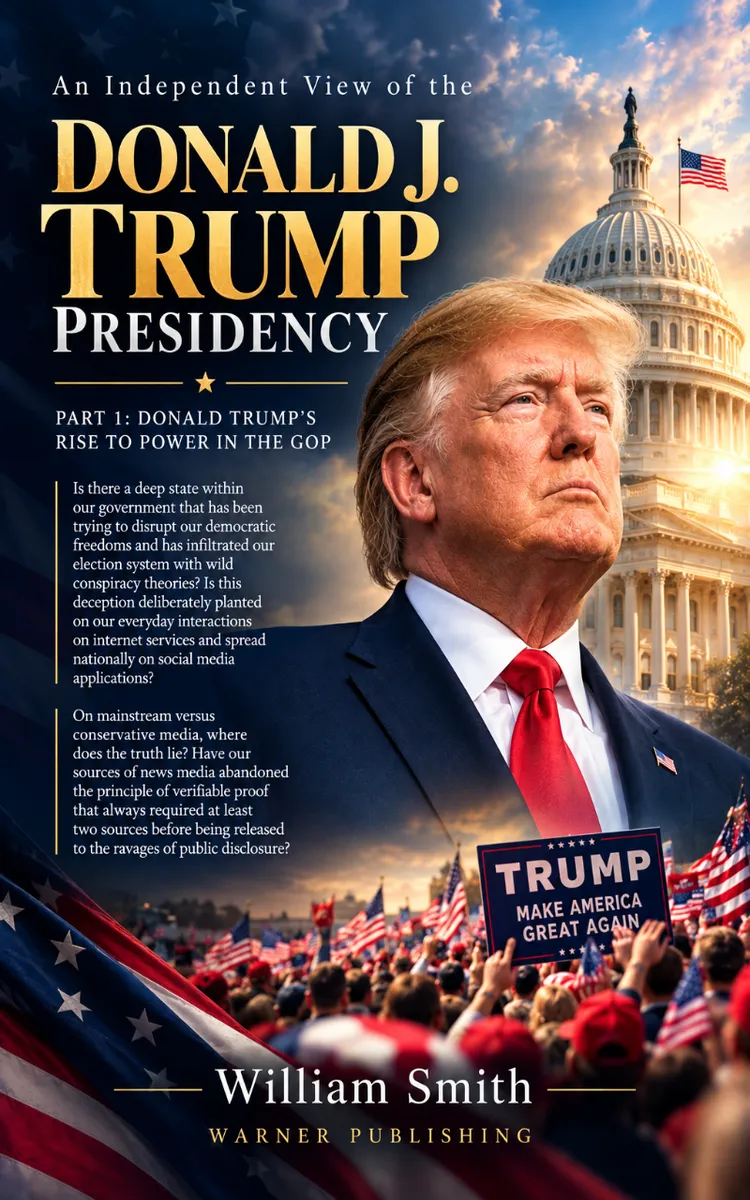
"An Independent View of the Donald J. Trump Presidency" is a biography book by William Smith with 15 chapters and approximately 161,886 words. It covers key insights and practical takeaways on the topic.
This book was created using Inkfluence AI, an AI-powered book generation platform that helps authors write, design, and publish complete books. It was made with the AI Biography Writer.
Frequently Asked Questions
What is "An Independent View of the Donald J. Trump Presidency" about?
"An Independent View of the Donald J. Trump Presidency" is a biography book by William Smith covering key insights and practical takeaways on the topic.
How many chapters are in "An Independent View of the Donald J. Trump Presidency"?
The book contains 15 chapters and approximately 161,886 words. Topics covered include How Trump Won the 2016 Republican Nomination, The GOP’s All-Out Attack on Hillary Clinton, The Republican-Controlled House of Representatives, Hillary Clinton’s Emails, and more.
Who wrote "An Independent View of the Donald J. Trump Presidency"?
This book was written by William Smith and created using Inkfluence AI, an AI book generation platform that helps authors write, design, and publish books.
How can I create a similar biography book?
You can create your own biography book using Inkfluence AI. Describe your idea, choose your style, and the AI writes the full book for you. It's free to start.
Write your own biography book with AI
Describe your idea and Inkfluence writes the whole thing. Free to start.
Start writingCreated with Inkfluence AI


