
Read the first chapter
The whole of chapter one, free. About 4 min. Turn the pages with the arrows, your keyboard, or a swipe.
Chapter 1
A Childhood Without a Father
The first thing Kevin remembered about his father was not a face, but an absence.
He had been two months old when the man left. Kevin learned this from his mother years later, in the family home where the walls were thin and every private sorrow seemed to pass through them. By the time Kevin was old enough to ask questions, there was no photograph on the wall, no folded letter in a drawer, and no familiar voice waiting behind the door. His father had gone before Kevin could know what it meant to be left.
The house continued without him. His mother carried on as best she could, though the household was marked by instability from the beginning. There were days when food was measured carefully and days when the rooms felt crowded with silence. His mother had become involved with a stranger, and from that relationship came a child who was not Kevin’s responsibility by birth, but gradually became his responsibility in every way that mattered.
Kevin grew up watching adults make choices and children carry their weight.
At school, he tried to keep his attention on his lessons. The wooden desk pressed against his knees, and the smell of chalk dust clung to the warm air. He liked the order of the classroom. Books opened to pages that stayed where they were placed. Numbers followed rules. A teacher’s explanation could be listened to, understood, and carried home.
For a while, school gave Kevin a place where his future seemed to belong to him.
At home, the future belonged to whoever needed him most.
He was fifteen when the difference became impossible to ignore. The child his mother had outside marriage needed food, clothing, and care. His mother could not provide enough on her own. Kevin had already been helping in small ways, but small ways no longer covered what the household required. The need had grown larger than his schoolbag.
One morning, he sat at the edge of his bed with his uniform folded beside him. The fabric was worn at the elbows. His books rested on the floor, their pages bent from use. From the other room came the thin sounds of the younger child, followed by his mother moving across the floor.
Kevin touched one of the books. He thought about the lessons he would miss and the classmates who would ask why he was no longer there. He thought about the road to school, the dust rising beneath his shoes, and the quiet hope he had carried without telling anyone.
Then he looked toward the room where the child was crying.
His mother appeared in the doorway. Her face was tired, and she did not need to explain the situation. Kevin had understood it for years.
“You cannot go today,” she told him.
He kept his hand on the book. “For how long?”
She lowered her eyes. “Until things improve.”
Kevin knew what those words meant. In their home, “until things improve” had no clear date. It could mean weeks, months, or the rest of a childhood.
“I need to work,” he said.
His mother did not answer immediately. The silence between them held shame, fear, and the helplessness of someone asking a child to become older than he was.
“I know,” she said at last.
That was all. There was no ceremony for the end of his education. No final lesson, no farewell from a teacher, no opportunity to close the door with dignity. Kevin folded his uniform and placed it back where he had found it. The book remained on the floor for a while, open to a page he could no longer afford to finish.
He began earning wherever work was available near the family home. The workplace was louder than the classroom and less forgiving. Tools struck against hard surfaces. Feet moved constantly across packed ground. Sweat gathered under his shirt, and the smell of dust, oil, and old wood followed him home.
At first, Kevin tried to think of the work as temporary. He told himself that he would return to school when the household became stable. He held on to that hope because surrendering it would have made the sacrifice final.
Each day, however, made returning more difficult.
He left home early and came back tired. His hands became rough. His body learned the weight of labor before his mind had finished learning what kind of man he wanted to become. The money he earned passed quickly from his hands to household needs. Food came first. Then clothing. Then whatever small necessity could not wait.
He did not complain. Complaining would not fill a plate.
Sometimes, when he returned, his mother asked how the work had gone.
“It was fine,” he would say.
She would look at his hands. “Are you sure?”
Kevin nodded. “I can manage.”
He said it because she needed to hear it. He also said it because he needed to believe it.
Yet managing was not the same as being ready. Kevin was still fifteen. He still wanted the ordinary things other students seemed to possess without asking for them: time to study, a future chosen slowly, and the belief that someone older would protect him when the world became too heavy.
His father’s absence lived inside each of those wants.
Kevin did not know the man who had left him, but he knew what the leaving had done. It had forced his mother to carry more than she could bear, and it had made Kevin suspicious of promises he had not yet received. He feared becoming like the father he had never known. The fear was not about blood alone. It was about responsibility. If a man could walk away from his own child, what kept any man from doing the same?
End of chapter one. 4 more chapters and about 9,766 words in the full book.
Swipe or use the arrows to turn the page
What's inside: 5 chapters
- 1. A Childhood Without a Father
- 2. Running Away with Elara
- 3. Six Months Behind Bars
- 4. The Beach, the Burns, the Betrayal
- 5. Raising Three After Elara Leaves
About this book
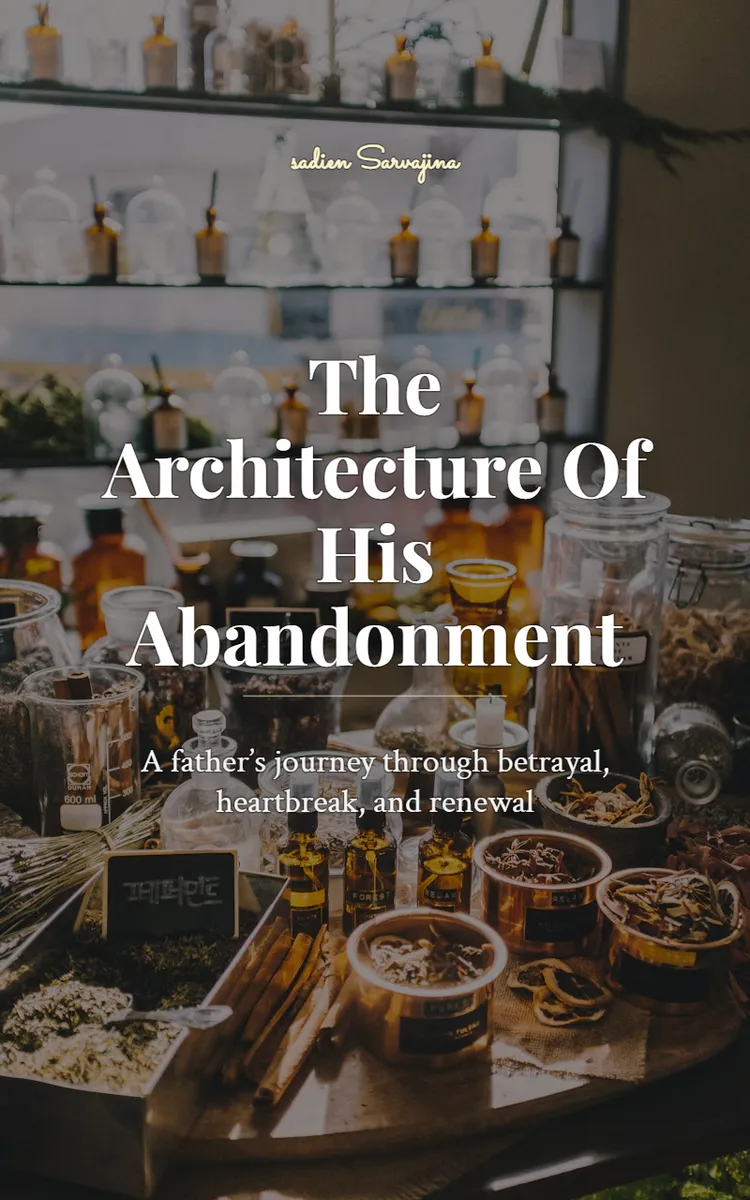
"The Architecture Of His Abandonment" is a biography book by sadien Sarvajina with 5 chapters and approximately 9,766 words. A man’s journey from childhood abandonment and marital betrayal to raising his children.
This book was created using Inkfluence AI, an AI-powered book generation platform that helps authors write, design, and publish complete books. It was made with the AI Biography Writer.
Frequently Asked Questions
What is "The Architecture Of His Abandonment" about?
A man’s journey from childhood abandonment and marital betrayal to raising his children
How many chapters are in "The Architecture Of His Abandonment"?
The book contains 5 chapters and approximately 9,766 words. Topics covered include A Childhood Without a Father, Running Away with Elara, Six Months Behind Bars, The Beach, the Burns, the Betrayal, and more.
Who wrote "The Architecture Of His Abandonment"?
This book was written by sadien Sarvajina and created using Inkfluence AI, an AI book generation platform that helps authors write, design, and publish books.
How can I create a similar biography book?
You can create your own biography book using Inkfluence AI. Describe your idea, choose your style, and the AI writes the full book for you. It's free to start.
Write your own biography book with AI
Describe your idea and Inkfluence writes the whole thing. Free to start.
Start writingCreated with Inkfluence AI


