
Read the first chapter
The whole of chapter one, free. About 8 min. Turn the pages with the arrows, your keyboard, or a swipe.
Chapter 1
Debt Inventory and Reality Check
Why a Complete Debt List Changes the Problem
Three credit card statements sit unopened on the kitchen counter. One shows a balance of $4,860. Another shows $2,175. The third carries a $980 balance, but its payment is due tomorrow. You know the debt feels serious, yet you cannot say exactly how much you owe, which card costs the most, or how much money you need this month to avoid late fees.
That uncertainty creates expensive mistakes. You might send extra money to a card with a lower interest rate while another card charges more. You might budget for the minimum payment shown on one statement and forget an annual fee, a promotional rate ending soon, or a second due date. A complete inventory replaces guesses with facts.
The Total-Score Debt Audit gives every account one clear record. You will collect each balance, interest rate, minimum payment, due date, credit limit, and account status. You will also calculate the total debt and the amount required to keep every account current. After you finish, you should be able to answer three questions without opening another statement: “How much do I owe?” “What does each account cost?” and “What must I pay, and by when?”
Build Your Total-Score Debt Audit
Gather your latest statements, banking app details, email notices, and credit reports before you start. Use a spreadsheet, a notebook, or a free budgeting app. A spreadsheet works well because it lets you add totals and sort accounts by rate or due date. Do not rely on memory. Credit card balances change daily, and a remembered number can hide a cash advance, a returned payment fee, or a recent purchase.
Record the information in one place. Create one row for every credit card, including cards with zero balances if they remain open. Use these columns:
| Account | Balance | Interest rate | Minimum payment | Due date | Credit limit | Available credit | Status | |---|---:|---:|---:|---|---:|---:|---| | Card name or last four digits | $ | % | $ | Month/day | $ | $ | Current, late, or closed |
The interest rate may appear as the Annual Percentage Rate (APR). The APR represents the yearly cost of borrowing, although the card applies interest over shorter billing periods. If the statement lists separate rates for purchases, cash advances, and balance transfers, record each one in the notes. Use the purchase rate for ordinary card spending, but do not ignore a higher cash-advance rate.
Use the Total-Score Debt Audit by completing these steps:
1. List every account. Search your wallet, email, bank statements, and credit reports for cards you rarely use. Write down the card name and last four digits so you can match each record to the correct account. 2. Enter the current balance. Use the latest posted balance, not an old statement amount. If the app shows pending charges, record them separately and note the date you checked. 3. Record every rate. Copy the purchase rate exactly. Mark promotional rates and their expiration dates because a low rate today may not last. 4. Record the minimum and due date. Enter the required payment and the exact date. A payment due on the fifth requires a different cash plan from one due on the twenty-fifth. 5. Add the credit limit and available credit. Subtract the balance from the limit when the statement does not show available credit. This helps you spot a card near its limit and identify possible reporting errors. 6. Mark the account status. Write “current,” “late,” “in collections,” or “closed,” based on the latest information. Do not guess about an account you cannot verify. Contact the card issuer and request the current status. 7. Calculate the totals. Add all balances and all minimum payments. These totals show the size of the problem and the monthly amount required to prevent new late payments.
For example, Tanya, age 34, works as a warehouse supervisor and has three maxed-out cards. Her audit shows $4,860 at 29.99%, $2,175 at 27.49%, and $980 at 31.99%. Her total balance equals $8,015. Her minimum payments add up to $265 per month. Before writing the numbers down, Tanya knew she felt short on cash. After the audit, she knew the exact amount required to keep all three accounts current and which card charged the highest rate.
The audit does not ask you to judge yourself or solve the debt immediately. It gives you a reliable starting point. Save a copy with the date at the top, such as “Debt Audit - August 12.” Update the balance after each statement closes or at least once each week during the first month. The record matters because your payoff decisions depend on accurate numbers.
Put Tanya’s Audit Into Practice
Tanya checks her three accounts on a Monday evening after receiving her paycheck. She uses the card apps and the latest statements, then enters the figures into a spreadsheet. Her goal is not to make a payment during the audit. Her goal is to see the full picture before choosing where extra money should go.
1. She identifies each account. Tanya writes down the last four digits, card name, and current status. All three accounts show “current,” so she does not need to solve a late-payment problem before reviewing payoff choices.
2. She records the balances and rates. Her spreadsheet shows Card 4421 at $4,860 and 29.99%, Card 7810 at $2,175 and 27.49%, and Card 3066 at $980 and 31.99%. The highest rate belongs to Card 3066, even though it has the smallest balance.
3. She records the payment schedule. Card 4421 requires $145 on the 18th, Card 7810 requires $75 on the 7th, and Card 3066 requires $45 on the 23rd. The total minimum equals $265. Tanya marks the dates in her phone calendar with reminders three days before each due date.
4. She checks the limits. Each card has a $5,000 limit, making the balances $140, $2,825, and $4,020 below their limits. The account with the $980 balance is not actually maxed out, which tells Tanya that her memory did not match the statements. She uses the written figures instead of the label she had been carrying in her head.
5. She checks for extra charges. Tanya finds a $39 annual fee on Card 4421 and a $25 returned-payment fee on Card 7810. She adds both to her notes and calls the issuer about the returned-payment fee. The issuer removes it after Tanya explains the payment problem and confirms a new payment method. Her updated total falls from $8,015 to $7,990.
6. She calculates the cash requirement. Tanya writes “$265 required by due dates” at the top of her monthly budget. She separates that amount from groceries, transportation, and other bills. This prevents her from treating the minimum payments as optional spending.
7. She creates a verification date. Tanya schedules another audit for the first Monday after her next statements close. She will compare the new balances with the old ones and check whether any rate, fee, or due date changed.
The expected outcome is not a debt-free balance after one evening. The expected outcome is control over the facts: $7,990 owed, three current accounts, $265 in required minimums, and Card 3066 carrying the highest rate. Tanya can now make future payoff decisions from a verified record rather than three competing memories.
Quick checklist
• Gather every statement and account app. - List every open or recently closed card. - Record the latest posted balance. - Copy each purchase rate and promotional expiration date. - Write down each minimum payment and due date. - Add credit limits and available credit. - Mark current, late, closed, or collection status. - Add all balances and minimum payments. - Check for fees, pending charges, and errors. - Date the audit and schedule the next review.
Avoid Gaps That Distort the Picture
Using the statement balance from the wrong date
A statement may show $2,400 while the account app shows $2,615 after new purchases and fees. Neither number is automatically wrong; they represent different dates. If you mix statement balances from one month with app balances from another, your total will not match any real point in time.
Do this: Choose one audit date. Record the latest posted balance for every account and note pending charges separately.
Not this: Copy one card’s old statement balance, another card’s current app balance, and a third card’s remembered balance into the same total.
Missing a card because you stopped using it
An unused card may still charge an annual fee, carry a balance-transfer amount, or show a late payment from an old billing cycle. Search your email for terms such as “statement,” “payment due,” and the names of card issuers. Check your credit reports for accounts you forgot.
Do this: Match every account on your credit report to a row in your audit. If you cannot identify an account, contact the issuer before making assumptions.
Not this: Leave an unknown account out because it does not appear in your wallet or current bank app.
Treating a promotional rate as permanent
A balance-transfer offer may show a low or zero introductory rate until a stated date. The regular rate may apply after that date, and a missed payment may end the promotion early. Record the expiration date beside the rate and set a reminder at least one month before it ends.
Do this: Write both the current promotional rate and the regular rate listed in the agreement.
Not this: Rank the debt by today’s rate without checking when that rate changes.
A complete Total-Score Debt Audit turns a pile of statements into a working map. Keep the map current, protect the money needed for every due date, and use verified balances when you decide what to do next. Once you stop guessing, every later payoff choice has a solid number behind it.
End of chapter one. 7 more chapters in the full book.
Swipe or use the arrows to turn the page


What's inside: 8 chapters
- 1. Debt Inventory and Reality Check
- 2. The Minimum Payment Trap Fix
- 3. 90-Day Budget With No Guessing
- 4. Negotiate Rates and Fees Fast
- 5. Choose Your Payoff Order Method
- 6. Stop New Charges With a Spending Firewall
- 7. Rebuild Credit Without Sabotaging Payoff
- 8. 90-Day Maintenance Plan for Paycheck Freedom
About this book
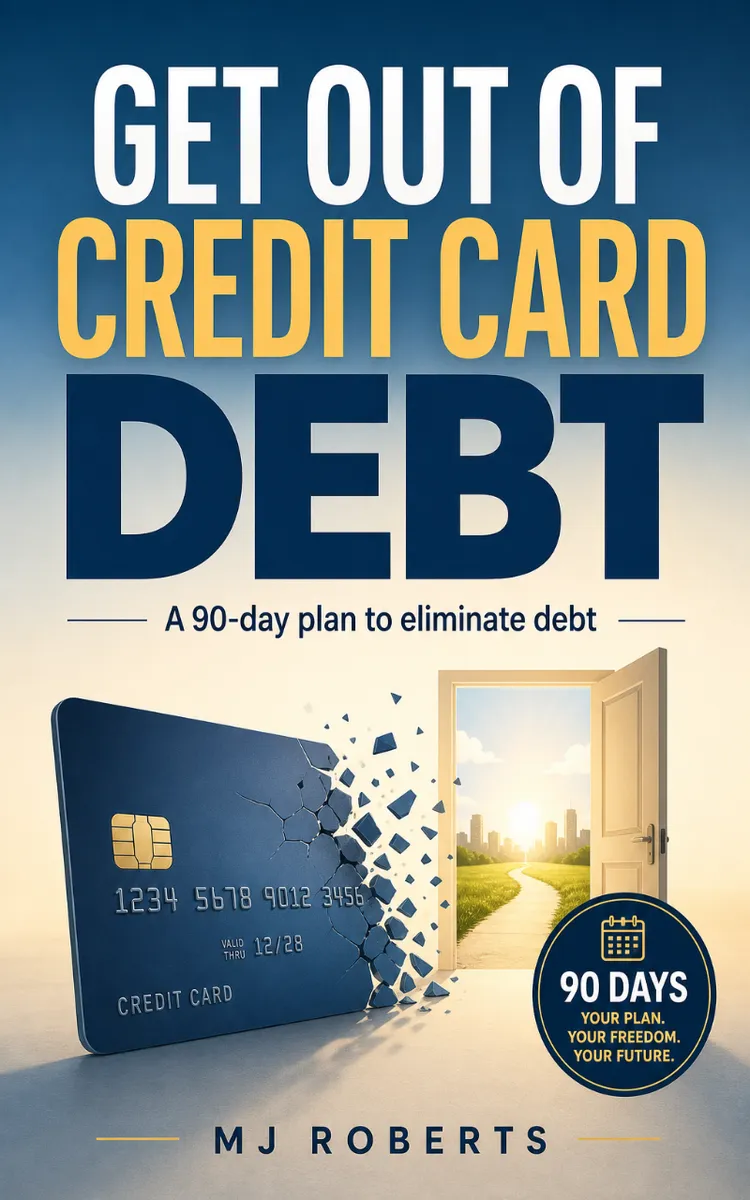
"Get Out Of Credit Card Debt" is a finance book by MJ Roberts with 8 chapters and approximately 13,827 words. Credit card debt payoff, budgeting, and credit rebuilding plan.
This book was created using Inkfluence AI, an AI-powered book generation platform that helps authors write, design, and publish complete books. It was made with the AI Ebook Generator.
Frequently Asked Questions
What is "Get Out Of Credit Card Debt" about?
Credit card debt payoff, budgeting, and credit rebuilding plan
How many chapters are in "Get Out Of Credit Card Debt"?
The book contains 8 chapters and approximately 13,827 words. Topics covered include Debt Inventory and Reality Check, The Minimum Payment Trap Fix, 90-Day Budget With No Guessing, Negotiate Rates and Fees Fast, and more.
Who wrote "Get Out Of Credit Card Debt"?
This book was written by MJ Roberts and created using Inkfluence AI, an AI book generation platform that helps authors write, design, and publish books.
How can I create a similar finance book?
You can create your own finance book using Inkfluence AI. Describe your idea, choose your style, and the AI writes the full book for you. It's free to start.
Write your own finance book with AI
Describe your idea and Inkfluence writes the whole thing. Free to start.
Start writingCreated with Inkfluence AI


