

Read the first chapter
The whole of chapter one, free. About 6 min. Turn the pages with the arrows, your keyboard, or a swipe.
Chapter 1
The Altar Before the Audience
Scripture Focus
Romans 12:1
> I appeal to you therefore, brothers and sisters, by the mercies of God, to present your bodies as a living sacrifice, holy and acceptable to God, which is your spiritual worship.
Before worship is carried through a microphone, it is offered through a life.
The apostle Paul doesn’t describe worship as a song set, a platform moment, or a Sunday responsibility. He speaks of a whole person placed before God. The word “bodies” matters. Our voices, schedules, relationships, habits, reactions, and hidden choices all belong at the altar. Worship becomes more than something we lead when it becomes something we live.
The altar in Scripture was a place of surrender and belonging. Noah built one after God preserved his family through the flood (Genesis 8:20). Abraham built altars as he responded to God’s promises (Genesis 12:7-8; 13:18). David refused to offer God what cost him nothing (2 Samuel 24:24). These moments remind us that an altar isn’t mainly about location. It marks a life turned toward God.
Reflection
A worship leader can sound sincere while privately running on empty. We can choose songs about surrender while resisting God’s correction. We can invite a congregation to draw near while our own prayer life has become a quick sentence between rehearsals. That tension doesn’t mean we’re beyond grace. It does mean the platform can never replace the altar.
Biblical integrity is the agreement between what we present publicly and what we practice privately. It doesn’t mean flawless living. It means an undivided life that is honest before God, quick to repent, and willing to walk in the light. First John 1:7 says, “If we walk in the light, as he is in the light, we have fellowship with one another.” Walking in the light includes admitting when our motives are mixed, when resentment has taken root, or when ministry has become a source of identity rather than an overflow of devotion.
Holiness, in Scripture, means being set apart for God and shaped by his character. Peter writes, “As he who called you is holy, you also be holy in all your conduct” (1 Peter 1:15). Holiness isn’t a polished religious image. It reaches into how we speak to our spouse after a difficult rehearsal, how we handle criticism from a team member, what we view when no one is checking, and whether we tell the truth when a mistake affects the service. The private altar is where public ministry receives its integrity.
Jesus confronted this gap in the religious leaders of his day. They cared deeply about outward appearance but neglected “the weightier matters of the law: justice and mercy and faithfulness” (Matthew 23:23). His words weren’t an attack on careful obedience. They exposed obedience that had become a costume. Ministry can drift in the same direction. We may spend hours refining transitions and minutes examining our hearts. We may know the right chord, cue, and lyric while avoiding the quiet work of forgiveness.
The story of Mary and Martha gives us another helpful picture. Martha served Jesus faithfully, but anxiety had crowded out attention to him. Mary sat at his feet, receiving his word, and Jesus called that “the good portion” (Luke 10:38-42). Scripture doesn’t make service unimportant. It puts service in its proper order. We don’t sit with Jesus because ministry doesn’t matter. We sit with him so ministry remains worship instead of performance.
Performance asks, “How did I come across?” Worship asks, “Did I offer myself to God?” Performance depends on applause, visible results, and the feeling that people noticed. Worship rests on God’s mercy, whether the room is full or half-empty, whether the arrangement worked or the monitor mix fought you all morning. Galatians 1:10 gives us a searching question: “For am I now seeking the approval of man, or of God?” That question can steady us before a service begins.
This is also why spiritual disciplines matter. Prayer, Scripture meditation, confession, silence, fasting, and Sabbath aren’t ways to earn God’s acceptance. In Christ, we already receive grace. These practices make room for us to notice God, receive his correction, and offer our lives again. A leader who spends fifteen minutes with Scripture before checking the set list is making a quiet declaration: God is not an accessory to this ministry. He is its source.
The altar also includes the team. Integrity isn’t only an individual concern. A worship ministry becomes healthier when people can speak honestly, apologize without excuses, and serve without competing for visibility. Philippians 2:3-4 calls believers to reject selfish ambition and look to the interests of others. That may mean letting another musician lead a song you hoped to lead. It may mean receiving feedback without defending every decision. It may mean repairing a relationship before asking the team to sing about unity.
Don’t overlook the encouragement in all of this. God isn’t waiting for you to become impressive enough to serve him. He sees the hidden offering. Jesus told the Father that he had finished the work given to him (John 17:4), and our acceptance rests in Christ’s completed work, not our perfect execution. We can bring him the real condition of our hearts - tired, distracted, repentant, hopeful - and trust him to form us. Second Corinthians 3:18 says we are being transformed into Christ’s image. That is a process, not a stage act.
So before asking whether the congregation responded, ask whether you were present to God. Before reviewing the recording, review your heart. Before adjusting the arrangement, surrender the ambition underneath it. Worship is not first what we do for God in public; it is who we are becoming before God in private.
Practice for Today
1. Take a ten-minute altar pause before touching ministry tasks. Put your phone on silent and read Romans 12:1 slowly three times. After each reading, name one part of your life you’re offering to God: your voice, your schedule, your relationships, your reputation, or your hidden habits. Don’t rush to produce a polished prayer. Let the verse search you.
2. Use a two-column integrity journal. On the left, write: “What people see.” On the right, write: “What God is forming.” Record one honest example. For instance: “I lead songs about trust” beside “I’m learning to trust God when attendance is low.” The goal isn’t self-criticism. It’s truthful alignment. End by writing one next step, such as confessing resentment, asking forgiveness, or setting a regular time for Scripture.
3. Make one private choice that supports your public confession. If you lead about reconciliation, contact the person with whom you’ve avoided peace. If you sing about surrender, release one desire for control in the rehearsal process. If your team serves from exhaustion, protect a Sabbath window this week. Keep the action small enough to complete within twenty-four hours, but real enough to cost you something.
As a team, you can adapt this practice by beginning the next rehearsal with one minute of silence and a simple question: “What are we offering to God before we offer music to the church?” No one needs to give a long answer. A quiet, honest beginning can reset the room.
Closing Prayer
Father, receive my life before you receive my service. Bring my private devotion and public ministry into agreement. Search my motives without crushing me, correct me with your mercy, and teach me to serve from communion with Christ rather than a need for approval. Make our team truthful, humble, and attentive to you. Let every song we lead rise from lives already placed on your altar. Amen.
End of chapter one. 7 more chapters and about 9,828 words in the full book.
Swipe or use the arrows to turn the page


What's inside: 8 chapters
- 1. The Altar Before the Audience
- 2. Trusting God in the Hidden Place
- 3. Surrendering the Platform Ego
- 4. Walking in Moral Purity
- 5. Repentance, Healing, and Grace
- 6. Serving One Another with Clean Hands
- 7. Enduring in Hope and Faithfulness
- 8. A Blameless Life, an Open-Handed Legacy
About this book
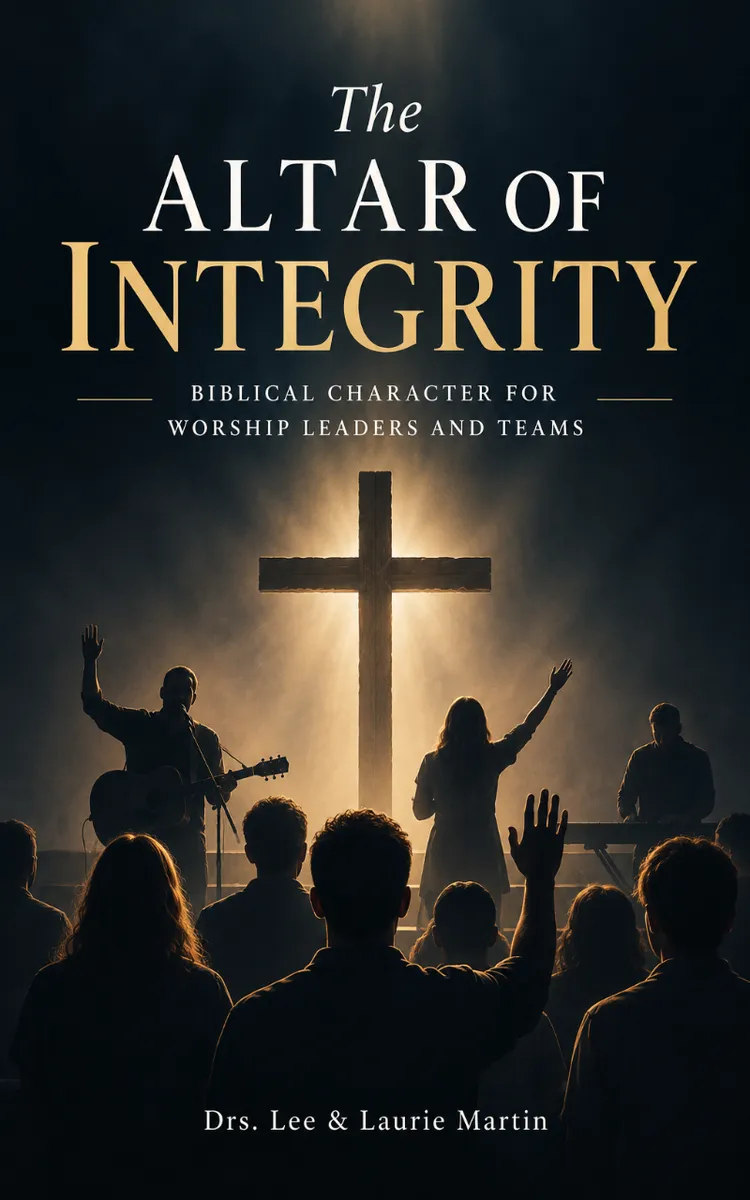
"The Altar Of Integrity" is a religious devotional book by Drs. Lee & Laurie Martin with 8 chapters and approximately 9,828 words. Biblical integrity, private devotion, and holy living in public worship ministry.
This book was created using Inkfluence AI, an AI-powered book generation platform that helps authors write, design, and publish complete books.
Frequently Asked Questions
What is "The Altar Of Integrity" about?
Biblical integrity, private devotion, and holy living in public worship ministry
How many chapters are in "The Altar Of Integrity"?
The book contains 8 chapters and approximately 9,828 words. Topics covered include The Altar Before the Audience, Trusting God in the Hidden Place, Surrendering the Platform Ego, Walking in Moral Purity, and more.
Who wrote "The Altar Of Integrity"?
This book was written by Drs. Lee & Laurie Martin and created using Inkfluence AI, an AI book generation platform that helps authors write, design, and publish books.
Write your own religious devotional book with AI
Describe your idea and Inkfluence writes the whole thing. Free to start.
Start writingCreated with Inkfluence AI


