
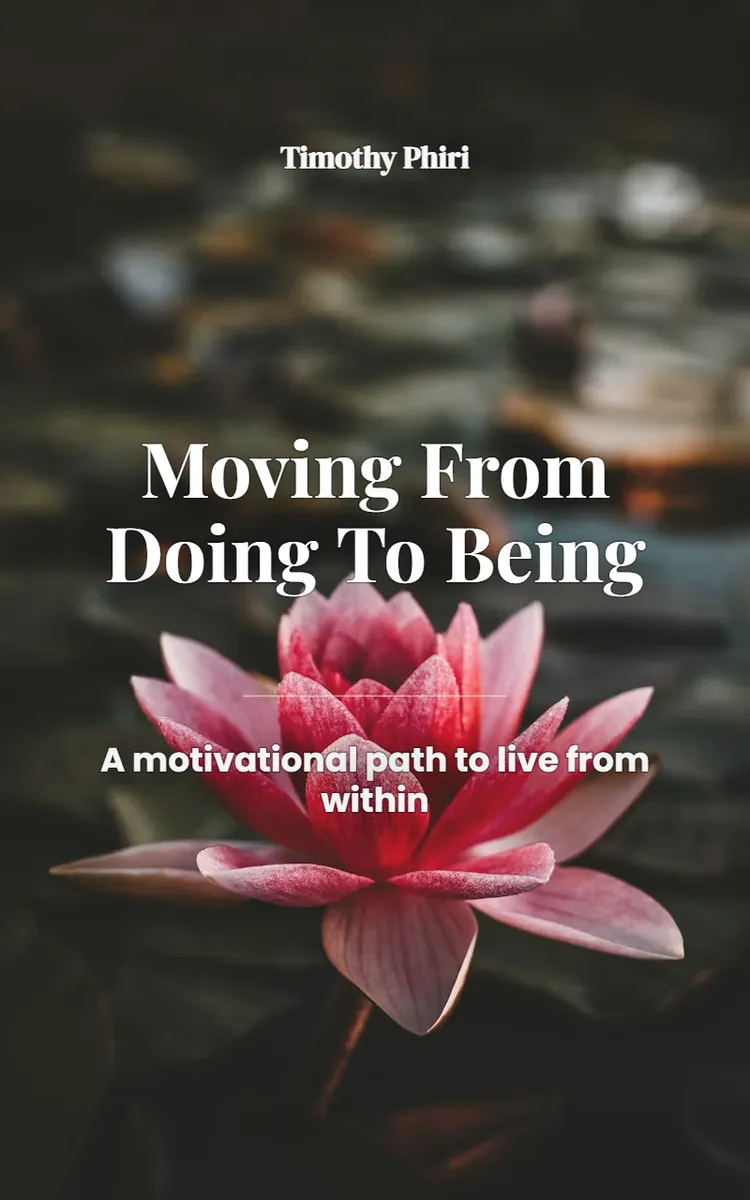
Read the first chapter
The whole of chapter one, free. About 7 min. Turn the pages with the arrows, your keyboard, or a swipe.
Chapter 1
Identity Before Effort
The fastest way to drain your motivation is to keep treating your life like a performance review. You show up, you work hard, you check the numbers, and you think, Okay… if this goes well, then I’m “worthy.” But the moment things get messy (and they always do), you start wondering whether you’re actually the kind of person who can do this. That “prove yourself” loop is exhausting because it asks you to earn your identity after the effort - like you’re waiting for permission.
Here’s the shift: let your identity lead your actions. Not in a fluffy, “manifest it” way. More like: you decide who you are first, then you choose behaviors that match that decision. When you do that, effort stops being a test and starts being a tool. You’re not trying to convince yourself you’re enough - you’re practicing being the person you already decided to become.
This Chapter Is For You If... - You find yourself working hard, then losing steam when results aren’t immediate (you’re not lazy - you’re proving, not becoming). - You keep changing your goals based on mood, feedback, or energy levels. - You want more consistency without forcing yourself through sheer willpower. - You’re ready for a clearer “decision rule” for what to do when you feel behind.
---
Be the identity first, then let your effort be the expression of it - not the proof of it.
Think about what you do when you’re under pressure. Most of us don’t just work differently - we interpret ourselves differently. If you miss a workout, you don’t just say, “I missed a workout.” You say, “I must not be the kind of person who does this.” That interpretation becomes your identity, and then your next action follows it. That’s the proving-yourself cycle: effort is the courtroom, and you’re the defendant.
Now let’s make it concrete with Nadia, 34, an ER nurse working nights. Nadia’s world has its own pace - chaos, urgency, and the kind of fatigue that doesn’t care about your plans. When Nadia started trying to “get healthy,” she kept setting goals like they were deadlines for her worth: If I can stick to workouts for two weeks, I’ll feel like I’m disciplined. If her body didn’t cooperate after a rough shift, she’d shrink back into guilt and restart again later, like her identity depended on whether she performed on schedule.
The moment she changed one thing, everything got simpler: she stopped asking, “Am I disciplined?” and started asking, “What would a nurse who takes care of her body do on a night off?” She didn’t wait to feel motivated. She chose identity-based actions that fit her reality - short walks on the days she could, a simple meal plan she could repeat, and a “minimum standard” she could meet even after a hard stretch. Her effort didn’t disappear; it became more reliable. Not because she suddenly became a different human overnight, but because her actions stopped being auditions for a new self.
In Practice, This Means... - You stop treating missed effort as evidence that you’re not “that person.” - You choose actions that match the identity you’re practicing (even at a smaller size). - You measure progress by consistency of expression, not by whether you hit a perfect week. - You recover faster after setbacks because you’re not re-litigating who you are.
---
To turn this into something you can actually live with, use the Identity-First Loop: a quick internal order of operations that keeps you from flipping back into proving mode.
1. Morning (2 minutes): Name your identity for the day. Say it plainly, like a job title you’re practicing. Examples: “I’m a person who recovers,” “I’m a person who keeps promises to my body,” or “I’m a steady worker.” Keep it short - one sentence max.
2. Midday (30 seconds): Check for “proof talk.” When you catch yourself thinking, “I’ll be proud of myself if…” pause and reframe: “I’m practicing my identity by…” This is the whole point: you’re switching the question before it turns into a spiral.
3. Evening (5 minutes): Log one identity-based action you completed. Not ten things. One. If you did nothing big, choose the smallest thing that matches your identity - like drinking water, stretching for three minutes, or preparing a simple option for the next day.
4. Before bed (1 minute): Decide tomorrow’s minimum expression. Pick one action you can do even when you’re tired. Nadia’s minimum might be “10-minute walk” or “protein + one vegetable,” not “full gym session.” Identity leads; effort follows.
5. When you slip: correct the identity, not the self-worth. If you missed your plan, don’t use it as a verdict. Use it as information for what your identity needs to look like under real conditions. Then choose the next smallest action that still fits.
That’s it. No dramatic life overhaul required - just an order change. Your nervous system gets the message: you’re not here to win a trial. You’re here to practice.
---
Real-Life Example: Nadia’s Shift from Proving to Becoming
Before: Nadia would plan workouts after night shifts like they were proof of discipline. If she made it to the gym, she felt solid - like, See? I’m a consistent person. If she didn’t, her inner voice turned harsh and final: I’m not that kind of person. I’ll try again later. The result was a cycle of restarting, not building.
Action: She picked an identity statement she could live with: “I’m the kind of nurse who takes care of her body.” Then she set an identity-matching minimum for low-energy days: a 10-minute walk or a 15-minute home routine, plus a repeatable meal choice. Instead of asking, “Can I keep my streak?” she asked, “Did I express the identity today?”
Result: Her effort became steadier. She still had rough nights, but she stopped treating them like a character flaw. When she missed a workout, she didn’t abandon the whole idea. She adjusted the expression and moved on. Over time, her consistency improved - not because she became superhuman, but because her identity stopped being a prize she had to earn.
You can feel the difference right away, can’t you? The “doing” didn’t disappear. It got anchored.
---
Time to Reflect
Let’s do a little truth-telling (kind truth, not “beat yourself up” truth). Answer these prompts in your own words. Don’t overthink it - your first honest answer is usually the most accurate.
1. Where do you currently ask effort to prove your identity? Maybe it’s health, money, work output, or relationships. Notice the exact phrase your mind uses, like “If I can just…” or “Once I finally…”
2. What do you tell yourself when you fall short? Look for the verdict. Does it sound like “I’m not someone who…”? If it does, that’s your proving loop talking.
3. What identity would still be true even on your worst day? Nadia’s worst day didn’t change her job identity, so she chose a body-care identity that could survive fatigue. What’s one identity you can keep without needing perfect conditions?
4. What’s your smallest identity-based action that you can repeat for 7 days? Make it measurable and realistic. If you can’t describe it in one sentence, it’s too big. Keep it small enough that “busy” won’t erase it.
5. What would “recovery” look like if it wasn’t permission to quit? Your answer might include one reset action - drink water, prep one meal option, write one plan, take one walk. Recovery isn’t the opposite of effort; it’s how effort stays safe.
Gentle note: if you notice you’ve been using proving to feel safe, that’s not something to shame. It just means you’re used to earning stability. We’re replacing that with something more reliable: practiced identity.
---
Next Step
Today, choose your identity statement and write down your Minimum Expression - one action you can do even on a rough day.
Complete this sentence in your notes app (or on paper): “I am the kind of person who __.” Then add: “My minimum expression tomorrow is __ (under 15 minutes).”
• Time needed: 10-15 minutes. - You will know it worked when: you’ve picked an action you can do without waiting for motivation, and you can explain it in one sentence that matches your identity (not your mood).
Do this once, and you’ll feel the difference immediately: you’re not chasing proof anymore - you’re choosing who you’re practicing to be. And that’s where consistency starts to feel like yours, not like something you have to force.
End of chapter one. 14 more chapters in the full book.
Swipe or use the arrows to turn the page


What's inside: 15 chapters
- 1. Identity Before Effort
- 2. From Goals to Standards
- 3. Practice the Being Pause
- 4. Let Your Values Drive
- 5. Reframe Motivation as Alignment
- 6. Build a Daily Identity Ritual
- 7. Speak Yourself Into Reality
- 8. Replace Perfection With Integrity
- 9. Handle Resistance Without Fighting
- 10. Practice Small Acts of Being
- 11. Create Boundaries That Protect Your Becoming
- 12. Choose Environments Over Willpower
- 13. Turn Setbacks Into Identity Updates
- 14. Sustain Being Through Community
- 15. Live the New Identity Daily
About this book
"Moving From Doing To Being" is a inspirational book by Timothy Phiri with 15 chapters and approximately 23,416 words. Inspiration and motivation to shift from action to identity.
This book was created using Inkfluence AI, an AI-powered book generation platform that helps authors write, design, and publish complete books. It was made with the AI Inspirational Book Writer.
Frequently Asked Questions
What is "Moving From Doing To Being" about?
Inspiration and motivation to shift from action to identity
How many chapters are in "Moving From Doing To Being"?
The book contains 15 chapters and approximately 23,416 words. Topics covered include Identity Before Effort, From Goals to Standards, Practice the Being Pause, Let Your Values Drive, and more.
Who wrote "Moving From Doing To Being"?
This book was written by Timothy Phiri and created using Inkfluence AI, an AI book generation platform that helps authors write, design, and publish books.
How can I create a similar inspirational book?
You can create your own inspirational book using Inkfluence AI. Describe your idea, choose your style, and the AI writes the full book for you. It's free to start.
Write your own inspirational book with AI
Describe your idea and Inkfluence writes the whole thing. Free to start.
Start writingCreated with Inkfluence AI


