
Read the first chapter
The whole of chapter one, free. About 7 min. Turn the pages with the arrows, your keyboard, or a swipe.
Chapter 1
Catch It, Name the Loop
Overthinking usually gives you a warning before it takes over: a message arrives, a task feels unclear, a decision sits unfinished, or one small mistake keeps replaying. Your first useful move isn’t to solve everything. It’s to notice the loop while it’s still small enough to name.
This is a catching exercise, not a fixing exercise. You won’t analyze whether the thought is true or decide what to do next yet. You’ll simply map what happened, what showed up in your mind, how it felt, and what you did afterward. That map helps you spot your pattern earlier next time.
Learn to Identify the Trigger
A trigger is the moment, situation, or cue that starts the mental replay. It might be obvious, such as receiving criticism. It might be quiet, such as opening your email and seeing an unanswered message. Sometimes the trigger is an internal cue: tiredness, hunger, a memory, or the sudden thought, “I should have handled that better.”
You don’t need to find the deepest reason. Capture the first clear spark. Use one recent example from the last seven days. Choose a moment when you noticed repeated thinking, checking, replaying, delaying, or asking for reassurance.
Materials: this workbook, a pen or pencil, and about 10 minutes.
Your Turn - Trigger Snapshot
Write one specific situation, not a general category such as “work” or “relationships.” Include what happened immediately before the loop began.
What was happening? __________________________________________________________ __________________________________________________________
Where were you, and who was involved? __________________________________________________________ __________________________________________________________
What was the first cue that something had shifted? __________________________________________________________ __________________________________________________________
When did you notice your mind speeding up or circling back? ____________________________________________________________
You’re done with this section when you’ve described one event in two or three clear sentences. If your description contains words like “always,” “never,” or “everything,” narrow it down to one moment. Specific beats dramatic here.
A trigger isn’t the same as a cause, and it isn’t a personal failure. It’s simply the starting bell your mind has learned to react to. One unanswered text can trigger a long chain. So can a vague instruction from a customer, a change in plans, or a task you’ve been putting off. The point is to catch the bell, not blame yourself for hearing it.
Quick Trigger Check
Read your snapshot once. Circle or mark any details that fit:
• A message, call, or conversation - A mistake, correction, or awkward moment - An unfinished task - An unclear request or expectation - A choice with several options - A change in plans - A body cue, such as tiredness or tension - A memory or imagined future event - Something else: ______________________________________
Now complete this sentence:
My most common early trigger in this example was: ____________________________________________________________
One small sign that tells me a loop may be starting is: ____________________________________________________________
That sign might be rereading the same sentence, opening the same app repeatedly, mentally rehearsing a conversation, or feeling unable to begin. Keep it observable. “I feel bad” is real, but “I check the email six times” gives you something you can catch.
Repeated Pattern to Interrupt Overthinking Early
Once you’ve named the trigger, track the short chain that follows. A useful pattern is:
TRIGGER → THOUGHT → FEELING → RESPONSE
The thought is the sentence, image, question, or prediction that appears in your mind. The feeling is the emotional or body response that comes with it. The response is what you do next, including actions that happen only in your head. Replaying a conversation counts. So does searching for more information, asking someone to confirm your choice, or putting the task off while you “figure it out.”
You’re not being asked to judge the thought yet. Just record it as accurately as you can. If several thoughts appeared, write the first one and the thought that kept returning. That repeated sentence is often the loop’s handle.
Your Turn - Name the Loop
Use the trigger you recorded above. Complete each box with a short phrase or sentence. Allow 8-12 minutes. Don’t polish your answers; this is a snapshot, not a report for the board of directors.
TRIGGER - What set it off? __________________________________________________________ __________________________________________________________
THOUGHT - What kept repeating in my mind? __________________________________________________________ __________________________________________________________
FEELING - What emotion or body sensation showed up? __________________________________________________________ __________________________________________________________
RESPONSE - What did I do, avoid, check, replay, or ask? __________________________________________________________ __________________________________________________________
RESULT - What happened to the loop afterward? __________________________________________________________ __________________________________________________________
You’ve completed the map when all five spaces contain an answer and the response is something observable. For example, “I worried” is a thought or feeling. “I reread the message and delayed replying for 45 minutes” is a response. Clear details make the pattern easier to recognize.
Now look at the response you wrote. Many overthinking responses bring a few seconds of relief. Checking may briefly reassure you. Replaying may feel like preparation. Asking someone else may settle the uncertainty for a moment. Then the question returns, often louder. That doesn’t mean you’re doing something foolish. It means the response may be keeping the loop active.
Pattern Check - Find Your Early Warning Signs
Read your completed map and answer each prompt with one specific detail.
The first change I noticed in my body was: ____________________________________________________________
The first action I took was: ____________________________________________________________
The repeated phrase, question, or image was: ____________________________________________________________
The response that gave me brief relief was: ____________________________________________________________
The point where I could have noticed the loop earlier was: ____________________________________________________________
Your answers are complete when each line names one concrete sign. If you wrote “when I started feeling overwhelmed,” add what that looked like: “my shoulders tightened,” “I stopped typing,” or “I opened three comparison tabs.” Your mind may be messy, but your notes can be precise.
Build Your Personal Loop Label
A short label helps you recognize the pattern without retelling the whole story. Make it plain and slightly memorable. “The unanswered-email loop” works. So does “the replaying-the-conversation loop” or “the too-many-options loop.” You’re naming a pattern, not naming yourself.
Create a Loop Label
Finish this sentence:
When ________________________ happens, I tend to ______________________, then ________________________.
Now give the pattern a short name:
My loop label: ____________________________________________________________
My earliest reliable warning sign: ____________________________________________________________
The first response I want to notice: ____________________________________________________________
To finish, read the sentence aloud or quietly to yourself. It should describe a repeated sequence, not a character judgment. “I’m impossible” is not a loop label. “The checking-after-a-small-mistake loop” is. If the label makes you feel attacked, rewrite it until it sounds neutral enough to use.
Practice Catching It Before It Grows
Use this final mini-practice during the next 24 hours. Choose one ordinary situation where you sometimes get stuck. You aren’t trying to stop every thought. You’re practicing the moment of recognition.
When you notice the first warning sign, pause for 30 seconds and write the following four lines. Use your phone notes if the workbook isn’t nearby, then transfer the answers here later. Complete one record only; more data isn’t automatically better.
Materials: this page and a pen, or a notes app; about 2 minutes at the moment you notice the loop.
Catch-It Record
Trigger: What just happened? ____________________________________________________________
Thought: What sentence or question appeared? ____________________________________________________________
Feeling: What emotion or body sensation did I notice? ____________________________________________________________
Pattern: What did I feel pulled to do next? ____________________________________________________________
You’re finished when all four lines are filled in before you act on the urge, if possible. If you noticed the loop afterward, complete the record anyway and mark the timing:
I noticed it: ☐ Before I reacted ☐ While I was reacting ☐ Afterward
What helped me notice it at all? ____________________________________________________________
That last question matters. Early awareness is a skill, and noticing after the fact is still practice. Each record gives you another clue about the loop’s doorway.
Keep your loop label somewhere visible for the next few days. When the familiar trigger appears, use the label as a quiet signal: “This is the unanswered-email loop,” or “This is the replay loop.” You don’t have to argue with it or solve it on the spot. Naming it creates a small gap between the trigger and the automatic response.
Closing Check
Complete these three lines:
My most common trigger is: ____________________________________________________________
My loop usually sounds or feels like: ____________________________________________________________
The earliest sign I can catch is: ____________________________________________________________
That’s the reset point: not perfect control, not an empty mind. Just enough recognition to say, “I know this pattern.” Once the loop has a name, it becomes easier to notice as a pattern you’re experiencing - not a command you have to follow.
For self-reflection and educational use only. Not medical advice or a substitute for professional care.
End of chapter one. 4 more chapters in the full book.
Swipe or use the arrows to turn the page
What's inside: 5 chapters
- 1. Catch It, Name the Loop
- 2. Separate Facts From Assumptions
- 3. Reframe Predictions Into Likelihood
- 4. Control Check and Balanced Perspective
- 5. Choose One Small Next Action
About this book
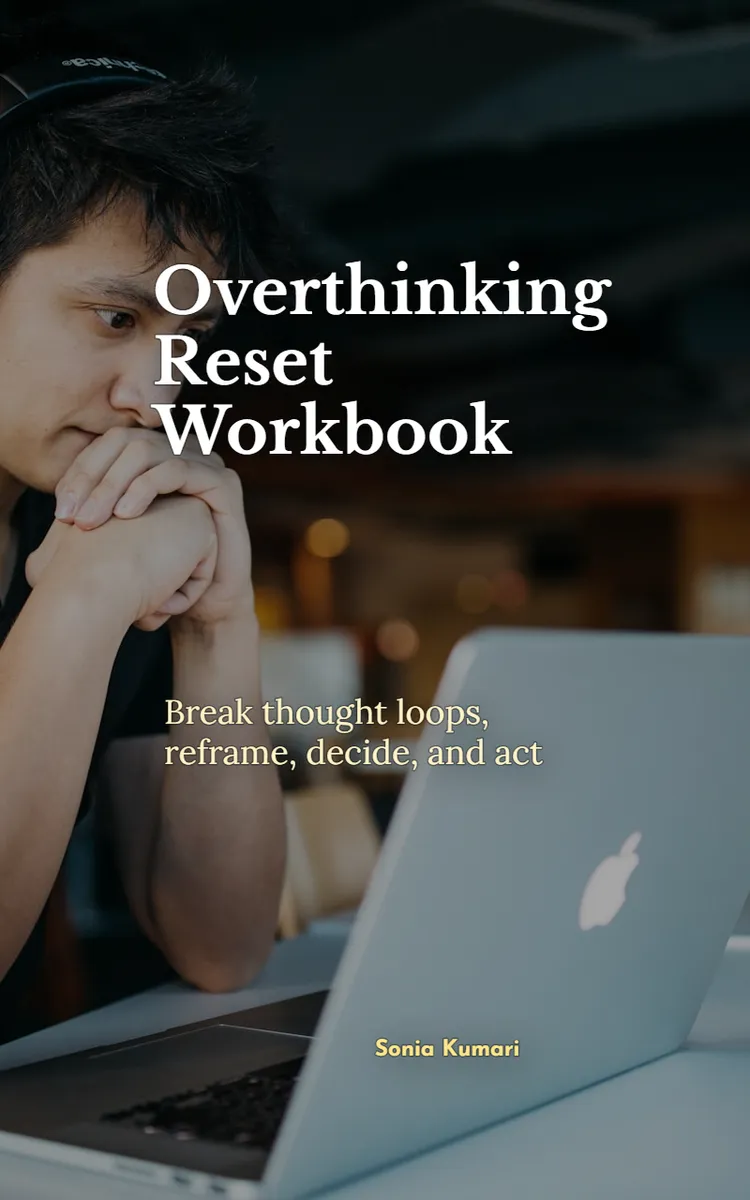
"Overthinking Reset Workbook" is a workbook by Sonia Kumari with 5 chapters and approximately 7,016 words. CBT-inspired exercises to reduce overthinking and indecision.
This book was created using Inkfluence AI, an AI-powered book generation platform that helps authors write, design, and publish complete books. It was made with the Workbook Generator.
Frequently Asked Questions
What is "Overthinking Reset Workbook" about?
CBT-inspired exercises to reduce overthinking and indecision
How many chapters are in "Overthinking Reset Workbook"?
The book contains 5 chapters and approximately 7,016 words. Topics covered include Catch It, Name the Loop, Separate Facts From Assumptions, Reframe Predictions Into Likelihood, Control Check and Balanced Perspective, and more.
Who wrote "Overthinking Reset Workbook"?
This book was written by Sonia Kumari and created using Inkfluence AI, an AI book generation platform that helps authors write, design, and publish books.
How can I create a similar workbook?
You can create your own workbook using Inkfluence AI. Describe your idea, choose your style, and the AI writes the full book for you. It's free to start.
Write your own workbook with AI
Describe your idea and Inkfluence writes the whole thing. Free to start.
Start writingCreated with Inkfluence AI


