

Read the first chapter
The whole of chapter one, free. About 9 min. Turn the pages with the arrows, your keyboard, or a swipe.
Chapter 1
Arrival at Thurleigh
The lorry’s rear wheels sank to their hubs before RAF Thurleigh came into view.
Frank “Okie” Dalton leaned through the cab window as the driver wrestled the wheel, watching the muddy lane buckle beneath them. Beyond the hedgerow, a row of barrage balloons drifted against the pale summer sky, their cables vanishing into the haze. Somewhere ahead, engines roared in uneven bursts, followed by the sharp clatter of a hammer striking metal.
“Tell me that’s the main road,” said the man beside him.
“It is if the Army’s lost its mind,” Okie said.
The driver gave him a sideways look. “You the captain?”
“Dalton.”
“Then tell your men to get out and push.”
Okie opened the cab door. Cold mud splashed his boots before he touched the ground. Behind him, the ten-man crew climbed down from the transport truck and scattered around the wheels, grumbling beneath their breath. Their flight bags were dark with rain. Their wool uniforms had been packed for England, but not for a road that seemed determined to swallow them.
“Come on,” Okie called. “Everybody on the rear axle. We get the truck clear, then we find the field.”
The men moved without argument. That pleased him. They were still strangers in some ways, drawn from different states, different outfits, and different ideas of what a crew ought to be. But they had crossed the Atlantic together. They had slept in troopship bunks beneath the Atlantic swell. They had arrived in England with one aircraft, a stack of orders, and twenty-five missions waiting somewhere beyond the gray horizon.
Now they had to get themselves and their bomber settled before the station swallowed them whole.
The driver released the brake. Ten men leaned into the truck as the engine snarled. Mud gave way with a wet sucking sound, and the lorry lurched forward. Someone slipped. Someone else cursed. Okie caught an elbow in his ribs and shoved harder until the wheels climbed onto firmer ground.
“Good,” he said, straightening. “Nobody drowned. Let’s keep it that way.”
A sergeant in a rain cape waited by the gate, clipboard tucked beneath one arm. He glanced at the truck, then at Okie’s captain’s bars.
“Crew for the new Fortress?” he asked.
“B-17. Okie’s Revenge.”
The sergeant’s pencil paused. “That the name?”
“That’s the name.”
“Aircraft arrived yesterday. You’re late.”
“We arrived when the ship put us ashore.”
The sergeant studied him without apology. Behind him, a bicycle messenger shot through the gate, tires spraying water. “Operations hut first. Personnel records, quartermaster, then dispersal. Don’t wander.”
“We’re looking for our aircraft.”
“You’ll find it where they tell you.”
Okie took the clipboard the sergeant offered and read the typed orders. The paper was damp at the edges, the ink blurred in places. Crew quarters, briefing assignment, hardstand number - each item had been stamped and initialed by men who had never seen his face.
“Which way to operations?” he asked.
The sergeant pointed toward a cluster of Nissen huts. “Follow the red flags.”
There were red flags everywhere.
Okie led the way through the station, boots slipping on the churned ground. Buildings appeared and vanished behind rain-streaked windows: mess halls, workshops, a sick bay, a tower with signal lamps blinking beneath its roof. Men in different uniforms hurried past carrying helmets, tools, ammunition boxes. A jeep honked twice and forced the crew against a bank of sandbags.
“England,” muttered one of the men behind him. “Thought it would be greener.”
“It is,” said another. “Under the mud.”
At the operations hut, a corporal barred the door with one hand.
“Crew manifest?”
Okie handed it over.
The corporal checked each name, lips moving. “Captain Dalton. Pilot.”
“Here.”
“Lieutenant Mercer. Copilot.”
“Here.”
“Lieutenant Hale. Navigator.”
“Here.”
“Second Lieutenant Boone. Bombardier.”
Boone lifted two fingers.
“Staff Sergeant Rusk. Flight engineer.”
“Present.”
“Sergeant Bell. Radio.”
Bell raised his hand.
“Sergeant Voss. Ball turret.”
“Here.”
“Sergeant Kincaid. Waist.”
“Here.”
“Sergeant Dwyer. Waist.”
“Here.”
“Sergeant Larkin. Tail.”
“Here.”
The corporal counted again, then looked past them toward the rain. “Aircraft assignment says hardstand twelve.”
“We need the location.”
“You’ll get it from dispersal control.”
“Where’s dispersal control?”
The corporal pointed through the door. “Where the red flags are.”
Okie felt his jaw tighten. “There are twenty red flags between here and the gate.”
“Then you’d better count.”
The door shut in his face.
For one second, nobody spoke. Rain tapped against the metal roof. Somewhere nearby, a telephone rang and rang.
Mercer leaned close. “Want me to count the flags?”
“No. I want us to find the aircraft before dark.”
They went back outside.
The red flags led them toward a broad stretch of hard-packed earth divided by trenches and drainage ditches. The rain had turned every lane into a ribbon of brown sludge. A pair of B-17s stood beneath the low clouds, their olive paint streaked with grime, propellers tied down against the wind. Ground crews moved beneath them like dark insects.
Okie stopped at a wooden sign marked DISPER-SAL. The lettering had been painted in a hurry, the final letters nearly hidden beneath mud.
An airman in oilskins approached carrying a folder.
“Dalton?”
“Yes.”
“Sergeant Avery. Dispersal control.” He looked at the crew, then at the transport trucks still struggling near the gate. “Your gear’s been sent to the wrong hut.”
“Where?”
“Quartermaster’s holding it.”
“We need our aircraft.”
“You need your bedding too unless you plan to sleep in the bomb bay.”
Okie unfolded the orders. “Hardstand twelve.”
Avery tapped the folder. “That’s what I’ve got. But the field’s been rearranged. Construction crews tore up the south lane this morning. Twelve may be on the other side of the drainage cut.”
“May be?”
“Unless you’ve got a map better than mine.”
Okie looked across the field. A line of wooden stakes disappeared into the rain. Beyond them, the ground dropped sharply into a ditch filled with brown water. On the far side, rows of aircraft stood under camouflage nets. One of them wore a hand-painted name beneath the cockpit, though the distance hid the letters.
“Can we take a jeep?” Okie asked.
Avery laughed once. “The last jeep sank up to its hood.”
“Then we walk.”
“Captain, the field’s restricted during engine movement.”
As if summoned by the warning, a B-17 ahead of them coughed awake. One propeller began turning, then another. The sound rolled across the dispersal ground, deep and violent. Men waved them back from the lane.
Okie raised both arms. “Hold up!”
The bomber’s engines climbed in pitch. Rain blew sideways from the propellers. The crew pressed against a bank of sandbags while the aircraft lumbered past, tires cutting fresh trenches into the mud. Water struck Okie’s face. The bomber’s tail swung near enough for him to see chipped paint along the rudder.
When it had passed, Avery shouted over the fading thunder, “You still want to walk?”
Okie wiped rain from his eyes. “Now more than ever.”
They crossed by a narrow plank bridge laid over the drainage cut. The boards flexed under their weight. Larkin moved carefully, clutching his flight bag to his chest. Voss reached back and steadied him when one plank shifted.
“Easy,” Voss said.
“I’m easy,” Larkin answered. “It’s the bridge that’s nervous.”
The joke earned a few tired laughs, but Okie kept his eyes on the far field. The aircraft with the hidden name stood alone beside a maintenance truck. Its nose was pointed into the wind. The landing gear was sunk unevenly in the mud, and a canvas sheet had been tied over the forward section.
As they approached, a ground crewman stepped from beneath the wing. He was young, pale, and streaked with grease from his cap to his collar.
“Who are you?” he called.
“Crew of Okie’s Revenge,” Okie replied.
The airman glanced toward the bomber. “That makes you Dalton.”
“That’s right.”
“Staff Sergeant Wilkes.”
Wilkes walked around the nose, motioning for them to follow. The name was painted in white beneath the cockpit, the letters chipped but readable: OKIE’S REVENGE. A cartoon Indian head had been added beside it, the paint still bright against the weathered fuselage.
For the first time since leaving the ship, Okie felt something settle inside him. The airplane was battered, but it was theirs. Their home in the sky. Their shelter against the guns and fighters waiting across the Channel.
Mercer ran a hand along the fuselage. “She’s smaller than I expected.”
“She’ll feel plenty big at twenty thousand feet,” said Rusk.
Wilkes did not smile. He crouched near the nose wheel and pointed to a dark stain in the mud.
“Hydraulic fluid,” he said.
Okie looked beneath the aircraft. A thin line of oil-colored liquid ran from the forward gear housing toward the ditch.
“How bad?”
“Could be a fitting. Could be a cracked line.”
“Can she fly?”
Wilkes rose slowly. “Not until we know.”
Okie stepped closer. The canvas over the nose snapped in the wind. “The record says she passed inspection.”
“The record says a lot of things.”
He held out a hand. “Show me.”
Wilkes hesitated, then opened the folder tucked beneath his arm. The maintenance sheet was crowded with signatures and hurried notes. Okie traced the entries with a gloved finger. The hydraulic system had been serviced the previous night. A repair had been marked complete at 0430.
“Who signed this?”
“Crew chief before me.”
“And where is he?”
“Transferred to another station.”
Okie looked from the paper to the leaking gear. Around him, his crew had gone quiet. The rain ticked against the metal skin of the bomber. Beyond the field, another aircraft started its engines, one at a time, the sound building like distant artillery.
Wilkes lowered his voice. “Captain, I can patch the line. But if the leak’s farther inside, the nose gear may not lock down.”
Mercer stared at him. “You’re saying we could take off and not be able to land?”
“I’m saying I won’t sign her ready until I know.”
Okie folded the maintenance sheet and handed it back. The hardstand was a stretch of mud bordered by ammunition crates, oil drums, and a sagging camouflage net. It was not the welcome he had imagined. No band waited. No one cared that they had crossed an ocean to get there.
But the aircraft stood under his command now.
“Then find out,” Okie said.
Wilkes blinked. “Captain?”
“Strip the housing. Pull the line. Whatever it takes.”
“That’ll put her down for at least a day.”
“Then she’ll be down for a day.”
The crew watched him. He could feel the question moving among them: whether their first lesson at Thurleigh would be obedience to a schedule or obedience to the machine that had to bring them home.
Okie turned toward the bomber. “Get our gear from quartermaster. Find the barracks. Be back here at 0600.”
Boone frowned. “We’ve got a briefing tonight.”
“Then we’ll attend it.”
“With an aircraft that can’t fly?”
“With an aircraft we intend to trust.”
Wilkes gave a reluctant nod and called two mechanics from the truck. They brought tools, a jack, and a wooden case of fittings. As they worked, the crew gathered beneath the wing, shoulder to shoulder against the rain.
Okie stood beneath the cockpit and looked up at the painted name. The letters were rough, uneven, and stubbornly bright. Somewhere behind him, Sergeant Avery shouted directions at a driver who had taken the wrong lane. A bell rang from the operations hut. Engines rose and fell across the field.
They had found their hardstand. They had found their quarters. They had found the aircraft that would carry them toward the war.
Then Wilkes slid out from beneath the nose, his hands dark with fluid.
“Captain,” he called. “You’d better come look at this.”
Okie crouched beside him.
The repaired line had split along its length, the metal peeled open like a torn seam. Beyond it, another fitting showed fresh scoring where someone had tightened it too far.
Wilkes met his eyes. “This wasn’t a leak waiting to happen.”
Rain struck the bomber’s skin above them.
“It was a repair waiting to fail.”
End of chapter one. 39 more chapters and about 81,444 words in the full book.
Swipe or use the arrows to turn the page


What's inside: 40 chapters
- 1. Arrival at Thurleigh
- 2. Ten Names on the Roster
- 3. The Missing Maintenance Log
- 4. A Test Flight in Fog
- 5. The First Crew Argument
- 6. The First Mission Scrubbed
- 7. The Empty Hardstand
- 8. The Briefing Room Map
- 9. A Promise Before Takeoff
- 10. Flak Over the Coast
- 11. The Fighter's First Pass
- 12. The Bomb Bay Jam
- 13. The Weight of the First Kill
- 14. The Missing Crew's Bunks
- 15. The Unmarked Damage
- 16. The Runway at Dawn
- 17. The Captain's Doubt
- 18. The Formation Breaks
- 19. The Long Return Leg
- 20. The Schweinfurt Target
- 21. A Crewman Wants Out
- 22. The Schweinfurt Launch
- 23. The Route Through Flak
- 24. Fighters at the Formation's Edge
- 25. The Navigator's Last Fix
- 26. The Bomb Run Under Fire
- 27. Counting the Missing Bombers
- 28. The Damaged Bomber's Descent
- 29. The Collision in Cloud
- 30. The Crew's Lowest Hour
- 31. A Signal in the Static
- 32. The Channel Crossing
- 33. The Choice to Keep Flying
- 34. The Field Beyond the Cloud
- 35. The Landing at Thurleigh
- 36. The Crew Counts Its Wounds
- 37. The Empty Hangar Slot
- 38. A New Bomber's Cockpit
- 39. The Mustang Escort Arrives
- 40. The Last Run to the Refinery
About this book
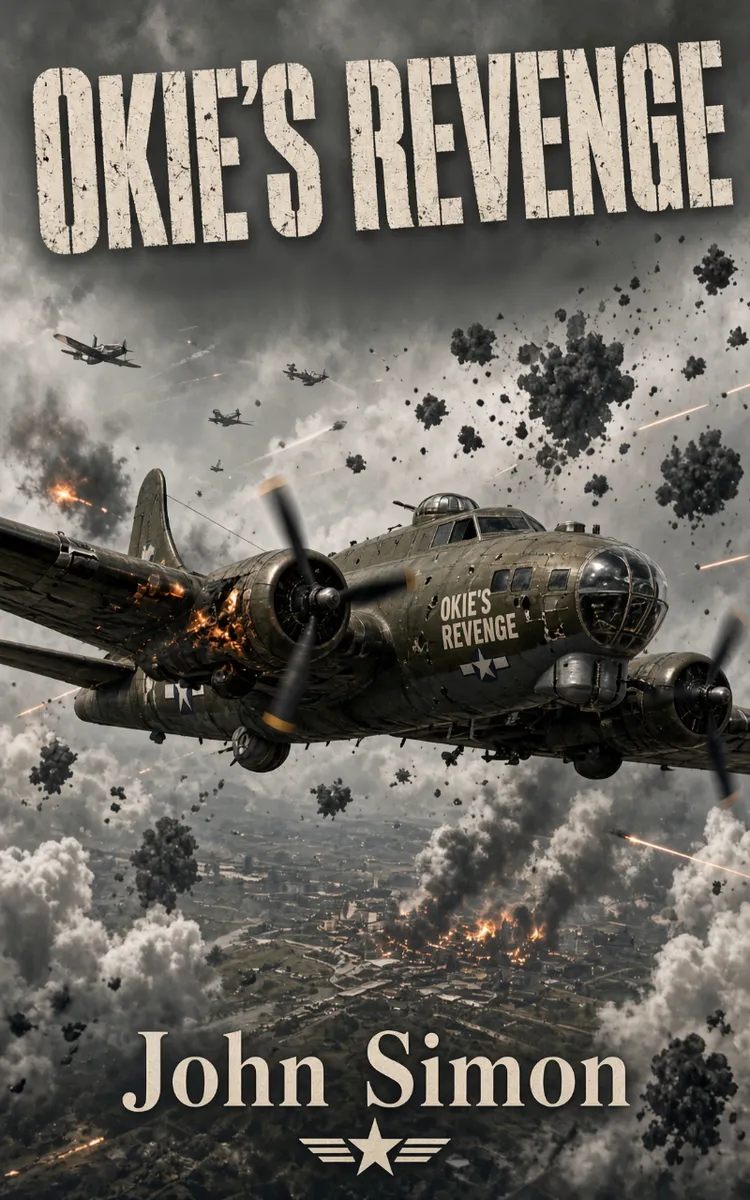
"Okie's Revenge" is a fiction book by John Simon with 40 chapters and approximately 81,444 words. A B-17 crew endures perilous bombing missions over Nazi-occupied Europe.
This book was created using Inkfluence AI, an AI-powered book generation platform that helps authors write, design, and publish complete books. It was made with the AI Novel Writer.
Frequently Asked Questions
What is "Okie's Revenge" about?
A B-17 crew endures perilous bombing missions over Nazi-occupied Europe
How many chapters are in "Okie's Revenge"?
The book contains 40 chapters and approximately 81,444 words. Topics covered include Arrival at Thurleigh, Ten Names on the Roster, The Missing Maintenance Log, A Test Flight in Fog, and more.
Who wrote "Okie's Revenge"?
This book was written by John Simon and created using Inkfluence AI, an AI book generation platform that helps authors write, design, and publish books.
How can I create a similar fiction book?
You can create your own fiction book using Inkfluence AI. Describe your idea, choose your style, and the AI writes the full book for you. It's free to start.
Write your own fiction book with AI
Describe your idea and Inkfluence writes the whole thing. Free to start.
Start writingCreated with Inkfluence AI


