
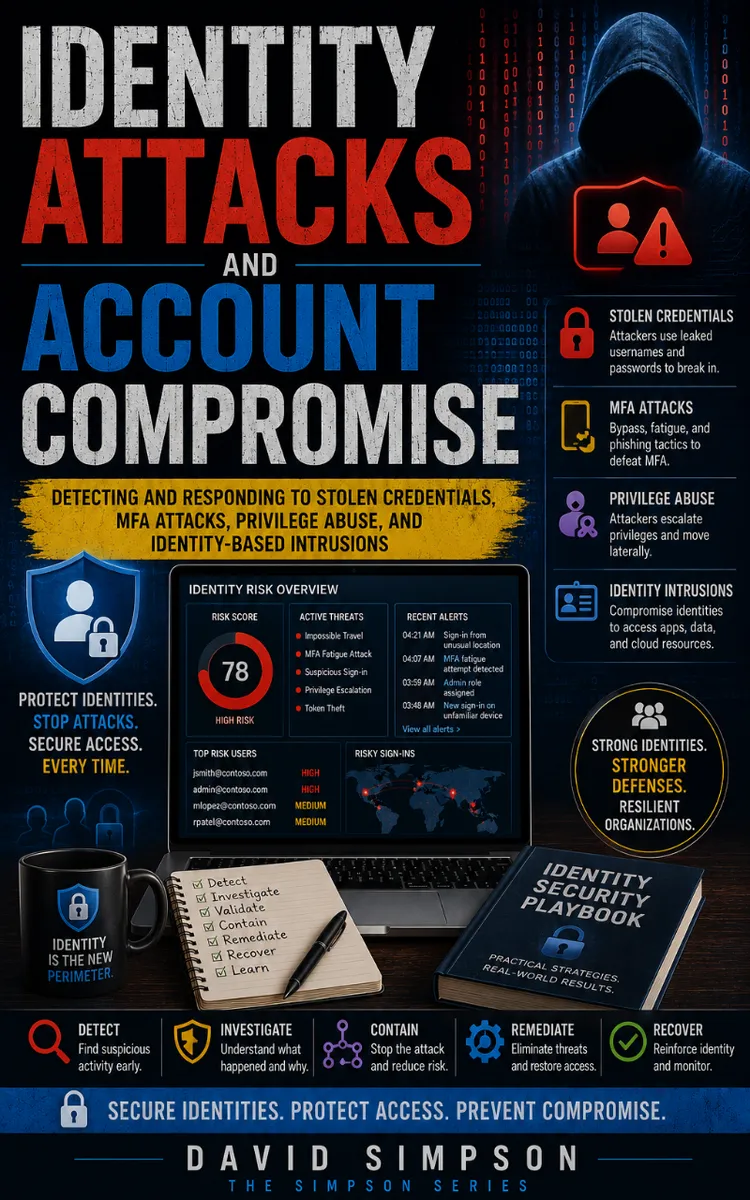
Identity Investigation Playbook
Created with Inkfluence AI
Practical investigation and response to identity-based cyber attacks
Table of Contents
- 1. OAuth 2.0 Authorization Code Flow
- 2. OIDC ID Token Validation
- 3. SAML Assertions and Audience
- 4. Kerberos Ticket Lifecycle Checks
- 5. Active Directory Authentication Logs
- 6. Azure AD Sign-In Logs Triage
- 7. AWS IAM Access Analyzer Findings
- 8. Google Workspace Login Audit
- 9. MFA Enrollment and Reset Events
- 10. TOTP Time-Step Drift Detection
- 11. FIDO2/WebAuthn Challenge Replay
- 12. Push MFA Fatigue Patterns
- 13. Password Reset Token Abuse
- 14. Email-to-Account Recovery Abuse
- 15. OAuth Refresh Token Theft Signals
- 16. Session Cookie Theft and Reuse
- 17. API Key Authentication and Rotation
- 18. JWT Claims and Critical Misconfigurations
- 19. Privilege Escalation via Group Membership
- 20. Role Assignment Drift in RBAC
- 21. ADCS Enrollment and Template Abuse
- 22. Certificate Revocation and OCSP Failures
- 23. Kerberos Constrained Delegation Misuse
- 24. Pass-the-Hash via SMB Authentication
- 25. Pass-the-Ticket with SPN Anomalies
- 26. Golden Ticket Indicators in AD
- 27. Overpass-the-Hash and NTLM Relay
- 28. Identity-Based Intrusion Kill Chain
- 29. Attack Decision Tree: Credential vs Token
- 30. Attack Decision Tree: MFA Bypass vs Fatigue
- 31. Attack Decision Tree: Privilege Abuse Origin
- 32. Attack Decision Tree: Lateral Movement Identity
- 33. Evidence Collection: Audit Logs and Timeline
- 34. Evidence Collection: Token Introspection Artifacts
- 35. Commands: Linux/Windows Log and Event Queries
- 36. Commands: PowerShell for AD Identity Triage
- 37. Lab: MFA Reset Incident Response
- 38. Lab: Privilege Abuse After Token Theft
- 39. Audit-Ready Fix Verification Checklist
- 40. Senior Playbook: Identity Investigation Runbook
Preview: OAuth 2.0 Authorization Code Flow
A short excerpt from “OAuth 2.0 Authorization Code Flow”. The full book contains 40 chapters and 22,472 words.
Overview
Could a valid authorization code be enough to take over an account? In OAuth 2.0, it can be when an attacker captures the code and defeats redirect URI validation. This reference covers the Token Trail Map: trace the authorization request, redirect, code exchange, and resulting tokens to determine whether redirect URI abuse caused account compromise.
Quick Reference
| Stage | Method | Endpoint or artifact | Investigation value |
|---|---|---|---|
| Authorization | `GET` | `/authorize` | Identify client, redirect URI, scope, and user session |
| Code delivery | Browser redirect | `redirect_uri?code=...` | Determine whether the code was exposed or altered |
| Token exchange | `POST` | `/oauth/token` | Confirm code redemption and client authentication |
| Refresh | `POST` | `/oauth/token` | Identify persistence after initial takeover |
| Revocation | `POST` | `/oauth/revoke` | Invalidate refresh and access tokens |
Parameters
| Parameter | Type | Required | Description |
|---|---|---|---|
| `response_type` | string | Yes | Must be `code`; reject implicit token delivery |
| `client_id` | string | Yes | Registered OAuth client identifier |
| `redirect_uri` | URI | Yes | Must exactly match the registered URI, including scheme, host, path, and port |
| `scope` | string | Yes | Requested permissions; investigate unexpected privileged scopes |
| `state` | string | Yes | Unpredictable request correlation value; prevents login-CSRF and response mix-up |
| `code_challenge` | string | Yes | PKCE challenge derived from the verifier |
| `code_challenge_method` | string | Yes | Use `S256`; reject `plain` |
| `code` | string | Yes at token exchange | Short-lived, single-use authorization code |
| `code_verifier` | string | Yes with PKCE | Secret value proving possession of the original client session |
Code Example
# Authorization request: exact redirect URI and PKCE are mandatory.
AUTH_URL="https://idp.example.com/authorize"
curl -G "$AUTH_URL" \
  --data-urlencode "response_type=code" \
  --data-urlencode "client_id=investigation-console" \
  --data-urlencode "redirect_uri=https://console.example.com/oauth/callback" \
  --data-urlencode "scope=openid profile email" \
  --data-urlencode "state=$(openssl rand -hex 32)" \
  --data-urlencode "code_challenge=BASE64URL_SHA256_VERIFIER" \
  --data-urlencode "code_challenge_method=S256"

# Exchange the captured code only at the registered token endpoint.
curl -sS -X POST https://idp.example.com/oauth/token \
  -H 'Content-Type: application/x-www-form-urlencoded' \
  --data-urlencode 'grant_type=authorization_code' \
  --data-urlencode 'client_id=investigation-console' \
  --data-urlencode 'redirect_uri=https://console.example.com/oauth/callback' \
  --data-urlencode 'code=AUTHORIZATION_CODE' \
  --data-urlencode 'code_verifier=ORIGINAL_VERIFIER'
For an incident, compare authorization and token-exchange timestamps, source IPs, user agents, client IDs, and redirect URIs. A code redeemed from a different network or device within its validity window is a high-value correlation.
Response Format
{
  "access_token": "redacted",
  "token_type": "Bearer",
  "expires_in": 3600,
  "refresh_token": "redacted",
  "scope": "openid profile email"
}
`access_token` authorizes API calls. `refresh_token` may preserve access after the original code expires. `expires_in` is the lifetime in seconds. Do not place tokens in URLs, browser history, referrer headers, or incident tickets.
Notes & Best Practices
- Reject redirect URI prefixes, wildcards, user-controlled subdomains, and HTTP except for controlled local development. Exact matching prevents `https://console.example.com.attacker.example` abuse.
- Authorization codes should be single-use and short-lived, commonly 60-120 seconds. Log failed reuse, redirect mismatch, PKCE failure, and client mismatch events.
- In the Token Trail Map, connect `state`, code ID, client ID, redirect URI, token issuance event, and refresh-token activity. Revoke refresh tokens and sessions, then preserve the related logs as audit evidence.
- Decision tree: If the redirect URI differs, classify as registration or validation abuse. If it matches but the code was redeemed elsewhere, investigate interception or callback compromise. If PKCE failed open, treat the code as potentially replayable and review all tokens issued from that client.
About this book
"Identity Investigation Playbook" is a technical book by David Simpson with 40 chapters and approximately 22,472 words. Practical investigation and response to identity-based cyber attacks.
This book was created using Inkfluence AI, an AI-powered book generation platform that helps authors write, design, and publish complete books. It was made with the AI Documentation Generator.
Frequently Asked Questions
What is "Identity Investigation Playbook" about?
Practical investigation and response to identity-based cyber attacks
How many chapters are in "Identity Investigation Playbook"?
The book contains 40 chapters and approximately 22,472 words. Topics covered include OAuth 2.0 Authorization Code Flow, OIDC ID Token Validation, SAML Assertions and Audience, Kerberos Ticket Lifecycle Checks, and more.
Who wrote "Identity Investigation Playbook"?
This book was written by David Simpson and created using Inkfluence AI, an AI book generation platform that helps authors write, design, and publish books.
How can I create a similar technical book?
You can create your own technical book using Inkfluence AI. Describe your idea, choose your style, and the AI writes the full book for you. It's free to start.
Write your own technical book with AI
Describe your idea and Inkfluence writes the whole thing. Free to start.
Start writingCreated with Inkfluence AI


