
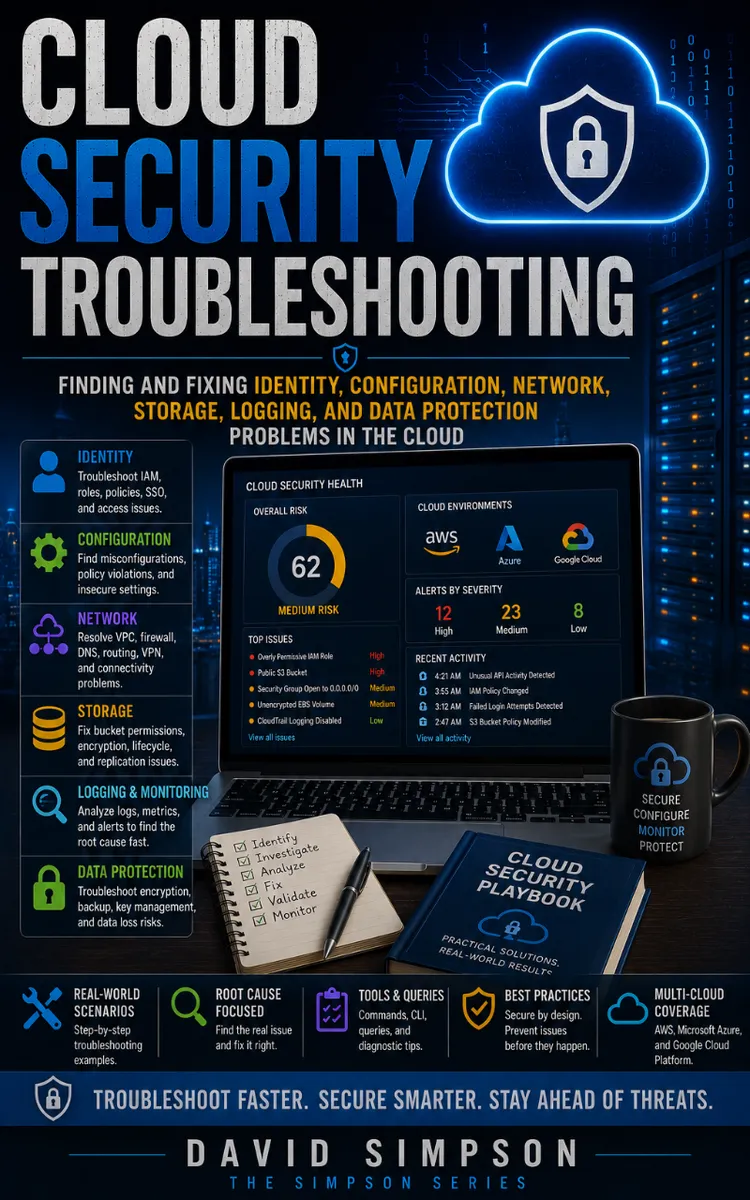
Cloud Security Troubleshooting Playbook
Created with Inkfluence AI
Troubleshooting cloud security across identity, configuration, network, storage, logging, data protection
Table of Contents
- 1. Incident Triage for Cloud Security
- 2. Cloud Threat Model Basics
- 3. Shared Responsibility Checklist
- 4. Evidence Preservation and Audit Trail
- 5. Identity Failure Symptoms and Signals
- 6. Role and Policy Drift Detection
- 7. MFA and Conditional Access Troubleshooting
- 8. OAuth Token Validation and Expiry
- 9. Federation and SSO Claim Mapping
- 10. Least Privilege Role Design
- 11. Configuration Drift in IaC Pipelines
- 12. Security Baseline Enforcement
- 13. Public Exposure and Network Reachability
- 14. Security Group and NACL Rule Debugging
- 15. Routing, Subnets, and Route Tables
- 16. DNS Misconfiguration and Resolution Failures
- 17. TLS Certificates and Handshake Errors
- 18. Private Connectivity: VPN and Peering
- 19. Packet Capture and Flow Log Analysis
- 20. Storage Access Control and ACL Issues
- 21. Encryption-at-Rest Key Troubleshooting
- 22. Client-Side Encryption and Permissions
- 23. Storage Lifecycle, Retention, and Deletion
- 24. Ransomware Recovery and Immutable Storage
- 25. Logging Coverage and Retention Gaps
- 26. Log Ingestion Failures and Parsing Errors
- 27. Time Sync and Correlation Accuracy
- 28. SIEM Detection Tuning for False Positives
- 29. Audit-Ready Documentation Templates
- 30. Identity and Access Review Playbook
- 31. Cross-Account Trust and Principal Confusion
- 32. Network Segmentation and Zero-Trust Checks
- 33. Data Exfiltration Indicators and Response
- 34. Data Classification and Access Enforcement
- 35. DLP and Content Inspection Troubleshooting
- 36. Command-Line Forensics Toolkit
- 37. Decision Trees for Root Cause Isolation
- 38. Verifying Fixes with Controlled Re-Tests
- 39. Postmortems and Preventing Recurrence
- 40. Senior Playbook: Runbooks for Any Incident
Preview: Incident Triage for Cloud Security
A short excerpt from “Incident Triage for Cloud Security”. The full book contains 40 chapters and 73,044 words.
Start With the Question That Limits the Blast Radius
What is the smallest confirmed set of cloud resources, identities, and data that this alert could affect - and what evidence supports that answer?
That question prevents two dangerous reactions to a production security alert: treating a weak signal as a full compromise, or dismissing a real compromise because the first event looks isolated. A useful triage process gives you a defensible scope before you disable accounts, rotate credentials, block traffic, or delete resources. Those actions can protect the environment, but they can also destroy evidence or interrupt a live service.
The goal is to classify the alert, establish its time window, identify affected assets, and begin investigation without changing more than necessary. You will use the 5W1H Triage Map - Who, What, When, Where, Why, and How - to organize facts across Azure, Amazon Web Services (AWS), or another cloud platform. By the end, you should have a short incident record, an initial severity decision, a safe evidence plan, and clear conditions for escalation.
Start every investigation with a timestamp, the alert source, and the alert’s exact wording. Do not rely on a dashboard title such as “suspicious sign-in.” Record the user or workload identity, source address, target resource, action, and detection time. Those fields let you compare the alert with identity logs, audit events, network flow records, and workload logs instead of guessing from a label.
Ask yourself: can another engineer read your first five minutes of notes and understand what happened, what remains unknown, and what action you have avoided? If not, your investigation needs structure before it needs more tools.
Build the 5W1H Triage Map
The 5W1H Triage Map turns an alert into a bounded investigation. Fill it from observed evidence, not assumptions. Mark each statement as confirmed, probable, or unknown. That distinction matters because severity decisions often fail when a probable explanation gets recorded as fact.
1. Who identifies the actor and the credentials involved. Check the human user, service principal, managed identity, role session, access key, or workload account. In Azure, review the Microsoft Entra ID sign-in and audit records. In AWS, review AWS CloudTrail events and the principal identity. Confirm whether the identity normally accesses the account, subscription, region, or service.
2. What describes the action and its result. Separate attempted actions from successful actions. A denied request to read a storage bucket does not prove data exposure. A successful policy change, secret read, or role assumption requires a different response. Capture the API operation, resource name, response code, and any object or record identifiers.
3. When defines the investigation window. Use Coordinated Universal Time (UTC) in the incident record so teams in different locations compare events correctly. Start at least 30 minutes before the first alert and continue until the latest related activity. Extend the window when a credential may have existed for longer or when logs show earlier reconnaissance.
4. Where maps the activity to cloud account, subscription, region, virtual network, workload, and source location. A sign-in from a new country may matter less than an unexpected access path from a familiar corporate network. Conversely, an attacker using a valid virtual private network (VPN) exit point can make location alone unreliable. Treat location as one signal, not proof.
5. Why records the detection reason and the business context. An impossible-travel alert may result from a mobile network, proxy, or token reuse. A new administrator role may come from an approved deployment or from privilege escalation. Compare the event with change tickets, deployment records, and on-call activity before assigning intent.
6. How explains the access path and the likely technique. Determine whether the actor used a password, multifactor authentication (MFA) session, access key, token, role assumption, automation pipeline, or exposed endpoint. Then check what permissions that path allowed. The same suspicious source produces different risk when it reaches a read-only test account versus a production administrator role.
Classify the alert after you populate the map. Use three practical states: benign or expected, suspicious but unconfirmed, and confirmed security incident. Mark an alert benign only when evidence explains the event and shows no unauthorized result. Mark it suspicious when the actor or behavior lacks a trusted explanation, but successful impact remains unproven. Mark it confirmed when logs show unauthorized access, a successful destructive or privileged action, data exposure, persistence, or a control failure with credible evidence of exploitation.
Then scope impact across four dimensions: identities, resources, data, and time....
About this book
"Cloud Security Troubleshooting Playbook" is a how-to guide book by David Simpson with 40 chapters and approximately 73,044 words. Troubleshooting cloud security across identity, configuration, network, storage, logging, data protection.
This book was created using Inkfluence AI, an AI-powered book generation platform that helps authors write, design, and publish complete books. It was made with the AI Ebook Generator.
Frequently Asked Questions
What is "Cloud Security Troubleshooting Playbook" about?
Troubleshooting cloud security across identity, configuration, network, storage, logging, data protection
How many chapters are in "Cloud Security Troubleshooting Playbook"?
The book contains 40 chapters and approximately 73,044 words. Topics covered include Incident Triage for Cloud Security, Cloud Threat Model Basics, Shared Responsibility Checklist, Evidence Preservation and Audit Trail, and more.
Who wrote "Cloud Security Troubleshooting Playbook"?
This book was written by David Simpson and created using Inkfluence AI, an AI book generation platform that helps authors write, design, and publish books.
How can I create a similar how-to guide book?
You can create your own how-to guide book using Inkfluence AI. Describe your idea, choose your style, and the AI writes the full book for you. It's free to start.
Write your own how-to guide book with AI
Describe your idea and Inkfluence writes the whole thing. Free to start.
Start writingCreated with Inkfluence AI


