
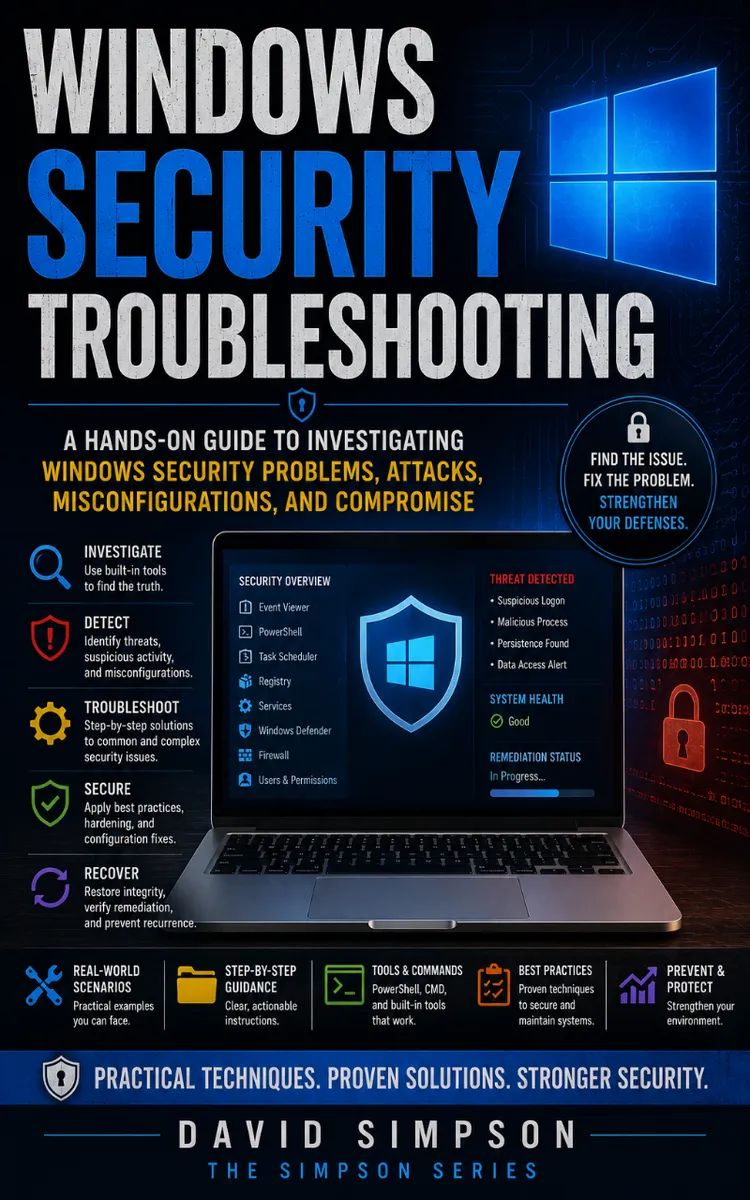
Windows Security Troubleshooting Path
Created with Inkfluence AI
Troubleshooting Windows security problems, attacks, misconfigurations, and compromise
Table of Contents
- 1. Security Troubleshooting Mindset
- 2. Windows Security Data Sources
- 3. Event Viewer for Security Triage
- 4. PowerShell Command Basics
- 5. Interpreting Windows Security Events
- 6. Building an Audit-Ready Timeline
- 7. Services: Startup and Security Impact
- 8. Scheduled Tasks and Persistence
- 9. Registry Persistence for Attackers
- 10. Accounts: Local Users and Groups
- 11. Account Lockouts and Authentication Failures
- 12. Kerberos vs NTLM Troubleshooting
- 13. Credential Guard and LSASS Protection
- 14. Windows Defender Alerts Triage
- 15. Defender Exclusions: When to Use
- 16. Defender Offline Scan Failures
- 17. Firewall Rules and Unexpected Blockages
- 18. Inbound/Outbound Rule Verification
- 19. Certificate Store and Trust Issues
- 20. SChannel Errors and TLS Handshake
- 21. BitLocker Status and Recovery Keys
- 22. BitLocker Repair and Suspend/Resume
- 23. Active Directory Authentication Basics
- 24. Domain Join Failures and Fixes
- 25. GPO Misconfigurations and Security Drift
- 26. Group Policy Processing Evidence
- 27. Credential Delegation and Double-Hop
- 28. RDP Hardening and Brute Force Clues
- 29. Lateral Movement Indicators in Logs
- 30. Process Execution and Command-Line Evidence
- 31. PowerShell Abuse Detection Patterns
- 32. Defender Tampering and Evasion Checks
- 33. Registry and Startup Backdoor Hunt
- 34. Scheduled Task Remediation and Verification
- 35. Incident Response Containment Steps
- 36. Root Cause Templates for Hardening
- 37. Verification Plans After Security Fixes
- 38. Decision Trees for Common Security Symptoms
- 39. Engineer-Level Automation with PowerShell
- 40. Senior Practitioner: Continuous Security Validation
Preview: Security Troubleshooting Mindset
A short excerpt from “Security Troubleshooting Mindset”. The full book contains 40 chapters and 72,378 words.
Start With Evidence, Not a Story
Did a failed logon, a new service, or a Defender alert actually identify the cause of a Windows security problem - or only show you where to start looking? A single event rarely answers that question. A failed authentication may reflect a mistyped password, a disabled account, a clock problem, or an attacker testing credentials. A new scheduled task may support malware persistence, or it may belong to approved software.
The practical risk comes from treating the first visible symptom as the conclusion. That approach leads administrators to disable accounts unnecessarily, delete legitimate tasks, clear logs, or reboot systems before collecting volatile evidence. A repeatable workflow prevents those errors. It gives you a controlled way to move from an alert to verified facts, preserve the evidence you need, and separate a configuration fault from active compromise.
Use the workflow here to record the initial signal, define a time window, build a timeline, test competing explanations, and verify the fix. You will also have a consistent structure for incident notes that another analyst can review without reconstructing your reasoning. The key takeaway is simple: make each action answer a specific question.
The Triage-to-Trace Loop
The Triage-to-Trace Loop starts with a narrow question and repeatedly moves between immediate risk assessment and deeper evidence collection. Triage means deciding what needs attention first. Trace means following related events, processes, accounts, configuration changes, and network activity until the evidence supports a conclusion. The loop matters because new evidence can change the priority. A suspicious service may look urgent until its publisher, installation time, and parent process match a documented software update. A quiet workstation may become urgent when its logs show successful remote logons followed by privilege changes.
Use these steps in order:
1. Capture the signal. Record the alert text, host name, user or service account, source address, event time, and detection source. Do not paraphrase a critical value if you can copy it. Preserve the original event record or export it.
2. Set the scope. Identify whether the issue affects one host, multiple hosts, one account, or an entire domain. Check the first and last known times. Scope prevents you from treating a local configuration error as a domain-wide attack - or missing a pattern across many computers.
3. Protect evidence and reduce immediate risk. If a host shows active malicious execution, isolate it through the approved network-control process. If the evidence only shows repeated failed logons, avoid destructive changes until you collect enough context. Record every containment action because it changes what you may observe later.
4. Build a timeline. Place authentication events, process starts, service changes, scheduled-task changes, Defender detections, firewall changes, and network connections on one time line. Use Coordinated Universal Time (UTC) when systems cross time zones, and confirm each system’s clock.
5. Test competing explanations. Write at least two plausible causes. For example: “A deployment created the service” and “An attacker installed persistence.” Then list the evidence that would support or weaken each explanation. This step blocks confirmation bias - the tendency to notice only evidence that supports your first idea.
6. Trace the strongest lead. Follow the account, process, file path, certificate, registry value, or remote address that connects the most events. Query related hosts and systems instead of collecting unrelated data.
7. Fix and verify. Apply the smallest safe correction, then confirm that the original symptom stopped and that the change did not create a new security problem. Verification requires fresh evidence, not a successful click in a management console.
For example, if Event Viewer shows a service created at 02:14, query the service configuration, executable path, file creation time, signer, parent process, and nearby logon events. PowerShell can collect details without changing the system:
Get-CimInstance Win32_Service -Filter "Name='UpdateHelper'" |
    Select-Object Name, DisplayName, State, StartMode, StartName, PathName

Get-FileHash "C:\ProgramData\UpdateHelper\uh.exe" -Algorithm SHA256
Get-AuthenticodeSignature "C:\ProgramData\UpdateHelper\uh.exe"
The expected result is not “malware” or “safe” from one command. You want a service record, a hash, and a signature status that you can compare with software inventory and the timeline. A valid signature supports trust in the publisher, but it does not prove that the file belongs on that host. Attackers can abuse signed software or install a validly signed unwanted program.
Keep the investigation record structured. A useful table forces you to distinguish observations from conclusions:
...
About this book
"Windows Security Troubleshooting Path" is a how-to guide book by David Simpson with 40 chapters and approximately 72,378 words. Troubleshooting Windows security problems, attacks, misconfigurations, and compromise.
This book was created using Inkfluence AI, an AI-powered book generation platform that helps authors write, design, and publish complete books. It was made with the AI Ebook Generator.
Frequently Asked Questions
What is "Windows Security Troubleshooting Path" about?
Troubleshooting Windows security problems, attacks, misconfigurations, and compromise
How many chapters are in "Windows Security Troubleshooting Path"?
The book contains 40 chapters and approximately 72,378 words. Topics covered include Security Troubleshooting Mindset, Windows Security Data Sources, Event Viewer for Security Triage, PowerShell Command Basics, and more.
Who wrote "Windows Security Troubleshooting Path"?
This book was written by David Simpson and created using Inkfluence AI, an AI book generation platform that helps authors write, design, and publish books.
How can I create a similar how-to guide book?
You can create your own how-to guide book using Inkfluence AI. Describe your idea, choose your style, and the AI writes the full book for you. It's free to start.
Write your own how-to guide book with AI
Describe your idea and Inkfluence writes the whole thing. Free to start.
Start writingCreated with Inkfluence AI


