
Read the first chapter
The whole of chapter one, free. About 9 min. Turn the pages with the arrows, your keyboard, or a swipe.
Chapter 1
The Taipei Signal
Rainwater trembled along the glass roof of Taipei Main Station, breaking the city lights into thin bands of white and red. Beneath it, thousands of people moved through the concourse with the practiced urgency of those who had somewhere to be. Their footsteps formed a single restless rhythm. Announcements rose and dissolved in Mandarin, English, and the electronic chime of departing trains.
Lucy heard all of it.
She heard the brakes beneath the platforms, the vibration of cables in the walls, the minute changes in temperature caused by opening doors. She heard the pulse of individual bodies as they passed through the station: quickened by coffee, fatigue, anticipation, illness. Once, such details would have been noise. Now they arrived without distance between them.
For years, she had kept herself apart from ordinary human life. Distance had seemed merciful. Human affairs repeated themselves with remarkable consistency - desire, fear, attachment, loss. Lucy had watched those patterns from beyond them, no longer confined by the limits that had once defined her. The transformation had carried her far beyond the woman she had been, and beyond any language adequate to describe what she had become.
Yet the signal had reached her.
It had not been a voice, exactly. It was a disturbance embedded in the station’s dense field of human activity, a sequence of interruptions where no interruption should have existed. It repeated at irregular intervals, moving through the station’s systems and then vanishing. The pattern contained urgency, but not panic. It had been constructed by someone who understood that a message could be hidden inside ordinary traffic.
Lucy had followed it to Taipei Main Station because the signal ended there.
She stood near a bank of ticket machines, unnoticed by the people around her. A child dragged a small suitcase over the tiled floor. A man spoke into his phone, his words clipped by the noise of the crowd. The smell of rain entered whenever the station doors opened, mixing with coffee, warm machinery, and the faint metallic odor of rail lines below.
The signal returned.
Lucy turned toward the underground passage.
The movement was simple. Its consequences were not.
Human contact had once been uncomfortable because it demanded attention. Now it threatened to overwhelm every boundary she maintained. As she entered the passage, the crowd closed around her, and each person became an entire field of information. Skin temperature. Electrical activity. Muscle tension. Chemical traces carried in breath and clothing. The station did not contain one collective mind, but thousands of separate systems crossing without understanding one another.
A woman brushed Lucy’s sleeve.
For an instant, Lucy received the woman’s recent history in fragments - not memories in the ordinary sense, but physical evidence arranged with impossible clarity. Poor sleep. A sore wrist. The residual sweetness of a drink. The woman glanced back, startled, though she could not have known why.
Lucy continued walking.
The signal pulsed again from somewhere below.
She descended toward the platforms, where the air grew warmer and the sound became heavier. Trains arrived with a force that moved through the soles of her feet. Passengers gathered, dispersed, and gathered again. Above them, screens displayed times and destinations. The information was orderly. The people were not.
Lucy stopped beside a column.
A security guard looked at her, then past her. His attention lingered for less than a second. That was enough. Lucy had learned that remaining unseen required more than physical concealment. Human beings noticed what did not fit their expectations. Her presence did not fit. Even when she stood still, the world around her seemed to adjust by degrees.
The signal came from a service corridor beyond the public platform.
A locked door separated it from the station. The lock was designed for a human hand and a human decision. Lucy placed two fingers against the metal. The mechanism yielded without sound.
She entered.
The corridor smelled of dust, insulation, and damp concrete. The station’s public noise diminished behind her, replaced by the muted hum of electrical equipment. Pipes crossed the ceiling. Cables ran along the walls in bundled lines, carrying information through the building. Lucy followed the signal as it moved among them.
It was not located in one device. It passed through several systems, using the station as a temporary body.
At the corridor’s end, she found a maintenance room containing a communications cabinet and a small monitoring terminal. The screen showed ordinary diagnostic data. Temperature. Power levels. Network traffic. Nothing that would have drawn human attention.
Lucy looked at the numbers.
The signal appeared between them.
It had been concealed in fluctuations so small that the system treated them as error. But errors had structure. The pattern repeated at intervals corresponding to human movement through the station. It had been sent from inside the crowd, then redirected through the infrastructure. Whoever had created it had known that the station’s busiest location would offer both cover and reach.
A voice sounded behind her.
You cannot be in here.
Lucy turned.
The guard had followed her into the corridor. He stood with one hand near his radio, breathing faster than before. The narrow room gave his fear nowhere to go.
I heard something, Lucy said.
Her voice remained calm. She had not needed to speak often in recent years. Words had become inefficient compared with the direct reading of matter and energy, but human beings still required them.
“There is no public access here, the guard replied. You need to leave.”
“Someone is transmitting from this station.”
His expression tightened. What does that mean?
Lucy looked toward the cabinet. It means someone is asking to be found.
The guard raised his radio. I am calling -
The terminal went dark.
The signal had stopped.
Lucy felt the interruption travel through the room. The cabinet’s current shifted. Somewhere above them, a train entered the station, and the vibration passed through the floor. The guard spoke into his radio, but Lucy no longer heard the words as language. His voice became another pressure in the air, another pattern competing for space.
She reached toward the terminal.
The screen returned.
For less than a second, a line of characters appeared. They were not a name. They were coordinates within the station, followed by a sequence that Lucy recognized as a request for assistance. The message had been compressed so tightly that it carried almost no explanation.
Only distress.
Lucy withdrew her hand.
The terminal displayed a small burst of static. It was enough to alter the room’s electrical balance. Somewhere in the station, a camera reset. A nearby access panel flickered. The guard’s radio emitted a sharp tone.
He stepped back. What did you do?
Nothing that will harm you.
That is not an answer.
No, Lucy said. It is not.
The signal began again, weaker but more precise. It came from the public concourse now, beneath the movement of passengers. Lucy understood why. The sender had shifted locations, perhaps because the system had detected her response. The distress call was not passive. It was waiting for an answer and adapting to whoever received it.
Lucy moved past the guard.
He caught her arm.
The contact was brief. His fear entered her awareness with such force that the corridor seemed to narrow. She saw the chemical changes in his body, the tightening of his fingers, the calculation of whether to hold on or let go. She could have ended the encounter without effort. Instead, she looked at his hand.
Release me.
He did.
The guard lowered his arm. Who are you?
Lucy paused.
For years, the question had seemed irrelevant. Names belonged to the period when she had been one person among many, when identity depended on memory, history, and the recognition of others. After the transformation, Lucy had become difficult to locate within those boundaries. She had remained Lucy because the name still connected her to the woman who had experienced fear, pain, and wonder before becoming something else.
I am the person who heard the call, she said.
Then she returned to the station.
The crowd had thickened. Evening commuters moved toward trains, carrying umbrellas, bags, and the small burdens of their private lives. The signal threaded through them, appearing first near a bank of vending machines and then beneath the floor. Lucy tracked it by its effects. A phone lost connection for half a second. A ticket gate opened without a valid entry. A row of lights dimmed and recovered.
Each response left a mark.
She understood that now. The signal had not merely drawn her into the station. It had measured her attention. By answering it, she had allowed the world to measure her in return.
A train arrived. Wind rushed along the platform, carrying the scent of metal and wet clothing. People stepped aside, irritated by the delay caused when the doors failed to open immediately. Lucy saw the disturbance beneath the platform, where the signal had gathered around a compact device hidden behind a maintenance panel.
She opened the panel.
Inside was a small transmitter, warm from use. It had no identifying label. Its casing had been altered by hand, but the work was careful. The device was not broadcasting a message in the conventional sense. It was listening for a response, translating changes in the station’s systems into evidence of contact.
Lucy touched it.
The distress call became clear.
Not words, but intention. Someone had attempted to reach her through the only channel they believed she might still monitor. The message carried fear, exhaustion, and the disciplined restraint of people who had learned that panic made information useless. They had found traces of her presence elsewhere - brief disturbances in electrical systems, unexplained changes in recorded data, patterns that appeared and vanished before investigators could isolate them.
They were asking for help.
Lucy closed her hand around the transmitter.
The device broke apart without heat or noise. Its components separated into their smallest useful forms, then settled against the concrete. The signal ceased.
Around her, the station continued. A child laughed. A train announcement repeated in two languages. Someone complained into a phone about being late. Human life did not pause for the disappearance of one hidden message.
Lucy remained beside the open panel.
She had found what she came for. The signal was a distress call, and it was connected to human activity - not an abstract disturbance, not an accidental pattern, but an attempt by living people to reach beyond the limits of what they understood.
The cost became visible a moment later.
Above the platform, three security cameras turned toward her at once.
Their lenses adjusted. A nearby screen flickered. On the far side of the station, a network monitor registered the same anomaly that had appeared when she touched the terminal. The trace would not identify her completely, but it would prove that someone had answered.
Lucy looked up at the cameras.
For a long time, she had believed that distance protected both sides. Humans could continue their lives without confronting what she had become, and she could observe without being pulled back into the narrow pressures of human affairs. The arrangement had preserved her solitude.
It had also allowed her to mistake solitude for freedom.
The cameras continued recording.
Lucy closed the maintenance panel and stepped into the moving crowd. The station carried her upward toward the city, toward rain and traffic and the unfinished business of being seen. She no longer moved as a detached observer.
She had answered.
Now someone knew where to look.
End of chapter one. 9 more chapters and about 22,956 words in the full book.
Swipe or use the arrows to turn the page


What's inside: 10 chapters
- 1. The Taipei Signal
- 2. Choosing to Answer
- 3. Who Sent the Signal
- 4. Crossing the Research District
- 5. The Collective's Hidden Purpose
- 6. The Cost of Intervention
- 7. The Citywide Blackout
- 8. The Silence After Exposure
- 9. Restoring the Human Network
- 10. A Place Among the Living
About this book
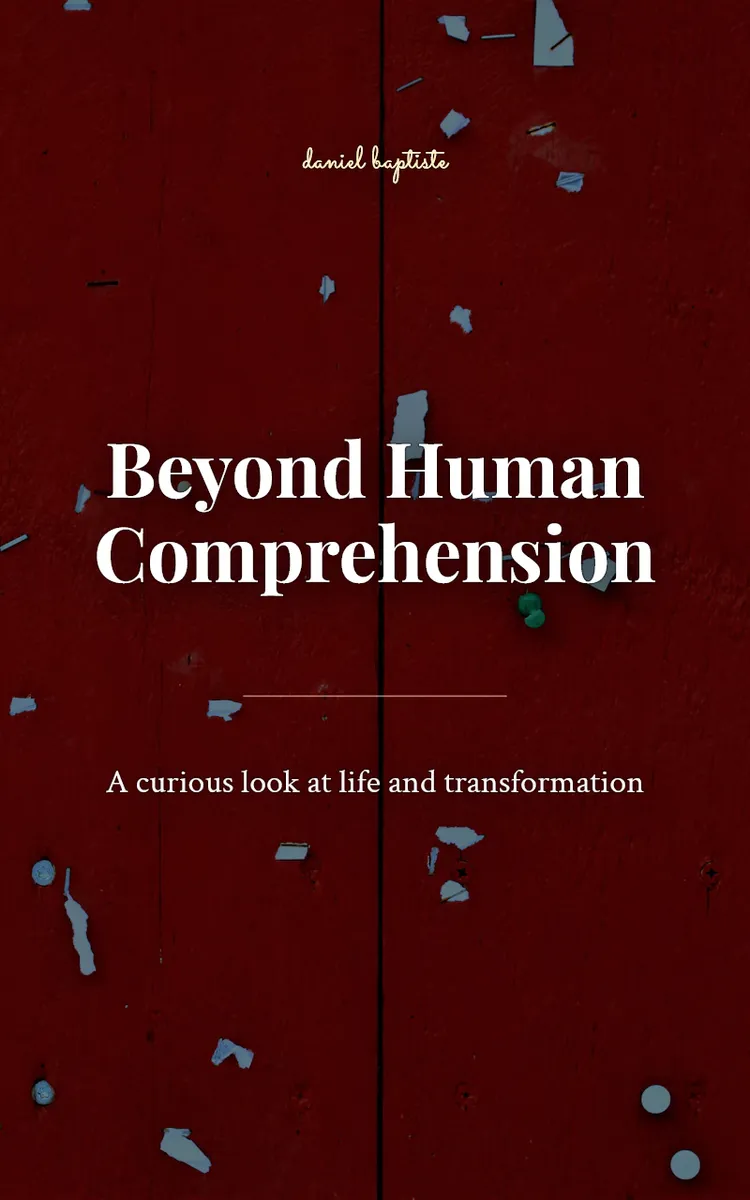
"Beyond Human Comprehension" is a biography book by daniel baptiste with 10 chapters and approximately 22,956 words. The film Lucy, human transformation, and ideas about life in 2026.
This book was created using Inkfluence AI, an AI-powered book generation platform that helps authors write, design, and publish complete books. It was made with the AI Biography Writer.
Frequently Asked Questions
What is "Beyond Human Comprehension" about?
The film Lucy, human transformation, and ideas about life in 2026
How many chapters are in "Beyond Human Comprehension"?
The book contains 10 chapters and approximately 22,956 words. Topics covered include The Taipei Signal, Choosing to Answer, Who Sent the Signal, Crossing the Research District, and more.
Who wrote "Beyond Human Comprehension"?
This book was written by daniel baptiste and created using Inkfluence AI, an AI book generation platform that helps authors write, design, and publish books.
How can I create a similar biography book?
You can create your own biography book using Inkfluence AI. Describe your idea, choose your style, and the AI writes the full book for you. It's free to start.
Write your own biography book with AI
Describe your idea and Inkfluence writes the whole thing. Free to start.
Start writingCreated with Inkfluence AI


