
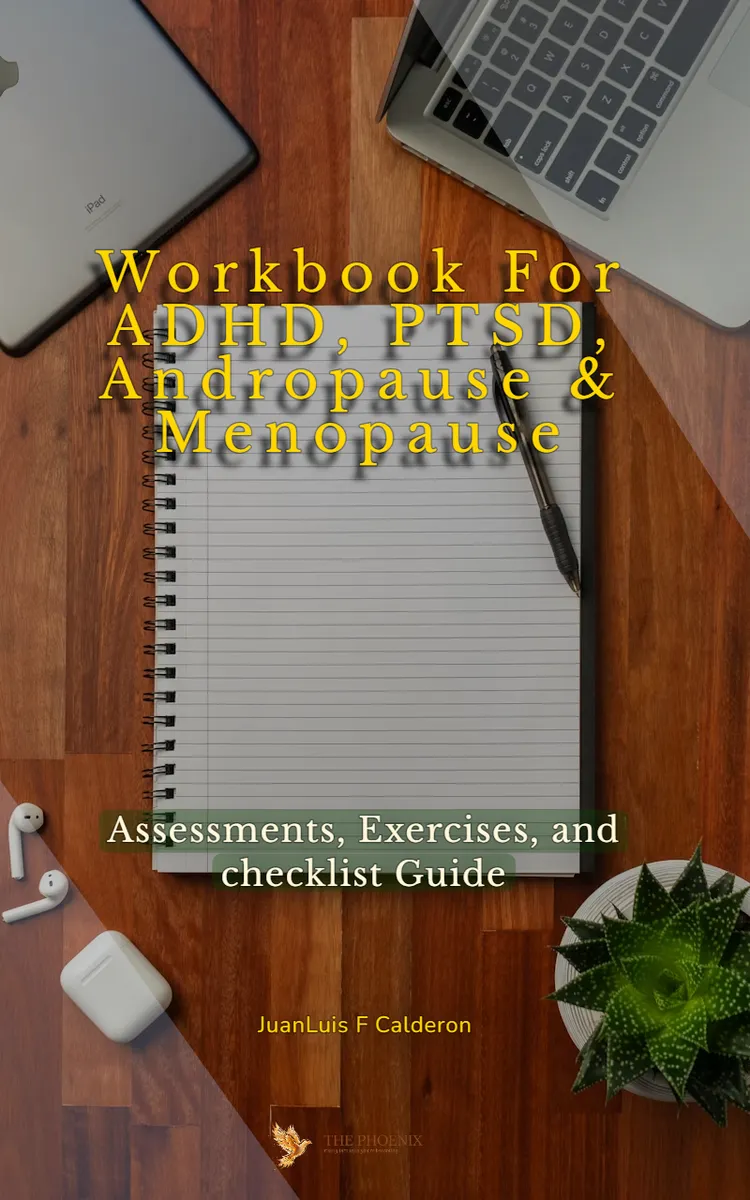

Workbook companion for andropause, menopause, ADHD, and PTSD support
Table of Contents
- 1. Andropause and ADHD Baseline Map
- 2. Symptoms Grounding for Daily Flashbacks
- 3. Sleep Timing That Protects Hormones
- 4. Caffeine, Alcohol, and Cravings Plan
- 5. ADHD-Friendly Task Chunking System
- 6. Morning Routine for Energy and Mood
- 7. Evening Wind-Down and Nervous System
- 8. Hormone-Supportive Movement You’ll Do
- 9. Nutrition for Stability and Cravings
- 10. Boundary Scripts for Triggered Relationships
- 11. Emotional Regulation with Urge Surfing
- 12. Rebuilding Self-Trust After Setbacks
- 13. Therapy-Ready Symptom Tracking
- 14. AI OS Support: Personal Copilot Prompts
- 15. 90-Day Integration and Maintenance Plan
Preview: Andropause and ADHD Baseline Map
A short excerpt from “Andropause and ADHD Baseline Map”. The full book contains 15 chapters and 22,440 words.
A useful baseline turns “I feel off” into information you can work with. For 14 days, track five areas: physical symptoms, triggers, sleep, mood, and focus. You’re not trying to diagnose yourself. You’re looking for patterns that can guide a better conversation with a qualified healthcare professional and help you choose one change at a time.
Keep the process simple. Record the same measures each day, use a 0-10 scale, and note what happened before a difficult period. Andropause-related changes, ADHD symptoms, stress, PTSD responses, poor sleep, medication effects, and other health conditions can overlap. A written profile helps separate a rough day from a repeating pattern.
Key takeaway: a baseline is not a judgment; it is a clear starting point for targeted change.Use these five tracking areas:
Symptoms: energy, hot flashes or night sweats, headaches, pain, sexual changes, irritability, and physical tension.
Triggers: conflict, noise, skipped meals, alcohol, caffeine, deadlines, memories, medication timing, or disrupted routines.
Sleep: bedtime, wake time, awakenings, estimated total sleep, and sleep quality from 0-10.
Mood: calm, low, anxious, angry, numb, or unusually activated. Rate the strongest mood from 0-10.
Focus: task-starting, distractibility, time blindness, working memory, and task completion. Rate usable focus from 0-10.
If you have thoughts of harming yourself or someone else, severe confusion, chest pain, or a sudden major change in behavior, seek urgent help rather than waiting for the tracking period to end.
Build Your 14-Day Baseline MapMaterials needed: this workbook, a pen or notes app, and a clock or phone.
Time required: 5 minutes each evening, plus 10 minutes at the end of Day 7 and Day 14.
Use one row per day. Keep the numbers honest, not impressive. A focus score of 3 is useful data. Writing down a 3 instead of pretending it was a 7 is how the map becomes trustworthy.
Your TurnCopy the daily record below into a notebook or notes app. Complete one record each evening.
Record sleep first. Write the time you went to bed, the time you got up, the number of awakenings, and sleep quality from 0-10.
Rate energy, mood stability, and usable focus from 0-10. Use 0 for none or unusable and 10 for strong or steady.
List up to three symptoms. Include a time when possible.
List the strongest trigger or context before a difficult period. If there was no clear trigger, write “unknown.”
Record caffeine, alcohol, exercise, medication or supplement timing, and unusual stress. Do not change prescribed medication without medical guidance.
At the end of each week, circle one repeating pattern and one question to investigate.
Mark the checklist when the record is complete.
Daily Baseline RecordDate: ____
Bedtime: __ Wake time: __
Awakenings: __ Estimated sleep hours: __
Sleep quality, 0-10: __
Energy, 0-10: __
Mood stability, 0-10: __
Usable focus, 0-10: __
Symptoms and times: __________
Strongest trigger or context: __________
Caffeine, alcohol, exercise, medication or supplement timing:
_____________
One thing that helped: ____________
☐ Record complete
Here’s a completed example. Notice that it’s specific without becoming a novel.
Date: Tuesday
Bedtime/Wake time: 11:30 p.m. / 6:15 a.m.
Awakenings: 3; Estimated sleep: 5.5 hours
Sleep quality: 4/10
Energy: 3/10; Mood stability: 5/10; Usable focus: 2/10
Symptoms: night sweat at 2:40 a.m.; morning headache; afternoon irritability
Trigger/context: skipped lunch, then a noisy meeting at 2 p.m.
Caffeine/exercise/medication: two coffees before noon; no exercise; usual medication at 8 a.m.
One thing that helped: 15-minute quiet break and water
☑ Record complete
After Day 7, total the scores for sleep quality, energy, mood stability, and focus. Divide each total by seven. Then repeat after Day 14. Write the averages below.
Week 1 sleep average: __ /10
Week 1 energy average: __ /10
Week 1 mood stability average: __ /10
Week 1 focus average: __ /10
Week 2 sleep average: __ /10
Week 2 energy average: __ /10
Week 2 mood stability average: __ /10
Week 2 focus average: __ /10
Your baseline is complete when you have 14 daily records, two weekly reviews, and four averages for each week. Check each item:
☐ 14 daily records completed
☐ Sleep was recorded on at least 12 days
☐ Symptoms and triggers were recorded on at least 12 days
☐ Week 1 averages calculated
☐ Week 2 averages calculated
☐ One repeating pattern identified
☐ One healthcare question written
Use the Map During Real DaysThe map becomes useful when you connect a rating to a decision....
About this book
"Companion Workbook For Andropause" is a workbook by JuanLuis F Calderon with 15 chapters and approximately 22,440 words. Workbook companion for andropause, menopause, ADHD, and PTSD support.
This book was created using Inkfluence AI, an AI-powered book generation platform that helps authors write, design, and publish complete books. It was made with the Workbook Generator.
Frequently Asked Questions
What is "Companion Workbook For Andropause" about?
Workbook companion for andropause, menopause, ADHD, and PTSD support
How many chapters are in "Companion Workbook For Andropause"?
The book contains 15 chapters and approximately 22,440 words. Topics covered include Andropause and ADHD Baseline Map, Symptoms Grounding for Daily Flashbacks, Sleep Timing That Protects Hormones, Caffeine, Alcohol, and Cravings Plan, and more.
Who wrote "Companion Workbook For Andropause"?
This book was written by JuanLuis F Calderon and created using Inkfluence AI, an AI book generation platform that helps authors write, design, and publish books.
How can I create a similar workbook?
You can create your own workbook using Inkfluence AI. Describe your idea, choose your style, and the AI writes the full book for you. It's free to start.
Write your own workbook with AI
Describe your idea and Inkfluence writes the whole thing. Free to start.
Start writingCreated with Inkfluence AI


