

Read the first chapter
The whole of chapter one, free. About 9 min. Turn the pages with the arrows, your keyboard, or a swipe.
Chapter 1
Choosing the Stay Decision
You can feel the decision sitting between you like a third person at the table - quiet, heavy, and always watching. One night you’re trying to talk about dinner plans, and the next you’re snapping at each other because the word trust lands like a bruise. And underneath it all is the same question, looping in your head at 2 a.m.: Do we stay and rebuild… or are we just postponing the pain?
Talia, an ER nurse who knows what urgency looks like, described it this way: “In the break room, everyone moves fast. But in my marriage, time doesn’t heal. It just stacks.” She’d decided to “try,” but the word try was starting to feel like denial. She wasn’t sure if she was choosing her marriage - or just refusing to face the cost of leaving. When she finally said it out loud, her voice cracked: “I don’t want to hurt him. I also don’t want to keep lying to myself.”
That tension - between hope and honesty - is the whole point of this chapter. Can you commit to rebuilding with clarity instead of letting denial drive the steering wheel?
Picture This: The Stay-or-Leave Compass vs. the “Falling Apart Quietly” Loop
Picture a night when you both finally get home. The house looks normal. The laundry is folded. The kids (or schedules) are handled. And still - something is off.
Talia told me she’d sit on the edge of the couch and wait for the “right feelings” to show up. You know the ones: calm certainty, trust arriving like a package, relief that proves she made the correct choice. But the feelings didn’t come. Instead she felt a dull ache and a kind of vigilance - checking his tone, checking her own reactions, checking for signs that she was either safe to believe again or foolish for hoping.
So she did what a lot of couples do when they’re scared: she stayed in the fog. She called it “working on things,” but it was really avoiding the truth. The truth was: she didn’t know yet what her life would look like if rebuilding required more than good intentions.
Now zoom in to the moment you’re about to make the stay decision - not the paperwork, not the dramatic speech, but the inner choice you make in your bones.
Old Belief: Staying means you’re confident everything will be okay. New Reality: Staying means you’re willing to rebuild on purpose, even while it feels uncertain.
That shift matters because affair recovery isn’t a feeling-first journey. It’s a choice-first journey. Feelings follow decisions like weather follows pressure systems - sometimes quickly, sometimes slowly, but always in response to what you’re actually doing.
Here’s a concrete example from Talia’s week. She and her husband agreed to “talk” after the kids went to bed. But the conversation always drifted into rehearsed safety: apologies that didn’t land, reassurance that didn’t answer the real question, humor that turned grief into a joke. She realized she was treating rebuilding like a conversation you have until it becomes “fine.”
So she tried something different. She asked one simple question before the talk started: “Are we here to rebuild, or are we here to avoid the parts that hurt?” That one question didn’t fix everything. But it stopped the performance. It grounded her in clarity - what we’re doing tonight has a purpose, not just a mood.
When you choose rebuilding with clarity, you’re not promising the outcome. You’re choosing the direction.
The Mindset Shift: Clarity Holds, Denial Flinches
The Stay-or-Leave Compass is built for couples who are emotionally tired of guessing. It’s a way to decide that steadies both partners - because it doesn’t require you to pretend you feel safe when you don’t.
With denial, the mind tries to protect you by shrinking the truth. It says, “If we don’t look too closely, it won’t be real.” Or, “If we stay hopeful, we won’t have to grieve.” The problem is that denial doesn’t remove the pain - it just moves it underground. Then it leaks out sideways: through suspicion, resentment, sudden anger, or a numb kind of compliance.
With clarity, you do the opposite. You let the truth be real without letting it become the whole story. Clarity says, “I can love you and still be hurt. I can stay and still demand accountability. I can be uncertain and still choose a direction.”
That’s why the stay decision needs to be values-based. Not values like “be positive” or “make it work.” Values like: honesty over comfort, accountability over excuses, repair over appearances, love expressed through effort.
When you anchor in values, you don’t have to force trust to feel real before you start building it. You build trust by living differently - consistently, visibly, and with enough courage to face what’s true.
Signs this pattern is running your life 1. You’re saying “we’re working on it,” but your conversations avoid the specific questions - the ones that would actually change behavior. 2. You rely on mood to decide what happens next. If you feel okay, you act like progress is happening. If you feel triggered, you spiral into “maybe we should leave.” 3. You confuse staying with pretending. You stay physically, but emotionally you protect yourself by not fully engaging - so nothing meaningful can grow. 4. You’re waiting for certainty before you commit. But rebuilding needs a choice you make before your heart catches up.
A clear stay decision is choosing the work, not choosing the outcome.
Going Deeper: What the Compass Protects You From (and What It Asks of You)
Let’s be honest: the stay decision can feel like a trap either way. If you stay, you worry you’re signing up for years of pain. If you leave, you worry you’re abandoning hope and hurting someone you still care about.
The Stay-or-Leave Compass doesn’t pretend those fears aren’t real. It just refuses to let fear drive the steering wheel.
It asks you to separate three things that often get tangled together:
• Your pain (real, valid, sometimes urgent) - Your commitment (what you’re willing to do next) - Your certainty (what you can’t demand right now)
Pain is information. Commitment is action. Certainty is a luxury you don’t get on demand.
When Talia finally used this framework, she didn’t focus on “Should we?” in the abstract. She focused on “What are we willing to do if we stay?” That question made the decision less theoretical and more honest.
For example, she noticed she kept demanding emotional safety before accountability was even clear. She was asking for trust while the behavior that would earn trust was still murky. That’s not her fault - pain makes you hungry for relief. But it’s a setup for disappointment.
So she made her values concrete. When she said “rebuild,” she meant: not just talking, not just apologizing, but showing up with consistency. That meant agreeing on specific boundaries for honesty, specific ways to handle triggers, and specific times to return to the truth instead of running from it. (Not forever. Just long enough to see whether repair is actually happening.)
The compass also protects the betrayed partner from getting stuck in an exhausting “prove it to me” loop that never ends. Because while you should be able to ask hard questions, you shouldn’t be forced to become the detective forever. Clarity builds a structure where accountability can be demonstrated - not demanded.
And it protects the unfaithful partner from hiding behind vague promises like “I’m trying.” Trying is not a plan. Trying is a feeling. Rebuilding requires behavior that can be tracked and discussed - without contempt, without games, without pretending.
Reflection & Self-Assessment: Answer These Questions Like Your Marriage Depends on It
Here are questions that cut through the fog. Don’t rush them. If an answer makes you tense, that’s usually the exact place to look.
1. When you say “we should stay,” what are you actually committing to - time, behavior, and boundaries - or just hope that things will feel better? If your answer is mostly hope, try naming one specific behavior you want to see consistently over the next month.
2. What truth are you avoiding because it would force a harder decision? An honest answer might sound like: “I’m avoiding the reality that I don’t feel safe yet,” or “I’m avoiding how much damage is still unresolved.”
3. What would “clarity” require from you this week that you’ve been skipping because it feels too painful? For Talia, clarity looked like asking one uncomfortable question at the start of a conversation and staying present long enough to hear the answer.
4. If the stay decision was based on your values, which value would you refuse to compromise on - no matter what emotions show up? Examples: “honesty,” “accountability,” “repair,” “respect.” Pick one. If you pick five, you’ll water it down.
5. What pattern do you fall into when you feel triggered: withdraw, attack, bargain, or numb out? After you name the pattern, choose one small alternative you can try immediately (more on that in the challenge).
If you can answer these without performing, you’re already moving toward clarity. Not because it feels good - but because it’s true.
Growth Challenge: 7 Days to Choose Rebuilding on Purpose (Not on Mood)
This is a short challenge, but it’s not fluffy. It’s designed to help you feel the difference between denial and commitment in real time.
Challenge Title: The Compass Check-In (7 Days)
• Day 1: Write down your top two values for rebuilding (for example: honesty, repair). Then write one sentence: “If we stay, I will protect these values by…” - Days 2-4: Have one 20-minute conversation each day where you start with one question: “Are we working on repair, or are we avoiding something painful?” Keep the talk focused on actions and truth - not promises and reassurance. - Day 5: Choose one concrete boundary you need to feel safe enough to engage (something that can actually be followed, not a wish). - Day 6: Both of you each write one paragraph: “What I can do differently next week to rebuild trust through behavior is…” - Day 7: Do a short review together: What felt clearer? What still feels foggy? What would we do differently if we stay for another 30 days?
Difficulty rating: Medium (because it asks you to be honest while emotions are loud)
You'll know it's working when... - You can tell the difference between “we’re avoiding” and “we’re repairing” without guessing. - Conversations start to include specific actions, not just feelings and intentions. - You feel steadier - even if the relationship is still painful - because you’re choosing direction on purpose. - At least one behavior changes in a way you can actually observe.
Key Takeaway: Your Stay Decision Is a Values-Based Anchor, Not a Leap Into Uncertainty
If you take nothing else from this chapter, take this: clarity doesn’t erase heartbreak. It keeps heartbreak from running your life.
Staying with clarity means you choose repair as your path - even before trust feels returned.
• You don’t need certainty to commit, but you do need honesty about what’s true. - Denial keeps pain hidden; clarity turns pain into direction. - The Stay-or-Leave Compass helps you separate pain, commitment, and certainty so fear doesn’t get the final say. - Your rebuilding decision becomes real when it shows up in behavior you can discuss and track.
Next, we’ll move from choosing to staying steady - because once you’ve made the decision with clarity, you still have to handle the moments when your emotions try to hijack the compass.
End of chapter one. 19 more chapters in the full book.
Swipe or use the arrows to turn the page


What's inside: 20 chapters
- 1. Choosing the Stay Decision
- 2. Naming the Betrayal Truth
- 3. Grief for the Relationship You Lost
- 4. Breaking the Shame Silence Spiral
- 5. Rebuilding Trust with Micro-Consistency
- 6. Setting Boundaries Without Guilt
- 7. Owning Responsibility Without Defensiveness
- 8. Managing Triggers with the Pause Protocol
- 9. Asking Questions That Heal
- 10. Listening to Understand the Wound
- 11. Repair Conversations in 20 Minutes
- 12. Rewriting the Story of “Why”
- 13. Building a Shared Safety Plan
- 14. Transparency That Doesn’t Become Control
- 15. Healing Intimacy Without Pressure
- 16. Repairing Communication Under Stress
- 17. Handling Relapse of Old Patterns
- 18. Forgiveness as a Process, Not a Switch
- 19. Choosing a New Marriage Identity
- 20. Sustaining Courage to Stay
About this book
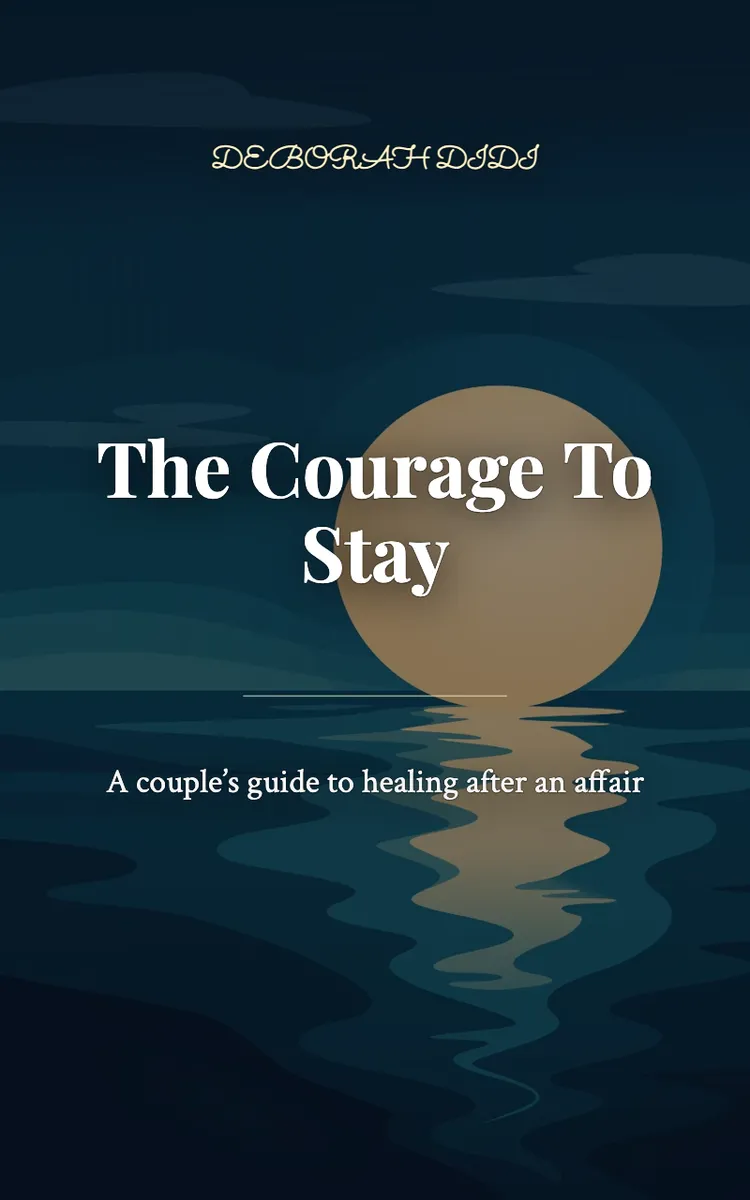
"The Courage To Stay" is a self-help book by DEBORAH DIDI with 20 chapters and approximately 36,125 words. Healing and rebuilding a marriage after an affair.
This book was created using Inkfluence AI, an AI-powered book generation platform that helps authors write, design, and publish complete books. It was made with the AI Self-Help Book Writer.
Frequently Asked Questions
What is "The Courage To Stay" about?
Healing and rebuilding a marriage after an affair
How many chapters are in "The Courage To Stay"?
The book contains 20 chapters and approximately 36,125 words. Topics covered include Choosing the Stay Decision, Naming the Betrayal Truth, Grief for the Relationship You Lost, Breaking the Shame Silence Spiral, and more.
Who wrote "The Courage To Stay"?
This book was written by DEBORAH DIDI and created using Inkfluence AI, an AI book generation platform that helps authors write, design, and publish books.
How can I create a similar self-help book?
You can create your own self-help book using Inkfluence AI. Describe your idea, choose your style, and the AI writes the full book for you. It's free to start.
Write your own self-help book with AI
Describe your idea and Inkfluence writes the whole thing. Free to start.
Start writingCreated with Inkfluence AI


