

Read the first chapter
The whole of chapter one, free. About 7 min. Turn the pages with the arrows, your keyboard, or a swipe.
Chapter 1
Choosing Your Journal Intention
Your journal won’t magically pull you toward the good stuff unless you give it a job. In this chapter, you’ll set a clear Journal Intention for your entries - so each page naturally leans into memories, gratitude, and connection instead of drifting into “what happened today” mush.
Here’s the sweet spot: you’re not trying to write perfectly. You’re choosing a direction. When you know what you’re aiming at, your words fall into place faster, and your entries start to feel like they belong to you (not to some blank page with opinions).
Key takeaway: A Journal Intention turns each entry into a magnet for memories, gratitude, and connection.
Anchor the Purpose: The Journal Intention that pulls you in A Journal Intention is one simple statement that tells your future self what to look for on every page. Not a life motto. Not a “be better” slogan. Something specific enough that, when you sit down with your pen, you instantly know what kind of thinking to do.
Think of your intention as having three parts you’ll revisit in every entry: 1. Memory lens - what you’re remembering (a moment, a person, a place, a detail). 2. Gratitude fuel - what you’re appreciating about that memory (even if it’s small or messy). 3. Connection thread - how it ties to someone (or to the version of you who needed it).
To make this practical, use this intention formula: 1. Memory lens: “I’m writing about.” 2. Gratitude fuel: “I’m grateful for in that.” 3. Connection thread: “I’m noticing how it connects to ___ (a person, a relationship, or my future self).”
Your Turn: Pick your first Journal Intention (copy it onto the first page of your journal). Choose one blank and fill it in with real words you actually use.
• Option A (Relationships): “I’m writing about a moment with, grateful for, and connecting it to.” - Option B (Work/Projects): “I’m writing about a moment from, grateful for, and connecting it to.” - Option C (Everyday Life): “I’m writing about a small moment today, grateful for, and connecting it to.”
Before you move on, write your intention in one sentence. Keep it short enough to fit on a sticky note.
My Journal Intention (one sentence): __________________________________________________________________________________ __________________________________________________________________________________
If you want a differentiator you can hold onto: try including a specific detail type in your memory lens - like “a sound,” “a smell,” or “a sentence someone said.” That way, your entries don’t stay blurry.
Guided Practice: Build a one-page entry that follows your intention You’re going to write a single practice page right now. This is hands-on, not theory - so you’ll feel how the intention changes what shows up on the page.
Time required: 12-18 minutes Materials needed: your journal (or loose paper), a pen, and a timer (optional, but helpful)
Here’s the exact format to follow. You’ll stop when you hit the completion criteria at the end.
1. Set your timer for 12 minutes (if you hate timers, do 15 - no big deal). 2. Choose one memory anchor from the last 7 days. Pick something you can describe in one sentence. - Examples: “The way my coworker laughed when the printer jammed,” “The smell of coffee at the counter,” “A five-minute walk after work.” 3. Write the Memory lens (3-4 lines). - Prompt: “I’m remembering _ (include one detail: a sound, a place, or a phrase).” 4. Write the Gratitude fuel (2-3 lines). - Prompt: “In that memory, I’m grateful for _ because.” - Completion note: You must write one “because.” Even a tiny one counts. 5. Write the Connection thread (2-4 lines). - Prompt: “This connects to (a person, relationship, or the kind of person I’m becoming) because _.” 6. Do a quick “tighten pass” (1 minute). - Prompt: Circle one sentence that feels most true. Rewrite it once, using fewer words. - Completion note: exactly one sentence gets rewritten. 7. Name your entry using a tiny title (1 line). - Prompt: “Title: _” (Make it specific, like “Printer Jam Laughter” or “Coffee at the Counter.”)
Completed example (so you can copy the structure) > Title: Printer Jam Laughter > Memory lens: I’m remembering the moment the printer jammed during the meeting. I heard that sharp “thunk,” and then my coworker laughed like it was the funniest interruption. The room relaxed fast after that. > Gratitude fuel: I’m grateful for their laugh because it turned stress into something we could handle together. > Connection thread: This connects to my need to feel safe with people at work. When someone can be real and light, I remember I don’t have to carry everything alone.
When you’re done, check your completion criteria: - Your page includes Memory lens, Gratitude fuel, Connection thread headings (even if you just write the words). - You wrote one “because” in the gratitude section. - You wrote one connection “because” in the connection section. - You included a specific title.
If any of those are missing, fix just that part. No starting over.
Your Turn (write your practice page now): Title: ______________________________________________ Memory lens: ______________________________________________________________________ ______________________________________________________________________________________ ______________________________________________________________________________________ Gratitude fuel: _____________________________________________________________________ ______________________________________________________________________________________ ______________________________________________________________________________________ Connection thread: __________________________________________________________________ ______________________________________________________________________________________ ________________________________________________________________________________________
Real-World Application: Use your intention in everyday moments Once your Journal Intention is set, the trick is using it when life is loud - when you don’t feel “journal-ready.” Your intention is your on-ramp. It tells you what to grab first.
Try this in three common scenarios:
Scenario 1: You had a rough day but you can’t explain it. Use your Memory lens to grab one concrete moment, not the whole day. Your expected outcome is a page that doesn’t spiral - it lands. Then gratitude gets easier because you’re grateful for something specific that helped you survive the day (like “I made it home” or “someone texted me back”). Connection comes last: “This connects to how I want to be supported.”
Scenario 2: You had a good day and you want to remember it later. Your Journal Intention keeps it from turning into “It was nice.” Expected outcome: you’ll write down one detail you’d forget (a look, a sentence, a smell, the exact time you noticed it). Gratitude fuel turns that detail into meaning, and connection thread helps you see who you were with - or what you were becoming.
Scenario 3: You’re thinking about someone (but you don’t know what to say). Your intention helps you write without performing. Expected outcome: your connection thread becomes a bridge. You might write, “This connects to the way I learned patience from ___,” even if you don’t talk to them every week. That’s still connection.
Apply It (choose one scenario and do one quick entry): Pick the scenario that matches your current mood. Then write using the same three-part structure from the practice page - just shorter.
• If you’re doing Scenario 1, limit Memory lens to one moment. - If you’re doing Scenario 2, include one sensory detail (sound/smell/touch). - If you’re doing Scenario 3, name one person or one relationship in the connection thread.
Your Turn (short entry, 6-10 minutes): Memory lens (one moment): __________________________________________________________ ______________________________________________________________________________________ Gratitude fuel (one because): _____________________________________________________ ______________________________________________________________________________________ Connection thread (one because): __________________________________________________ ________________________________________________________________________________________
Reflect and Plan: Lock it in so your next page pulls you forward Now you’ll make your intention stick. Not by promising you’ll write every day. By making sure your intention is usable when you’re tired, busy, or a little blank.
Reflect: Look at your practice page and answer with honesty. If something felt forced, that’s information - not failure.
Your Turn: adjust your intention for what you actually wrote. Answer these in your journal, then rewrite your intention if needed.
1) Did your memory lens pull up real details, or did it stay general? ________________________________________________________________________________________ ________________________________________________________________________________________
2) Where did gratitude feel easiest - during the memory, or after you named the “because”? ________________________________________________________________________________________ ________________________________________________________________________________________
3) Did connection feel warm, awkward, or surprisingly clear? What helped it show up? ________________________________________________________________________________________ ________________________________________________________________________________________
Question 1: What’s one specific detail type you want to include every time (a sound, a smell, a phrase, a time of day)? ________________________________________________________________________________________ ______________________________________________________________________________________ ________________________________________________________________________________________
Question 2: If your next entry only hits one part - Memory, Gratitude, or Connection - which one do you want it to prioritize, and why? ________________________________________________________________________________________ ______________________________________________________________________________________ ________________________________________________________________________________________
Question 3: Write your “next page” intention sentence exactly as you want it to appear in your journal. ________________________________________________________________________________________ ______________________________________________________________________________________ ________________________________________________________________________________________
When you finish, take one last step: put a reminder somewhere you’ll see it before you write again. A sticky note on your journal cover works. Or copy your intention onto the inside front cover. The goal is simple: so the moment you open to a blank page, your pen already knows what kind of page it’s about to become.
And honestly? Once your intention is clear, your journal starts doing something quiet and powerful: it starts remembering for you.
End of chapter one. 39 more chapters in the full book.
Swipe or use the arrows to turn the page


What's inside: 40 chapters
- 1. Choosing Your Journal Intention
- 2. Creating a Cozy Reflection Setup
- 3. Using the Memory Map Prompt
- 4. Spotting Gratitude in Everyday Moments
- 5. Naming Your Feelings Without Judgment
- 6. Writing Sensory Details That Linger
- 7. Turning Regret Into a Learning Letter
- 8. Practicing Gratitude Toward Yourself
- 9. Building a Personal Timeline of Moments
- 10. Finding Meaning in Hard Seasons
- 11. Collecting Quotes That Mirror You
- 12. Writing a Gratitude List With Specifics
- 13. Creating Your Personal Values Compass
- 14. Practicing Compassionate Self-Talk
- 15. Remembering With Boundaries and Safety
- 16. Choosing a Memory to Honor Today
- 17. Writing a Letter You Don’t Send
- 18. Turning Gratitude Into a Thank-You Note
- 19. Using the “I Thought of You” Trigger
- 20. Remembering Through Objects and Keepsakes
- 21. Noticing Patterns in Your Relationships
- 22. Setting Boundaries With Gentle Clarity
- 23. Repairing After Misunderstandings
- 24. Practicing Forgiveness Without Forgetting
- 25. Gratitude for People Who Changed You
- 26. Creating a “We” Story With Others
- 27. Turning Photos Into Conversation Starters
- 28. Writing Boundaries for Your Time and Energy
- 29. Planning a Small Reach-Out Moment
- 30. Using Gratitude to Rebuild Trust
- 31. Remembering Your Support Network
- 32. Asking for What You Need
- 33. Giving Gratitude in Different Styles
- 34. Creating a Shared Tradition of Reflection
- 35. Writing a Memory That Heals You
- 36. Celebrating Milestones With Gratitude
- 37. Reviewing Your Entries for Themes
- 38. Choosing One Connection to Deepen
- 39. Writing Your Closing “I Thought of You” Page
- 40. Continuing the Practice Beyond These Pages
About this book
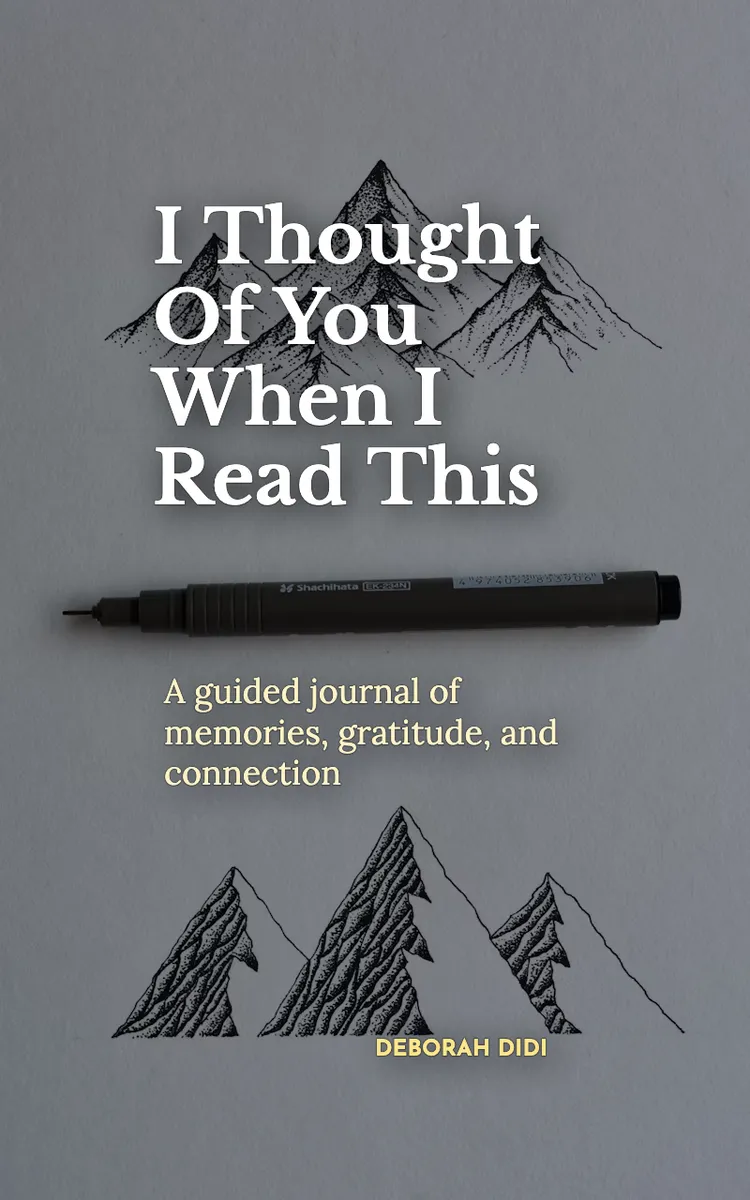
"I Thought Of You When I Read This" is a workbook by DEBORAH DIDI with 40 chapters and approximately 55,709 words. Guided journaling prompts for memories, gratitude, and connection.
This book was created using Inkfluence AI, an AI-powered book generation platform that helps authors write, design, and publish complete books. It was made with the Workbook Generator.
Frequently Asked Questions
What is "I Thought Of You When I Read This" about?
Guided journaling prompts for memories, gratitude, and connection
How many chapters are in "I Thought Of You When I Read This"?
The book contains 40 chapters and approximately 55,709 words. Topics covered include Choosing Your Journal Intention, Creating a Cozy Reflection Setup, Using the Memory Map Prompt, Spotting Gratitude in Everyday Moments, and more.
Who wrote "I Thought Of You When I Read This"?
This book was written by DEBORAH DIDI and created using Inkfluence AI, an AI book generation platform that helps authors write, design, and publish books.
How can I create a similar workbook?
You can create your own workbook using Inkfluence AI. Describe your idea, choose your style, and the AI writes the full book for you. It's free to start.
Write your own workbook with AI
Describe your idea and Inkfluence writes the whole thing. Free to start.
Start writingCreated with Inkfluence AI


