
Read the first chapter
The whole of chapter one, free. About 8 min. Turn the pages with the arrows, your keyboard, or a swipe.
Chapter 1
Why Fear Sounds Like Wisdom
When Uncertainty Wakes the Dragon
A message arrives without its usual greeting: “Can we talk?” Before the next sentence appears, the body may tighten, attention may narrow, and the mind may begin assembling explanations. Nothing dangerous has happened, yet the brain has already started preparing for danger.
That rapid shift is part of the work of the amygdala, a small group of almond-shaped structures deep within the brain. It never waits for a complete account of events. It scans for significance, compares the present with fragments of the past, and helps organize the body’s response before conscious thought has finished forming an opinion.
The amygdala is often described as an alarm system, but the image is incomplete. A household alarm usually waits for a sensor to be triggered. The amygdala is a watchful dragon in a labyrinth: ancient, vigilant, and alarmed at omission more than error. Its mistake is not a design flaw. It is part of the bargain that allowed nervous systems to survive uncertain environments.
When fear speaks first, how can we tell whether it is warning us about danger - or merely about the unknown?
The Dragon Beneath the Thought
The amygdala belongs to a network involved in detecting emotionally important events, especially those connected with threat. It receives information from several routes, including signals processed by the senses and information assembled by the cerebral cortex. One route is fast and rough. Another is slower and more detailed.
That distinction became central to modern explanations of fear through the work of neuroscientist Joseph LeDoux, whose research helped show how the brain can begin defensive responses before conscious recognition is complete. A sudden shape at the edge of vision may cause a person to turn, tense, or step back before the visual system has identified whether the shape is a branch, an animal, or a coat hanging from a door.
The fast route is useful precisely because it is crude. A brain that waits for certainty may be accurate but late. A brain that reacts to every ambiguous signal may be startled often, but it is less likely to overlook a genuine threat. Evolution has no requirement that an alarm be elegant. It needs to be quick enough to matter.
The amygdala does not operate alone. The hypothalamus helps coordinate bodily changes associated with stress, including shifts in heart rate, breathing, muscle readiness, and hormone release. The prefrontal cortex contributes more deliberate evaluation, while the hippocampus helps place events in context: where something happened, when it happened, and whether the current setting resembles the original danger.
This arrangement resembles the enchanted labyrinth of the mind. The amygdala is the dragon guarding a passage. The hippocampus keeps maps and old route markers. The prefrontal cortex studies the whole floor plan, though it may do so only after the dragon has already raised its head.
Fear therefore arrives with a misleading authority. Because it is accompanied by bodily force, it can feel like knowledge. A racing heart seems to announce that something is wrong, even when it is only announcing that the alarm system has activated.
Why the Alarm Prefers False Alarms
The brain’s threat detection is shaped by an uneven cost structure. Missing a real danger can be disastrous; reacting to a harmless signal usually costs less. This makes the system biased toward caution when information is incomplete.
A rustle in grass may be caused by wind, an animal, or nothing more than a shifting stem. The nervous system does not calculate these possibilities like a careful statistician. It responds to patterns, associations, and resemblance. The sound of the rustle may be enough to prepare the body before the source has been identified.
Human culture extends this problem far beyond forests and open fields. A delayed reply, an unfamiliar medical result, an employer’s closed office door, or an unexpected change in someone’s voice can activate the same basic logic. The modern setting changes the object of uncertainty, but not the underlying machinery. The dragon has learned to patrol email, elevators, traffic, social judgment, and financial paperwork.
The difficulty is that uncertainty and danger often share the same physical opening: incomplete information. The body tightens in both cases because the nervous system is preparing for what might happen. Fear does not always say, “This is dangerous.” Sometimes it says, “I do not yet know what this is.”
That distinction matters because the sensation of urgency can distort interpretation. Once the alarm is active, attention is drawn toward confirming details. A neutral expression may look hostile. A minor symptom may appear ominous. A pause in conversation may feel loaded with meaning. The brain is not simply receiving reality; it is searching through reality under the influence of a prediction.
A single sentence captures the problem: the amygdala can treat ambiguity as evidence.
Memory adds another layer. The amygdala helps strengthen the emotional significance of experiences, while the hippocampus stores aspects of their setting. A frightening event can leave behind a network of associations: a smell, a place, a tone of voice, a time of day. Later, one element may activate the alarm even when the original danger is absent.
This is why a person may feel uneasy in a hospital corridor years after a difficult diagnosis, or tense when hearing a particular ringtone associated with bad news. The reaction is not imaginary. It is a real bodily response to a learned connection. But the connection may be outdated, overbroad, or detached from the circumstances that first gave it meaning.
The Strange Logic of Fear
Fear is often treated as the opposite of reason, yet the amygdala’s response can be understood as a form of rapid reasoning. It gathers partial clues and reaches a provisional conclusion: prepare now, investigate later. The conclusion may be wrong, but it is not random.
That is why fear sometimes sounds like wisdom. It speaks in compressed summaries drawn from previous experience. A person who has been betrayed may notice subtle changes in trust long before being able to explain them. A firefighter may detect an unsafe building from cues that a visitor does not consciously register. Expertise can make fast judgment remarkably useful.
The same machinery can also produce overgeneralization. A person who has learned that one dog is dangerous may tense around every dog. Someone who has experienced public humiliation may interpret ordinary attention as a warning. The brain’s protective shortcut does not automatically know when a category has become too wide.
The Dragon Alarm Check, a useful name for this distinction, is not a self-help exercise or a command to silence fear. It is a way of describing the question hidden inside an alarm: is the dragon responding to a present threat, or to a resemblance carried from an earlier passage in the labyrinth? The question separates the signal from the story that gathers around it.
One counterintuitive fact changes the picture: the amygdala is not simply the brain’s fear center, and its activity does not always mean that a person feels afraid. It responds to emotionally significant information, including novelty, reward, social importance, and uncertainty.
This matters because it reframes fear as part of a broader system for deciding what deserves attention. The dragon guards more than the gates of danger; it also points toward what might matter. A surprising opportunity, a loved one’s unusual silence, and a possible threat can all command the same first burst of vigilance. The feeling becomes fear only after the brain and the surrounding context give that activation a particular meaning.
A Real Alarm in a New World
The public history of panic offers a clear example of how uncertainty can acquire the voice of danger. In the early 1980s, reports of a mysterious illness began circulating in the United States. Information was limited, transmission was poorly understood, and public explanations were often mixed with rumor and stigma. The result was not merely concern about a disease; it was a social alarm operating under conditions of incomplete knowledge.
As scientific understanding developed, the picture changed. Researchers identified HIV, clarified routes of transmission, and showed that casual contact did not spread the virus. Yet fear did not vanish simply because facts became available. Emotional associations had already formed around illness, sexuality, death, and social exclusion. For many people, the unknown had become fused with moral judgment and imagined contamination.
The history of HIV/AIDS demonstrates that an alarm can be socially amplified. Individual nervous systems respond to uncertainty, but communities supply the stories through which uncertainty is interpreted. Headlines, political language, public rituals, and personal testimony can all influence what the dragon believes it is guarding against.
A different kind of alarm appears in the experience of Māori communities in New Zealand, where traditional understandings of health have often treated emotional, physical, family, and spiritual dimensions as connected rather than isolated. Such frameworks do not remove fear, but they place distress within relationships and context. The meaning of an alarm may depend not only on an individual’s internal state but also on belonging, history, and collective memory.
These examples point to a central feature of the amygdala’s work: it is biological, but never purely private. The brain learns what counts as threatening through bodies, places, language, and other people. A child learns which sounds signal danger partly from the expressions and reactions of adults. A community learns what to fear through its history. A society can inherit alarms long after the original conditions have changed.
The dragon is therefore both ancient and teachable. It carries old survival equipment into environments filled with unfamiliar signals. It can mistake a notification for a summons, a pause for rejection, or uncertainty for proof. Yet its vigilance also reveals something valuable about human nature: we are creatures who do not merely experience events; we continually interpret what events might mean.
The Wisdom Hidden Inside the Alarm
Fear deserves neither blind obedience nor easy dismissal. Its first message is often accurate in one limited sense: something has become important enough to command the body’s attention. What remains uncertain is the nature of that importance.
The amygdala’s speed gives human beings a remarkable capacity for protection, but speed compresses detail. Conscious thought can widen the frame, recover context, and distinguish a present threat from an old association. Neither system is sufficient by itself. The dragon notices the movement; the map tells us where we are.
Emotional literacy begins in that narrow space between sensation and conclusion - not as a technique for controlling every feeling, but as a clearer understanding of how feelings acquire authority. The body may sound an alarm before the mind knows what it is hearing. Somewhere in the labyrinth, the question remains open: what, exactly, has the dragon seen?
End of chapter one. 7 more chapters in the full book.
Swipe or use the arrows to turn the page


What's inside: 8 chapters
- 1. Why Fear Sounds Like Wisdom
- 2. How Thoughts Put on Armor
- 3. The Weather Inside Your Body
- 4. The Library That Rewrites Yesterday
- 5. Paths Your Brain Practices Into Place
- 6. Naming Emotions Before They Rule
- 7. When the Labyrinth Changes Shape
- 8. Becoming the Cartographer Within
About this book
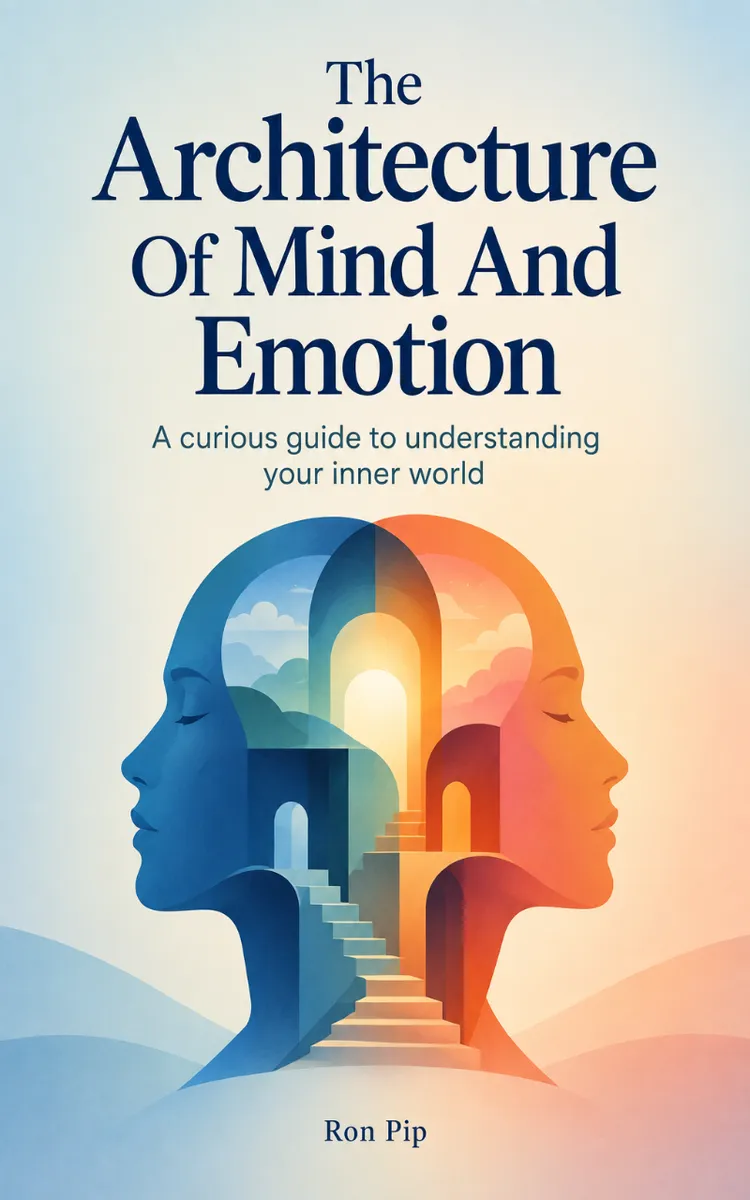
"The Architecture Of Mind And Emotion" is a self-help book by Ron Pip with 8 chapters and approximately 12,790 words. Neuroscience, psychology, emotional literacy, and the mind’s inner landscape.
This book was created using Inkfluence AI, an AI-powered book generation platform that helps authors write, design, and publish complete books. It was made with the AI Self-Help Book Writer.
Frequently Asked Questions
What is "The Architecture Of Mind And Emotion" about?
Neuroscience, psychology, emotional literacy, and the mind’s inner landscape
How many chapters are in "The Architecture Of Mind And Emotion"?
The book contains 8 chapters and approximately 12,790 words. Topics covered include Why Fear Sounds Like Wisdom, How Thoughts Put on Armor, The Weather Inside Your Body, The Library That Rewrites Yesterday, and more.
Who wrote "The Architecture Of Mind And Emotion"?
This book was written by Ron Pip and created using Inkfluence AI, an AI book generation platform that helps authors write, design, and publish books.
How can I create a similar self-help book?
You can create your own self-help book using Inkfluence AI. Describe your idea, choose your style, and the AI writes the full book for you. It's free to start.
Write your own self-help book with AI
Describe your idea and Inkfluence writes the whole thing. Free to start.
Start writingCreated with Inkfluence AI


