

Read the first chapter
The whole of chapter one, free. About 7 min. Turn the pages with the arrows, your keyboard, or a swipe.
Chapter 1
The Marsh Takes the Stick
The church bell began to tremble before it rang.
Claire Lefèvre felt the vibration through the stone wall beside her bed, a faint shiver traveling down from the tower. Then the sound came - not a bell, but aircraft, many engines beating at the darkness beyond the shutters. Her son stirred beneath the blanket.
“Maman?”
“Stay there.”
The floor was cold under her bare feet. She crossed to the window and lifted one corner of the curtain. No lights showed over the village, but the sky above the flooded fields pulsed with moving shadows. Far off, something struck the water. A second later, a cry rose from the marsh.
Claire held the curtain still.
Another cry answered, thinner and nearer.
She thought of the messages she had carried beneath loaves of bread, of the BBC voice whispering through the wireless after midnight, of all the warnings that had passed from hand to hand without ever becoming real until now. Men were out there. Men were calling in the dark.
Her son sat up. “What is it?”
“An animal.”
The lie came easily. The next cry did not.
Claire pulled on her dress, found her shoes, and took the small hand lamp from the shelf. She left the lamp unlit. At the door she paused, looking back at the child’s pale face.
“If anyone knocks, you do not answer.”
“Where are you going?”
“To the marsh edge.”
His eyes widened. “Maman - ”
“I will be back before dawn.”
She closed the door before he could argue.
The village lay on a rise above the inundated fields, its houses pressed close around the church as if sheltering from the water. Beyond the last garden wall, the land fell away into black channels and drowned pasture. German engineers had flooded the marshes to hinder an Allied landing, and the water had swallowed paths, fences, and ditches alike. In daylight, Claire knew where the old footbridge stood. At night, the marsh became a country without roads.
She crossed the lane with the lamp hidden beneath her coat. Aircraft still droned overhead. Their sound rolled across the roofs and seemed to shake loose small stones from the church tower.
At the edge of the village, she found the first parachute.
It clung to the branches of a pollarded willow, pale silk fluttering above the water. Beneath it, a body floated face down in a narrow ditch. Claire stepped closer, then stopped. The man was motionless. His harness straps had caught on something below the surface.
She looked toward the fields.
“Help me,” a voice called.
Not French. American.
The voice came from somewhere beyond the ditch, followed by a splash and a curse.
Claire lowered the lamp and moved along the bank. The ground gave under her shoes. Water seeped over the leather, icy around her ankles. She tested each step with a branch, but the branch plunged suddenly into emptiness, revealing a ditch hidden beneath the dark surface.
“Where are you?”
“Here! For God’s sake, lady, here!”
She found him by the sound of his breathing. A man in a parachute harness clung to the broken top of a fence post, his helmet gone, one arm wrapped around a bundle of lines. The water reached his chest. Behind him, another soldier struggled in a ditch, only his helmet and one hand visible.
“Can you stand?” Claire whispered.
“Not unless the bottom comes up.”
She lay flat on the bank and reached for him. His fingers closed around her wrist with desperate strength.
“Not so hard,” she said. “You will pull me in.”
“Sorry.”
The word was strangely gentle.
She shifted her weight and dragged him toward the bank. His wet uniform scraped against the mud. He kicked once, struck something beneath the water, and cried out. Claire caught the harness strap and pulled again until his shoulders came free.
The second man had gone silent.
“Your friend,” she said.
“He’s stuck.”
Claire crawled farther along the bank. The ditch widened there, its water smooth except for the trembling hand. She extended the branch.
“Take this.”
The hand missed.
“Again.”
This time the fingers closed around the wood. Claire braced her knees against the mud. The first soldier seized the branch too, and together they hauled. A helmet surfaced, then a face white with cold. The man coughed water onto Claire’s sleeve.
“Move,” she said. “Both of you.”
The taller soldier rolled onto the bank and lay gasping. The other remained on his knees, one hand pressed to his ribs.
“Are you hurt?”
“Bruised,” he said. “Maybe cracked. Name’s Doyle.”
He spoke with a Midwestern flatness that made the word sound almost ordinary.
“James Doyle?”
“Jimmy.” He looked at her as though only now noticing she was a woman. “You French?”
Claire ignored the question. “Can you walk?”
“Have to.”
“Then walk.”
Behind them, the marsh gave a soft sucking sound. Something drifted past in the ditch: a canvas bundle, lashed shut, bumping against reeds. Jimmy saw it too.
“Equipment,” he said.
“Leave it.”
“It may be ammunition.”
“It may be a German trap.”
“It’s ours.”
He pushed himself upright. The other soldier tried to rise and fell against him. Claire caught the man beneath the arm. He was young - no older than her dead husband had been when he left for the army - and his teeth chattered uncontrollably.
A burst of gunfire cracked somewhere south of the fields.
All three froze.
The aircraft had faded now, but the sky still throbbed with distant explosions. Across the water, a light moved briefly, then vanished.
“Germans?” the younger soldier whispered.
Claire looked toward the village. Its roofs were black against the paling horizon. “If they are searching, they will search the roads first.”
Jimmy bent and seized the canvas bundle. It dragged through the mud, heavy enough to leave a furrow.
“Leave it,” Claire said again.
“No.”
He pulled until the rope cut into his glove. Claire wanted to strike him, to tell him that courage was a luxury for men who had not watched soldiers take a neighbor’s cow for refusing a requisition order. Instead she took the rope from him.
“Then carry it quietly.”
They moved toward the rise.
The marsh resisted every step. Water filled Claire’s shoes. Reeds slapped her face, and hidden branches caught at her skirt. Twice the ground vanished beneath Jimmy’s boots, and once the younger soldier disappeared to his waist before Claire found his collar and dragged him back. The bundle bumped behind them, opening a dark trail through the water.
At the edge of a drowned pasture, Jimmy stopped.
“Which way?”
Claire pointed toward a line of low trees. “There is a drainage path.”
“I don’t see one.”
“You are standing in it.”
He looked down. Water swirled around his knees.
“Wonderful.”
“Keep your feet where mine go.”
They advanced by touch. Claire remembered the old path from childhood, when the marsh had been grass and cattle had grazed there. Beneath the water, the stones remained. She found them one by one, guiding the Americans around the deeper cuts.
A flare rose in the distance.
Its white light spread over the marsh, flattening everything - the drowned fences, the willow, the parachute silk trembling in the branches. Claire dropped behind a bank and pulled both men down with her. The flare burned above them while the younger soldier fought for breath.
“Quiet,” she breathed.
Jimmy pressed a hand over the man’s mouth. His other hand found Claire’s shoulder and stayed there.
In the open water behind them, the canvas bundle floated free of its rope.
It drifted away, pale and square beneath the flare.
The light died. Darkness returned, thicker than before.
Jimmy lifted his hand. “We go.”
They reached the first garden wall just before dawn. Claire climbed over, then helped the injured soldier across. Jimmy dragged the bundle after them and collapsed against the stones, his face streaked with mud.
The church stood above the village, its narrow windows blind and dark. Somewhere inside one of the houses, a child began to cry. Another voice hushed him.
Jimmy looked up at the tower.
“Is this your village?”
“Yes.”
“Will they help us?”
Claire glanced toward the roofs. Behind those walls were women who had hidden ration cards, old men who had learned to lower their eyes, children who knew the sound of German boots. If she brought the Americans among them, the danger would no longer belong to her alone.
“No,” she said. “They will decide.”
The injured soldier swayed. Claire caught him before he fell.
Jimmy’s voice softened. “We need a place until daylight.”
“So do the Germans,” she answered.
A sharp flare burst over the marsh.
This time it rose much closer.
White fire poured across the fields and caught the three of them in the open: Claire, one hand gripping the wounded American’s sleeve; Jimmy bent over the abandoned bundle; and behind them, the shining trail of water that led straight back into the dark.
On the far bank, a rifle cracked.
Claire turned toward the church.
“Run,” she said. “Now.”
End of chapter one. 39 more chapters and about 84,003 words in the full book.
Swipe or use the arrows to turn the page


What's inside: 40 chapters
- 1. The Marsh Takes the Stick
- 2. The Sergeant at the Church Door
- 3. The Missing Supply Bundles
- 4. The Ditch Beyond the Reeds
- 5. A Widow’s Measure
- 6. The First Bundle Lost
- 7. Tracks at the Mill
- 8. The Canal Crossing
- 9. The Farmhand’s Promise
- 10. The Bell That Summoned Them
- 11. The Officer’s Questions
- 12. The Cemetery Wall
- 13. The Price of Silence
- 14. The Mortar Misfire
- 15. A Message in the Missal
- 16. The Floodgate Path
- 17. Étienne’s Hidden Courage
- 18. The Search at the Schoolhouse
- 19. The Orchard Passage
- 20. Keller Finds the Drop
- 21. The Cost of Keeping Watch
- 22. The Roadblock at Saint-Lô Road
- 23. The Schoolmaster’s Account
- 24. The Sunk Causeway
- 25. The Neighbor’s Bargain
- 26. The North Gate Falls
- 27. The Missing Girl’s Ribbon
- 28. The Culvert’s Blind End
- 29. The Church as a Redoubt
- 30. The Widow’s Lowest Hour
- 31. The Patrol’s False Report
- 32. The Sluice Ladder
- 33. A Mother’s Bargain
- 34. Keller’s Last Question
- 35. The Hill Holds
- 36. The Surrendered Rifle
- 37. The Road Through the Marsh
- 38. The Silk in the Trunk
- 39. The Village Counts Its Dead
- 40. The Weeks After Carentan
About this book
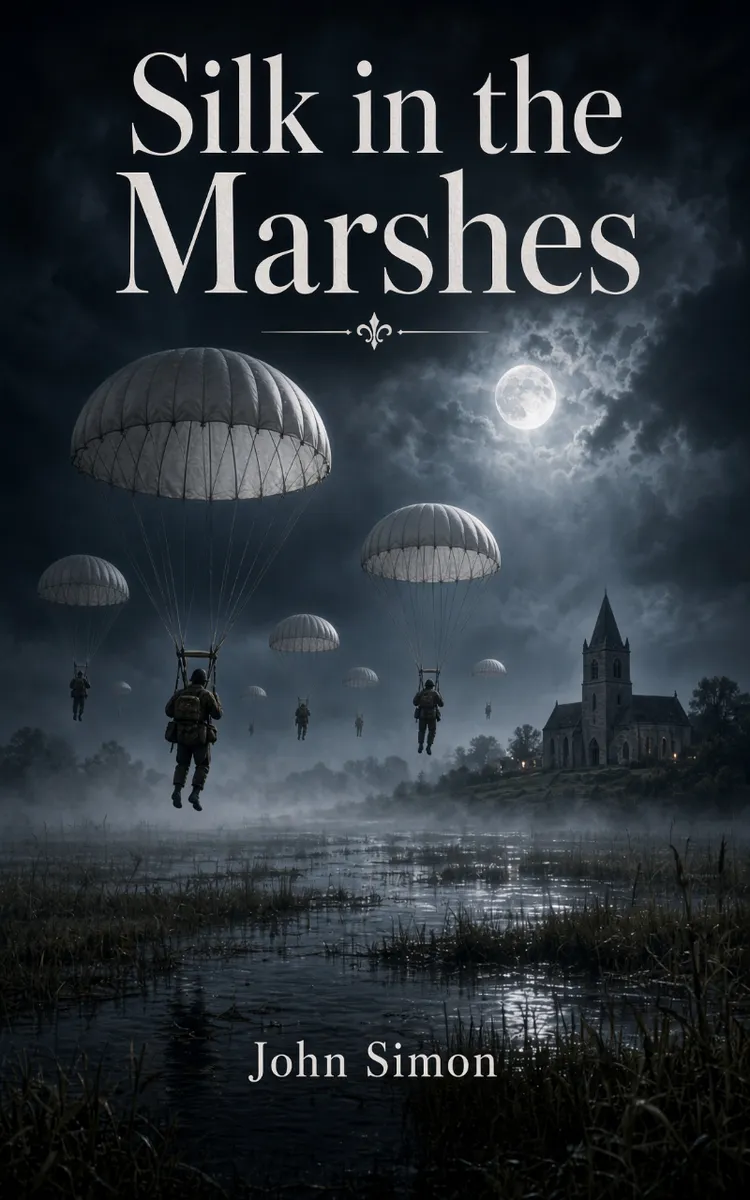
"Silk In The Marshes" is a fiction book by John Simon with 40 chapters and approximately 84,003 words. Misdropped American paratroopers and Norman villagers during the D-Day invasion.
This book was created using Inkfluence AI, an AI-powered book generation platform that helps authors write, design, and publish complete books. It was made with the AI Novel Writer.
Frequently Asked Questions
What is "Silk In The Marshes" about?
Misdropped American paratroopers and Norman villagers during the D-Day invasion
How many chapters are in "Silk In The Marshes"?
The book contains 40 chapters and approximately 84,003 words. Topics covered include The Marsh Takes the Stick, The Sergeant at the Church Door, The Missing Supply Bundles, The Ditch Beyond the Reeds, and more.
Who wrote "Silk In The Marshes"?
This book was written by John Simon and created using Inkfluence AI, an AI book generation platform that helps authors write, design, and publish books.
How can I create a similar fiction book?
You can create your own fiction book using Inkfluence AI. Describe your idea, choose your style, and the AI writes the full book for you. It's free to start.
Write your own fiction book with AI
Describe your idea and Inkfluence writes the whole thing. Free to start.
Start writingCreated with Inkfluence AI


