
Read the first chapter
The whole of chapter one, free. About 7 min. Turn the pages with the arrows, your keyboard, or a swipe.
Chapter 1
Delivering Reliable Results Every Time
Why Reliable Commitments Build Promotion-Ready Trust
What happens when your manager asks, “Can I count on this by Friday?” Do you answer quickly, then spend Thursday night discovering that the request included three tasks, two missing approvals, and a quality problem no one discussed?
Many employees lose trust this way. They work hard, care about the result, and still miss commitments because the work started with unclear scope, an unrealistic timeline, or no planned quality check. A missed deadline does more than delay one task. It makes managers hesitate before assigning larger work - the same work that often leads to promotion.
This chapter gives you a practical way to make commitments you can keep. You will learn how to define exactly what “done” means, set a timeline based on the real work, check quality before delivery, and raise problems early. The result is not a promise to work perfectly. It is a repeatable method for delivering dependable results.
The method comes from a lesson I learned early in my own work: effort does not protect a deadline when the agreement stays vague. I once accepted a “quick update” that turned into a report requiring data checks, formatting, and review from another team. The work finished late because I treated a description as a complete plan. Since then, I have used the Commitment-to-Completion Loop to turn requests into clear agreements before work begins.
The loop works because it closes four gaps that cause most delivery problems: unclear scope, guessed timing, unchecked quality, and silent changes. It also gives your manager useful information without forcing them to chase you. That visibility helps you earn larger assignments because people can see both your results and your control of the work.
The Commitment-to-Completion Loop
The Commitment-to-Completion Loop moves a task through four connected points:
1. Define the finish line. Write what you will deliver, what you will not deliver, and how someone will judge completion. A request such as “update the customer report” needs more detail: “Add March sales, remove duplicate customer records, keep the existing layout, and send the spreadsheet to Priya by 3 p.m. Thursday.” Clear scope prevents extra work from appearing halfway through the task.
2. Build the timeline. Break the work into actions and assign time to each one. If the report needs 90 minutes to clean data, 45 minutes to update formulas, 30 minutes to review, and 15 minutes to send, the task needs three hours - not “most of Thursday.” Add time for known dependencies, such as waiting for figures or approval. A timeline based on task length gives you an early warning when the requested deadline does not fit.
3. Check the result. Create a quality check that matches the work. For a spreadsheet, compare totals with the source file, test formulas, scan for blank fields, and open the final attachment. For a presentation, check names, dates, figures, slide order, and readability. Quality checks work best when you schedule them before the deadline rather than hoping you have time afterward.
4. Close the loop. Deliver the agreed result, state what you completed, and identify any approved changes. If the scope changed, record the new deadline or reduced output. This step prevents a finished task from looking incomplete and creates a clear record of your reliability.
Use a simple “commitment card” in your notes, task manager, or email:
| Field | Example | |---|---| | Deliverable | March customer sales report | | Included | Sales totals, duplicate removal, existing layout | | Not included | New charts or customer commentary | | Owner and deadline | You, Thursday at 3 p.m. | | Quality checks | Compare totals, test formulas, review blanks | | Dependencies | Finance sends refunds by Tuesday at noon |
The card takes a few minutes, but it exposes trouble while you can still fix it. If finance cannot send refunds until Wednesday afternoon, you can discuss the effect before making a promise. Use this wording: “I can send the complete report Thursday at 3 p.m. if I receive the refund file by Tuesday at noon. If that file arrives Wednesday, I can send the report Friday morning or send the sales section Thursday. Which option works better?”
That statement does more than report a risk. It gives your manager a choice between clear outcomes. The Commitment-to-Completion Loop therefore protects both sides: you avoid an accidental promise, and your manager receives an accurate delivery plan.
Start with the first phase - define the finish line - on every new request. Then move through timing, quality, and closure in order. Do not skip directly from “I will do it” to “I sent it.” The middle steps create the reliability others can see.
Applying the Loop to a Tight Deadline
Consider a realistic assignment: your manager asks you Monday at 10 a.m. to prepare a 12-slide operations review for Friday’s 9 a.m. meeting. The source data sits in three files, one file contains inconsistent department names, and the manager wants a draft by Wednesday afternoon.
Apply the loop this way:
1. Confirm the scope by Monday at 10:15 a.m. Write down the 12 slides, the three source files, the reporting period, the audience, and the delivery points: a draft Wednesday at 3 p.m. and a final version Thursday at 4 p.m. State that you will include operating results and open issues, but not redesign the department’s reporting system. Expected outcome: both you and your manager share the same definition of finished.
2. Map the work by Monday at 10:30 a.m. Reserve two hours to combine the files, one hour to correct department names, two hours to calculate totals, three hours to build slides, one hour for a content review, and one hour for final edits. Schedule the work across Monday afternoon through Thursday morning. Expected outcome: you discover that the assignment needs 10 hours of work plus review time, not a vague “few days.”
3. Check dependencies by Monday at 11 a.m. Ask the data owner to confirm that the files are final by noon Tuesday. Ask your manager whether the Wednesday draft needs full design or only accurate content. Expected outcome: you remove two sources of delay before they affect the deadline.
4. Run the first quality check by Wednesday at 1 p.m. Compare the slide totals with the source files, check that every department appears once, and verify the reporting dates. Send the draft at 3 p.m. with three specific questions about wording or emphasis. Expected outcome: your manager reviews a usable draft instead of discovering basic errors on Thursday night.
5. Run the final quality check by Thursday at 2 p.m. Read every slide aloud, test charts, check labels and dates, confirm that the file opens correctly, and ask a colleague to review the five slides containing financial figures. Send the final file at 4 p.m. with a short completion note. Expected outcome: the meeting starts with a correct, readable presentation.
6. Close the loop on Friday morning. Confirm that the meeting version matches the approved file and record any requested follow-up work as a new commitment. Expected outcome: new requests do not quietly attach themselves to the original delivery.
Quick checklist
• Write the exact deliverable and deadline. - State what the work does not include. - Break the task into timed actions. - Identify files, approvals, and people you need. - Schedule quality checks before the final deadline. - Report risks when you first see them. - Send a completion note that names the delivered result. - Treat new requests as changes to scope, timing, or both.
Use the checklist until the loop becomes routine. You should be able to answer three questions at any point: What am I delivering? What could delay it? How will I know it is correct?
Mistakes That Break the Loop
Accepting a vague request
“Handle the client issue” does not tell you whether the expected result is an email, a corrected invoice, a call, or a full account review. Starting without clarification creates rework and makes disagreement likely.
Do this: Ask, “What should the customer have by the end, and what would make you consider this complete?” Then repeat the answer in writing.
Not this: Reply “Sure, I’ll take care of it” and hope the expected result becomes clear later.
Treating the deadline as the plan
A Friday deadline does not explain when you need information, when someone must review your work, or when you will test the final result. Employees often discover the real schedule on the last day, when no recovery time remains.
Do this: Work backward from delivery. Put the final quality check at least one work block before the deadline and set earlier dates for dependencies.
Not this: Reserve all available time for production and leave review to the last 15 minutes.
Hiding a scope change
A manager may add “one small item” that actually requires new research, approvals, or testing. If you absorb every addition without discussing the effect, you may miss the original commitment and appear unreliable.
Do this: Name the change and its effect: “Adding the regional breakdown will take about two more hours. I can keep Friday’s deadline if we remove the commentary section, or I can deliver everything Monday morning.”
Not this: Say yes silently, then explain the delay after the deadline passes.
Reliable delivery starts before the work begins. Define the finish line, build a truthful timeline, check the result, and close the loop. Repeat that process until your commitments become easy for others to understand and safe for them to trust. That trust is the first solid step from being dependable to becoming the person others choose for bigger opportunities.
End of chapter one. 9 more chapters in the full book.
Swipe or use the arrows to turn the page


What's inside: 10 chapters
- 1. Delivering Reliable Results Every Time
- 2. Clarifying Priorities With Stakeholders
- 3. Writing Updates That Build Trust
- 4. Asking Better Questions Early
- 5. Managing Risk With Pre-Mortems
- 6. Turning Feedback Into Action Plans
- 7. Documenting Work for Visibility
- 8. Leading Without Authority
- 9. Building Cross-Team Partnerships
- 10. Presenting Your Case for Promotion
About this book
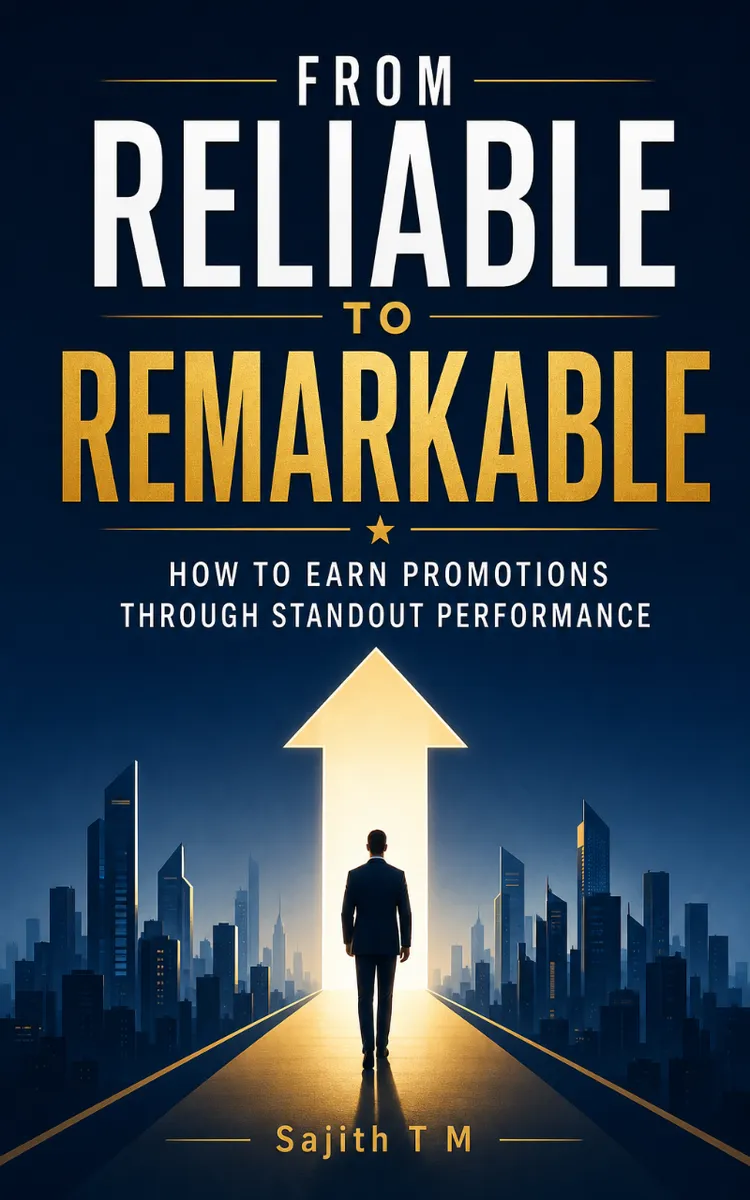
"From Reliable To Remarkable" is a business book by Sajith T M with 10 chapters and approximately 18,113 words. What if the reason you are not getting promoted is not your effort, but your reliability in the moments that matter? Your manager asks, “Can I count on this by Friday?” and you say yes, then discover the scope, approvals, or quality checks were never agreed. That gap turns hard work into hesitation, and hesitation kills bigger assignments.
This book was created using Inkfluence AI, an AI-powered book generation platform that helps authors write, design, and publish complete books. It was made with the AI Business Book Writer.
Frequently Asked Questions
What is "From Reliable To Remarkable" about?
What if the reason you are not getting promoted is not your effort, but your reliability in the moments that matter? Your manager asks, “Can I count on this by Friday?” and you say yes, then discover the scope, approvals, or quality checks were never agreed. That gap turns hard work into hesitation, and hesitation kills bigger assignments. From Reliable To Remarkable shows you a practical way to deliver dependable results, align priorities fast, and report progress so others can trust what you do. You will learn how to define “done,” confirm timelines based on real work, raise risks early, and communicate status that drives decisions. Start using the Remarkable Pathway now, and build the expertise that promotion depends on.
How many chapters are in "From Reliable To Remarkable"?
The book contains 10 chapters and approximately 18,113 words. Topics covered include Delivering Reliable Results Every Time, Clarifying Priorities With Stakeholders, Writing Updates That Build Trust, Asking Better Questions Early, and more.
Who wrote "From Reliable To Remarkable"?
This book was written by Sajith T M and created using Inkfluence AI, an AI book generation platform that helps authors write, design, and publish books.
How can I create a similar business book?
You can create your own business book using Inkfluence AI. Describe your idea, choose your style, and the AI writes the full book for you. It's free to start.
Write your own business book with AI
Describe your idea and Inkfluence writes the whole thing. Free to start.
Start writingCreated with Inkfluence AI


