
Read the first chapter
The whole of chapter one, free. About 7 min. Turn the pages with the arrows, your keyboard, or a swipe.
Chapter 1
Days 1-6: Stabilize Your Daily Non-Negotiables
Why a daily checklist matters when you’re rebuilding your sobriety
Right now, your brain is still learning how to live without the substance doing the heavy lifting. That means your emotions, your sleep, your cravings, and even your motivation can swing hard. A daily checklist is how you bring structure back when you don’t have the energy (or the trust in yourself yet) to “wing it.” It’s not about being perfect. It’s about making it harder to spiral and easier to stabilize.
This checklist covers the stuff that keeps you from falling through the cracks: your basic needs (food, water), the support pieces (meetings and outreach), and the body reset (movement). When those are handled, the day stops feeling like a hostage situation. You start getting small wins that stack - so you can think clearer, feel steadier, and act like the version of you who’s staying sober on purpose.
Build your substance-free daily checklist (needs, meetings, food, water, movement, outreach)
You’re going to create a one-page daily plan you can actually use. Not a “someday” plan. A real checklist you can fill out in the morning and check off as the day unfolds.
Setup (takes about 10 minutes) Grab one of these: - A notebook page - A printed page you can mark up - A notes app on your phone
Write the date at the top and copy the checklist lines below. Keep it simple enough that you can do it even on a bad day.
The Skill Builder: your Day 1-6 checklist Use this exact order. Check items off when you finish them.
1. Stay substance-free today. Write: “I did not use ____ today.” (Fill in the substance(s) you’re avoiding.)
2. Meetings / treatment follow-through (if scheduled). Write the time and place. Check it off after you go.
3. Needs: eat something nutritious. Pick a real option you can access today (example: eggs + toast, chicken soup, yogurt + fruit). Check it off when you eat.
4. Needs: drink water. Set a number you can hit. Aim for 8 cups (64 oz) today. Check it off after you finish.
5. Movement for your nervous system. Do 15 minutes of walking, stretching, or light movement. Check it off when the 15 minutes are done.
6. Outreach (someone who helps you stay sober). Reach out to one person (call, text, or show up). Write who you contacted.
7. One practical task: work or job steps. If you’re employed: do one work task. If you’re not: submit one application or contact one employer today.
8. Bed with a plan. Write tomorrow’s first step (one line). Example: “Go to the 9:00 meeting” or “Apply for 1 job.”
Worked example (copy this format) > Date: July 12 > 1) Stay substance-free: I did not use alcohol today. ✅ > 2) Meetings: 6:30 PM group at Recovery Center. ✅ > 3) Eat nutritious: Eggs + toast (plus fruit). ✅ > 4) Water: Finished 64 oz by 8:00 PM. ✅ > 5) Movement: Walked 15 minutes after dinner. ✅ > 6) Outreach: Texted Jamie: “Made it to group. You good?” ✅ > 7) Work/job step: Submitted 1 job application for warehouse lead position. ✅ > 8) Bed plan: Tomorrow morning: call my sponsor at 9:00 AM. ✅
Your Turn: fill out today’s checklist Date: ___________________________
1) Stay substance-free today: “I did not use ________________ today.” __________________________________________________________________ ✅/❌
2) Meeting/treatment (if scheduled): Time/Place: ____________________________ __________________________________________________________________ ✅/❌
3) Food (what did you eat?): ______________________________________________ __________________________________________________________________ ✅/❌
4) Water (how many cups/oz did you drink?): _______________________________ __________________________________________________________________ ✅/❌
5) Movement (what exactly, and for how long?): ____________________________ __________________________________________________________________ ✅/❌
6) Outreach (who + how?): _______________________________________________ __________________________________________________________________ ✅/❌
7) Work/job step (what did you do?): _____________________________________ __________________________________________________________________ ✅/❌
8) Tomorrow’s first step: ________________________________________________ __________________________________________________________________
What good looks like (Day 1-6 standard) - You check off substance-free every day, no exceptions written in pencil. - If you had a meeting scheduled, you show up and mark it done. - You eat something nutritious (not just caffeine and vibes). - You hit 8 cups (64 oz) of water (or you adjust to a realistic number you can finish). - You complete 15 minutes of movement. - You do one outreach step that’s connected to your recovery. - You handle one practical task (work task or 1 application/contact). - You go to bed with a clear first step for tomorrow.
Adjust the checklist when life hits (variations you can actually use)
Some days you’ll feel fine. Other days you’ll wake up tired, angry, or foggy. The checklist still works - your job is to adapt it without dropping the recovery pieces.
Here are three variations you can use depending on what’s going on:
Variation A: “Craving day mode” (tighten the schedule) - Keep the same checklist. - Add a single line under Outreach: “I texted/called before 3:00 PM.” - If you miss movement time, do 10 minutes instead of 15 - but still get it done.
Adapt it when: cravings show up early and you feel restless.
Variation B: “Meeting day mode” (protect the support block) - Put meetings/treatment at the top as the anchor. - For Food, choose a meal you can eat near the meeting (example: grab a sandwich before you go). - For Water, set a smaller checkpoint: “At least 32 oz by the time I leave.”
Adapt it when: you’re running late or transport is messy.
Variation C: “No energy day mode” (minimum viable recovery) - You still do everything, but you shrink the effort in a way that stays measurable: - Movement: 10 minutes - Outreach: one text only (not a whole conversation) - Work/job step: one action only (submit one application OR send one email)
Adapt it when: you’re exhausted, ashamed, or your thoughts are loud.
Your Turn: pick which mode you’ll use today Today feels like: A / B / C (circle one)
Mode choice: ____________
One change I’m making (write it clearly): __________________________________________________________________ __________________________________________________________________
Track whether it’s working (progress checks for Days 1-6)
You’re not doing this to “feel better.” You’re doing it to build proof. Proof that you can handle a day without using. Proof that you can follow through even when your brain is acting up.
Answer these questions after you fill out your checklist for the day.
1) Which two checklist items kept me most stable today - and why? __________________________________________________________________ ________________________________________________________________ __________________________________________________________________
• Success looks like: you can name specific items (not “everything”). - Success looks like: you connect stability to an action you did, not luck.
2) Where did I slip (if I did), and what was happening right before it? __________________________________________________________________ ________________________________________________________________ __________________________________________________________________
• Success looks like: you identify the moment before the slip (time, feeling, situation). - Success looks like: you don’t blame yourself - you just get accurate.
3) What did outreach change for me today? __________________________________________________________________ ________________________________________________________________ __________________________________________________________________
• Success looks like: outreach helped you stay grounded, even if you were still uncomfortable. - Success looks like: you can say what kind of contact worked (text vs call vs in-person).
4) Did I meet my water + movement target? If not, what is my fix tomorrow? __________________________________________________________________ ________________________________________________________________ __________________________________________________________________
• Success looks like: you set a clear next attempt (example: “I’ll drink 32 oz by 2 PM and finish the rest at night.”) - Success looks like: you don’t abandon the targets - you adjust them while keeping structure.
5) What’s my one “tomorrow first step” that makes relapse less likely? __________________________________________________________________ ________________________________________________________________ __________________________________________________________________
• Success looks like: the step is concrete and time-based (example: “9 AM meeting” or “submit application at noon”). - Success looks like: it’s something you can do even if your mood is bad.
Criteria for success (quick scoreboard) - ✅ You completed the checklist at least once today. - ✅ You hit substance-free plus at least 5 out of 8 other items. - ✅ You did outreach at least once. - ✅ You have a tomorrow first step written down. - ✅ You answered the questions without skipping the real parts.
Close it out: your structure is a form of protection
When people are early in sobriety, it’s easy to think the goal is to “feel strong.” But most days you won’t feel strong. You’ll feel tired. Or irritated. Or bored. Or flat-out scared. The checklist doesn’t require feelings. It requires actions.
Do this for Days 1-6 and you’ll start seeing a pattern: the days you follow the checklist are the days you stay in control. The days you skip it are the days your mind starts bargaining with you. That’s not a moral failing. That’s data. And now you’re using it.
Tomorrow, keep the same structure - then we’ll tighten it even more so it holds up when you’re tested.
End of chapter one. 4 more chapters in the full book.
Swipe or use the arrows to turn the page
What's inside: 5 chapters
- 1. Days 1-6: Stabilize Your Daily Non-Negotiables
- 2. Days 7-12: Build Momentum With Job and Appointment Rhythm
- 3. Days 13-18: Create Stability With Money and Sleep Systems
- 4. Days 19-24: Rebuild Relationships With Healthy Contact Rules
- 5. Days 25-30: Build Your Future Plan and Relapse Prevention
About this book
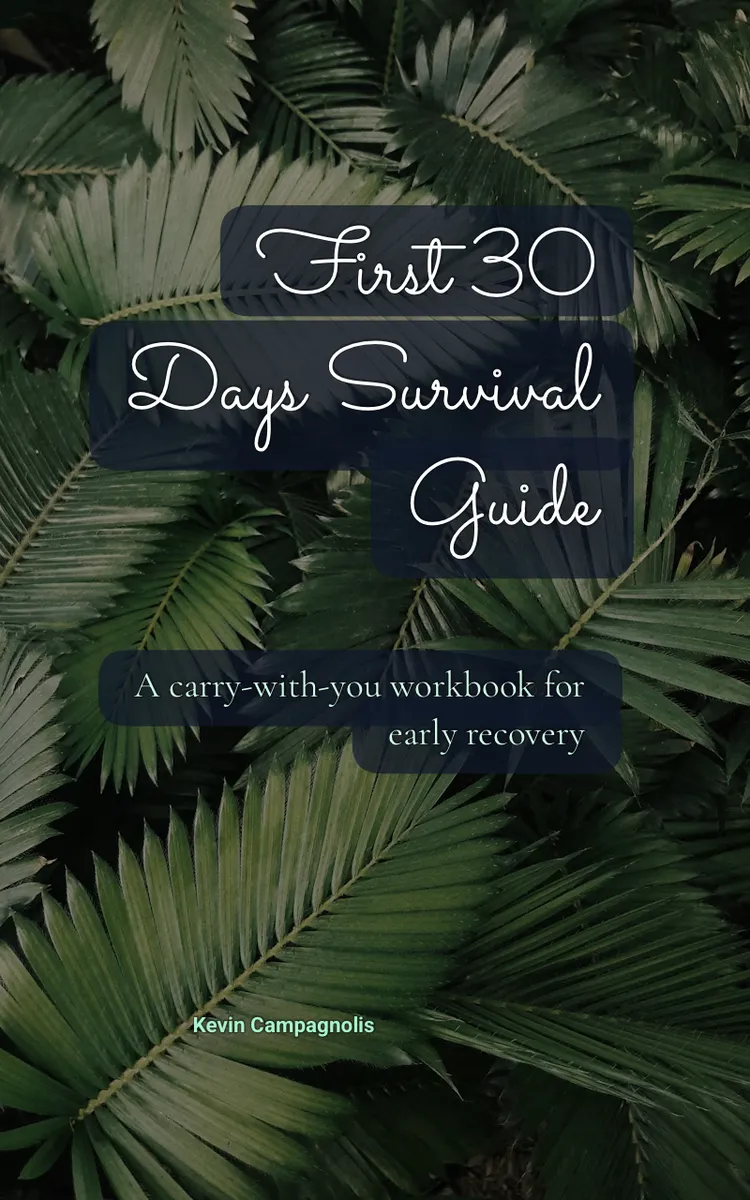
"First 30 Days Survival Guide" is a workbook by Kevin Campagnolis with 5 chapters and approximately 6,766 words. Daily checklists and planning tools for substance-free recovery.
This book was created using Inkfluence AI, an AI-powered book generation platform that helps authors write, design, and publish complete books. It was made with the Workbook Generator.
Frequently Asked Questions
What is "First 30 Days Survival Guide" about?
Daily checklists and planning tools for substance-free recovery
How many chapters are in "First 30 Days Survival Guide"?
The book contains 5 chapters and approximately 6,766 words. Topics covered include Days 1-6: Stabilize Your Daily Non-Negotiables, Days 7-12: Build Momentum With Job and Appointment Rhythm, Days 13-18: Create Stability With Money and Sleep Systems, Days 19-24: Rebuild Relationships With Healthy Contact Rules, and more.
Who wrote "First 30 Days Survival Guide"?
This book was written by Kevin Campagnolis and created using Inkfluence AI, an AI book generation platform that helps authors write, design, and publish books.
How can I create a similar workbook?
You can create your own workbook using Inkfluence AI. Describe your idea, choose your style, and the AI writes the full book for you. It's free to start.
Write your own workbook with AI
Describe your idea and Inkfluence writes the whole thing. Free to start.
Start writingCreated with Inkfluence AI


