
Read the first chapter
The whole of chapter one, free. About 7 min. Turn the pages with the arrows, your keyboard, or a swipe.
Chapter 1
Karachi: The Beginning
Karachi was already moving before I had learned how to describe my place within it. Its roads carried buses, motorcycles, rickshaws, and people travelling toward work, school, markets, and responsibilities. The air often held a mixture of dust, heat, traffic, and the smell of food being prepared nearby. This was the city in which I was born, the city that became the first landscape of my life, and the place from which my story began.
I was Zubair Khan, a child growing up in Karachi, although the details of those early years are not yet complete. Some parts of my personal history remain clear only in outline. I know the city, the country, and the direction my life eventually began to take. I know that technology, education, learning, and the desire to build something meaningful became important to me. But a true life story cannot be built from conclusions alone. It must return to the beginning and ask careful questions.
What was my family environment like? What did I notice as a child? Which experiences made me curious? What did I enjoy learning, and what did I struggle to understand? These questions are not gaps to hide. They are part of the honest work of remembering.
Karachi shaped my first understanding of possibility. It was large enough to make the world feel open and complicated at the same time. Different people, languages, occupations, neighbourhoods, and ways of thinking existed within the same city. Even before I understood the meaning of culture or opportunity, I was surrounded by variety. The city taught me that life did not follow one single path.
My early years must be understood through the ordinary details that formed them: the home where I grew up, the people who guided me, the schools I attended, and the small interests that appeared before I had words for ambition. These details may seem simple, but they are often where identity begins. A child does not usually announce a future career. Instead, curiosity appears quietly - in the things they ask about, the activities they repeat, and the subjects that hold their attention longer than others.
When I look back at my journey, I can see that my identity was not created in one sudden moment. It developed through layers. First came my family and surroundings. Then came education, exposure to new ideas, and the discovery that learning could extend beyond the classroom. Later, technology gave that curiosity a new direction.
At this stage of my story, however, I must be careful not to place later knowledge into my childhood. I did not begin life already knowing about websites, digital marketing, artificial intelligence, or entrepreneurship. Those interests came through time and experience. The child I was had not yet met Zubair WebsiteWala. That identity belonged to a later version of me - the version that began to see websites, coding, and digital tools not only as subjects to study, but as ways to create.
The first confirmed thread is my connection to learning. I became interested in discovering how things worked and how knowledge could be used. The exact memories still need to be gathered: the first time I used a computer, the first subject that truly attracted me, the first person who encouraged me, and the first challenge that made me question myself. Each answer will add colour to the beginning of this story.
What I already understand is that education became more than a formal requirement. It became a path through which I could imagine a wider life. In Karachi, surrounded by the limits and possibilities of my immediate surroundings, learning allowed me to look beyond what was directly in front of me. It gave me the sense that a person could begin in one place and still connect with people, ideas, and opportunities far beyond it.
That connection later became central to my ambitions. I became interested in technology and artificial intelligence, in website development and AI-assisted coding, in digital marketing and social media, and in the ways technology could support education. I completed training in digital marketing and web development, and I completed Google AI Essentials. My learning did not end with those achievements. If anything, they made me more aware of how much remained to discover.
Looking back, I now understand that curiosity was one of the earliest forces behind my development. It did not always appear as a clear plan. Sometimes it was simply the wish to understand something unfamiliar. Sometimes it was the feeling that there had to be another way to solve a problem or communicate an idea. Over time, these small interests began to connect.
The connection between education and technology became especially important when I joined the Rehan School team. For around three years, I have worked as a facilitator, supporting students, parents, educational activities, campus coordination, and teacher-training tasks. I have also used technology in learning and helped people engage with new tools. That work has shown me that technology is most valuable when it serves people. A website, an AI tool, or a digital platform is not meaningful only because it is modern. It becomes meaningful when it helps someone learn, communicate, organise, or create an opportunity.
I did not begin with a complete understanding of this principle. It developed through experience. Working with students and parents made me more aware of the human side of education. Campus responsibilities required coordination and patience. Supporting teachers required communication and responsibility. Each role added something to my understanding of leadership. I learned that helping people move forward often requires listening before speaking and adapting before directing.
These lessons reached back toward my own childhood. I began to see that every learner carries a personal background into a classroom. A student’s confidence, questions, silence, or excitement may be connected to experiences that are not immediately visible. Because I had also travelled through an uncertain learning journey, I could recognise the importance of encouragement and access.
My identity as Zubair WebsiteWala grew from this wider interest in creating and connecting. The name reflected my attraction to websites, coding, digital technology, and the possibilities of building with AI. It was not a replacement for Zubair Khan. It was another expression of the same person: someone from Karachi trying to turn curiosity into practical work.
At first, the idea of building a future through technology carried uncertainty. Learning a skill did not automatically explain how to earn from it, how to serve others with it, or how to build a lasting business. I had to consider what kind of entrepreneur I wanted to become. I did not want success to be measured only by income or recognition. I wanted to build meaningful businesses, explore the world, connect with people from different cultures, and use technology and education to help others.
That dream was larger than my immediate circumstances, but it was not separate from them. Karachi remained the starting point. The city had taught me to notice movement, difference, pressure, and possibility. It had shown me that people were constantly trying to improve their lives, even when the path was not easy. My own ambitions grew within that reality.
The early details of my family background and education still require confirmation. I do not want to invent memories simply to make the story appear complete. I want to know which moments truly belong to me. I want to remember the names of the schools, the influence of family members, the subjects I enjoyed, and the experiences that shaped my confidence. I want to understand not only what happened, but how I felt and what I learned from it.
This honesty matters because a life story is not a collection of impressive claims. It is an attempt to understand the connection between the person one was and the person one is becoming. If I leave questions unanswered, they remain part of the journey. The process of discovering them is itself a form of learning.
What can be confirmed is that my story began in Karachi with a growing relationship to education and curiosity. The city was my first environment, learning became an early direction, and technology later gave that direction a wider language. The path from Zubair Khan to Zubair WebsiteWala did not appear fully formed. It began with a person trying to understand the world and wondering how he could contribute to it.
I now understand that my future ambitions were rooted in those early questions. The desire to explore international connections came from knowing that the world was larger than one neighbourhood or one city. The interest in entrepreneurship came from wanting to create something useful. The commitment to education came from recognising the power of guidance and opportunity. The interest in technology came from seeing how ideas could travel through digital tools.
There is still more to recover from the beginning: the family stories, the classrooms, the first encounters with computers, and the moments when a private interest began to resemble a purpose. But one thread is now clear. Before I became known through technology as Zubair WebsiteWala, I was a Karachi-born child whose curiosity slowly began reaching beyond his immediate surroundings.
That was the first direction of my life - not yet a plan, not yet a profession, but a willingness to keep learning.
End of chapter one. 4 more chapters and about 8,834 words in the full book.
Swipe or use the arrows to turn the page
What's inside: 5 chapters
- 1. Karachi: The Beginning
- 2. Choosing a Direction
- 3. Building the WebsiteWala Identity
- 4. Learning Through Rehan School
- 5. Designing the Next Chapter
About this book
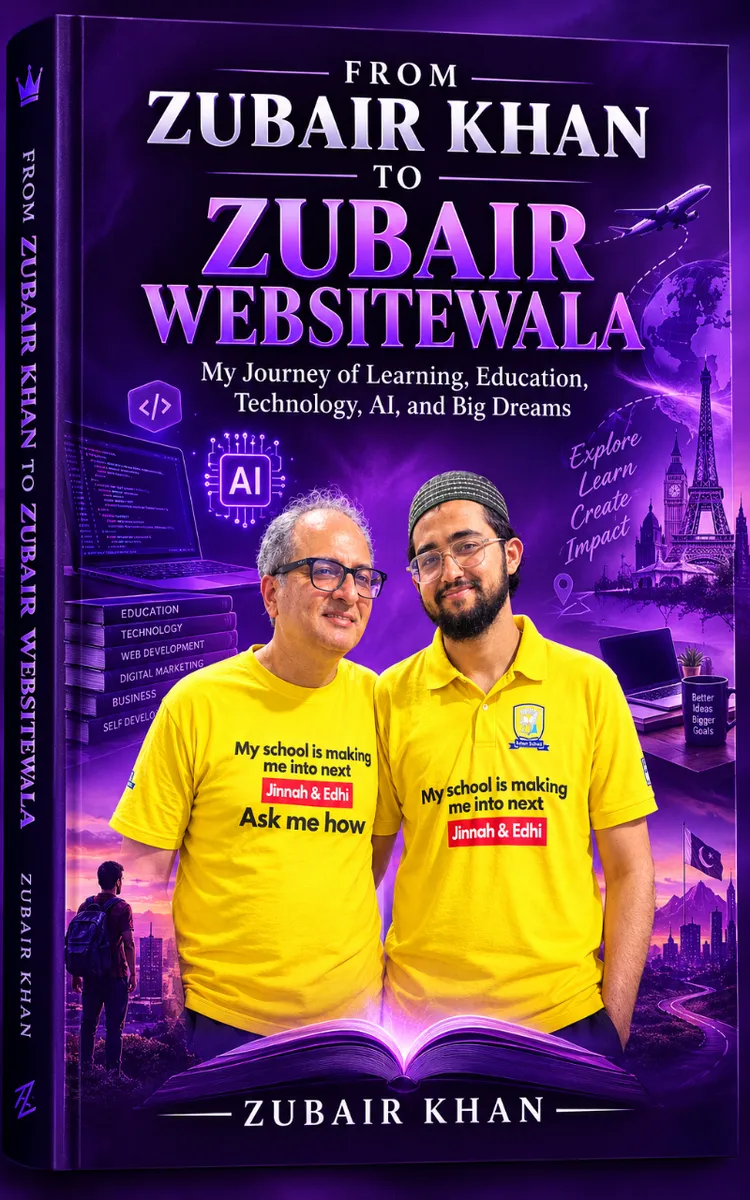
"From Zubair Khan To Zubair Websitewala" is a biography book by Zubair khan with 5 chapters and approximately 8,834 words. Zubair Khan’s life, technology learning, education work, and entrepreneurial ambitions.
This book was created using Inkfluence AI, an AI-powered book generation platform that helps authors write, design, and publish complete books. It was made with the AI Biography Writer.
Frequently Asked Questions
What is "From Zubair Khan To Zubair Websitewala" about?
Zubair Khan’s life, technology learning, education work, and entrepreneurial ambitions
How many chapters are in "From Zubair Khan To Zubair Websitewala"?
The book contains 5 chapters and approximately 8,834 words. Topics covered include Karachi: The Beginning, Choosing a Direction, Building the WebsiteWala Identity, Learning Through Rehan School, and more.
Who wrote "From Zubair Khan To Zubair Websitewala"?
This book was written by Zubair khan and created using Inkfluence AI, an AI book generation platform that helps authors write, design, and publish books.
How can I create a similar biography book?
You can create your own biography book using Inkfluence AI. Describe your idea, choose your style, and the AI writes the full book for you. It's free to start.
Write your own biography book with AI
Describe your idea and Inkfluence writes the whole thing. Free to start.
Start writingCreated with Inkfluence AI


