
Read the first chapter
The whole of chapter one, free. About 9 min. Turn the pages with the arrows, your keyboard, or a swipe.
Chapter 1
Baigal Khan’s Steppe Alliance
The horses began to stumble before the storm reached its full strength.
Baigal Khan saw it in the uneven line of their backs. Snow had gathered along their manes and frozen around the edges of their nostrils. The bells tied to the lead animals sounded faintly through the wind, then disappeared beneath the rising roar. Behind the horses came the families, wrapped in felt and wool, carrying what they could save from the winter passage. The herds moved slowly. The children were silent. Even the dogs kept close to the sleds.
Ahead lay the route toward shelter near the country of Lake Baikal, though the land no longer resembled any path known to the riders. Wind had erased the old tracks. Low hills had become white walls, and the frozen ground offered no clear answer about where it was safe to cross. The camp had entered a place where a wrong turn could separate families from their animals before anyone understood what had happened.
Baigal was not yet an old man, but he had lived long enough to know that age alone did not command obedience. He had not inherited a quiet kingdom, nor a settled people protected by walls. The riders around him belonged to families that had followed different leaders and trusted different promises. Some had joined for safety. Others had joined because their former alliances had failed. All carried their own memories of betrayal.
Now, with the storm closing around them, those old divisions had become a danger greater than the cold.
“We should turn south,” one rider called.
His words were carried away and returned in broken pieces.
“There is no south in this white,” another answered. “The ridge is ahead. We cross it before night.”
“The ridge is buried. You will lead us into a hollow.”
Baigal listened while he checked the leather binding on a child’s sled. His fingers were stiff, and the strap had cut into his palm. He tightened it anyway. The child’s mother watched him without speaking. Her face was pale from cold and fear, but she held the blanket close around the child’s shoulders.
The riders gathered around their own opinions. One claimed to know the land from an earlier season. Another insisted that his horses could find the old route. A third accused the others of trying to protect their own herds first. Their voices rose, though none of them could see more than a few paces through the snow.
Baigal stood.
“Bring the lead horses together,” he said.
The nearest men turned toward him.
“Which way?” one asked.
Baigal looked into the storm. The air smelled of ice and horse sweat. Beneath his boots, the snow shifted over hard ground.
“Not yet,” he said. “First we count the families.”
The answer displeased them. They wanted a direction, not a delay. But Baigal had learned that a leader who chose a path before knowing who was missing was only choosing the manner of failure.
The count took time. Two children were found in a sled at the rear. An old herder had fallen behind with three pack animals. A young rider had gone searching for a broken harness and had not returned. No one knew how long he had been gone.
Baigal sent two men after him, but they refused to move together.
“I know the ground better,” one said.
“You know the ground as it was,” the other replied. “The storm has changed it.”
Baigal stepped between them.
“You will go side by side,” he said. “Tie yourselves to the same rope. If one loses the route, the other will bring him back.”
The first rider frowned. “And if the rope holds us both in a hollow?”
“Then you will have one chance to climb out together instead of two chances to disappear alone.”
The men looked at each other. Neither liked the order, but they took the rope.
Baigal watched them vanish into the snow. He did not pretend that courage could remove danger. It could only keep a person from meeting danger alone.
The camp moved again, slowly and without agreement about the final route. Baigal rode at the front, then returned to the rear, then crossed the line from one side to the other. He examined the snow where the wind had thinned it. He tested the crust with the shaft of his spear. In one place the ground gave way beneath the horse’s foreleg, and the animal lurched. Baigal dismounted at once and led it back.
The riders saw him do it.
“Leave the weak ground,” he said. “We cross where the snow is firm.”
A man near the middle of the line called out, “The families cannot wait for every horse.”
Baigal turned toward him. “The families are the reason we are moving.”
The man lowered his gaze, but the dispute did not end. Some riders wanted to abandon the heavier loads. Others argued that food must be protected before bedding or tools. One suggested leaving the oldest animals behind. Another said the families could not survive without them.
Baigal heard each claim. He also saw what lay beneath them. Every man feared losing what belonged to him. Each believed that if he surrendered first, his own household would be the one left without protection.
He opened the nearest food bundle and removed a strip of dried meat.
“Share the provisions,” he said.
A rider gave a short, bitter laugh. “Share them with whom? The strong or the weak?”
“With whoever is hungry.”
“That will leave us with less.”
“It will leave us with people who still trust one another.”
Baigal tore the meat into smaller pieces and handed them to the children first. Then he gave some to the old herder when he returned, his beard stiff with frost. The two men sent to find the missing rider came back with empty hands. They had lost the rope but had found a broken harness near a drift. Baigal did not accuse them of lying. He asked where they had searched, then sent no one else into that part of the storm.
The missing rider was not found.
That loss settled over the camp without ceremony. The families understood what it meant. Baigal understood something more: every decision from that moment would be judged against the absence of the man who had gone out alone.
The route climbed toward a ridge. The wind struck harder there, driving snow across the animals’ legs. Several horses refused the slope. Their breath rose in thick clouds, and the sled runners groaned against the frozen ground.
One of the rival riders moved beside Baigal.
“You are spending strength on a route that may not lead to shelter,” he said.
“Do you know a safer one?”
“No.”
“Then help me keep the camp moving.”
The rider looked toward the families. A woman had fallen beside a sled, and another was helping her stand. The horses had stopped again.
“I will take the rear,” he said.
Baigal nodded. It was not a surrender, but it was the first useful agreement anyone had offered.
At the crest, they found the ridge was not a ridge at all. It was the edge of a broad frozen hollow. The wind had swept its surface clean in places, exposing hard blue ice. At the far end stood a line of dark trees. They were not close, but they were real. Beyond them, the land dipped toward a sheltered valley.
Baigal raised his arm.
“There,” he said.
The riders followed his gaze. The sight did not remove their exhaustion, but it gave their movement a shape. They began to guide the horses toward the trees, placing the strongest animals where the snow was deepest. Men walked beside the sleds and pushed when the runners stuck. Baigal took hold of one rope himself.
The rider who had argued with him earlier saw it.
“You should be mounted,” he said.
“Then take my place.”
The man did. Baigal moved to another sled, where a child had begun to cry from cold. He lifted the front runner and helped pull it across the ice. His hands burned inside his gloves. The rope cut into his shoulder. He did not release it until the sled reached firmer ground.
After that, the riders stopped waiting for orders. They tied their ropes together. They placed food bundles in one shared group. Those with stronger horses took the heavier loads. Those without horses walked beside the families. The change was not sudden or complete, but it was enough to carry the camp forward.
The trees gave them shelter before darkness settled. Beneath them lay a narrow hollow where the wind was weaker. The men cleared snow from the ground and set the felt coverings between the trunks. Fires were made from dry wood gathered under the trees. Smoke clung low beneath the branches, and the smell of burning resin mixed with the sour warmth of tired animals.
The families reached the shelter alive.
For a short time, no one spoke of leadership. They cared for the horses, checked the children, and rubbed warmth into hands and feet. Baigal walked through the camp, counting again. No one else was missing, but several animals had been lost. Two sleds had broken. The food bundles were lighter than they had been that morning.
The rider who had taken the rear came to him beside the smallest fire.
“You brought us through,” he said.
Baigal looked toward the trees. Beyond them, the storm still moved across the open land.
“We brought one another through.”
“You gave the orders.”
“I carried the rope.”
The man studied him. “The others will follow you now.”
Baigal did not answer at once. Authority had seemed distant when the riders argued on the ridge. It had not come from a claim of blood or from an old title. It had formed in the cold, while he counted the families, shared the food, and accepted the same burden he placed upon others.
“We have shelter,” Baigal said finally. “But we have less food, fewer animals, and no certainty about the next passage.”
The rider glanced at the dark bundles. “Then we must take from another camp.”
Baigal’s expression hardened.
“We will trade if trade is possible. We will ask if asking can preserve peace. If fighting is forced upon us, we will not surrender our families. But we will not call theft a victory.”
The man nodded, though his face showed that he had hoped for an easier answer.
Baigal returned to the fire. A piece of dried meat lay in his hand, the last portion from the bundle he had opened on the ridge. He divided it and gave half to the old herder, who had sat down beneath a felt covering.
Only after the old man had eaten did Baigal take his own share.
Looking back, the crossing was remembered as the moment Baigal’s authority became visible. The family tradition did not preserve it as a peaceful inheritance. It remembered a divided camp, a dangerous route, and a leader who had been forced to prove that command meant bearing the first burden and accepting the same hunger as everyone else.
The people reached shelter, but safety had a cost. Their stores were reduced, their animals weakened, and the winter passage ahead remained uncertain. Yet the riders no longer stood apart in separate groups. They had tied their ropes together, and that simple act had changed the camp.
Baigal understood that unity did not mean that fear had disappeared. It meant that fear no longer decided each person’s actions alone. The families had survived the route because the riders had learned, for a little while, to protect more than their own tents.
In the years that followed, the memory of that winter would be joined to the older northern names of the steppe, including Dadan and the peoples remembered in different records as Tatars or Dada. Those names could not be treated as proof of one tribe or one unbroken ancestry. They belonged to a wider and changing world of communities, alliances, and migrations. But within the family tradition, the lesson of Baigal remained clear: a people could lose land, animals, and provisions and still preserve itself if loyalty was stronger than division.
That night, beneath the trees near Lake Baikal, Baigal slept lightly beside the shared stores. The camp had reached shelter. The next morning would bring hunger and hard choices, but the riders would face them together.
End of chapter one. 4 more chapters and about 11,128 words in the full book.
Swipe or use the arrows to turn the page
What's inside: 5 chapters
- 1. Baigal Khan’s Steppe Alliance
- 2. The Wild Tatars’ Code
- 3. The Tatar Defeat of 1202
- 4. Gùldoz Han’s Southern Branch
- 5. From Baigal Tatari to Tanoli
About this book
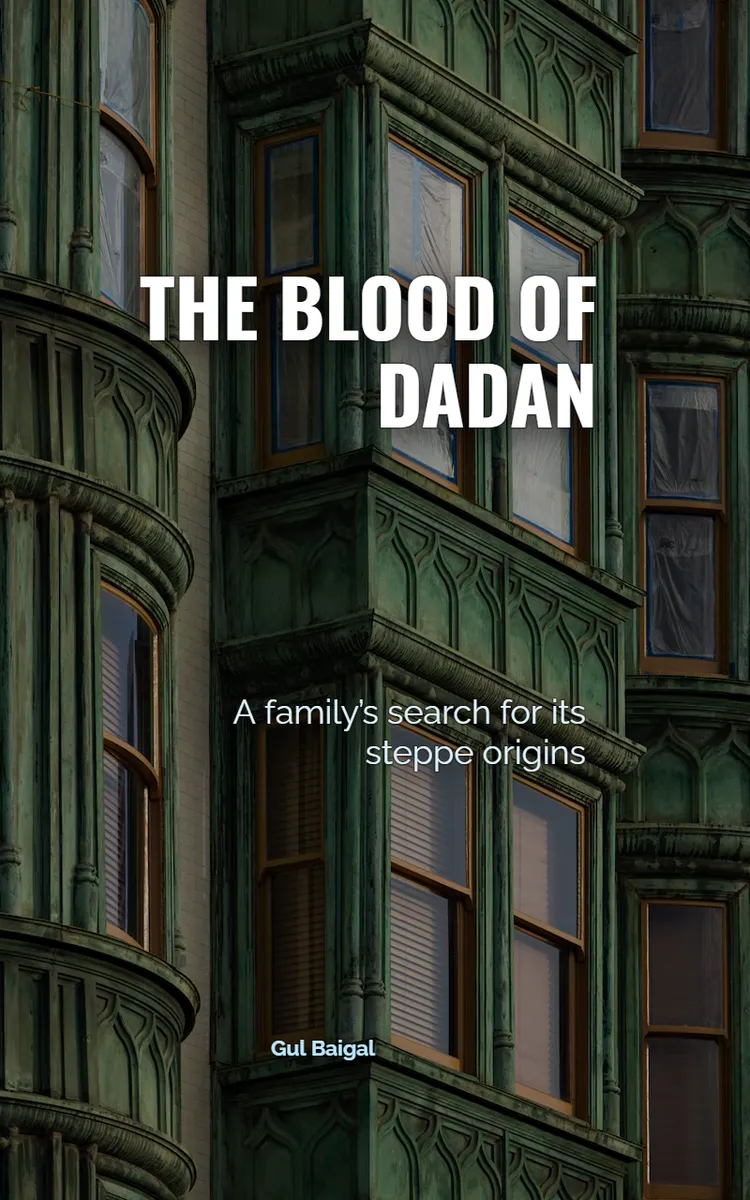
"The Blood Of Dadan" is a biography book by Gul Baigal with 5 chapters and approximately 11,128 words. Baigal Tanoli family tradition and its claimed migration from the northern steppe.
This book was created using Inkfluence AI, an AI-powered book generation platform that helps authors write, design, and publish complete books. It was made with the AI Biography Writer.
Frequently Asked Questions
What is "The Blood Of Dadan" about?
Baigal Tanoli family tradition and its claimed migration from the northern steppe
How many chapters are in "The Blood Of Dadan"?
The book contains 5 chapters and approximately 11,128 words. Topics covered include Baigal Khan’s Steppe Alliance, The Wild Tatars’ Code, The Tatar Defeat of 1202, Gùldoz Han’s Southern Branch, and more.
Who wrote "The Blood Of Dadan"?
This book was written by Gul Baigal and created using Inkfluence AI, an AI book generation platform that helps authors write, design, and publish books.
How can I create a similar biography book?
You can create your own biography book using Inkfluence AI. Describe your idea, choose your style, and the AI writes the full book for you. It's free to start.
Write your own biography book with AI
Describe your idea and Inkfluence writes the whole thing. Free to start.
Start writingCreated with Inkfluence AI


