
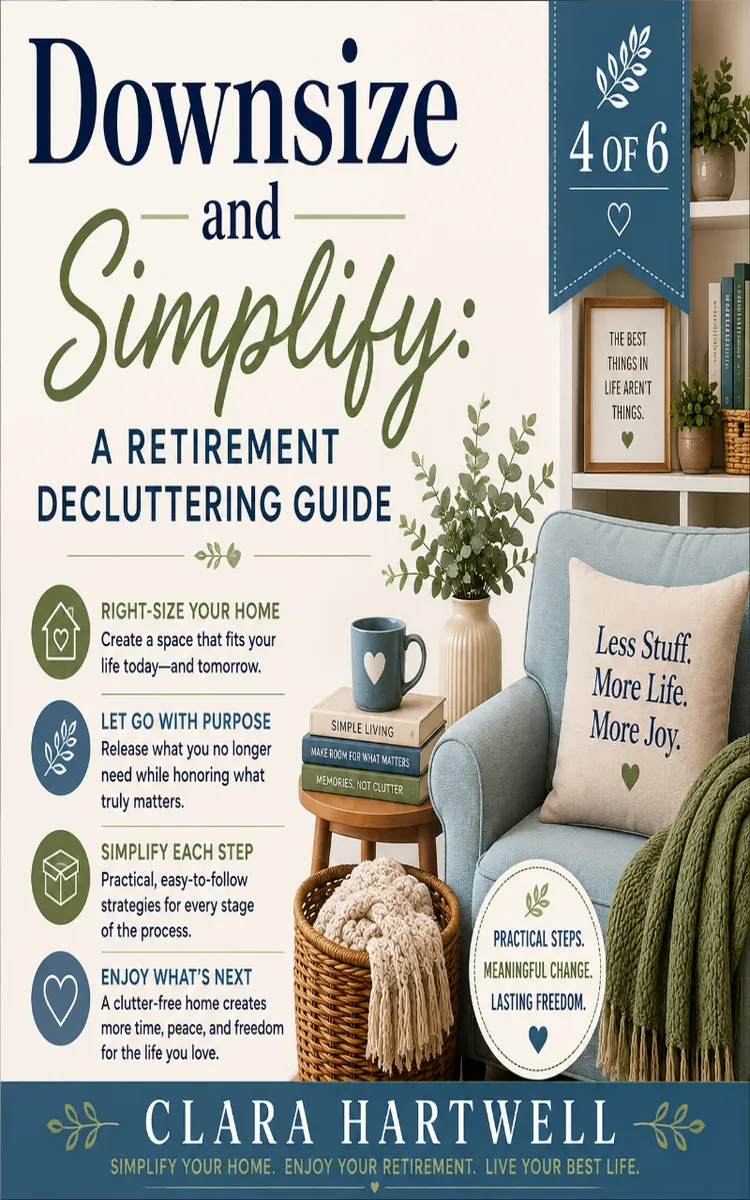
Downsize And Simplify
Created with Inkfluence AI
Retirement-focused decluttering and downsizing planning
Table of Contents
- 1. Retirement Declutter Goal Map
- 2. The 4-Zone Sorting System
- 3. Keep, Donate, Sell, Trash Rules
- 4. The One-Drawer Decision Sprint
- 5. Donation and Selling Route Planning
- 6. Paperwork Downsizing Without Stress
- 7. Kitchen and Pantry Simplification Plan
- 8. Closet Capsule for Easy Living
- 9. Moving Day Packing That Works
- 10. The 30-Day Simplify Maintenance Loop
Preview: Retirement Declutter Goal Map
A short excerpt from “Retirement Declutter Goal Map”. The full book contains 10 chapters and 19,104 words.
Chapter 1: Retirement Declutter Goal Map
Why Your Retirement Plan Needs a Declutter Goal Map
What would your home need to look like if you stopped working next month - and what would need to change if retirement remained ten years away?
That question turns decluttering from a vague chore into a practical retirement decision. Without a clear timeline and lifestyle target, people often keep everything “just in case,” donate useful items too soon, or spend months sorting belongings that do not affect their future. A Retirement Goal Map gives each possession a place in your plan: keep for your target life, remove before a deadline, or review later.
Your map connects three decisions. First, you set the date or time range for retirement. Second, you describe how you expect to live after work. Third, you rank the belongings and spaces that matter most. After you complete the map, you will know which room to start with, how much you need to remove, and when each decision must happen.
Tanya, a 46-year-old school administrator, has no fixed retirement date yet. She expects to work at least another ten years, but she wants to travel more, spend winters in a smaller home, and stop maintaining a large yard. Her current house contains work clothes, extra furniture, school materials, inherited dishes, and outdoor equipment. Her map does not tell her to empty the house today. It shows which items support her future and which ones create work she no longer wants.
Ask yourself: What future activity should guide my first decluttering decisions? Write one answer before you continue. A clear answer keeps your sorting connected to retirement rather than personal taste or temporary frustration.
Build Your Retirement Goal Map
The Retirement Goal Map uses three parts: Timeline, Lifestyle, and Priorities. Complete them in that order because each part answers a different question. Your timeline sets urgency, your lifestyle sets the destination, and your priorities set the work sequence.
1. Set your retirement timeline. Write a target date, a date range, or a planning checkpoint. Use a date range when your income, health, or work plans remain uncertain. For example, “Retire between June 2034 and June 2036” gives you a usable window without pretending you know the exact day.
2. Describe your target lifestyle. Name the activities, home setup, and maintenance level you want after work. “A simpler life” does not guide decisions. “A two-bedroom apartment near public transportation, with space for visiting family and no lawn care” does.
3. Rank your decluttering priorities. Choose the spaces and belongings that most affect your timeline or target lifestyle. A large dining set matters if you plan to move into a smaller home. Ten boxes of old paperwork matter if they fill the room you want to use as a guest room.
4. Assign a decision date. Give each priority a deadline that fits your timeline. A planned move in eighteen months requires earlier furniture decisions than a possible move in ten years. A deadline also prevents “review later” from becoming permanent storage.
5. Define the result you can check. State what finished means. “Reduce the garage” remains unclear. “Keep one car’s worth of tools and clear the walking path from the door to the freezer” gives you a visible result.
Use a single sheet of paper or a spreadsheet with these columns:
| Area or item group | Retirement connection | Action | Decision date | Finished result |
|---|---|---|---|---|
| Dining room furniture | Smaller future home | Measure, then keep one table and four chairs | March 2027 | Clear path and no extra chairs |
| Work clothing | Fewer workdays after retirement | Keep current seasonal set; review yearly | January 2028 | One closet section |
| Garage tools | Less yard maintenance | Keep tools for current home only | September 2027 | One labeled shelving unit |
| Inherited dishes | Family visits and sentimental value | Keep one serving set; photograph the rest | December 2026 | One cabinet shelf |
Separate planning from removing. During planning, you decide what your future requires. During removal, you donate, sell, recycle, give away, or discard items. This separation helps you avoid rushed choices. It also lets you measure furniture and storage before you remove something useful.
When you feel unsure, ask three questions: Will I use this in the target lifestyle? Will I have room for it? Does keeping it create work, cost, or care that I do not want? If you answer no to all three, place the item in your removal group. If an item carries strong family meaning, record the reason and set a separate review date instead of allowing sentiment to stop every decision.
A good map does not demand that you predict every detail of retirement. It gives you a working direction and a date for checking whether that direction still fits....
About this book
"Downsize And Simplify" is a how-to guide book by Clara Hartwell with 10 chapters and approximately 19,104 words. Retirement-focused decluttering and downsizing planning.
This book was created using Inkfluence AI, an AI-powered book generation platform that helps authors write, design, and publish complete books. It was made with the AI Ebook Generator.
Frequently Asked Questions
What is "Downsize And Simplify" about?
Retirement-focused decluttering and downsizing planning
How many chapters are in "Downsize And Simplify"?
The book contains 10 chapters and approximately 19,104 words. Topics covered include Retirement Declutter Goal Map, The 4-Zone Sorting System, Keep, Donate, Sell, Trash Rules, The One-Drawer Decision Sprint, and more.
Who wrote "Downsize And Simplify"?
This book was written by Clara Hartwell and created using Inkfluence AI, an AI book generation platform that helps authors write, design, and publish books.
How can I create a similar how-to guide book?
You can create your own how-to guide book using Inkfluence AI. Describe your idea, choose your style, and the AI writes the full book for you. It's free to start.
Write your own how-to guide book with AI
Describe your idea and Inkfluence writes the whole thing. Free to start.
Start writingCreated with Inkfluence AI


