
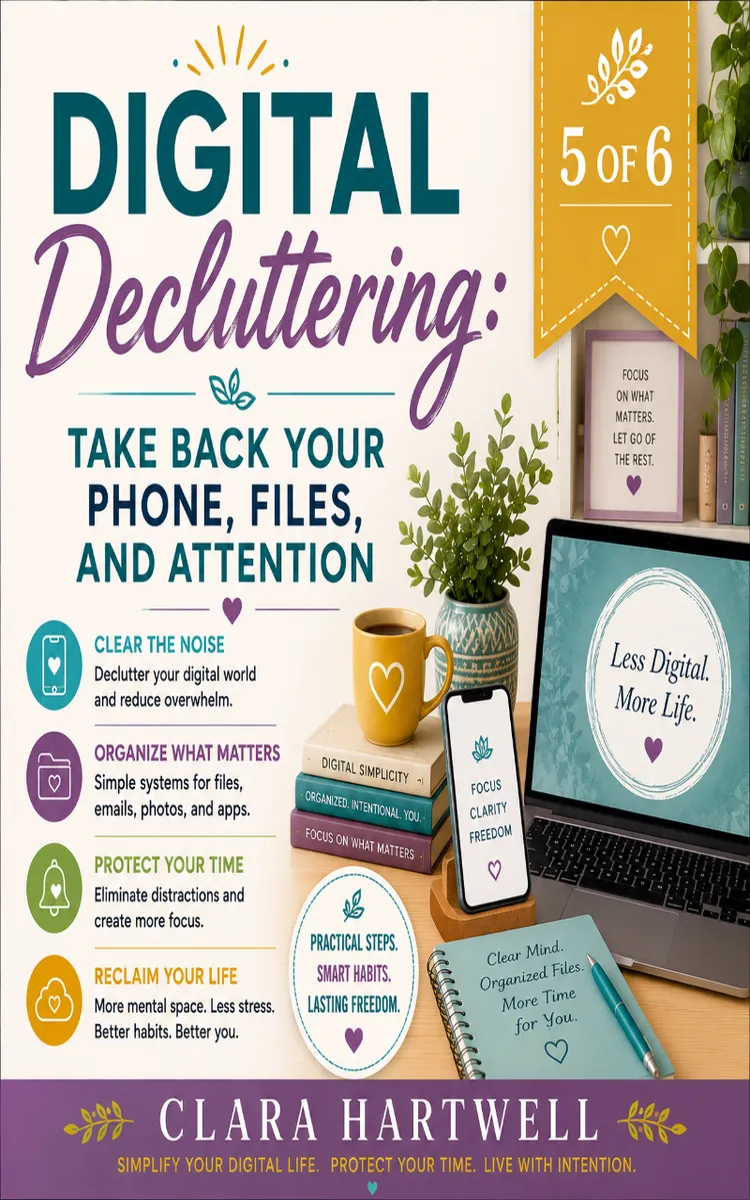
Decluttering: Take Back Your Phone, Files, and Attention
Created with Inkfluence AI
Reducing digital clutter across phone, files, and attention
Table of Contents
- 1. Reclaiming Your Attention Identity
- 2. Breaking the Notification Addiction Loop
- 3. Designing a Personal Focus Operating System
- 4. Building Boundaries Without Guilt
- 5. Decluttering Apps Using the One-Week Test
- 6. Creating a File System You’ll Actually Use
- 7. Mastering Inbox Zero for Email and Messages
- 8. Using the Two-List Decision Rule
- 9. Recovering From Backslides With the Reset Ritual
- 10. Turning Decluttering Into Purposeful Living
Preview: Reclaiming Your Attention Identity
A short excerpt from “Reclaiming Your Attention Identity”. The full book contains 10 chapters and 15,850 words.
The Moment Your Attention Gets Taken
What do you reach for when nobody is asking anything from you?
For Nadia, 34, a customer support lead, the answer was usually her phone. She’d finish a call, unlock the screen, and check one message. Then a team chat. Then a news alert. Then a short video that had nothing to do with her day. Ten minutes later, she’d look up feeling busy but strangely absent.
At home, the pattern followed her. Her partner would be talking about dinner while Nadia refreshed an inbox she’d already checked. She wasn’t choosing to ignore the conversation. Her attention had simply learned to move whenever a notification, red badge, or empty moment appeared.
The uncomfortable question isn’t only, “How much time am I losing to my phone?” It’s also, “Who am I becoming when my attention is always being chosen for me?”
Are you using your devices, or are they quietly defining the person you get to be?
From Reactive Scrolling to Chosen Presence
Old Belief: My phone shows me what matters, so I should check it whenever something appears.
New Reality: My attention is part of my identity, and I can decide what deserves access to it.
This shift matters because attention isn’t just a resource you spend. It shapes your days, your conversations, and your sense of yourself. If every quiet moment gets filled with scrolling, you may start believing you’re restless, distracted, or incapable of focus. But the problem may not be your personality. Your habits may simply be training you to react.
Nadia noticed this during a Saturday morning walk. She had planned to leave her phone at home, but stopped at the door and slipped it into her pocket “just in case.” She checked it before reaching the end of the street, even though no one had called. The check didn’t give her useful information. It gave her a familiar feeling: something was happening, and she needed to know what it was.
The Attention Identity Reset begins with a different question: “What kind of person do I want to be in this moment?” Not “What’s new?” Not “Who needs me?” Maybe the answer is someone who listens fully, finishes one task, notices the walk, or lets a thought develop without immediately covering it with content.
You don’t need to reject technology or become unreachable. Nadia still needed her phone for work and family. She simply stopped treating every alert as an instruction. When she saw a message during dinner, she asked, “Is this truly urgent, or is it merely available?” That pause gave her a choice. Choice is where your attention identity starts coming back.
The Attention Identity Reset in Daily Life
Your digital habits often reveal an identity you didn’t consciously choose. If you open email whenever you feel uncertain, you may be practicing the identity of “the person who must stay on top of everything.” If you scroll whenever you feel bored, you may be practicing “the person who can’t sit with an unfilled minute.”
These patterns feel automatic because they remove the need to decide. A notification arrives, and your hand moves. A difficult task appears, and you open an app. A conversation becomes uncomfortable, and you glance down. The device offers instant relief, even when it leaves you more scattered afterward.
The Attention Identity Reset interrupts that loop. It asks you to notice the trigger, name the person you want to be, and make one small choice that matches that identity. You might silence a group chat while writing, leave your phone in another room during a meal, or take three breaths before opening a social app. The action is small. The meaning behind it is not.
Signs this pattern is running your life
1. You check your phone before you know what you need.
The movement happens first, and the reason arrives afterward. This is a sign that checking has become a reflex rather than a decision.
2. You feel uncomfortable during ordinary pauses.
Waiting for coffee, standing in an elevator, or sitting in the car becomes a cue to scroll. Your mind has learned that silence must be filled immediately.
3. You’re physically present but mentally elsewhere.
You hear half of a conversation while wondering about unread messages. The problem isn’t a lack of care. Your attention has been divided into too many open tabs.
4. You describe yourself with labels your habits created.
“I’m terrible at focusing” or “I’m always behind” can sound like permanent truths. Often, they’re descriptions of a repeated environment and routine.
Your attention identity is built through the moments when you pause before reacting.
That pause doesn’t need to be dramatic. It can last five seconds. The goal isn’t perfect control. It’s gathering enough space to remember that a notification is an event on a screen, not a command about who you must become.
Questions That Bring You Back to Yourself
1....
About this book
"Decluttering: Take Back Your Phone, Files, and Attention" is a self-help book by Clara Hartwell with 10 chapters and approximately 15,850 words. Reducing digital clutter across phone, files, and attention.
This book was created using Inkfluence AI, an AI-powered book generation platform that helps authors write, design, and publish complete books. It was made with the AI Self-Help Book Writer.
Frequently Asked Questions
What is "Decluttering: Take Back Your Phone, Files, and Attention" about?
Reducing digital clutter across phone, files, and attention
How many chapters are in "Decluttering: Take Back Your Phone, Files, and Attention"?
The book contains 10 chapters and approximately 15,850 words. Topics covered include Reclaiming Your Attention Identity, Breaking the Notification Addiction Loop, Designing a Personal Focus Operating System, Building Boundaries Without Guilt, and more.
Who wrote "Decluttering: Take Back Your Phone, Files, and Attention"?
This book was written by Clara Hartwell and created using Inkfluence AI, an AI book generation platform that helps authors write, design, and publish books.
How can I create a similar self-help book?
You can create your own self-help book using Inkfluence AI. Describe your idea, choose your style, and the AI writes the full book for you. It's free to start.
Write your own self-help book with AI
Describe your idea and Inkfluence writes the whole thing. Free to start.
Start writingCreated with Inkfluence AI


