
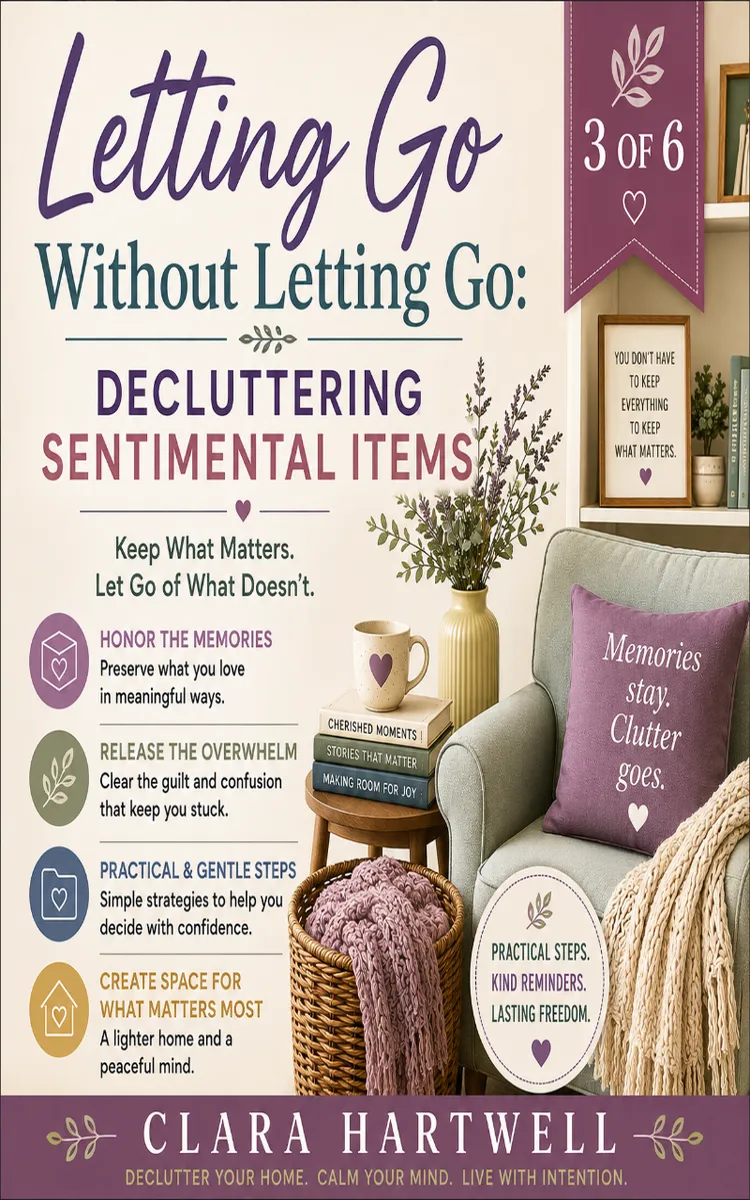
Letting Go Without Letting Go: Decluttering Sentimental Items
Created with Inkfluence AI
Decluttering and emotionally managing sentimental belongings
Table of Contents
- 1. Identifying Your Sentimental Triggers
- 2. Separating Love From Attachment
- 3. Breaking the Perfectionism Trap
- 4. Choosing Identity Over Objects
- 5. Creating Boundaries Without Guilt
- 6. Using the One-Photo Rule
- 7. Negotiating With Your Inner Child
- 8. Decluttering With a Decision Timer
- 9. Handling Relapse and Donation Grief
- 10. Building a Purposeful Keepsake System
Preview: Identifying Your Sentimental Triggers
A short excerpt from “Identifying Your Sentimental Triggers”. The full book contains 10 chapters and 15,985 words.
When an Item Feels Bigger Than It Is
What if the hardest part of decluttering isn’t deciding whether to keep something, but figuring out what you’re afraid of losing with it?
You’re standing in front of a closet shelf with an old concert sweatshirt in your hands. You haven’t worn it in years. It’s faded, stretched, and taking up space beside clothes you actually use. Still, your chest tightens when you picture putting it in a donation bag. Suddenly, you’re not holding fabric. You’re holding a night, a friendship, a version of yourself, and the worry that letting go means saying the whole thing didn’t matter.
That’s how sentimental belongings catch us. One object can carry several meanings at once, and those meanings can blur together until every decision feels dangerous.
What if you could keep the meaning without keeping every object carrying it?
The Meaning-Magnet Map Changes the Question
Old Belief: If an item holds an important memory, I have to keep the item.
New Reality: I can identify what the item means, honor that meaning, and choose whether the object still needs to stay.
The old belief makes decluttering feel like a test of loyalty. If you release your grandmother’s serving dish, are you releasing your grandmother? If you donate your child’s first pair of shoes, are you erasing how small their feet once were? If you let go of a trophy from a job you left, are you admitting that season of your life no longer counts?
The Meaning-Magnet Map gives you another way to look. Instead of asking only, “Do I want this?” you ask, “What is this pulling toward itself?” The item may be attracting a memory, a relationship, an identity, a promise, or a fear. Once you name the pull, you can make a decision based on the meaning - not just the object.
Nia, a 34-year-old school counselor, found this useful with a box of handwritten notes from former students. She had kept every note because each one reminded her that her work mattered. But the box had become difficult to store, and she rarely opened it. When she mapped the meaning, she noticed three different magnets: appreciation, proof of impact, and connection to students she had helped. She photographed a few notes, chose five originals to keep, and recycled the rest after writing down the messages she most wanted to remember. She didn’t throw away her purpose. She released the pile that had been carrying it.
This distinction matters because sentimental clutter often grows when one object is asked to perform too many jobs. A photograph becomes the only proof that a relationship was real. A dress becomes the only evidence that you once felt beautiful. A child’s artwork becomes a record of your love. The object may be meaningful, but it doesn’t have to be the sole keeper of that meaning.
Finding the Magnet Beneath the Object
The Meaning-Magnet Map starts with a simple pause. Before deciding, place the item in front of you and finish this sentence: “This matters because…” Don’t rush to sound reasonable. Your first answer might be “because my dad gave it to me,” but keep going. What does your dad’s gift represent? His attention? A difficult year you survived together? The feeling of being known?
The deeper answer usually points to the real decision. You may want to keep the object because it connects you to someone. Or because it protects a memory from fading. Or because it supports an identity you’re afraid you’ve outgrown. None of these reasons are silly. They’re clues.
The pattern becomes especially powerful when you notice whether the item is connected to a present relationship or an old emotional need. Nia’s notes represented meaningful work, but they also reassured her during a season when she doubted herself. Keeping a small selection supported her values. Keeping every note kept her doubt in charge.
Signs the Sentimental Pattern Is Running Your Life
1. You feel guilty before you’ve even made a decision.
The item is no longer simply a possession. It has become a test of whether you’re grateful, loving, loyal, or successful.
2. You use “what if” to avoid looking at what is true today.
“What if I want this someday?” may really mean, “What if I regret choosing space, change, or freedom?”
3. You keep duplicates because each one carries a slightly different emotional charge.
Five birthday cards may all represent love, but the fifth card may not need to remain the permanent keeper of that feeling.
4. You hide sentimental items instead of enjoying them.
If the objects live in sealed bins, crowded drawers, or an attic you avoid, they may be preserving memories while preventing you from actually engaging with them.
The goal isn’t to make sentimental items meaningless; it’s to stop asking every item to carry your whole history.
Questions That Separate Meaning from Matter
1. What exactly am I afraid will disappear if I let this go?
Try naming the fear plainly....
About this book
"Letting Go Without Letting Go: Decluttering Sentimental Items" is a self-help book by Clara Hartwell with 10 chapters and approximately 15,985 words. Decluttering and emotionally managing sentimental belongings.
This book was created using Inkfluence AI, an AI-powered book generation platform that helps authors write, design, and publish complete books. It was made with the AI Self-Help Book Writer.
Frequently Asked Questions
What is "Letting Go Without Letting Go: Decluttering Sentimental Items" about?
Decluttering and emotionally managing sentimental belongings
How many chapters are in "Letting Go Without Letting Go: Decluttering Sentimental Items"?
The book contains 10 chapters and approximately 15,985 words. Topics covered include Identifying Your Sentimental Triggers, Separating Love From Attachment, Breaking the Perfectionism Trap, Choosing Identity Over Objects, and more.
Who wrote "Letting Go Without Letting Go: Decluttering Sentimental Items"?
This book was written by Clara Hartwell and created using Inkfluence AI, an AI book generation platform that helps authors write, design, and publish books.
How can I create a similar self-help book?
You can create your own self-help book using Inkfluence AI. Describe your idea, choose your style, and the AI writes the full book for you. It's free to start.
Write your own self-help book with AI
Describe your idea and Inkfluence writes the whole thing. Free to start.
Start writingCreated with Inkfluence AI


