
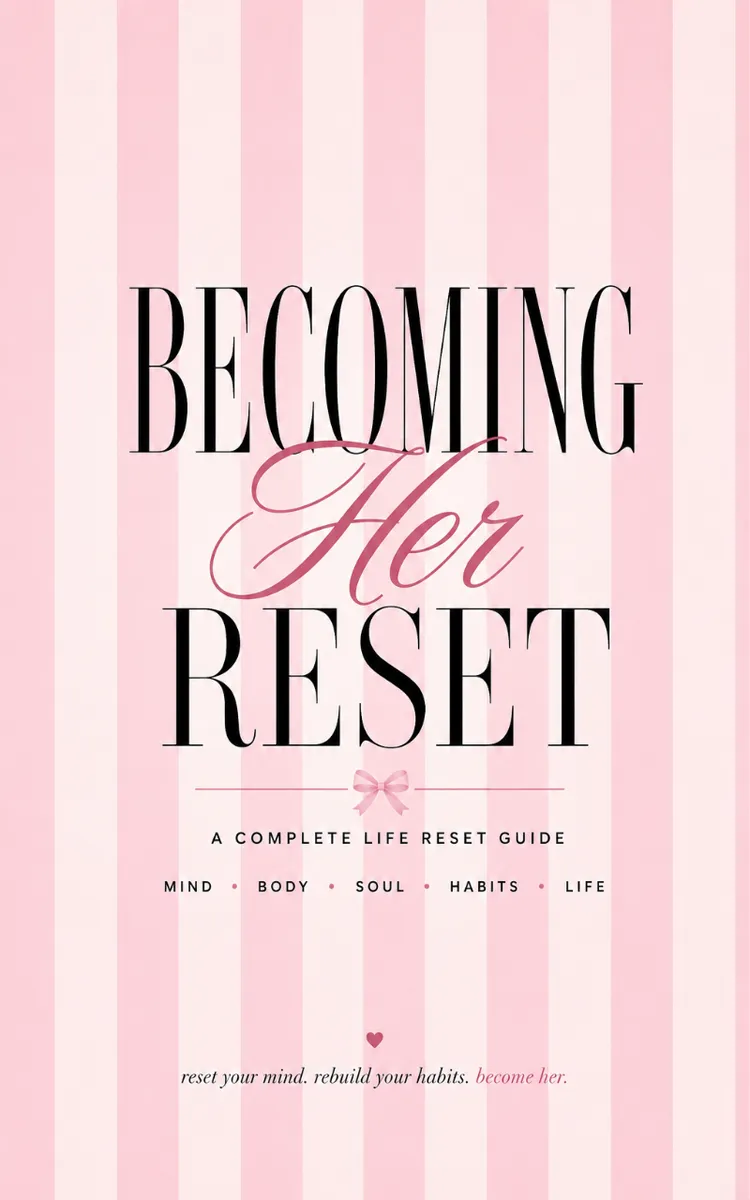
Becoming Her Reset
Created with Inkfluence AI
Resetting body, mindset, relationships, hygiene, environment, and habits
Table of Contents
- 1. Identity Reset: Become Her Who Tries
- 2. Mindset Reset: Think Beyond the All-or-Nothing Cycle
- 3. Body and Hygiene Reset: Romanticize Your Routine
- 4. Relationship Reset: Know Your Worth & Protect Your Peace
- 5. Digital and Environment Reset: Clear Your Space & Your Mind
Preview: Identity Reset: Become Her Who Tries
A short excerpt from “Identity Reset: Become Her Who Tries”. The full book contains 5 chapters and 6,708 words.
When Your Inner Voice Keeps Moving the Finish Line
What do you say to yourself after missing one workout, ignoring your morning routine, or spending an hour scrolling when you meant to study? Maybe it sounds like, “I always do this.” Maybe it’s harsher: “I’m lazy,” “I have no discipline,” or “I never follow through.”
The next morning, you promise to start again. You lay out your clothes, open the planner, fill the water bottle, and feel that familiar spark. By evening, the plan has slipped. Then the same sentence returns, wearing a slightly different outfit: See? This is just who I am.
Are you trying to force better habits with an identity that keeps arguing against them?
From Proving Yourself to Practicing Who You Are
Old Belief: I need to build perfect habits first so I can finally become a disciplined person.
New Reality: I build a believable identity by taking small actions that prove who I’m becoming.
The old belief makes every habit feel like a test. If you complete the workout, you’re “back on track.” If you miss it, you’re “back to square one.” That all-or-nothing pressure turns a simple action into a judgment about your character. No wonder starting feels heavy.
The Identity-to-Action Loop works in the opposite direction. Your self-talk shapes the identity you practice. Your identity influences the actions that feel natural. Those actions create evidence, and the evidence strengthens your self-talk. The loop doesn’t require a dramatic personality change. It needs repeated proof.
Take a morning shower. “I should shower because I’m a mess” carries shame and resistance. “I’m someone who gets ready before facing the day” creates a different feeling. The action is still the same, but the meaning has changed. You’re not punishing yourself into hygiene. You’re rehearsing self-respect.
That distinction matters when life gets crowded. A person who thinks, “I’m trying to become organized,” may abandon the whole plan after one messy evening. A person who says, “I reset my space before I sleep,” can clear one surface, put away five items, and keep the identity alive. Small proof counts because your brain learns from what you repeatedly do, not from what you passionately promise.
Catching the Identity-to-Action Loop in Real Time
Self-talk usually runs faster than awareness. You don’t hold a meeting with yourself before saying, “I’m terrible at this.” The sentence appears, your mood follows, and your next choice often matches it.
That’s why changing habits starts with noticing the loop, not attacking yourself for having it. The goal isn’t to replace every negative thought with exaggerated positivity. If you’ve missed three deadlines, “I’m the most productive person alive” won’t feel believable. A grounded statement works better: “I can repair this by choosing the next clear action.”
Look for these signs that the old pattern is running your life:
One missed action becomes a character verdict.
You skip one gym session and decide you’re undisciplined. The mistake grows larger than the behavior itself.
You wait to feel motivated before acting.
Your identity depends on the right mood, so tiredness becomes permission to postpone everything.
You use future promises to avoid present proof.
“Tomorrow I’ll be different” feels comforting, but it doesn’t give today’s identity anything solid to stand on.
You hide small wins because they seem too small.
Making your bed, putting your phone across the room, or answering one message may feel insignificant. Those are precisely the actions that build trust.
The identity you repeat becomes the action you reach for.
A useful self-talk reset has three parts: name what happened without drama, choose the identity you want to practice, and take the smallest action that supports it. “I stayed up scrolling. I’m someone who protects tomorrow’s energy. I’ll charge my phone outside the bedroom tonight.” That’s honest, specific, and immediately testable.
Notice the difference between an identity statement and a slogan. “I’m disciplined” can feel like a performance. “I keep one promise to myself before noon” gives your mind something concrete to recognize. Your identity becomes believable because it has a location, a time, and an action attached to it.
Questions That Make Your Self-Talk More Honest
What label do you give yourself after a setback, and what behavior does that label make easier?
If you say, “I’m hopeless with money,” you may avoid checking your account. Try replacing the label with a repair statement: “I made a careless choice, and I’m learning to check before I spend.”
Which habit would feel more automatic if it were connected to the person you want to be?
Maybe cleaning your sink isn’t about being tidy. Maybe it represents being someone who makes tomorrow morning easier. That meaning can make the action feel less like a chore.
...
About this book
"Becoming Her Reset" is a self-help book by J. Pennington with 5 chapters and approximately 6,708 words. Resetting body, mindset, relationships, hygiene, environment, and habits.
This book was created using Inkfluence AI, an AI-powered book generation platform that helps authors write, design, and publish complete books. It was made with the AI Self-Help Book Writer.
Frequently Asked Questions
What is "Becoming Her Reset" about?
Resetting body, mindset, relationships, hygiene, environment, and habits
How many chapters are in "Becoming Her Reset"?
The book contains 5 chapters and approximately 6,708 words. Topics covered include Identity Reset: Become Her Who Tries, Mindset Reset: Think Beyond the All-or-Nothing Cycle, Body and Hygiene Reset: Romanticize Your Routine, Relationship Reset: Know Your Worth & Protect Your Peace, and more.
Who wrote "Becoming Her Reset"?
This book was written by J. Pennington and created using Inkfluence AI, an AI book generation platform that helps authors write, design, and publish books.
How can I create a similar self-help book?
You can create your own self-help book using Inkfluence AI. Describe your idea, choose your style, and the AI writes the full book for you. It's free to start.
Write your own self-help book with AI
Describe your idea and Inkfluence writes the whole thing. Free to start.
Start writingCreated with Inkfluence AI


