
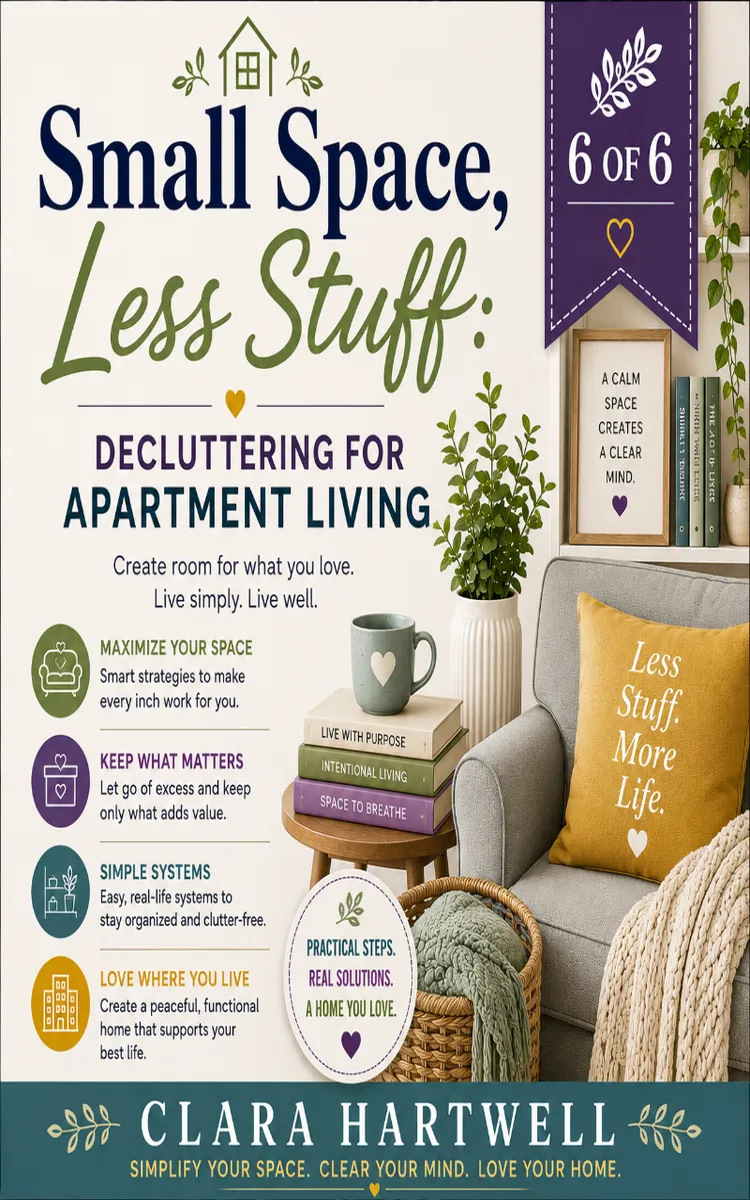
Small Space, Less Stuff: Decluttering for Apartment Living
Created with Inkfluence AI
Decluttering and organizing small apartments with minimal possessions
Table of Contents
- 1. Declutter Your Identity First
- 2. Break the “Not Enough” Belief Loop
- 3. Use the 10-Minute Reset Rule
- 4. Choose a Home for Every Item
- 5. Declutter by Categories, Not Rooms
- 6. Set Boundaries for Incoming Stuff
- 7. Communicate Decluttering Without Conflict
- 8. Conquer Paper Clutter With a System
- 9. Design Storage That Disappears Visually
- 10. Build a Forever Maintenance Rhythm
Preview: Declutter Your Identity First
A short excerpt from “Declutter Your Identity First”. The full book contains 10 chapters and 15,597 words.
When Your Belongings Start Answering for You
What would happen if someone asked, “Who are you?” and your mind immediately scanned your apartment for clues?
You might point to the linen blazer hanging behind the door. The camera in the drawer. The stack of cookbooks you haven’t opened since moving in. The expensive notebook waiting for the version of you who writes every morning. In a small apartment, these objects aren’t quiet. They press against the walls, crowd the shelves, and whisper stories about who you’re supposed to be.
Nia, 34, knows that feeling. Her apartment isn’t filthy or chaotic, but every corner carries an unfinished identity. The yoga mat says she should become flexible. The camping gear says she should be adventurous. The serving dishes say she should host more. When she considers letting any of it go, the decision feels strangely personal.
If your belongings are carrying your identity, decluttering can feel like losing yourself.
From Proving Who You Are to Living What You Value
Old Belief: My belongings show who I am, so getting rid of them means giving up part of myself.
New Reality: My values define me; my belongings are only tools that either support those values or take up space away from them.
This shift matters because objects often become evidence. The guitar proves you’re creative. The designer coat proves you’ve made it. The full kitchen cabinet proves you’re prepared for the dinner party you keep meaning to host. When an item feels like proof, releasing it can feel like admitting something uncomfortable: perhaps you aren’t the person you hoped to become.
But an object can’t complete an identity. It can only support a choice you’re already making. Nia’s camera might support her value of noticing and documenting community life. If she hasn’t used it in two years, keeping it doesn’t make her a photographer. It simply keeps the possibility visible - and sometimes the possibility becomes pressure.
The Identity-to-Objects Ladder helps separate the person from the possession. Start at the top with a value, move to the kind of action that expresses it, and only then decide whether an object belongs.
For Nia, the ladder might look like this:
- Value: Connection
- Action: Make space for friends to gather twice a month
- Object: Four sturdy mugs and a clear table, not twelve mismatched serving pieces
That last step is where decluttering becomes empowering. She isn’t removing “hosting” from her identity. She’s choosing the version of hosting that fits her actual life and her 500-square-foot apartment.
You can do the same with almost anything. If you value learning, you may need one current book and a library card - not a leaning tower of books you feel guilty about. If you value movement, perhaps you need the shoes you wear and the mat you use, not equipment for six imaginary workout routines. Your values stay. The excess gets questioned.
The Identity-to-Objects Ladder in Real Life
The ladder works because it asks you to define yourself before you evaluate your stuff. Without that pause, decluttering becomes a tug-of-war between guilt and fantasy. You hold a pair of dress shoes and think, “Maybe I’ll need them someday.” The better question is, “What value would these help me live this month, and do I actually have a place for that action?”
Your apartment gives you useful feedback. A narrow entryway may reveal that “being prepared” has turned into storing every possible future need. A crowded desk may show that “being creative” has become collecting supplies instead of making anything. The goal isn’t to shrink your personality. It’s to remove the objects that speak louder than your real priorities.
Signs your belongings are running the story
1. You keep items for identities you admire but don’t practice.
The watercolor set, cocktail shaker, or hiking backpack represents a version of you. Yet months pass without the related activity.
2. You feel guilty when you see certain possessions.
Instead of offering pleasure or usefulness, an item reminds you of money spent, plans abandoned, or a promise you made to yourself.
3. You buy symbolic objects when you want a fresh start.
A new planner can feel like becoming organized. A new outfit can feel like becoming confident. The purchase gives a quick emotional lift, but the underlying value still needs daily action.
4. You can’t name what an item helps you do.
“It’s nice” or “I might need it” may be true, but they don’t explain how it supports your current life.
Your identity is built through repeated choices, not stored in your apartment.
Nia tested this with her “community manager” identity. She had branded event supplies, extra notebooks, and three tote bags from past projects. Some objects genuinely supported her work. Others were souvenirs from periods when she felt useful and connected....
About this book
"Small Space, Less Stuff: Decluttering for Apartment Living" is a self-help book by Clara Hartwell with 10 chapters and approximately 15,597 words. Decluttering and organizing small apartments with minimal possessions.
This book was created using Inkfluence AI, an AI-powered book generation platform that helps authors write, design, and publish complete books. It was made with the AI Self-Help Book Writer.
Frequently Asked Questions
What is "Small Space, Less Stuff: Decluttering for Apartment Living" about?
Decluttering and organizing small apartments with minimal possessions
How many chapters are in "Small Space, Less Stuff: Decluttering for Apartment Living"?
The book contains 10 chapters and approximately 15,597 words. Topics covered include Declutter Your Identity First, Break the “Not Enough” Belief Loop, Use the 10-Minute Reset Rule, Choose a Home for Every Item, and more.
Who wrote "Small Space, Less Stuff: Decluttering for Apartment Living"?
This book was written by Clara Hartwell and created using Inkfluence AI, an AI book generation platform that helps authors write, design, and publish books.
How can I create a similar self-help book?
You can create your own self-help book using Inkfluence AI. Describe your idea, choose your style, and the AI writes the full book for you. It's free to start.
Write your own self-help book with AI
Describe your idea and Inkfluence writes the whole thing. Free to start.
Start writingCreated with Inkfluence AI


