
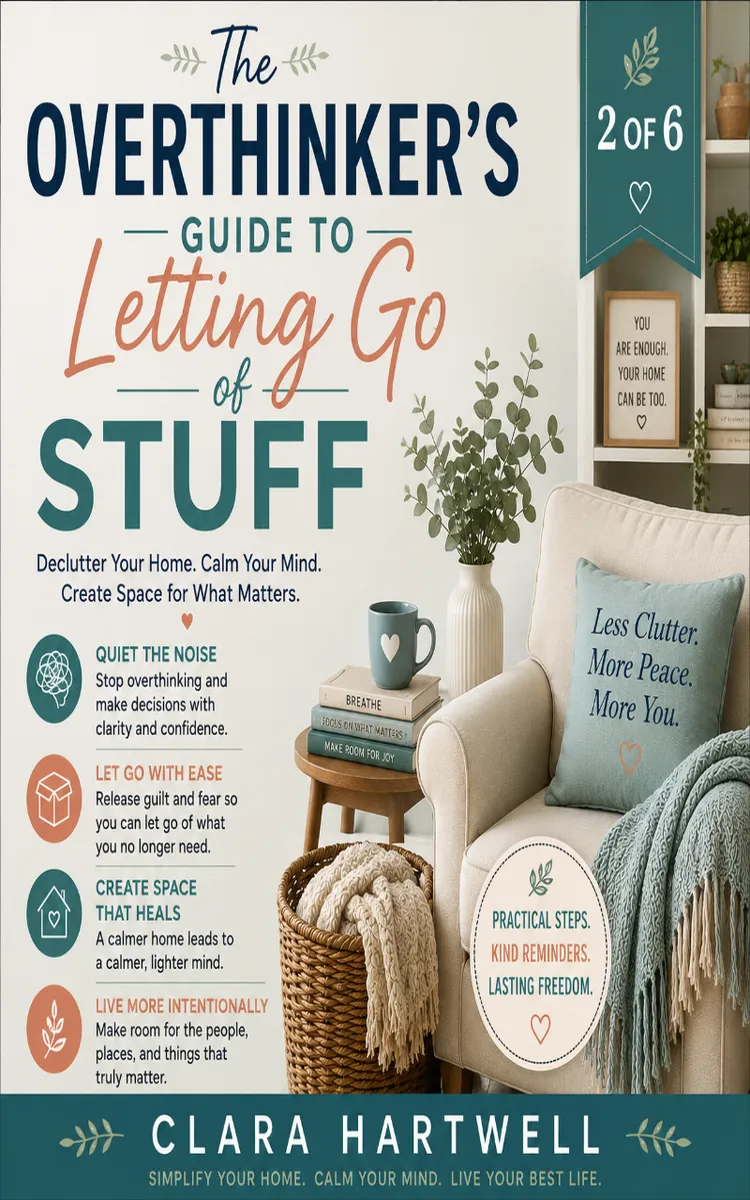
The Overthinker’s Guide to Letting Go of Stuff
Created with Inkfluence AI
Overcoming overthinking to declutter possessions and mental clutter
Table of Contents
- 1. Unclutter Your Identity First
- 2. Defuse the “What If I Need It?” Loop
- 3. Replace Perfection with “Good Enough” Sorting
- 4. Create a Values-Based Keep List
- 5. Use the One-Box “Try It Again” Rule
- 6. Stop Hoarding Promises with a “Next Action” Test
- 7. Set Boundaries for Shared Space Guilt
- 8. Make Decisions Faster with the “If/Then” Exit Plan
- 9. Recover After Relapse with the Reset Ritual
- 10. Turn Letting Go into a Purpose Habit
Preview: Unclutter Your Identity First
A short excerpt from “Unclutter Your Identity First”. The full book contains 10 chapters and 16,532 words.
When Your Things Start Speaking for You
Nina, 34, works as a museum curator. She can explain why a cracked ceramic bowl matters, which exhibition catalogue belongs with which collection, and why a box of old postcards shouldn’t be thrown away. Her apartment is full of objects with stories.
The trouble starts when every object becomes evidence. The bowl proves she has taste. The catalogues prove she’s serious about her work. A dress she hasn’t worn in four years proves she might become the person who wears it again. Letting go feels less like clearing a shelf and more like deleting a paragraph from her biography.
You may know this feeling in a different form. A kitchen gadget connects you to the ambitious version of yourself. Old textbooks connect you to a career you left. Clothes connect you to a body, relationship, or social life that no longer exists. The object sits quietly, but your mind keeps asking, “What will it mean about me if I let this go?”
Are you keeping the object - or trying to keep the identity attached to it?
The Identity-to-Objects Switch
Old Belief: My possessions show who I am, so letting go means losing part of myself.
New Reality: My possessions may reflect parts of my story, but they don’t own my identity. I can keep the meaning without keeping every object.
This shift matters because overthinking turns a practical decision into a personal verdict. You’re no longer asking, “Do I use this?” You’re asking, “What kind of person throws this away?” That question is loaded. It makes a donation bag feel like a courtroom.
The Identity-to-Objects Switch gives you a different question: “Is this object helping me live as I am now, or am I asking it to preserve who I used to be?” The point isn’t to reject your past. Your past shaped you. It just doesn’t need to occupy every drawer.
Nina used this switch with a set of exhibition posters from early in her career. They represented long nights, hard-won opportunities, and the first time she felt respected in her field. She had kept twelve posters, even though she only had wall space for one. The honest answer wasn’t that all twelve were equally meaningful. The honest answer was that she feared losing proof of how far she’d come.
She kept her favorite poster, photographed the rest, and wrote three lines about what that period taught her. The lesson stayed. The pile didn’t have to.
That’s the difference between honoring an identity and storing evidence of it. One lives in you. The other takes up space.
When the Past Is Running the Room
Your possessions can become identity anchors. An identity anchor is an object you use - often without realizing it - to feel connected to a version of yourself. The object might be useful, beautiful, or completely ordinary. What makes it difficult to release is the story wrapped around it.
The story often sounds reasonable: “I paid good money for it.” “I might need it someday.” “It reminds me of who I was.” Those statements may be true. But truth isn’t the same as obligation. An expensive object can still be unused. A memory can still be real after the object leaves.
Signs this pattern is running your life:
1. You defend an object before checking whether you use it.
You start with its history, price, or potential instead of its role in your current life. That usually means the decision has become personal.
2. You keep duplicates because each one represents a different version of you.
Three sets of art supplies may stand for the professional artist, the weekend creative, and the person who hopes to begin again.
3. You feel guilty when your present life doesn’t match your possessions.
A formal wardrobe, a full home gym, or shelves of business books can make you feel behind when they’re really just leftovers from an earlier plan.
4. You postpone decisions until you feel completely certain.
Certainty rarely arrives. The mind keeps searching for a guarantee that you won’t regret letting go.
Your stuff becomes heavy when it has to prove that every former version of you still matters.
The goal isn’t to erase those versions. It’s to stop making them compete for space in your current home. Nina didn’t need to pretend she had never been an uncertain junior curator. She only needed to stop asking twelve posters to keep that memory alive.
Try separating three things: the object, the memory, and the identity. The object is physical. The memory is what happened. The identity is what you learned or became. They’re connected, but they aren’t the same thing. Once you separate them, you have more choices.
Questions for the Person You Are Now
1. Which possession would be easiest to release if nobody else could see the decision?
This question removes the imagined audience. Maybe you’re keeping a designer coat because it signals success, or a shelf of books because it signals intelligence....
About this book
"The Overthinker’s Guide to Letting Go of Stuff" is a self-help book by Clara Hartwell with 10 chapters and approximately 16,532 words. Overcoming overthinking to declutter possessions and mental clutter.
This book was created using Inkfluence AI, an AI-powered book generation platform that helps authors write, design, and publish complete books. It was made with the AI Self-Help Book Writer.
Frequently Asked Questions
What is "The Overthinker’s Guide to Letting Go of Stuff" about?
Overcoming overthinking to declutter possessions and mental clutter
How many chapters are in "The Overthinker’s Guide to Letting Go of Stuff"?
The book contains 10 chapters and approximately 16,532 words. Topics covered include Unclutter Your Identity First, Defuse the “What If I Need It?” Loop, Replace Perfection with “Good Enough” Sorting, Create a Values-Based Keep List, and more.
Who wrote "The Overthinker’s Guide to Letting Go of Stuff"?
This book was written by Clara Hartwell and created using Inkfluence AI, an AI book generation platform that helps authors write, design, and publish books.
How can I create a similar self-help book?
You can create your own self-help book using Inkfluence AI. Describe your idea, choose your style, and the AI writes the full book for you. It's free to start.
Write your own self-help book with AI
Describe your idea and Inkfluence writes the whole thing. Free to start.
Start writingCreated with Inkfluence AI


