
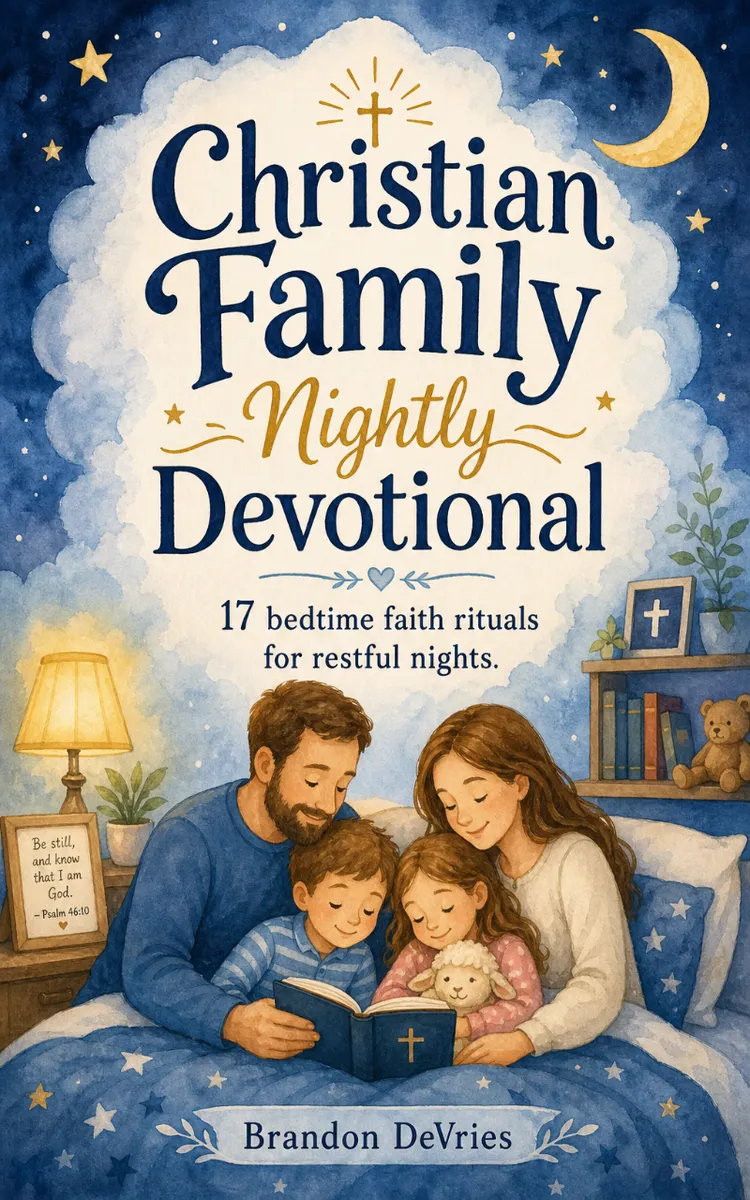

Get your nights back with a faith-based bedtime routine that actually lowers the pressure. In this Christian family nightly devotional, you will use a clear 5-day framework to respond to the real drivers behind bedtime fights, separation anxiety, and hyperactivity, without escalating the struggle. You will learn how to shift your child from cortisol-fueled alertness to melatonin-ready calm through physical cues, boring predictability, and God-centered rituals. Each day focuses on a specific bedtime obstacle, so you always know what to do next and why it works. By the end, you will have a practical routine you can repeat, a calmer bedtime rhythm, and a way to reassure your child with scripture-shaped presence.
Table of Contents
- 1. The 5-Day Reset: Why Bedtime Feels Like a Battle (and How Faith Lowers Cortisol)
- 2. Day 1-2: Separation Anxiety Rituals (Abiding Presence When Mommy/Daddy Leaves)
- 3. Day 2-3: Hyperactivity & Stalling Rituals (Stillness That Calms the Brain)
- 4. Night 3 Extinction Burst: The Warning and the Plan (Don’t Add, Don’t Break)
- 5. Day 3-4: Imaginary Fears Rituals (Protection That Speaks Louder Than the Dark)
- 6. Day 4-5: The Full Habit Stack (17 Rituals in One Progressive Bedtime Flow)
- 7. After Day 5: Keep the Sleep Win (Maintenance Rituals, Confidence, and Next Steps)
- 8. Chapter 8
- 9. Chapter 9
- 10. Chapter 10
- 11. Chapter 11
- 12. Chapter 12
Preview: The 5-Day Reset: Why Bedtime Feels Like a Battle (and How Faith Lowers Cortisol)
A short excerpt from “The 5-Day Reset: Why Bedtime Feels Like a Battle (and How Faith Lowers Cortisol)”. The full book contains 12 chapters and 15,379 words.
CHAPTER 1
The 5-Day Reset Framework: The Neurobiology of Bedtime Battles
The Science of the Bedtime Battle: Cortisol vs. MelatoninTo fix the bedtime chaos, you must first understand the biological battlefield. Your child’s body relies on a delicate hormonal balance to transition from high-energy daylight down to restorative nighttime sleep. The two primary drivers in this system are melatonin (the sleep hormone) and cortisol (the stress and alertness hormone).
When a child feels safe, secure, and physically relaxed, their brain naturally releases melatonin, causing their heart rate to drop, their muscles to loosen, and their mind to drift into slumber. However, when a child experiences anxiety-whether from being separated from you, fearing the dark, or feeling overwhelmed by a chaotic routine-their adrenal glands flood their system with cortisol.
[Anxiety/Fear] ➔ Boosts Cortisol (Fight-or-Flight) ➔ Blocks Melatonin ➔ Bedtime Battle
Cortisol acts like a biological jolt of caffeine. It triggers a fight-or-flight response, driving up their heart rate and causing their nervous system to scream that sleep is unsafe. When you see your child pacing, arguing, stalling, or throwing a tantrum, they aren't simply being stubborn; their bodies are literally trapped in a neurochemical state that makes sleep biologically impossible.
Your primary job as a father during the bedtime routine is not to force compliance through volume or frustration. Your job is to act as a co-regulator. By maintaining a calm, unshakeable presence and utilizing structured faith rituals, you actively signal to your child's nervous system that the danger is artificial. This drops their cortisol levels, clears the pathway for melatonin, and allows their body to naturally shut down for the night.
Decoding the Big Three Bedtime Triggers (Ages 2-5)Children in the toddler and preschool age bracket experience a massive cognitive explosion. While their imaginations and self-awareness are growing exponentially, their emotional regulation and logical faculties are still highly underdeveloped. This developmental gap creates three distinct behavioral patterns that routinely destroy bedtime peace:
1. Separation Anxiety (The Search Loop)The Root Cause: Toddlers are still mastering a psychological milestone known as object permanence-the understanding that people and objects continue to exist even when out of sight.
The Behavioral Expression: The moment you close the bedroom door, their brain perceives your absence as total abandonment or an immediate safety threat. This triggers an intense, visceral panic that forces them to cry out, knock on the door, or physically leave their room to re-establish your presence.
2. Hyperactivity and Stalling (The Second Wind)The Root Cause: When a child surpasses their optimal sleep window, their brain compensates for exhaustion by pumping out cortisol and adrenaline to keep them awake. This is the classic "second wind."
The Behavioral Expression: This manifests as sudden bursts of physical bouncing, rapid-fire talking, and tactical delay loops ("I need a glass of water," "I need to go to the bathroom again," "Just one more story"). They are weaponizing interaction to keep their overstimulated nervous system from crashing.
3. Imaginary Fears (The Threat Illusion)The Root Cause: Around age three, a child’s capacity for abstract imagination develops rapidly, but they lack the cognitive maturity to distinguish fantasy from reality. Shadows, ordinary household creaks, and a dark room are instantly interpreted as literal dangers.
The Behavioral Expression: They demand continuous room inspections, insist on leaving bright lights on, or refuse to stay in their own bed because they genuinely believe their environment is hostile.
The 5-Day Reset ArchitectureThe reason most parenting advice fails is lack of predictability. If your bedtime routine changes based on how tired you are, how long your work day was, or how hard your child fights, you are feeding their anxiety. When a child cannot predict exactly what happens next, their brain stays alert, trying to figure out where the boundaries are.
The 5-Day Reset is an intentional, uncompromised structural overhaul. For five consecutive nights, you will execute a highly specific, unchanging sequence of events. You will use the exact same tone of voice, the exact same words, and the exact same physical transitions.
Day of ResetCore Tactical FocusNeurological ObjectiveDays 1-2
Separation Anxiety Mitigation
Shift the child from relying on your physical presence to resting in God's abiding presence.
Days 2-3
Hyperactivity & Stalling Suppression
Implement somatic wind-down triggers to artificially decelerate the physical body.
Night 3
The Extinction Burst Stand-Off
Maintain absolute boundary consistency when the child throws their maximum behavioral protest.
Days 3-4
Imaginary Fear Deconstruction
...
About this book
"Christian Family Nightly Devotional" is a religious devotional book by Brandon DeVries with 12 chapters and approximately 15,379 words. Get your nights back with a faith-based bedtime routine that actually lowers the pressure. In this Christian family nightly devotional, you will use a clear 5-day framework to respond to the real drivers behind bedtime fights, separation anxiety, and hyperactivity, without escalating the struggle.
This book was created using Inkfluence AI, an AI-powered book generation platform that helps authors write, design, and publish complete books.
Frequently Asked Questions
What is "Christian Family Nightly Devotional" about?
Get your nights back with a faith-based bedtime routine that actually lowers the pressure. In this Christian family nightly devotional, you will use a clear 5-day framework to respond to the real drivers behind bedtime fights, separation anxiety, and hyperactivity, without escalating the struggle. You will learn how to shift your child from cortisol-fueled alertness to melatonin-ready calm through physical cues, boring predictability, and God-centered rituals. Each day focuses on a specific bedtime obstacle, so you always know what to do next and why it works. By the end, you will have a practical routine you can repeat, a calmer bedtime rhythm, and a way to reassure your child with scripture-shaped presence.
How many chapters are in "Christian Family Nightly Devotional"?
The book contains 12 chapters and approximately 15,379 words. Topics covered include The 5-Day Reset: Why Bedtime Feels Like a Battle (and How Faith Lowers Cortisol), Day 1-2: Separation Anxiety Rituals (Abiding Presence When Mommy/Daddy Leaves), Day 2-3: Hyperactivity & Stalling Rituals (Stillness That Calms the Brain), Night 3 Extinction Burst: The Warning and the Plan (Don’t Add, Don’t Break), and more.
Who wrote "Christian Family Nightly Devotional"?
This book was written by Brandon DeVries and created using Inkfluence AI, an AI book generation platform that helps authors write, design, and publish books.
Write your own religious devotional book with AI
Describe your idea and Inkfluence writes the whole thing. Free to start.
Start writingCreated with Inkfluence AI


