
Read the first chapter
The whole of chapter one, free. About 7 min. Turn the pages with the arrows, your keyboard, or a swipe.
Chapter 1
Spot the Bars You’re Assuming
Have you ever said, “I can’t do that,” and later realized you were arguing with a story - not a real obstacle?
Most of the “bars” we feel are actually invisible: the beliefs that decide what’s possible before we even try. They show up as quick conclusions like “That’s not for people like me,” “It won’t work here,” or “I don’t have enough time.” Sometimes those beliefs come from past experiences. Other times, they’re just habits of thinking that got repeated until they sounded like truth. Either way, they can shrink your choices without touching your circumstances.
Tanya, 34, a community organizer, noticed this pattern after a meeting where she pitched a small volunteer program. The funding she needed wasn’t even confirmed yet, but she walked out thinking, “They’ll never say yes. I should’ve known.” The “bar” felt solid - like it was out there in the world. But when she later checked her notes, there were no “never” clauses in the conversation. The real constraint was her belief about what the outcome could be.
This Chapter Is For You If You’re Ready to Audit What You Call “Possible” - You keep hitting the same wall and can’t tell if it’s a real limitation or a belief you’re carrying. - You’re tired of planning around assumptions that never get tested. - You want a practical way to sort “facts” from “probablys” (without spiraling). - You’re open to trying a simple tool - The Assumption Audit Compass - to widen your options.
Spot the Bars by Auditing Your Beliefs About “Possible” Real constraints are what remain after you test your assumptions; imagined ones are what your beliefs declare before you check.
Here’s the core shift: you’re not trying to “think positive.” You’re trying to think accurate. Because your mind can treat a belief like a law of physics. It will convince you there’s only one path, even when there are three. And the louder the belief, the more it sounds like certainty.
Let’s use Tanya again. After she made that pitch, she didn’t just feel discouraged - she started planning like the answer was already “no.” She drafted follow-up messages as if the door was shut. She stopped asking the next question. That’s the moment the imagined bar got built: her belief about what was possible changed what she did next. The situation didn’t force her plan. Her belief did.
Now consider what would’ve happened if she treated her belief like a hypothesis instead of a verdict. If she had asked, “What exactly did I assume?” and then checked the facts available - who decides, what criteria they use, what timeline they follow - she could separate “unknown” from “impossible.” The space between the bars opens when you stop worshipping certainty and start collecting information.
In Practice, This Means... - You replace “I can’t” with “I believe ___; what would prove or disprove it?” - You distinguish “not yet” from “never” by checking the next real step (who, when, how). - You stop planning your life like rejection is guaranteed. - You collect one piece of evidence before you decide the outcome is settled.
The Assumption Audit Compass: Daily Habits That Separate Facts From Stories This is where the method gets hands-on. The Assumption Audit Compass helps you locate the “bars” in your thinking so you can measure what’s actually in front of you.
Use it in three short windows - morning, midday, and evening - so it doesn’t become another task you “should” do.
1. Morning (2 minutes): Name the belief Write one sentence about what you think is possible today, and what you think will happen if you try. Example: “If I ask for permission to run the program, they’ll say no.” Notice the language: will, can’t, never. Those words are usually belief-clues.
2. Midday (5 minutes): Compass check - North, East, South, West Pick one belief and run it through these four directions: - North (Constraint check): What real rule or limitation is actually present? (Budget, policy, time, capacity.) - East (Evidence check): What facts do I already have? What did they actually say? - South (Assumption check): What am I filling in that I don’t know yet? - West (Test check): What’s the smallest test that could confirm or challenge this? The “West” part is the magic. Imagined bars shrink when you choose a test that costs little and teaches quickly.
3. Evening (3 minutes): Decide the next action Ask: “Based on what I know tonight, what’s one step I can take that moves the situation forward?” Then do only that one step tomorrow morning. Keep it small enough that your belief can’t dodge it.
4. Optional (30 seconds when you feel stuck): Label the bar When you catch yourself saying “It won’t work,” pause and label it: “This is a belief bar, not a fact bar.” You’re not denying reality - you’re reminding yourself the difference matters.
Before / Action / Result: Tanya’s Assumption Gets Tested Before: Tanya left that meeting convinced the funding request was already doomed. Her internal sentence sounded like: “They’ll never approve it.” So she stopped asking for clarity, treated follow-ups like formalities, and planned as if the program wouldn’t happen.
Action: Two days later, she used The Assumption Audit Compass on one belief: “They’ll never say yes.” - North: She checked what was actually required: a short budget summary and a timeline. - East: She reviewed the notes and saw the decision-maker hadn’t responded yet - there was no “no” in the record. - South: She admitted her mind was inventing certainty to protect her from another disappointment. - West: She wrote a focused message asking for the exact criteria and whether the proposal should be submitted now or after a review date. (Small test. Low drama. Clear next step.)
Result: Instead of a rejection, she got a concrete reply: the program could be considered, but they needed the budget in a specific format and a deadline date. The “bar” didn’t move because the world changed overnight. It moved because her belief stopped pretending it was fact. Her next steps suddenly had edges she could work with.
That’s the space between the bars: not the removal of struggle, but the opening of options.
Time to Reflect: Prompts That Expose What You’re Assuming Here are a few questions to help you audit your beliefs without turning it into a self-attack.
1. What exact sentence am I using to declare “possible”? Write it down word-for-word. If it includes “will,” “can’t,” or “never,” you’ve found a likely belief bar.
2. What real constraint am I actually seeing - and what am I guessing? Be specific. “No money” is a constraint. “They won’t care” is a guess unless you’ve gotten evidence.
3. What would I do differently if the belief were wrong? Your answer exposes how much power the assumption has. If your behavior doesn’t change, the belief is still running the show.
4. What is the smallest test I can run in the next 48 hours? Smaller is better. A test might be asking one clarifying question, sending one draft, or checking one policy detail.
5. What story am I protecting myself from by assuming the worst? This one gets honest fast. Sometimes the “impossible” belief protects you from the sting of being wrong. Naming that helps you choose the test anyway.
Take your time with these. You’re not trying to win an argument with yourself. You’re trying to find the truth that helps you move.
Your Next Step: Complete One Assumption Audit Today Pick one belief that’s been holding you back - just one. Use The Assumption Audit Compass and answer the four directions in writing:
• North: What real constraint exists? - East: What facts do I already have? - South: What am I assuming? - West: What’s the smallest test I can do within 48 hours?
Then send, ask, or check that test. One message. One call. One form submission. One question to the right person.
Time needed: 15-20 minutes, plus however long the test takes (usually under 10 minutes).
You will know it worked when... you can point to at least one piece of evidence that either confirms your belief as fact or shows it was an imagined bar. Even if the answer is still “no,” the difference is huge: you’ll know it’s real, not just assumed - and you’ll see what options remain.
The space between the bars isn’t emptiness. It’s room for honest information, careful questions, and the next step you can actually take.
End of chapter one. 10 more chapters in the full book.
Swipe or use the arrows to turn the page


What's inside: 11 chapters
- 1. Spot the Bars You’re Assuming
- 2. Name the Space Between Choices
- 3. Reframe Failure as Information
- 4. Use Pause Power for Clear Thinking
- 5. Choose Growth Language Over Labels
- 6. Build Micro-Bridges to Freedom
- 7. Turn Boundaries into Launchpads
- 8. Practice Gratitude for Invisible Progress
- 9. Live the Lion’s New Perspective
- 10. Practical Bonus: Tools That Make the Space Between the Bars Usable
- 11. What the Space Between the Bars Actually Leaves You With
About this book
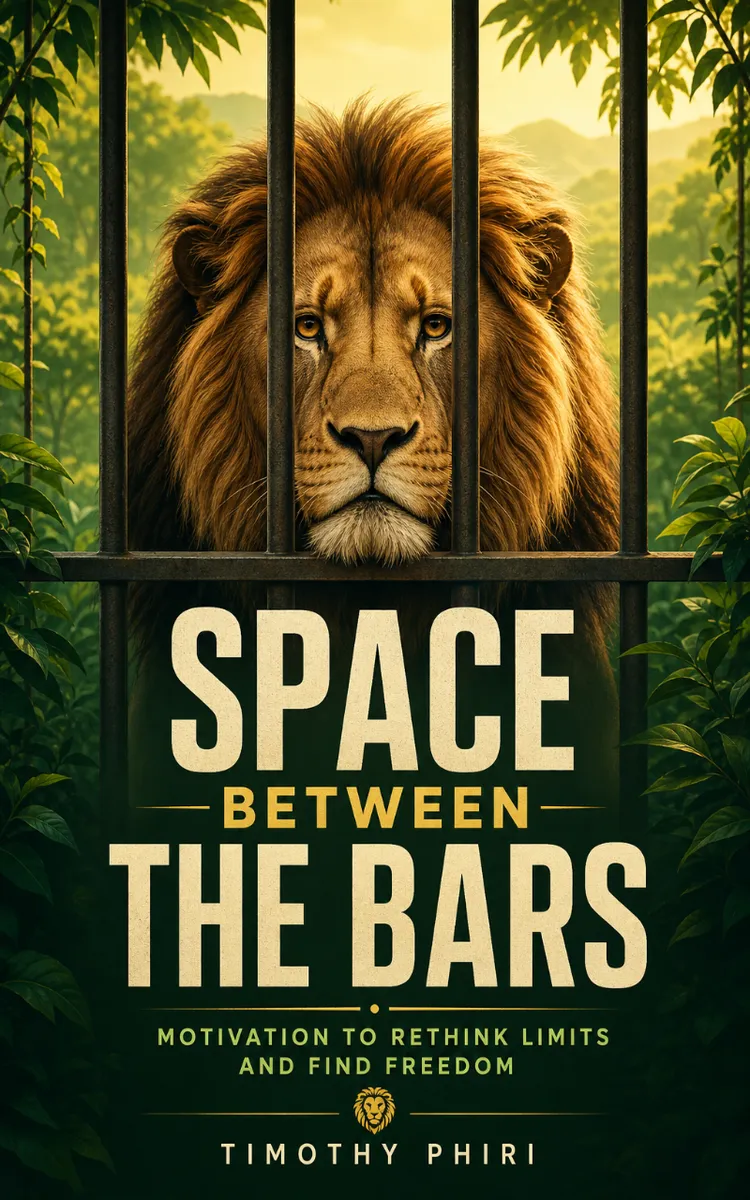
"Space Between The Bars" is a inspirational book by Timothy Phiri with 11 chapters and approximately 15,763 words. Encouragement about mindset and perception overcoming perceived barriers.
This book was created using Inkfluence AI, an AI-powered book generation platform that helps authors write, design, and publish complete books. It was made with the AI Inspirational Book Writer.
Frequently Asked Questions
What is "Space Between The Bars" about?
Encouragement about mindset and perception overcoming perceived barriers
How many chapters are in "Space Between The Bars"?
The book contains 11 chapters and approximately 15,763 words. Topics covered include Spot the Bars You’re Assuming, Name the Space Between Choices, Reframe Failure as Information, Use Pause Power for Clear Thinking, and more.
Who wrote "Space Between The Bars"?
This book was written by Timothy Phiri and created using Inkfluence AI, an AI book generation platform that helps authors write, design, and publish books.
How can I create a similar inspirational book?
You can create your own inspirational book using Inkfluence AI. Describe your idea, choose your style, and the AI writes the full book for you. It's free to start.
Write your own inspirational book with AI
Describe your idea and Inkfluence writes the whole thing. Free to start.
Start writingCreated with Inkfluence AI


