
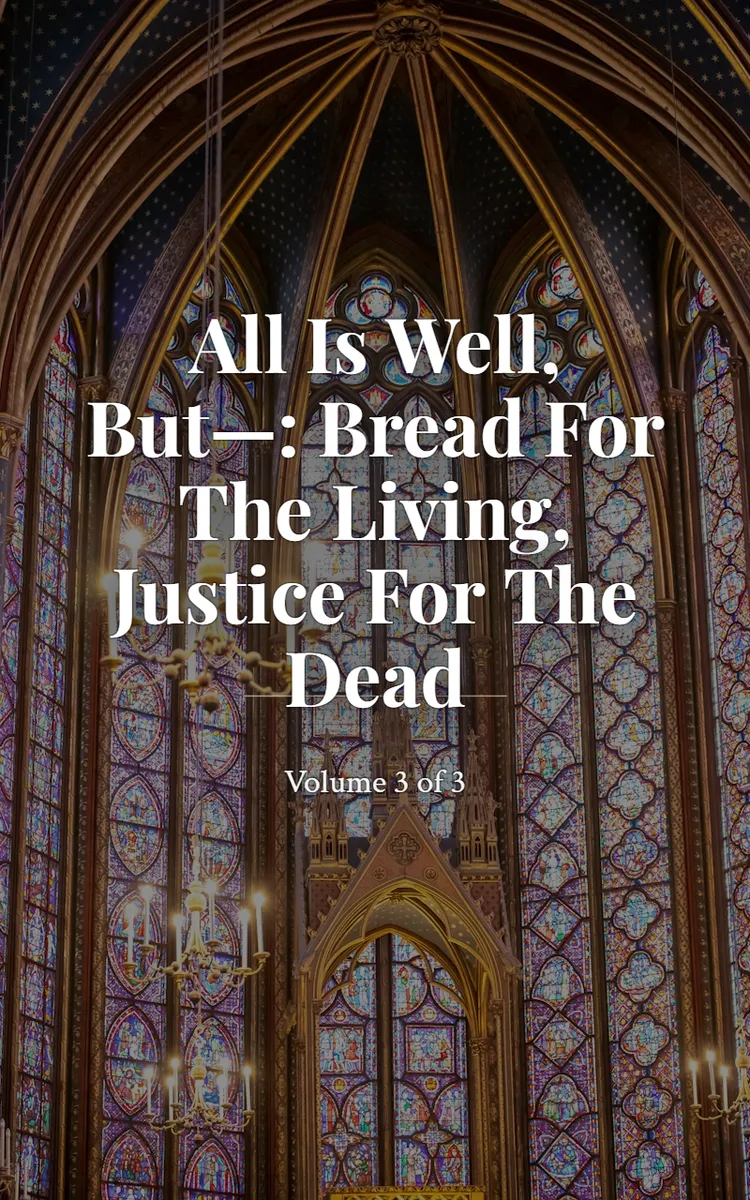

Read the first chapter
The whole of chapter one, free. About 9 min. Turn the pages with the arrows, your keyboard, or a swipe.
Chapter 1
The Promise That Wouldn’t Stay Quiet
For a long time, the waiting felt like the only safe place to stand.
In the first volume, we learned how grief can make a home out of small things. A bed. A lampstand. Bread that arrived at the right hour and said, without words, we see you. In the second volume, the waiting stretched and turned into a road. Rumors spread like bread, not because anyone wanted them to, but because people could not keep silence from moving. We followed familiar voices to the edges of the map, and we opened a ledger of promises that had been broken.
And now, in the last volume, the question was not whether the promises mattered. The question was whether we were going to keep letting them be swallowed by darkness.
That is what happened when night finally loosened its grip. Not all at once. Not with a loud announcement. It came the way truth often comes - quietly at first, then all at once when you realize you cannot un-know what you have seen.
Waiting, Revisited
They had gathered again in the same kind of room, the kind that tries to feel ordinary even when it cannot. Chairs scraped softly against the floor. Someone kept refilling cups. Someone else kept glancing at the door, as if the next visitor might bring a new explanation for why the boy’s name had become a rumor instead of a promise.
But the people in that room were no longer only waiting for comfort. They were waiting for honesty.
“We promised,” said Mara, not as a question but as a reminder. Her hands were steady, which meant her heart was not. “We promised we would not let it disappear.”
“We promised we would remember,” her brother added. He said it like he was testing the words for cracks. “Not just remember in our heads. Remember in a way that makes it hard to lie.”
That was the trouble with the promises made in the dark. They were meant to protect people from despair, but the dark also protects excuses. When you make a promise in a place where no one is watching, it can sound like a whisper that slips away when morning comes.
Only this promise would not stay quiet.
It showed up in the details they had been carrying but not organizing. Names that had been spoken once and then swallowed by fear. Dates that had been written down and then shoved into a drawer. Witnesses who had said, “I saw,” and then had been asked to say it again, slower, until they got tired and stopped.
Now those details were pressing against their pockets. Now they had weight.
From Comfort to Evidence
It is easy to confuse kindness with passivity. In the earlier volumes, we learned how important it is to receive mercy and to offer it. But mercy without truth becomes a blanket over a problem, not a cure for it.
That is why the family’s allies shifted from comfort to evidence.
Elijah, the holy man they had trusted in the first book, did not speak like a lawyer. He still had the habit of looking people in the face when he talked to them, as if he could see whether they were hiding from their own words.
“The promises were not meant to be soft,” he said. “They were meant to be strong enough to hold up in daylight.”
He laid out what they had: a folded page from a ledger, a list of names written on the back of a meal ticket, a note with a date and only half a sentence. He did not pretend the scraps were enough. He treated them like the beginning of a case, not a finished argument.
Then he asked for three things, simple and specific.
• Names - who said what, who agreed, and who was present.
• Dates - when it was promised, when it was delayed, when it was denied.
• Witnesses - who could back the words with memory.
Someone laughed once, short and sharp, the kind of laugh people use when they are trying not to cry. “You mean we have to do paperwork now?”
Elijah shook his head. “Not paperwork. Accountability. The kind that keeps a promise from being treated like a story.”
In Volume 2, they had opened the ledger of promises broken. This time, they did not just read it. They began to fill in what was missing.
The Room Where Hope Stays, and What It Demands
There was a phrase that kept coming back in their conversations, the one that had helped them survive the worst mornings: Hope stays in rooms where promises are cared for.
In Volume 1, the room had been literal. A chamber built on the wall. A table. A stool. A lampstand. A place where a holy man could come in out of hunger and weariness.
Now the room was also a method.
They decided to make a new kind of chamber. Not a building on a wall, but a practice inside the community. The family would not only receive help. They would manage what help produced.
“We keep letting people tell us what they think we want,” Mara said, standing to point at the scraps on the table. “That’s how promises get eaten. Someone gives us bread, and then we forget to ask what they promised along with it.”
Her brother nodded. “So we start asking again. Not in anger, but in order.”
The allies agreed to take turns. One person would write down every name and date they could find. Another would visit the places where witnesses had been last seen. A third would make sure the family had a clear record of who was coming and what they were saying.
They were building something that could not be easily pushed aside.
Collecting Names
Names are powerful because they slow down forgetting.
It started with the simplest question: “Who was there?”
When they asked it, people remembered. Not perfectly, but enough to begin. A neighbor recalled a conversation held near the well. A shopkeeper remembered a man who had promised, in public, that the boy’s case would be handled without delay. A woman who had once argued with someone in the street admitted, with shame, that she had heard the promise and had not insisted on it.
That last part mattered. The truth was not only for those who broke promises. It was also for those who let the breaking happen by staying silent.
“I thought it was safer to keep my mouth shut,” the woman said. “I told myself I would speak later. But later never came.”
Mara did not scold her. Instead, she offered a task. “Then we speak now. If you remember even one detail, we can build a whole picture around it.”
It became clear quickly that the boy’s story had been treated like a door that people did not want to open. Now they were turning the handle again and again until it could not be forced closed.
Tracking Dates
Dates are less emotional than names, but they are harder to dismiss.
When someone says, “That happened a long time ago,” they are trying to turn memory into fog. So the family began to fight fog with calendars.
They worked from the edges. If they could confirm the day someone delivered bread, they could estimate the day the promise was made. If they could identify when the boy was last seen, they could work backward to find the meetings that should have led to action.
Elijah’s eyes narrowed when he noticed a gap. “Here,” he said, tapping the paper. “There is a promise recorded, but no follow-up. That means someone expected us to stop asking.”
He was right. People had hoped that grief would do their work for them. Grief is heavy. Grief makes you tired. Grief convinces you to accept whatever explanation comes next, because fighting for truth feels like another loss.
But this was the final volume, and the whole series had been moving toward this exact moment. Not because anyone enjoys conflict, but because the dead deserve more than silence.
Finding Witnesses Who Would Not Fade
Witnesses are not always eager. Some people had been threatened. Some had been bribed with comfort. Some had been told that their involvement would cause trouble for them and their families.
Still, when the allies asked gently and clearly, many came forward.
One man, a former guard who had once escorted officials through the neighborhood, refused to meet at first. “I did my part,” he said. “I do not want to do it again.”
But when they met him, he brought a detail nobody else had mentioned: the name of the official who had asked for time, the phrase he used, and the place where he stood while he said it.
“He looked at the ground like he was already practicing how to avoid this,” the man admitted. “That is what I remember most.”
Mara wrote it down carefully. Not just the words. The tone. The location. The way a person can speak and still try to protect himself.
After the meeting, the room felt different, like the air had been cleared. Not lighter, exactly. Just more honest.
Honoring the Promises Now
By the end of the week, they had a list that looked nothing like the scraps from the first day. It was still incomplete. It would always be incomplete, because human memory is imperfect and fear has a way of erasing what people do not want to carry.
But it was real.
It included names. Dates. Witnesses.
And most importantly, it included a decision.
They would honor the promises now, not later. Not when it was politically convenient. Not when the family’s grief was quieter. Not after another rumor replaced the truth.
Elijah gathered everyone again and spoke plainly. “If anyone says, ‘We didn’t know,’ then our record will show they did. If anyone says, ‘We tried,’ then our record will show what they did not do. If anyone says, ‘It was too late,’ then our record will show the time they were given and the time they spent avoiding responsibility.”
“And if they say the boy’s name is just a tragedy,” Mara answered, “then we will answer with a list.”
She looked at the page full of writing. It was not poetry. It was not prayer. It was something sturdier than both, because it could be checked.
“We will answer with names,” she said again. “So justice for the dead is not only a hope. It becomes a task.”
That was the turning point in the story. Waiting had been a season. Action was becoming a way of life.
A Promise That Wouldn’t Stay Quiet
That night, after everyone went home, Mara sat alone for a while. The room felt echoey without the usual voices, like the building itself was listening.
She held the list and traced the top line with her finger. It was strange how a promise could be both heavy and hopeful. Heavy because it demanded accuracy. Hopeful because it refused to let the dead stay powerless.
She remembered the earlier days, the lampstand, the bread, the hidden chamber. Back then, the promises had been about survival. About making it through the next hour.
Now the promises were about more than surviving.
They were about honoring what had been sworn in the dark by bringing it into the light.
Outside, the neighborhood was quiet, but quiet did not mean safe. Quiet could still hide lies. Quiet could still delay action. Quiet could still turn grief into a waiting room that never opens.
So Mara whispered a vow to the paper, not because the paper needed it, but because she did.
“We will not let this be swallowed,” she said. “We will not let it fade. We will keep asking until someone answers.”
The promise, at last, stayed awake.
And in the next chapter, that promise would start walking with them, all the way from a list on a table to doors that would have to open, witnesses who would have to speak, and decisions that could no longer be postponed.
End of chapter one. 5 more chapters in the full book.
Swipe or use the arrows to turn the page


What's inside: 6 chapters
- 1. The Promise That Wouldn’t Stay Quiet
- 2. A Town That Wants an Answer
- 3. Evidence, Witnesses, and the Cost of Speaking
- 4. Mercy With Open Hands
- 5. All Is Well, Finally Understood
- 6. The Last Road and the New Home
About this book
"All Is Well, But—: Bread for the Living, Justice for the Dead" is a religious devotional book by Rev. Norm Stewart with 6 chapters and approximately 12,578 words. As the community wrestles with what “all is well” really means, the grieving family follows a final trail of truth that turns private sorrow into public repair—and brings closure without pretending the boy’s death was ever small..
This book was created using Inkfluence AI, an AI-powered book generation platform that helps authors write, design, and publish complete books.
Frequently Asked Questions
What is "All Is Well, But—: Bread for the Living, Justice for the Dead" about?
As the community wrestles with what “all is well” really means, the grieving family follows a final trail of truth that turns private sorrow into public repair—and brings closure without pretending the boy’s death was ever small.
How many chapters are in "All Is Well, But—: Bread for the Living, Justice for the Dead"?
The book contains 6 chapters and approximately 12,578 words. Topics covered include The Promise That Wouldn’t Stay Quiet, A Town That Wants an Answer, Evidence, Witnesses, and the Cost of Speaking, Mercy With Open Hands, and more.
Who wrote "All Is Well, But—: Bread for the Living, Justice for the Dead"?
This book was written by Rev. Norm Stewart and created using Inkfluence AI, an AI book generation platform that helps authors write, design, and publish books.
Write your own religious devotional book with AI
Describe your idea and Inkfluence writes the whole thing. Free to start.
Start writingCreated with Inkfluence AI


