

Read the first chapter
The whole of chapter one, free. About 6 min. Turn the pages with the arrows, your keyboard, or a swipe.
Chapter 1
The Battle Beneath the Battle
Scripture Focus
Colossians 2:15
> He disarmed the rulers and authorities and put them to open shame, by triumphing over them in him.
Spiritual warfare begins with the public victory of Jesus, not with the private fear of the believer.
The cross was not a narrow escape. It was Christ’s decisive triumph over the powers that opposed God’s rule. Paul does not describe Jesus as barely surviving the conflict. He describes Him as disarming rulers and authorities, exposing their defeat, and triumphing over them. That changes how we pray.
Spiritual warfare is real because Scripture says it is real. Satan is called an adversary, a tempter, a deceiver, and an accuser (1 Peter 5:8; Matthew 4:3; Revelation 12:10). Demonic opposition is not a metaphor for every difficult emotion or disappointing circumstance. At the same time, spiritual warfare is not a license to blame demons for every problem, treat people as enemies, or turn prayer into religious spectacle. The Bible gives us a steadier path: resist the devil, submit to God, stand in faith, speak truth, pursue holiness, and remain under the lordship of Jesus Christ.
The central issue is authority. Jesus possesses “all authority in heaven and on earth” (Matthew 28:18). Believers do not create spiritual authority through volume, dramatic language, or personal intensity. We receive authority from Christ and exercise it in submission to Him. A police officer has authority because of the office represented, not because of the officer’s personality. In the same way, our confidence in prayer rests in the name, work, and character of Jesus - not in our ability to sound impressive.
That distinction matters in ordinary life. When a family has endured years of addiction, when a church has become trapped in suspicion and division, or when a business owner notices a pattern of dishonesty and fear repeating across generations, prayer should address more than surface behavior. We can ask God for wisdom, repentance, protection, truth, and freedom. We can renounce sinful agreements and refuse to cooperate with accusation. Yet we must not turn spiritual discernment into suspicion of people. The person in front of us may be wounded, deceived, or acting sinfully, but that person is not the ultimate enemy. Paul’s words in Ephesians 6:12 correct both carelessness and cruelty: “We do not wrestle against flesh and blood.”
Spiritual warfare is not the art of finding someone to blame; it is the disciplined work of standing with Jesus against everything that resists God’s truth and love.
Jesus’ character is as important as Jesus’ power. He confronted demons, but He did not become theatrical. He corrected false teaching, but He did not manipulate crowds. He spoke with authority, yet He remained gentle toward the broken. His warfare was never detached from obedience to the Father. In the wilderness, He answered temptation with Scripture. In Gethsemane, He submitted His will to God. At the cross, He defeated the enemy through sacrificial obedience.
That pattern protects us from two opposite errors. One error is denial: spiritual opposition is dismissed as imagination, while prayer becomes merely positive thinking. The other is obsession: every delay, headache, disagreement, or inconvenience is treated as direct demonic attack. Both errors weaken discernment. Biblical maturity asks better questions. What does Scripture actually say? What fruit is appearing? Is there unconfessed sin, foolishness, injustice, trauma, or a practical problem that needs attention? Is there also a spiritual pressure that calls for prayer and resistance? Wisdom refuses shortcuts.
Authority without character becomes dangerous. A person may speak loudly about territorial powers while refusing to apologize, tell the truth, forgive, or submit to correction. That is not spiritual strength. It is a contradiction. The authority we exercise in prayer must be joined to the character of Christ. James connects effective prayer with righteousness, and Jesus connects spiritual power with abiding in Him (James 5:16; John 15:4-5). We do not earn victory through perfect performance, but we do demonstrate whether we are walking in fellowship with the One who has won.
This is why the “battle beneath the battle” often concerns agreement. What are we agreeing with? Fear says, “Nothing will ever change.” Accusation says, “That person is beyond redemption.” Pride says, “I alone understand what is happening.” Despair says, “God has abandoned this place.” Scripture calls us to agree with what God has revealed: Christ is Lord, sin is serious, repentance is possible, the devil is defeated in principle though still active in opposition, and God’s people are called to stand faithfully.
That agreement reshapes daily prayer. Instead of beginning with panic, begin with Christ’s rule. Instead of rehearsing the enemy’s activity, rehearse the gospel. Instead of making sweeping declarations about people, ask God to expose lies, strengthen the weak, restrain evil, and lead you into obedient action. If a conflict at church includes gossip, address the gossip. If a household is marked by addiction, seek wise pastoral and professional help alongside prayer. If a business relationship involves fraud, document the facts and pursue justice without hatred. Spiritual warfare does not cancel ordinary obedience; it makes ordinary obedience an arena for faithfulness.
The victory of Jesus gives us courage without arrogance. We can resist evil without fearing it. We can name sin without shaming sinners. We can pray for breakthrough without pretending to control God. We can confront darkness while remaining people of truth, mercy, and self-control.
Practice for Today
1. Begin with the victory of Christ. Set a timer for five minutes. Read Colossians 2:15 slowly three times. On the first reading, notice what Christ has done. On the second, notice what has been disarmed. On the third, ask how this truth should change your posture in one current struggle. Then pray in plain language: “Jesus, You are Lord over this situation. Show me what obedience looks like today.” Do not rush to name a spiritual power. Start by naming the authority of Christ.
2. Separate the person from the opposition. Write down one situation that has felt spiritually charged. Divide the page into two columns: “What I can observe” and “What I am assuming.” Under the first heading, record facts - words spoken, actions taken, patterns repeated, and consequences. Under the second, record conclusions you may have drawn about motives or hidden powers. Ask the Holy Spirit to replace accusation with discernment. If a conversation, boundary, apology, report, or request for help is needed, identify that next faithful step.
3. Examine your agreement. Journal this prompt: What statement of fear, accusation, pride, or hopelessness have I been repeating, and what specific truth from Scripture answers it? For example, “This family will always be controlled by addiction” can be answered - not with denial of the struggle - but with the truth that sin does not have final authority over those who belong to Christ (Romans 6:14). Bring both the pain and the promise to God. Then choose one action that agrees with the truth: tell the truth, seek counsel, forgive a specific offense, remove access to temptation, or ask someone mature to pray with you.
The goal is not to manufacture an intense spiritual moment. It is to bring your mind, speech, and conduct under the victory of Jesus. Some battles change through a decisive act of repentance. Others require months of faithful prayer, wise boundaries, counseling, accountability, and patient obedience. Neither pace gives the enemy the glory. Christ remains Lord in the sudden breakthrough and in the long process of restoration.
Closing Prayer
Lord Jesus, You have disarmed the powers that oppose God and triumphed through the cross. Teach me to resist evil without fear, to confront sin without hatred, and to exercise authority without pride. Expose every false agreement in my thinking, and bring my words and actions under Your truth. Give me courage to obey, wisdom to seek help, and love for the people affected by this struggle. I stand in Your victory, not my own strength. Amen.
End of chapter one. 19 more chapters and about 23,948 words in the full book.
Swipe or use the arrows to turn the page


What's inside: 20 chapters
- 1. The Battle Beneath the Battle
- 2. Victory Before the Fight
- 3. The Legal Right of the Believer
- 4. Authority Under Authority
- 5. The Armor and the Ordinary Means
- 6. The Consecrated Platform
- 7. Repentance Without Shame
- 8. Learning to Pray with Discernment
- 9. Praying from Trust, Not Panic
- 10. Breaking Generational Patterns with Truth and Grace
- 11. Breaking Local Resistance with Wisdom
- 12. When the Church Is the Place of Conflict
- 13. Resisting Accusation and Despair
- 14. The Power of Forgiveness and Boundaries
- 15. The Authority of Truthful Speech
- 16. Intercession as Love in Action
- 17. Persevering When the Answer Is Delayed
- 18. Building a Disciplined Life of Prayer
- 19. A Church Formed for Faithful Resistance
- 20. Standing in Hope Until the End
About this book
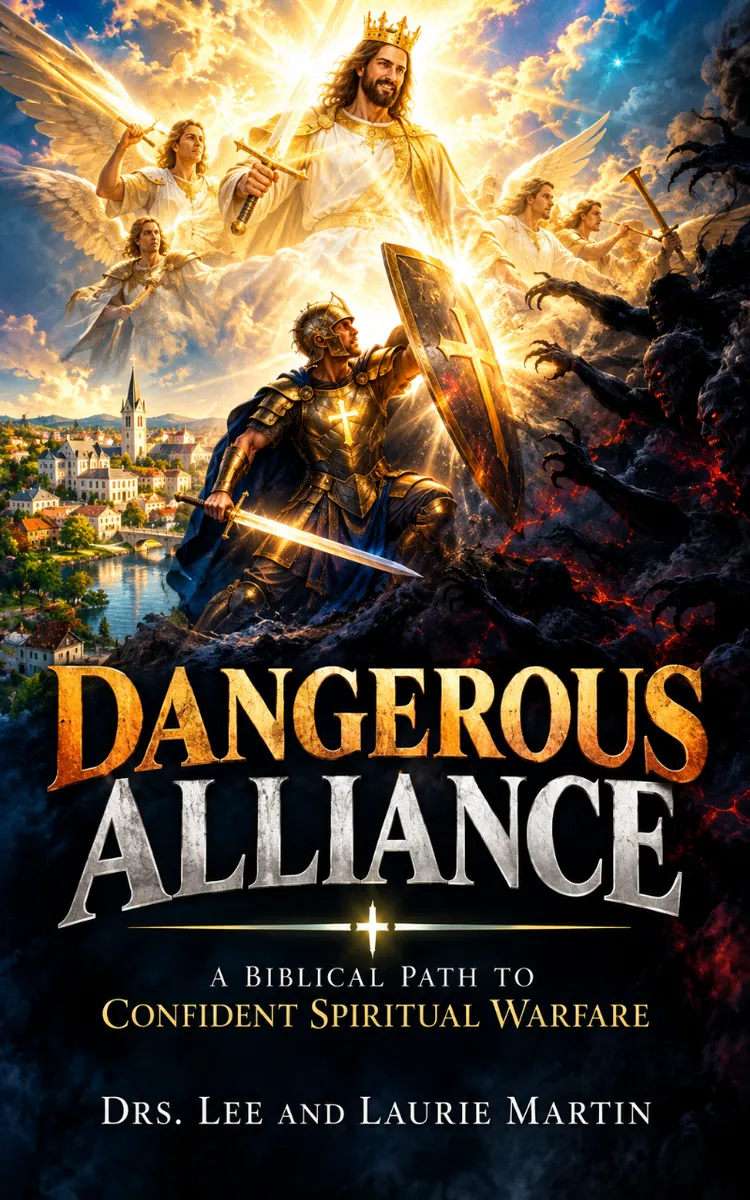
"Dangerous Alliances" is a religious devotional book by Drs. Lee & Laurie Martin with 20 chapters and approximately 23,948 words. Christian theology and practical spiritual warfare grounded in Scripture.
This book was created using Inkfluence AI, an AI-powered book generation platform that helps authors write, design, and publish complete books.
Frequently Asked Questions
What is "Dangerous Alliances" about?
Christian theology and practical spiritual warfare grounded in Scripture
How many chapters are in "Dangerous Alliances"?
The book contains 20 chapters and approximately 23,948 words. Topics covered include The Battle Beneath the Battle, Victory Before the Fight, The Legal Right of the Believer, Authority Under Authority, and more.
Who wrote "Dangerous Alliances"?
This book was written by Drs. Lee & Laurie Martin and created using Inkfluence AI, an AI book generation platform that helps authors write, design, and publish books.
Write your own religious devotional book with AI
Describe your idea and Inkfluence writes the whole thing. Free to start.
Start writingCreated with Inkfluence AI


