
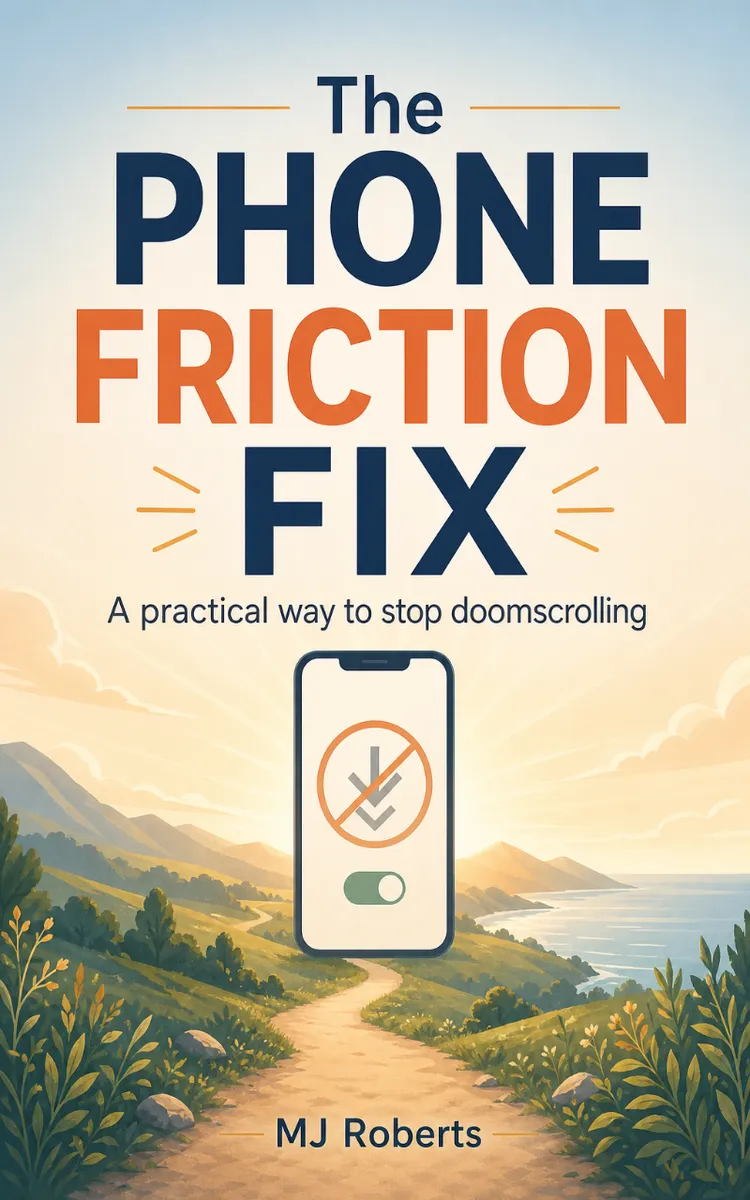
Read the first chapter
The whole of chapter one, free. About 7 min. Turn the pages with the arrows, your keyboard, or a swipe.
Chapter 1
Diagnose Your Doomscroll Triggers
The Moment the Scroll Takes Over
Talia, 31, leads a customer support team. Her workday is full of small fires: an upset customer, a teammate asking for help, a report that needs checking before lunch. She finishes one difficult reply, leans back, and reaches for her phone.
She tells herself she’ll take a quick breather. Instead, she opens a social app. A few minutes later, she’s watching a stranger reorganize a kitchen, reading an argument between people she doesn’t know, and tapping through updates that somehow make her feel both busy and tired. Then another support message arrives. Talia puts the phone down, but her attention doesn’t come back with her.
The frustrating part isn’t that she wants to waste her day. She doesn’t. She’s trying to escape the tiny pressure between one task and the next. Her phone has simply learned to meet her there.
If you don’t know what pulls you into the scroll, you’ll keep blaming yourself for getting caught.
From Willpower to the Trigger-Loop Map
Old Belief: I doomscroll because I lack discipline.
New Reality: I doomscroll when a specific trigger starts a repeatable loop - and I can map that loop before I try to change it.
Willpower is a poor starting point because it arrives after the pattern has already begun. By the time you’re staring at a feed, your brain has often made several quick decisions without asking for your full attention: finish the hard thing, soften the uncomfortable feeling, check for something new, keep going because the next item might be more rewarding.
That doesn’t mean you’re powerless. It means the useful question isn’t, “Why am I so weak?” It’s, “What happened right before I picked up my phone?”
Talia started paying attention to that question. She noticed that her longest scrolls didn’t happen during relaxed evenings. They happened after tense customer calls, especially when she had to make a decision she didn’t feel ready to make. The phone gave her an instant exit. Once she saw the pattern, “I need more discipline” became less useful than “I need a different response to pressure after difficult calls.”
The Trigger-Loop Map gives you a simple way to see that response. You’re looking for four points: the trigger, the reach, the reward, and the after-effect. The trigger is what happens inside or around you. The reach is the moment your hand goes to the phone. The reward is what the scroll seems to provide. The after-effect is what you’re left carrying.
Here’s Talia’s map:
| Map point | What she noticed | |---|---| | Trigger | A tense call followed by an uncertain decision | | Reach | Phone picked up while still sitting at her desk | | Reward | A quick feeling of escape and low-effort stimulation | | After-effect | Lost time, scattered attention, and more dread about the decision |
This kind of truth is practical. You can’t adjust a pattern you’ve only described as “I’m always on my phone.” You can adjust “I reach for my phone after difficult calls because I want to stop feeling stuck.”
What Your Trigger Is Really Doing
A trigger isn’t always a dramatic event. It can be a pause, a feeling, a place, or a thought. Waiting for a file to load. Walking into the kitchen. Feeling bored in bed. Seeing a notification. Finishing one task and not knowing which task comes next.
The phone becomes powerful because it offers a fast change in state. If you feel tense, it gives you distraction. If you feel lonely, it gives you contact. If you feel bored, it gives you novelty. If you feel uncertain, it gives you something definite to do - tap, swipe, watch, repeat.
That’s why simply deleting an app may not solve the whole problem. If the trigger stays untouched, your brain may search for another escape route. You might open a different app, refresh your email, or start checking messages you already checked. The surface behavior changes, but the loop stays alive.
Signs this pattern is running your life:
1. You reach for your phone before naming what you feel. The reach happens so quickly that “I’m stressed” only becomes clear afterward - or not at all.
2. Your scrolling clusters around the same moments. It may happen after meetings, during transitions, late at night, or whenever a task feels unclear.
3. You keep scrolling past the point of enjoyment. The first few minutes may feel soothing. Then the feed becomes automatic, but you continue anyway.
4. You blame the app while ignoring the moment before it. The app matters, but the trigger explains why you opened it right then.
The Trigger-Loop Map turns “I can’t stop” into a pattern you can work with.
Start small. You don’t need to record every phone use. Choose one repeated scroll - your first morning check, the post-lunch slump, or the bedtime spiral. Catching one loop is more useful than making a grand promise you can’t observe.
Questions That Expose Your Real Pattern
1. What usually happens in the five minutes before your longest scroll? Look for a concrete event, not a general label. “After I answer a difficult message” gives you something to work with. “When life is stressful” is true, but too wide to guide a change.
2. What feeling are you trying not to sit with when you reach? It might be irritation, uncertainty, loneliness, boredom, or the flat exhaustion that arrives after holding yourself together all day. There’s no prize for choosing the most flattering answer.
3. What does the phone give you immediately? Name the reward honestly. Is it escape, novelty, connection, relief, a sense of progress, or permission to stop deciding for a while? Talia realized she wasn’t looking for entertainment after tense calls. She was looking for relief from being responsible.
4. When does the scroll stop feeling good? Notice the turning point. Maybe the first ten minutes feel calming, then the next twenty leave you foggy. That shift shows where the reward ends and the automatic loop takes over.
5. What would help at the trigger point without requiring a perfect mood? Keep the replacement small. After a hard call, Talia could stand up, drink water, and write the next decision on paper before touching her phone. The goal isn’t to become a different person. It’s to interrupt one well-worn sequence.
Write your answers in your notes app if that’s where you’ll actually use them - or on paper if opening your phone would pull you straight into the feed. The tool matters less than capturing the moment while it’s fresh.
The Seven-Day Trigger-Loop Map Challenge
Challenge: Catch One Loop Before It Catches You
For the next seven days, track one specific doomscrolling pattern. Don’t attempt to fix every phone habit at once. Your job is to collect accurate evidence.
• Choose one target window, such as the first scroll after work or the last scroll before bed. - Each time it happens, record four short notes: Trigger / Reach / Reward / After-effect. - Add the time and place. “9:40 p.m., in bed” is more useful than “at night.” - Before opening the app, pause for ten seconds and name the trigger in one phrase. - At the end of each day, read your notes and circle any repeated trigger. - On day seven, write one sentence beginning with: “I most often scroll when…”
Expected difficulty: Medium.
You’ll know it’s working when:
• You can predict at least one moment when the urge is likely to appear. - You can name the feeling or situation before you open the app. - You notice the difference between the first reward and the later cost. - You feel curious about the pattern instead of automatically attacking yourself. - You have one clear trigger to address with phone friction later.
Some entries will be messy. You’ll forget to write them down. You’ll catch yourself halfway through a scroll and remember the challenge late. That still counts. A late observation is better than an invisible pattern. You’re building awareness, not performing a perfect experiment.
Start With the Truth, Not the Blame
Your phone habit becomes changeable the moment you can describe the trigger that starts it.
• You learned to look behind the scroll, at the moment that came before it. - You saw how the Trigger-Loop Map connects the trigger, reach, reward, and after-effect. - You identified why willpower alone often fails when the real need is relief, novelty, connection, or escape. - You now have a seven-day way to find your most reliable doomscrolling pattern.
Talia didn’t need a harsher rule to begin. She needed to notice that difficult calls were handing her phone a job: make uncertainty disappear. Once that job was visible, she could decide whether the phone was the best tool for it.
Your map will show you something specific, too. Maybe your scroll begins with boredom. Maybe it begins with one unanswered message. Maybe it begins when the day finally gets quiet. Whatever you find, that truth is not a verdict on your character. It’s the starting point for building friction exactly where your attention needs protection.
End of chapter one. 7 more chapters in the full book.
Swipe or use the arrows to turn the page


What's inside: 8 chapters
- 1. Diagnose Your Doomscroll Triggers
- 2. Rewire the Reward Prediction Belief
- 3. Build Your Identity as an Attender
- 4. Install Friction With the 3-Layer Lock
- 5. Replace Swipes Using the Pause-Choose Script
- 6. Set Boundary Conversations Without Overexplaining
- 7. Create a Focus Ritual for Hard Days
- 8. Turn Attention Into Purposeful Time
About this book
"The Phone Friction Fix" is a self-help book by MJ Roberts with 8 chapters and approximately 12,669 words. Reducing doomscrolling and reclaiming attention.
This book was created using Inkfluence AI, an AI-powered book generation platform that helps authors write, design, and publish complete books. It was made with the AI Self-Help Book Writer.
Frequently Asked Questions
What is "The Phone Friction Fix" about?
Reducing doomscrolling and reclaiming attention
How many chapters are in "The Phone Friction Fix"?
The book contains 8 chapters and approximately 12,669 words. Topics covered include Diagnose Your Doomscroll Triggers, Rewire the Reward Prediction Belief, Build Your Identity as an Attender, Install Friction With the 3-Layer Lock, and more.
Who wrote "The Phone Friction Fix"?
This book was written by MJ Roberts and created using Inkfluence AI, an AI book generation platform that helps authors write, design, and publish books.
How can I create a similar self-help book?
You can create your own self-help book using Inkfluence AI. Describe your idea, choose your style, and the AI writes the full book for you. It's free to start.
Write your own self-help book with AI
Describe your idea and Inkfluence writes the whole thing. Free to start.
Start writingCreated with Inkfluence AI


